Anand Mangal
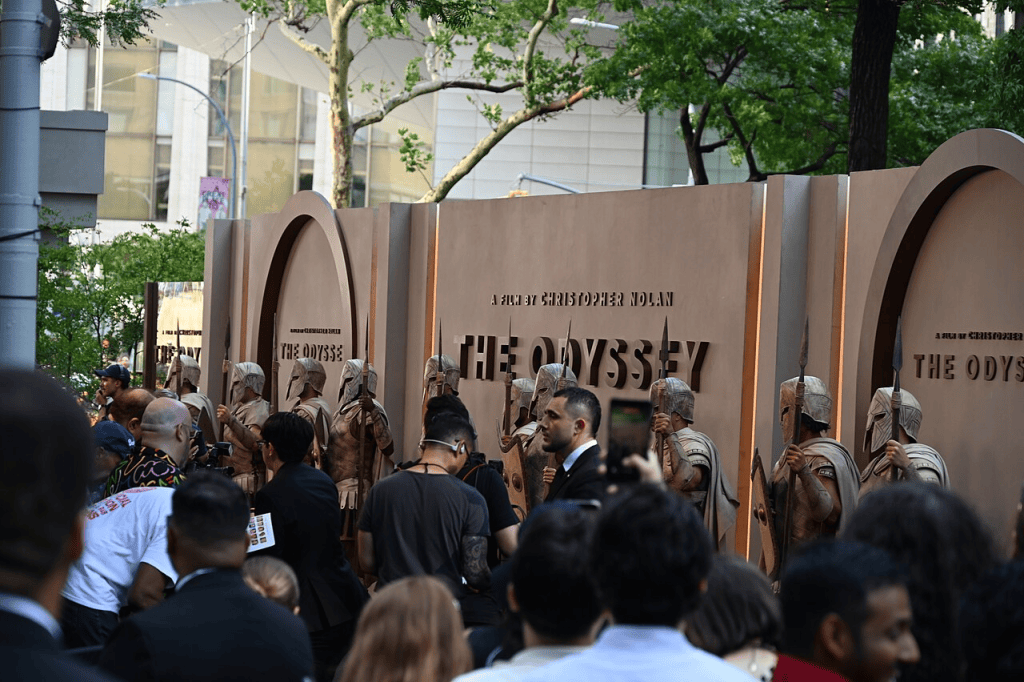
Few films have managed to divide critical opinion so thoroughly as Christopher Nolan’s Odyssey. The divisions break across political affiliations, cultural backgrounds, and even prejudicial expectations: some critics found their pre-release presentiments – whether for good or for ill – firmly validated; others were taken completely by surprise, pleasantly or otherwise. Given the turbid clamor of critical opinions, I believe some elucidation of Nolan’s poetic vision may be in order.
I choose the word “poetic” – from the Greek noun ποίησις (poiēsis), “making, creation, invention” – advisedly, because Nolan must be judged as a poet, and not a translator. As Alexander Pope said, “It is the first grand duty of [a translator] to give his author entire and unmaimed,”[1] but the duty of a poet is ποίησις, invention. In engaging with Homer’s Odyssey, therefore, decisions that would be unarguably condemnable in the former might be universally commendable in the latter.
The poetic tradition of engagement with Homer, and with Greek mythology in general, is marked by a willingness to squash and stretch the ancient sources. In Euripides’ Helen, for example, the playwright draws on early historical criticisms of Homer to suggest that it was not the real Helen of Troy, but a phantasmal copy, who absconded with Paris to Troy. This high degree of artistic license prevents the existence of a mythological “canon”, which the ancient philosophers often decry,[2] but the poets (and the general public) do not seem to mind.
All this is to say that the poetic tradition affords Christopher Nolan a great deal of latitude in his art. If we judge him as a translator, we use the wrong set of scales; it is his poetic vision that determines the quality of the film. There is some confusion, I believe, about the nature of Nolan’s vision, which has led to the broad range of critical opinions. Rather than weigh in on the quality of the film, I here wish to elucidate that vision.
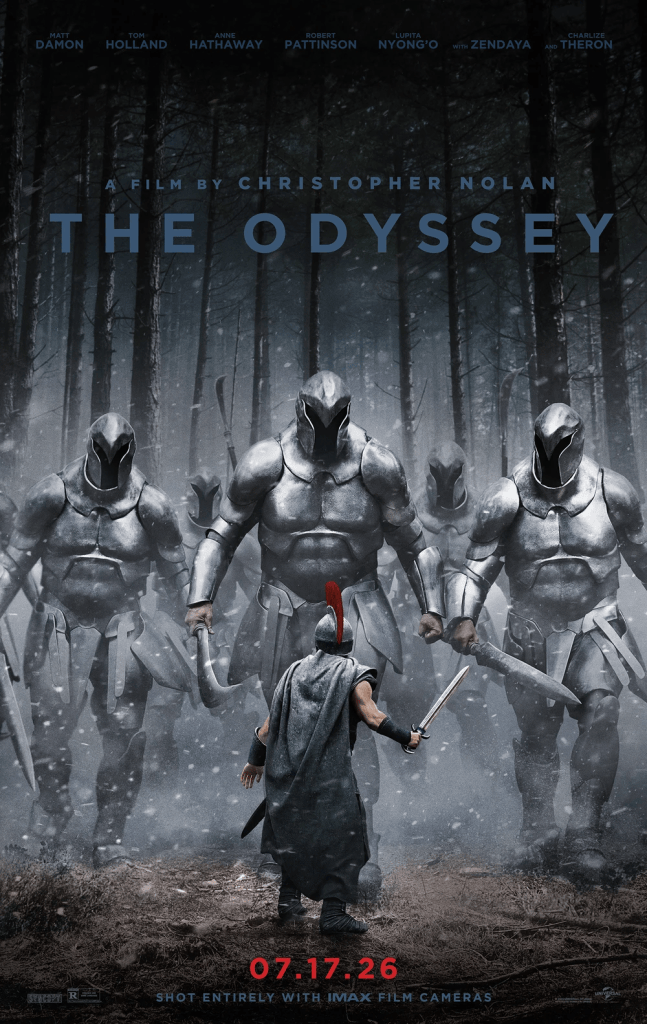
In Christopher Nolan’s vision, Odysseus’ victory at Troy was personally, politically, and existentially Pyrrhic. Every element of the film – its plot, its characters, even its casting – is in service of this ominous message. Nolan emphasizes those aspects of the poem that allow him to communicate this message, and he either minimizes or deletes everything else.
The Personal Pyrrhic
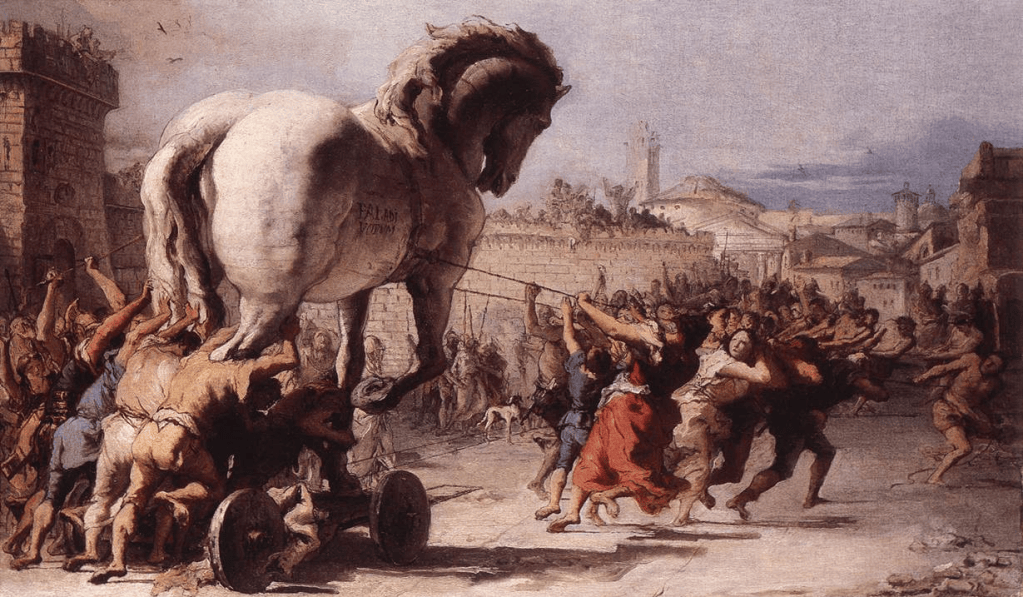
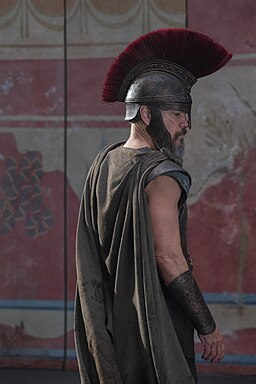
Matt Damon’s Odysseus is wracked with guilt for his actions in the Trojan War. He is the greatest offender against “Zeus’ Law”, Nolan’s conflation of Ancient Greek ξενία (xeniā), a sacred hospitality towards strangers, with the Golden Rule of Jesus of Nazareth. The Virgilian tradition interprets the Trojan Horse as a crime of perfidious deception – and so does Nolan. (Some of the most critically acclaimed sequences of the film are scenes of the Sack of Troy, which he pulls from Book II of the Aeneid.) Nolan is developing the idea that, although Odysseus won the war, his treacherous methods have corrupted his soul; thus Odysseus is tortured with images of the destruction of Troy, of the soldiers who died following his orders, and even of a young priestess of Athena who had been slaughtered at Troy. Odysseus is so consumed with guilt that when he washes up on Ogygia, Calypso feeds him the lotus flowers as an act of therapeutic mercy, to ease his suffering (although this procedure goes on for a bit longer than he may have liked).
Nolan’s focus on Odysseus’ personal guilt leads to the film’s almost hagiographical treatment of Elliot Page’s Sinon; instead of the Virgilian Sinon, who unscrupulously tricks the Trojans into accepting the Trojan Horse, Nolan’s Sinon is as pure as the driven snow. The young soldier was himself tricked by Odysseus into thinking the Trojan Horse truly was a peace offering from the Greeks; when he attempts to convey this message to the Trojans, as ordered, he is unceremoniously killed, having believed a lie. Sinon represents the innocent victims of Odysseus’ crimes, and as a shade in the Underworld Sinon becomes the moral authority of the film, offering Odysseus a form of penance, commanding him to journey to the West and “honor the dead”.
This significant expansion of Sinon’s role is a product of Nolan’s invention; although it lacks mythological precedent, it forms an essential part of his vision. Odysseus is morally bankrupt, and the film takes every opportunity to confront him with the consequences of his actions. This makes Nolan’s Odysseus distinct even from a modern vision, such as that of Emily Wilson, who also emphasizes Odysseus’ moral failings but does so by making him almost monstrous.[3] In contrast, Nolan does not depict much of the raping, pillaging, and slaughtering that characterize any Greek hero worthy of the epithet “breaker of cities”. His narrative is sanitized compared with Homer’s poem, especially with that of Wilson’s translation, because Nolan does not seem to find those crimes to be relevant to “Zeus’ Law” specifically.
Nolan’s vision even diminishes the element of νόστος (nostos), of homecoming, in the poem. His Odysseus is reluctant to return home, as doing so would mean confessing, to his wife and son, his actions during the war. The film gives us a man who is personally destroyed by his success in war.

Matt Damon: Vlixes redivivus?
The Political Pyrrhic
Nolan has a peculiar conception of the Trojan War, which is easily missed because the war itself is so iconic. Homer’s Iliad depicts a war in which celestial forces do battle, side by side with earthly forces, for celestial interests (such as honor, glory, and pride). Nolan’s war, in contrast, is flatly mundane. There is no Judgement of Paris, for the gods are merely “apparent” in this world. Instead, Agamemnon wants to consolidate power over commercial shipping, and since Troy stands in his path, he finds a flimsy pretext to go to war. Indeed, Nolan’s Helen of Troy is not intended to be possessed of supernatural beauty, and this is how he can explain the casting of Lupita Nyong’o (and the decision to make Helen and Clytemnestra identical twins) without utterly destroying the foundational logic of the war and its setting.
All this is to say that, in Nolan’s vision, the Trojan War is objectively not worth fighting. This makes Odysseus’ deception even more objectionable, and Nolan underscores this point in his narrative treatment of the other victors. He vividly shows us Agamemnon’s horrifying murder at the hands of his wife, upon his homecoming. As for Menelaus’ return, and his reunion with his hard-won bride, we see that Helen’s face is heavily disfigured, and it is strongly implied that Menelaus greeted her wife by violently beating her. At least our eponymous hero, in Homer’s poem, came home bearing gifts, a wealth of gold from the generous Phaeacians. But Nolan’s Odysseus returns to Ithaca with nothing to show for his efforts. In effect, his victory comes to no benefit: it destroys Troy, and it destroys the Greeks.

Nolan has significantly cut down Odysseus’ homeward itinerary; at first glance, this would seem due to time constraints, but there is a deeper intention behind his deletions. He has removed the encounters with the Phaeacians, Aeolus, Hermes, and the Lotus-Eaters; apart from the last, these are generally pleasant encounters where Odysseus is shown support and hospitality, or ξενία. (One imagines the Lotus-Eaters are at least intending to be gracious hosts.)
Nolan does depict the episodes with Polyphemus, the Laestrygonians, the Sirens, Circe, Calypso, the Cattle of Helios, Scylla and Charybdis, and Tiresias; apart from the last two, these are all scenes where ξενία is broken. The giants and monsters violently attack Odysseus and his men, who are seeking food and shelter; Circe’s appearance of generosity hides a terrifying enchantment; Calypso keeps Odysseus trapped in a soporific haze for seven years; Odysseus’ desperate crew take their turn to break ξενία by knowingly eating Helios’ cattle.
In short, Nolan places us in a world without ξενία – Odysseus, with his Trojan trick, has driven it out of existence. As punishment, his journey home must be cruel and troubled, for this is how all men, and all cities, must now relate to each other. The only exception to this is the house of Penelope and Telemachus. Although they have every reason to break this law and drive out the suitors, they refuse to do so, to their own cost. This is why Penelope must accompany Odysseus on his westward journey (another Nolan invention), to affirm its redemptive nature; this is why Telemachus is fit to rule, after learning a bit – but not too much – of his father’s warrior-prowess. This is why Odysseus shows mercy to those suitors who bow to him in the final fight, and why Nolan refuses to adjudicate the fate of the maidservants, without reforming them.

The Existential Pyrrhic
It is not hyperbole to say that Nolan’s Odysseus causes the Bronze Age Collapse, a historical event as cataclysmic as it is mysterious. The entire known world, what Nolan’s Odysseus calls “our age of bronze”, is clearly set to fall into ruin by the end of the film. Nolan has various sympathetic characters allude to a fearsome group of “People from the Sea”: these warriors have no regard for Zeus’ Law, making them an unprecedented threat to all civilized society. They are the Four Horsemen of Nolan’s apocalypse, and it is finally revealed to us that it is Odysseus and his men who inspired these fearsome accounts, because of their actions at Troy: they are the “People from the Sea”, a title which identifies them as the theorized harbingers of the real-life Bronze Age Collapse.[4]
This historical connection is by far Nolan’s most significant – and most original – display of poetic invention. He has taken thin, scattered, and disparate threads of historical and mythological precedent and woven them into a single narrative of civilizational collapse, caused by the actions of one man. To some extent, he has willfully forced this particular element into a poem that seemed quite complete without it.
Christopher Nolan has a particular vision of the Trojan War, of the man who ends it, and of the consequences of doing so. Whether we agree with his vision or not, we must see it clearly – then, we must acknowledge the invention, the ποίησις on display.

Telling or Re-Telling?
Critics have pointed out that if Nolan wanted to present such an idiosyncratic view of the Odyssey, he could have signaled his intentions by releasing the movie under a different title, a criticism with which I am not unsympathetic. But then we must ask ourselves: why does Xenophon call his account of the trial of Socrates the Apology? Why call his account of a dinner party the Symposium? Is he claiming to have the authoritative account, to be favored over the works of that imposter Plato? Why would Apuleius call his bombastic novel Metamorphoses? Does he intend to challenge Ovid, or to honor him? Which one is Kafka’s intent?
In any case, only a little discernment is needed to see that each of these homonymous works are significantly distinct from each other. Perhaps we ought to exercise the same discernment when evaluating any work called The Odyssey.

After working as a software developer in the Silicon Valley, Anand Mangal joined the inaugural cohort of Ralston College, where he fell in love with the Classical tradition. He is currently a doctoral student at Indiana University, where he researches the role of levity in the amatory poems of Ovid, along with their reception in Anglo-Norman literature of the 12th century.

Notes
| ⇧1 | Taken from his essay, “Preface to the Iliad of Homer” (1720). |
|---|---|
| ⇧2 | See Pausanius’ discussion of how Homer and Hesiod give different accounts of Aphrodite’s parentage in Plato’s Symposium. The moral inconsistency of Homer’s gods is also a problem that Plato considers often; this same issue might have motivated Heraclitus to say that Homer’s poetry should be banned, and his person flogged (Fragment B42). See also the character of Odysseus in Sophocles’ Philoctetes for a decidedly negative portrayal, a far cry from the figure in Homer’s Odyssey, who is at least in some respects exemplary. |
| ⇧3 | See Wilson’s approach to a passage near the end of the poem, in which Odysseus and Telemachus slaughter the maidservants who slept with the suitors. |
| ⇧4 | See Theodore Nash’s Antigone article on the historical and mythological accounts of the “Sea People”, and on Nolan’s engagement with those traditions. |