David Butterfield
Setting: 4p.m., tea time, on 28 January, 1905, in the combination room of a Cambridge college.
The title of Most Eccentric Victorian Classicist is one very keenly fought. Strong contenders include the terrifyingly learned but ever-absent-minded Robinson Ellis of Oxford (1834–1913), the fiercely “anti-everything” Francis William Newman (1805–97, brother of John Henry) of Manchester and University College London, and the pet-parrot-portering D’Arcy Wentworth Thompson (1860–1948), the reincarnated Aristotle of St Andrews. But all these are, in truth, squarely defeated by J.E.B. Mayor (1825–1910) of Cambridge, the lifelong-Latin-loving progressive professor who seemed to live outside time itself.
In this short piece I will share a document that marked the eightieth birthday of this remarkable figure. Before we come to that, though, a little context is called for. John Eyton Bickersteth Mayor was born in Sri Lanka (then British Ceylon) 201 years ago. Educated at home, with brief spells at Newcastle-under-Lyme Grammar and Christ’s Hospital, his transformative education occurred at Shrewsbury School under Benjamin Hall Kennedy (1804–89, of future Latin Primer fame). He duly entered St John ‘s College, Cambridge, in 1844, where he became a Fellow five years later. Other than for a brief spell as Classics master at Marlborough College (1849–53), the rest of John’s life was spent at John’s.
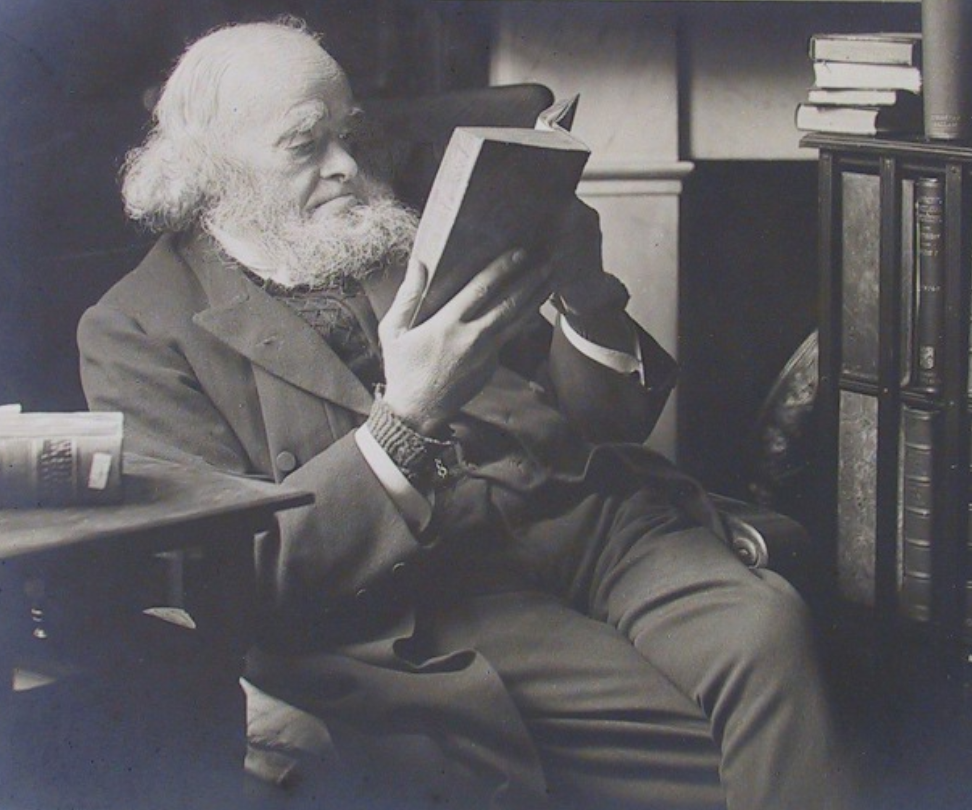
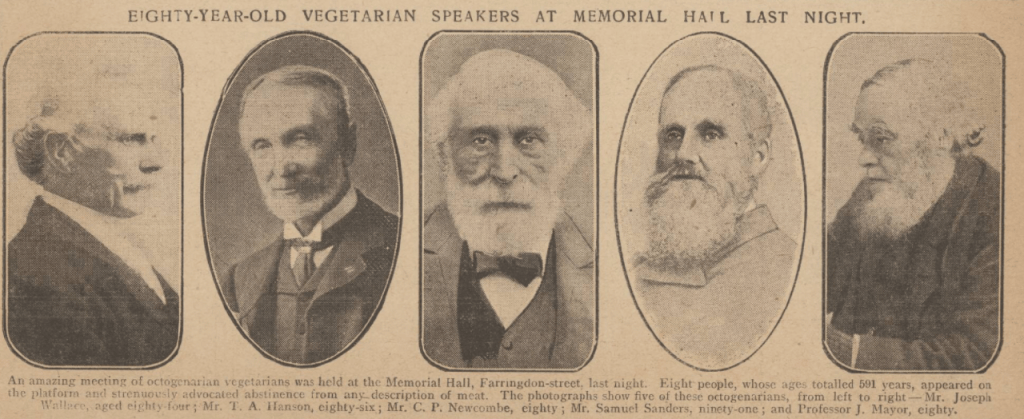
Like many Classicists of the age, Mayor took holy orders in 1857, which divided his working weeks between academic lectures and religious sermons. But his waking hours were shaped by his two chief passions: the Latin language and vegetarianism. Believing that the world’s apes revealed to us that vegetables, fruits and nuts should be our natural human diet, Mayor eschewed the typical fare of the Oxbridge High Table; he was, in fact, a complete teetotaller, and the only liquid he drank in the day was a lemonade with his evening meal. In 1884 he took over from the aforementioned Newman as President of the Vegetarian Society, a post he held until his death (at an impressive 86) on 1 December 1910. Despite his comfortable living in the great era of Cambridge academic salaries, Mayor sought to live on the exiguous ration of twopence a day, out of admiration for the asceticism of the great sages of old, especially Pythagoras and Seneca.
As a Classical scholar the majority of his career was spent on the chair of the <Kennedy> Professorship of Latin, to which he was appointed (until death) in 1872. His immediate successor, A.E. Housman, would speak in his inaugural lecture of 1911, of Mayor as a
scholar who in learning, if that word is taken to mean range and thoroughness of reading, had no equal in England and no superior in Europe. To dwell on the erudition of John Mayor is not merely superfluous but presumptuous; and I will now speak rather of a characteristic on which speech perhaps is not unnecessary. It is well known and sometimes lamented that for all his amplitude of knowledge he left behind him no complete work and no work having even the air of completeness. This regret I do not share; I am much more disposed to recommend for imitation the examples of one who recognized his own bent and followed it, and whose inclinations were exactly in harmony with his talents. Many a good piece of work has been spoilt by the vain passion for completeness. A scholar designs to edit a certain author, a complete edition of whom would involve the treatment of matters to whose study the editor has not been led by his own tastes and interests, and in which he therefore is not at home. The author discourses of philosophy, and the editor is no philosopher; or the author writes in complex metres, and the editor’s metrical education stopped short at Porson’s canon of the final cretic. It then sometimes happens that the editor, having neither the humility to acknowledge his deficiency nor the industry or capacity to repair it, scrapes a perfunctory acquaintance with the unfamiliar subject, and treats it incompetently rather than not treat it at all; so that his work, for the sake of ostensible completeness, is disfigured with puerile errors, and he himself is detected, not merely in ignorance, but in imposture.
It is the absence of any such vanity, the abstention from all misdirected effort, which redeems and even converts into merit what might else appear defective in the works of Mayor. The establishment and the interpretation of an author’s text were not matters in which he took the liveliest interest nor tasks for which he felt in himself a special aptitude: his likings pointed the same way as his abilities, to the collections of illustrative material. I said while he was alive, and I shall not unsay it because he is dead, that this labour is labour bestowed upon the circumference and not the centre of the subject. But this also is work which must be done, and which no other could have done so thoroughly… [Mayor’s] main concern is not with what the author wrote or meant, but with the words he used and the things he mentioned. These he carried in his mind through the whole width of his incomparable reading, and brought back from the limits of the literature all the parallels and imitations and echoes which it contained. What he has bequeathed us is less an edition than a treasure of subsidies: there he saw his true business, and to that business he stuck: and ‘it is an uncontrolled truth’, says Swift, ‘that no man ever made an ill figure who understood his own talents, nor a good one who mistook them.’
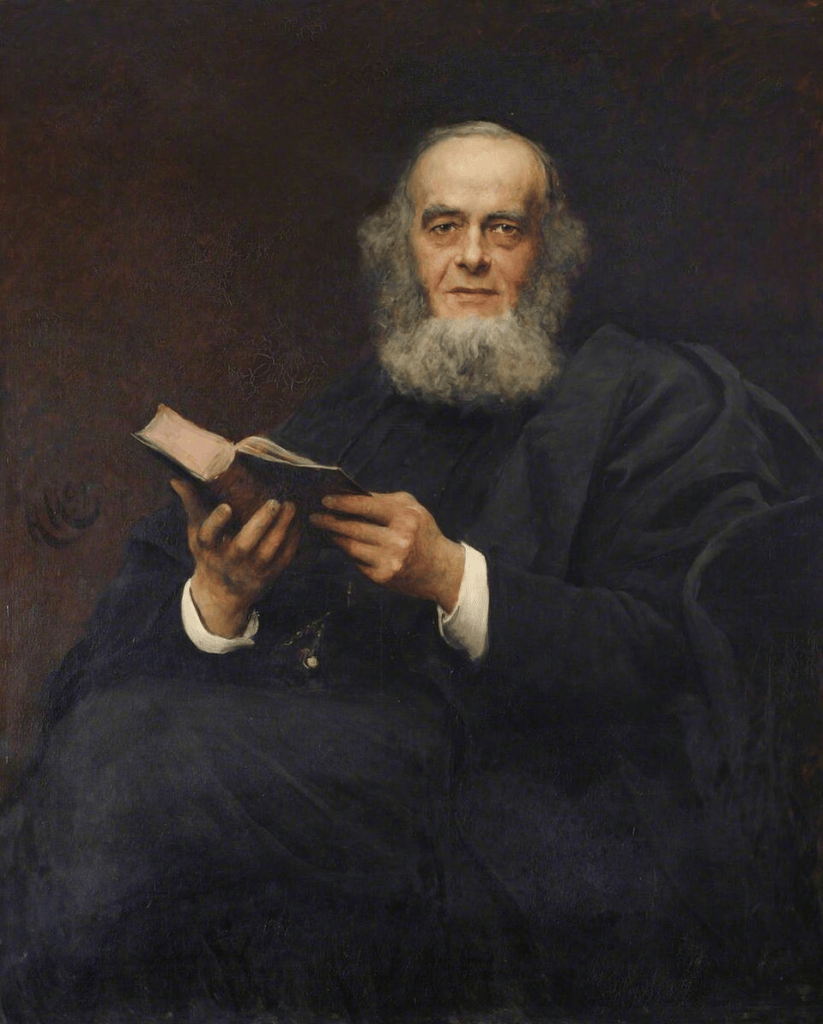
Housman was thinking in particular of the work that made Mayor’s fame – his remarkable commentary on Juvenal’s Satires, which first appeared in 1853 but did not reach its finished form until the fourth edition of 1886. It remains the case that no serious Classicist can afford to be without this book, whose pages still contain the most detailed accounts of various aspects of Roman life and letters. Even if we leave aside the impossibly rich and varied information that fills its near thousand pages, the “Advertisement” that precedes the commentary is one of the most notorious and idiosyncratic documents in the history of scholarship. This broadside – the satire that Juvenal never penned – is the textual decoction of the man, and most definitely deserves an article entirely of its own…
In addition to his work on Juvenal, Mayor’s broad interests led him to the Latin Heptateuch, Tudor England divines, Richard of Cirencester’s Speculum Historiale, and the Golden Rule of life (Nothing in excess). The spirit of his non-academic writings are well summarised by the title of his 1897 collection of sermons: Plain Living and High Thinking (1897). Much more can be gleaned of Mayor from John Henderson’s best book: Juvenal’s Mayor: The Professor who Lived on 2D. a Day (Cambridge Philological Society, Cambridge, 1998).
So now to the purpose of this piece. In January 1905 the Professor of Latin met the milestone of four-score years. To mark the occasion, the academic community of Cambridge decided to honour Mayor by signing their support of a Latin congratulatory address, composed by James Smith Reid (1846–1926), Professor of Ancient History and Fellow of Gonville & Caius. Reid sent printed copies to scholars throughout the university, both Fellows in the city and those living elsewhere. The instructions were simple: sign your name beneath the address, return it, and if you can attend, there will be a gathering in St John’s to present the collected addresses on Mayor’s birthday. The great Hellenist Sir Richard Jebb (1841–1905), then MP for the University, was invited to host the event.
By the time the day came round, 177 signatures had been garnered from the great and the good of contemporary Cambridge, and bound together in a beautiful volume of maroon Morocco. That volume now sits on my desk, and its contents are worth sharing.
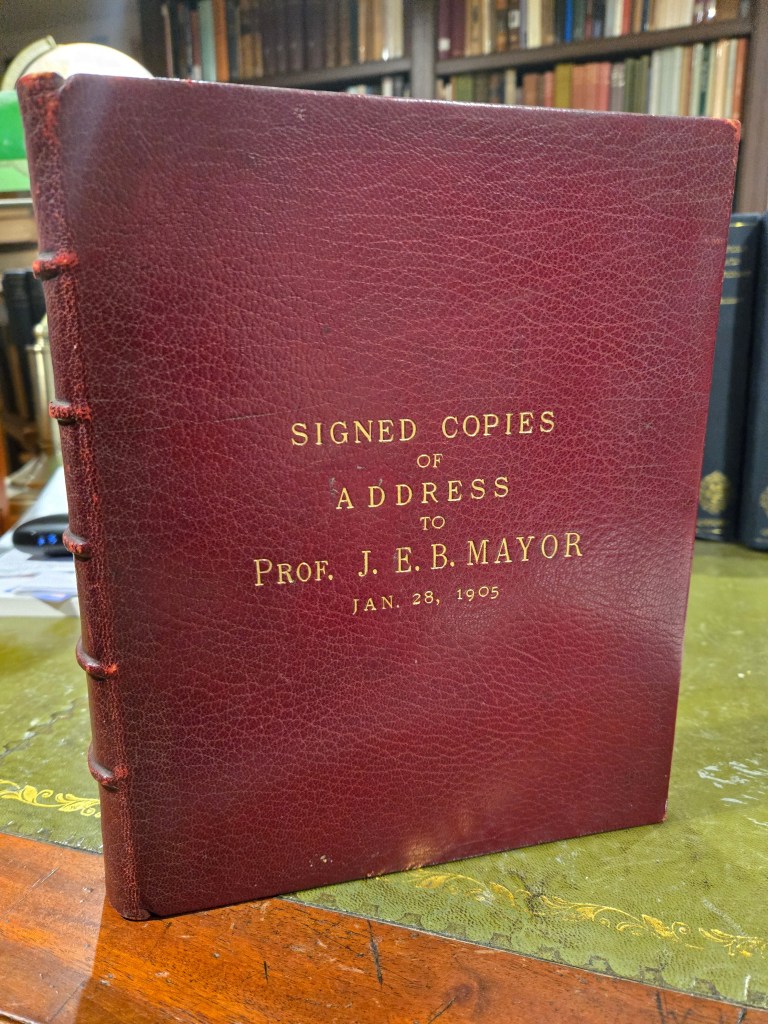
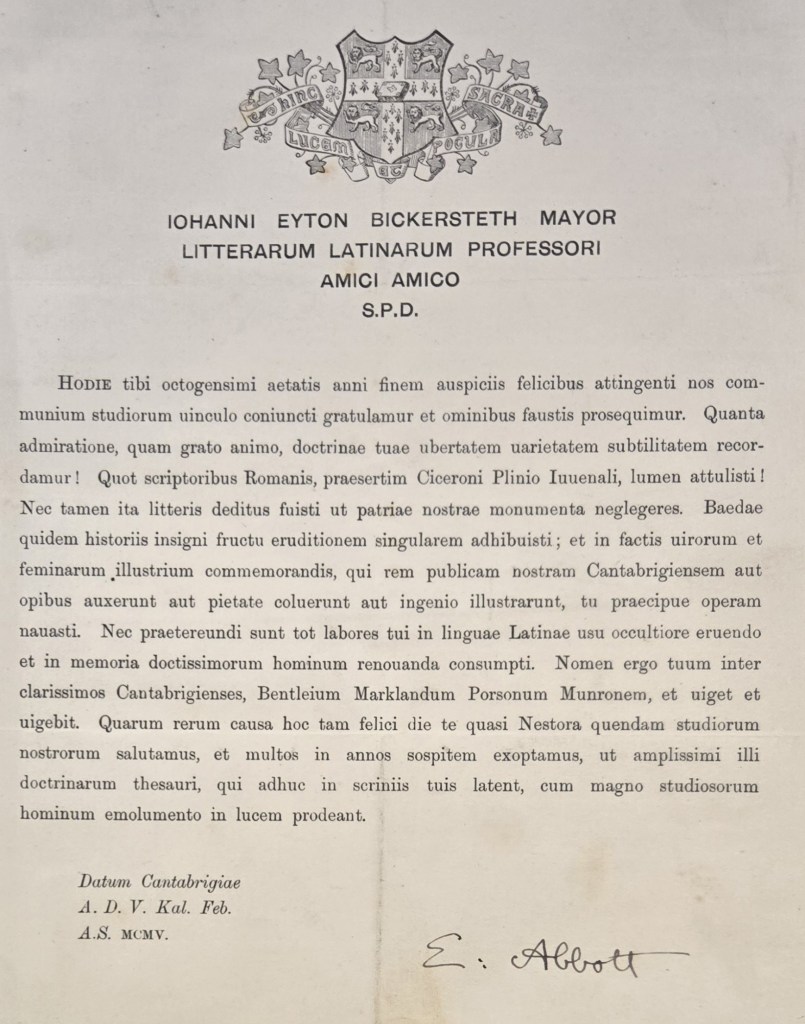
We should begin with the oration itself, which is the raison d’être of the volume. The same text, elegantly printed beneath the crest of the University of Cambridge, recurs page after page, undersigned by academic worthies in alphabetic order. Here is Reid’s Latin text, followed by my translation:
IOHANNI EYTON BICKERSTETH MAYOR
LITTERARUM LATINARUM PROFESSORI
AMICI AMICO
S.P.D.
HODIE tibi octogensimi aetatis anni finem auspiciis felicibus attingenti nos communium studiorum uinculo coniuncti gratulamur et ominibus faustis prosequimur. Quanta admiratione, quam grato animo, doctrinae tuae ubertatem uarietatem subtilitatem recordamur! Quot scriptoribus Romanis, praesertim Ciceroni Plinio Iuuenali, lumen attulisti! Nec tamen ita litteris deditus fuisti ut patriae nostrae monumenta neglegeres. Baedae quidem historiis insigni fructu eruditionem singularem adhibuisti; et in factis uirorum et feminarum illustrium commemorandis, qui rem publicam nostram Cantabrigiensem aut opibus auxerunt aut pietate coluerunt aut ingenio illustrarunt, tu praecipue operam nauasti. Nec praetereundi sunt tot labores tui in linguae Latinae usu occultiore eruendo et in memoria doctissimorum hominum renouanda consumpti. Nomen ergo tuum inter clarissimos Cantabrigienses, Bentleium Marklandum Porsonum Munronem, et uiget et uigebit. Quarum rerum causa hoc tam felici die te quasi Nestora quendam studiorum nostrorum salutamus, et multos in annos sospitem exoptamus, ut amplissimi illi doctrinarum thesauri, qui adhuc in scriniis tuis latent, cum magno studiosorum hominum emolumento in lucem prodeant.
Datum Cantabrigiae
A. D. V. Kal. Feb.
A. S. MCMV
TO THEIR FRIEND
JOHN EYTON BICKERSTETH MAYOR, PROFESSOR OF LATIN,
HIS FRIENDS SEND WARMEST GREETINGS
TODAY, joined as we are to you by the bond of shared scholarship, we congratulate you on reaching the end of your eightieth year with happy auspices, and wish you good fortune. With what admiration, with what gratitude, do we recall the richness, variety and subtlety of your learning! On how many Roman writers, especially Cicero, Pliny and Juvenal, have you shed light! Nor have you been so devoted to literature as to ignore the monuments of our own nation. Indeed you applied your unique erudition to Bede’s Histories to outstanding effect; and you did your very utmost to recount the deeds of the famous men and women who endowed our Cambridge commonwealth with their endowments, or cultivated it with their devotion, or illuminated it with their intellect. And we cannot fail to mention all your many labours spent in unearthing more obscure uses of the Latin language and reviving the memory of very learned men. Therefore your name flourishes, and will flourish, among the most famous Cantabrigians – [Richard] Bentley, [Jeremiah] Markland, [Richard] Porson, [Hugh] Munro. For this reason we salute you on this most happy day as a sort of Nestor to our studies, and we wish your good health for many years to come, so that those most abundant treasuries of your learning, which still lurk on your shelves, may be published to the great profit of scholars.
Given at Cambridge
On 28 February
A.D. 1905
At the party gathering in St John’s there were some 75 signatories in attendance. To begin, Jebb celebrated Mayor as the living ideal of academic life. He also remarked that the first edition of Mayor’s Juvenal, published in 1853 and dedicated to Kennedy, gave him (as a schoolboy at Charterhouse) “ a new conception of the way in which the Latin classics might be interpreted”. He closed his address as follows: “It is the earnest wish of all, a wish which would be shared in a world much larger than that of Cambridge, or even of England, that Prof. Mayor might have before him many years of life and strength, and fruitful work and of serene happiness.” It is poignant that Jebb himself would die later that year, aged 64, predeceasing Mayor by half a decade.
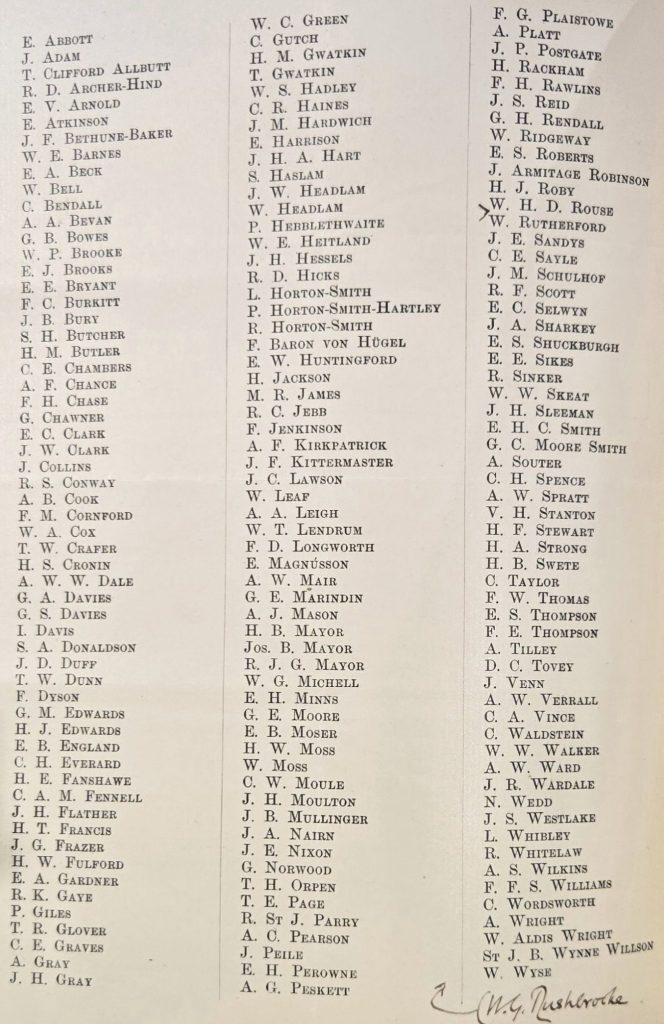
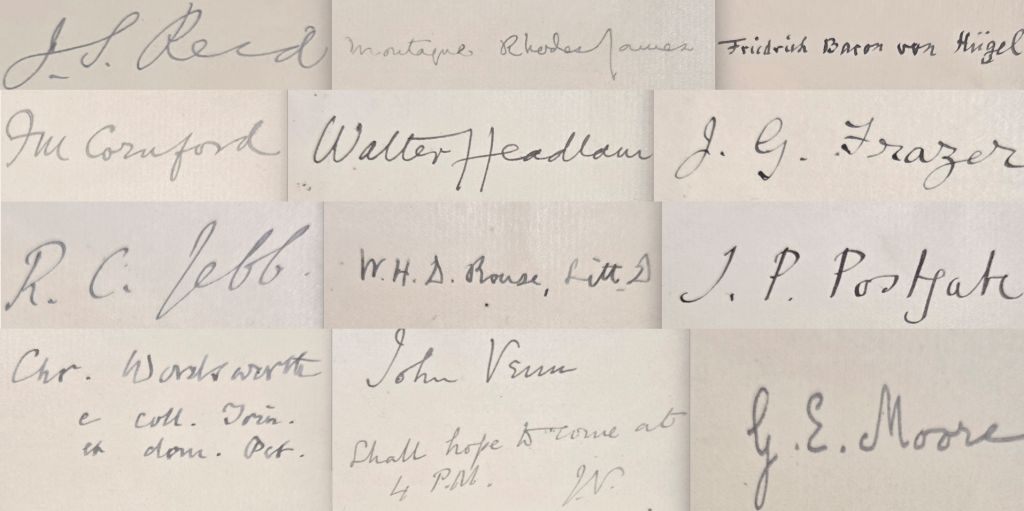
A shorter speech then followed from the venerable Master of Trinity, Henry Montagu Butler (1833–1918), recalling life in mid-century Cambridge. Jebb, drawing on his experience as a former Public Orator of Cambridge, then formally read Reid’s Latin address. Taking this as his cue, Mayor duly replied in Latin. His speech (summarised at length in the local press) was predictably unpredictable in its range of topics. It recalled the famous meeting of C.G. Cobet and J.N. Madvig at the tercentenary of Leiden University in 1875. It reported (in Latin) a conversation (in English) he had held with a woman in Manchester, who asked why Cambridge was not more progressive; Mayor argued back strenuously, explaining how the Vice-Chancellor Peter Peckard had delivered sermons against the slave trade in the 1780s, then set that cause as a topic for the Latin Essay Prize; and that the Thomas Clarkson of St John’s who won it went on to be the major abolitionist campaigner in Britain, along with his fellow Johnian William Wilberforce. He then transitioned (to the relief, perhaps, of some in the room) to English, turning his talk to educational methods and the necessity that languages “be acquired by voice, ear, and memory.” He spoke of the linguistic expertise of his teachers B.H. Kennedy, T.S. Evans and R.C. Shilleto, honed through the art of verse composition.[1] He then railed on a favourite topic – against the shortcomings of Lewis and Short’s Latin Dictionary: did these rogues not read Priscian?! Then he turned to university reform, a long-standing mission of Mayor. And finally, of course, he came to the essential importance of books.

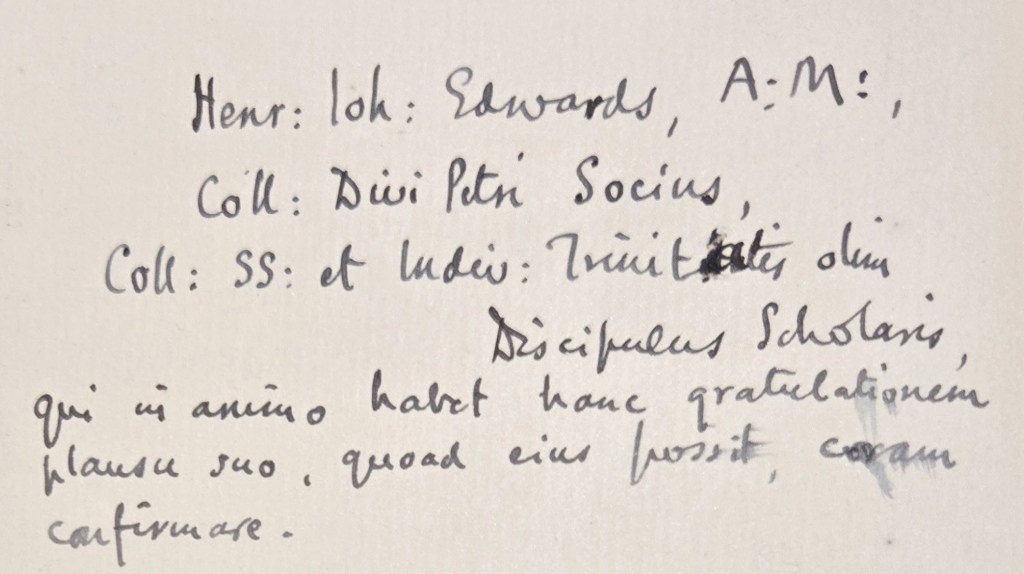

After such a substantive speech, the Vice-Chancellor, Edward Anthony Beck (1848–1916) of Trinity Hall, proposed a vote of thanks, noting the impressive stamina of the honorand: if a guest had “shut their eyes while listening to Professor Mayor they would have thought he was 40”. This motion was seconded by Reid the composer, and then given by the Master of St John’s, Charles Taylor (1840–1908).
The whole event lasted one hour and 45 minutes. There is no record of whether J.E.B. Mayor consumed any food or drink. But he did allow himself to be photographed with his beautiful birthday book.
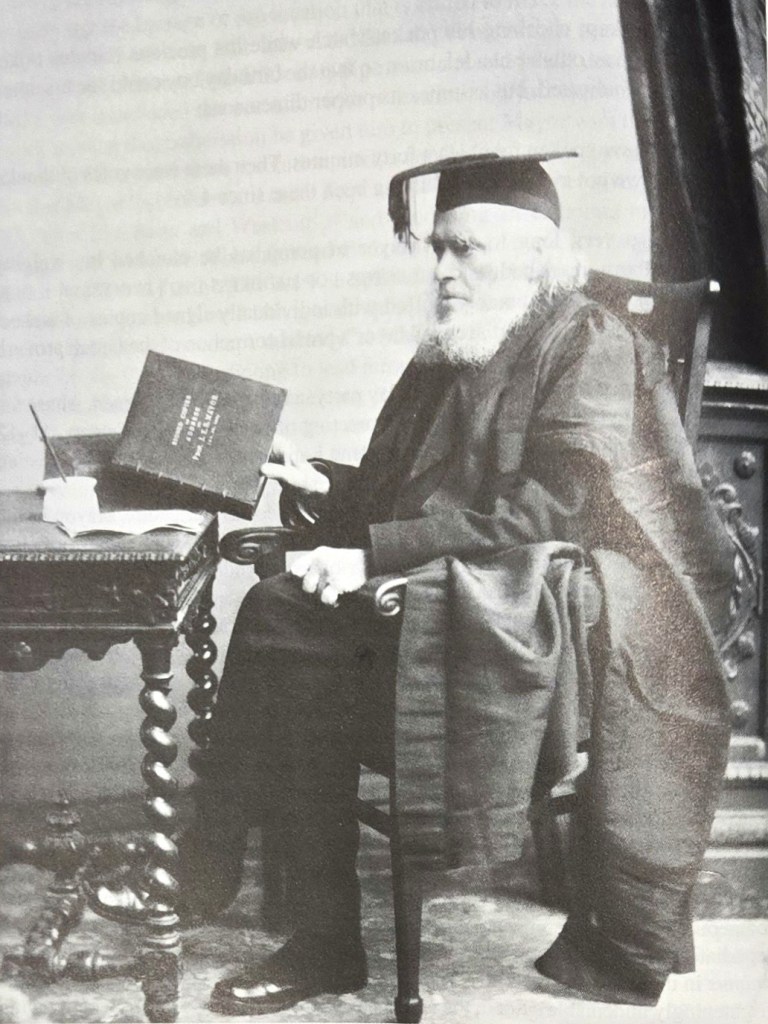
It is an irony for the ages that, in the wake of this Latin address which expressed the sincere hope that Mayor could bring his incomplete scholarly works to light, Mayor offered to resign his professorship to free up the necessary time. The University, however, had the funds neither to pay him a pension nor to pay his successor the higher salary that the age would require. The request was therefore refused. So it was, then, that J.E.B. Mayor served for another six years until his sudden death by heart failure, and that the world would never see the project on which he spent so much of his life: a commentary on the works of Seneca.[2]
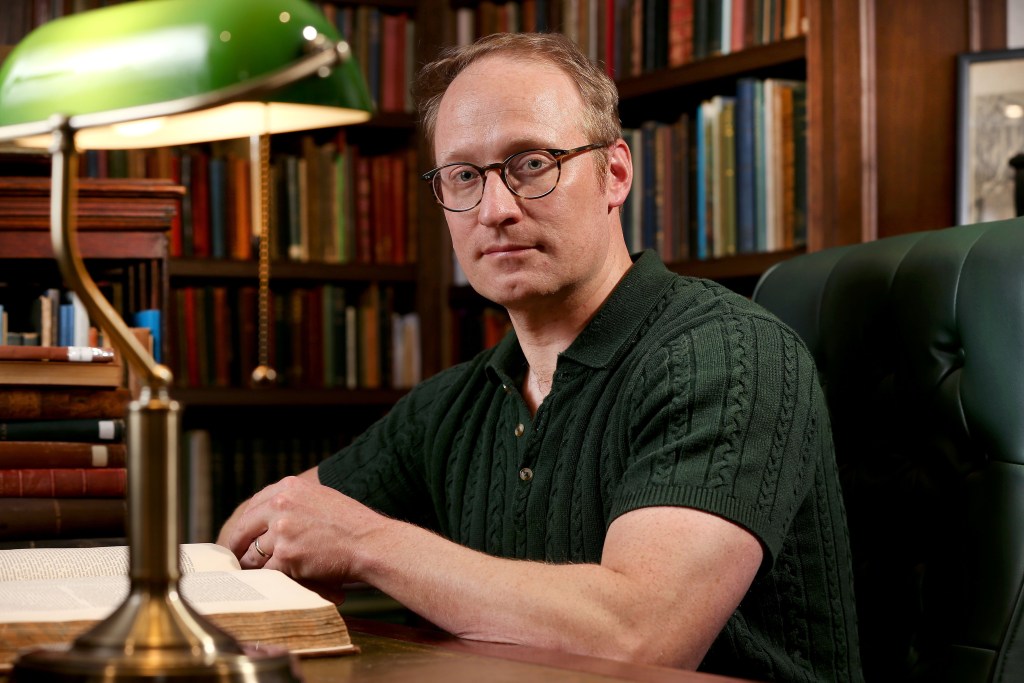
David Butterfield is Provost of Ralston College, where he is unashamedly in love with Classics.

Notes
| ⇧1 | It was at Shrewsbury that Mayor fell in love with verse composition. As he later recalled, “No occupation had greater charms for me: I constantly wrote exercises twice or three times the required length, committing to memory several thousand lines of verse, including a Greek play, Horace’s Odes, and a Georgic, and thumbed the Corpus Poetarum [edited by W.S. Walker] from Lucretius to Ausonius. Perhaps no single volume, except the Bible, embraces so many ages of literature, and reflects so clearly the changes of a nation’s life.” (First Greek Reader (Macmillan, London, 1868) xxxvi). |
|---|---|
| ⇧2 | Mayor had closed his famous “Advertisement” to the fourth edition of Juvenal (1886) with this sentence: “Henceforth I hope to devote myself to clearing off my many literary arrears; reserving for my old age a commentary on Seneca, for which I have made large collections” (p.liii). He was then 61. |