Vincent Russo
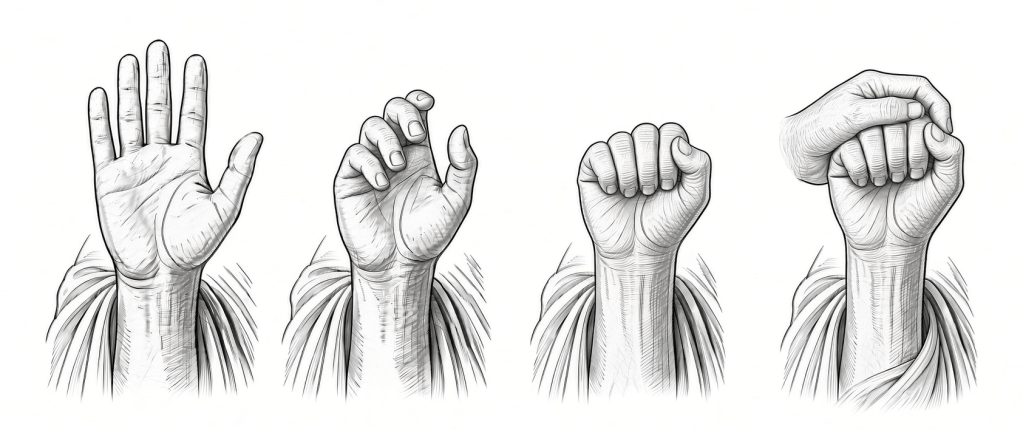
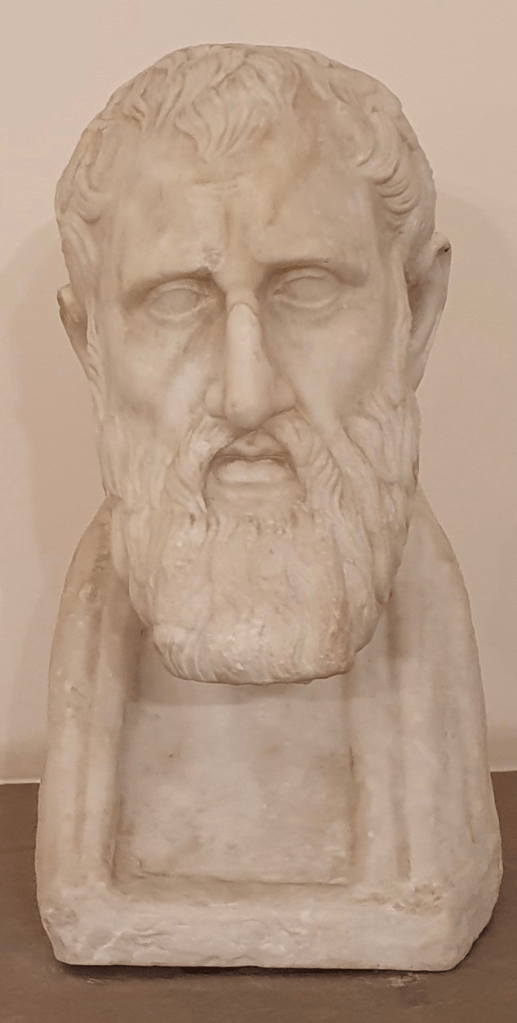
Zeno of Citium, founder of the Stoa, had a habit of demonstrating his theory of knowledge by holding up his hand. Open palm: this is an impression (phantasiā), the way the world presents itself to the mind. Fingers drawn in slightly: this is assent (synkatathesis), the soul’s “yes” to what it has seen. Fingers closed into a fist: this is katalēpsis, the grasp, a name which Cicero tells us Zeno coined for the occasion, and which Cicero rendered into Latin as comprehensio, the ancestor of our comprehension. And finally, the left hand pressed firmly over the closed right: this is knowledge (epistēmē), of which only the sage is capable. The demonstration is preserved by Cicero in his Academica (2.145).
It is a beautiful image because it is also a beautiful argument. The Stoic claim is that perception bears, when it is faithful, an intrinsic mark, an idiōma or peculiarity in Sextus’s Greek, a nota in Cicero’s Latin, that differentiates it from any impression which could have come from another source. Sextus Empiricus, writing nearly five centuries after Zeno had first closed his fist, distills the doctrine to its essentials at Adversus Mathematicos 7.247–52. A kataleptic impression, he tells us, is one that arises from what really exists; that is stamped and sealed in accordance with that very existing thing; and that is such as could not have arisen from anything that does not exist. The third clause does the heavy lifting: a faithful impression carries its provenance with it.
The objection from the Academy was immediate; ancient testimony has it that the third clause of the definition was itself added to answer Arcesilaus (Adversus Mathematicos 7.252). And the objection has the same form every time it is made. Take any candidate impression you like, the Sceptics replied; we can construct another impression, of something else, that you cannot tell apart from it. Cicero stages the exchange in the Academica. The proverbial likeness of eggs is common ground; the Stoic side answers that practice sharpens the eye, pointing to the poultry-keepers of Delos who could reportedly tell which hen had laid which egg (2.57).
The sceptical reply comes at 2.84–86: whoever saw Publius Servilius Geminus believed he was seeing his twin Quintus; press a hundred seals into wax with one and the same signet ring, and, Cicero asks, ecquae poterit in agnoscendo esse distinctio? (2.86), in recognizing them, can any distinction be drawn at all? Will you need to hunt up a ring-expert, he adds, the way you found your egg-man on Delos? If, for any true impression, an indistinguishable false impression is in principle possible, the Stoic criterion has nothing to fasten on. The faithful impression and the unfaithful one wear the same face.
This is the argument the Sceptics ran, in one form or another, for the better part of five hundred years. It is, on its surface, a debate about the epistemology of ordinary perception, and there is a long tradition of reading it as such. What I want to suggest is that the debate has a more recent life, conducted in the formal language of quantum information theory, and that the modern incarnation has the unexpected virtue of clarifying what the original was about. The tools the Sceptics deployed against the Stoa turn out to have a precise mathematical formulation, and so does the Stoic ideal. In a particular corner of contemporary quantum foundations, those same tools have, in the last decade and a half, been turned around and pointed back toward something that resembles a Stoic conclusion, though only under assumptions that remain contested. The Classical philologist will, I hope, forgive the digression through Hilbert space. I shall keep the mathematics offstage.
Indistinguishable Eggs
Begin with the Stoic claim, stripped of its terminology. There is some underlying state of the world; call it s. There is an impression of it in the perceiver; call it I(s). The Stoic asserts that for the faithful impressions, the mapping from s to I(s) is injective: distinct underlying states produce distinguishably distinct impressions. The Sceptic asserts that the mapping is not injective: there are pairs of distinct states s and s′ such that I(s) = I(s′). The eggs and the twins are existence proofs of this non-injectivity.
The two parties were arguing about whether, in matters of perception, one can in principle achieve unique recovery of the source. The Stoic ideal was a recovery procedure that, when it succeeds, succeeds with certainty: the impression of an existing thing could not have come from anything else, so the inference back to its source is guaranteed. The Sceptic’s response was that no such procedure is possible. There will always be impressions for which one cannot, even in principle, be certain.
In an ordinary perceptual case the question is, in part, one of contingent psychology and contingent biology. The Academic thesis was universal in form: for every true impression, Arcesilaus and Carneades held, a false one is possible that nothing distinguishes; and it made no difference whether the eggs really differed in themselves, so long as they could not be told apart (2.85). But the evidence for that sweeping claim was a handful of contingent facts about eggs, twins, and wax, and the Stoic could always answer, as Lucullus does, that practice sharpens the eye, that somewhere on Delos there is a keener keeper. Quantum mechanics supplies a domain in which there is no keener keeper to appeal to. The limit on distinguishability there is set by the theory itself, and no amount of practice moves it.

Two Ways to Tell Quantum States Apart
A quantum state is, for our purposes, a kind of mathematical impression: a description of a physical system. To “discriminate” between two such states is, by analogy, to recover the source from the impression. Given a single copy of a system, two distinct quantum states can in general not be perfectly distinguished by any measurement whatsoever, even though each state is as complete a description as the theory allows. There is no procedure, no matter how clever, that always returns the correct answer from one look. This is a theorem, not a limitation of present-day technology. The closer two states are, in a precise geometric sense (the smaller the angle between them, considered as vectors in an abstract space), the worse one’s prospects become.
What does one do, then, when faced with the practical task of saying which state one has? Two strategies are available, and they correspond rather precisely to the two ancient camps.
The first strategy is to commit. Make a measurement; pick an answer; accept that one will sometimes be wrong. The optimal version of this strategy, the procedure that minimizes the average probability of error, was worked out by Carl Helstrom in the late 1960s. The resulting Helstrom bound tells you exactly how often the best possible guess can be expected to fail, given two non-orthogonal states. This is the Academic pithanon, the “persuasive”, made formal (Carneades’ own procedure had further grades of scrutiny, but the spirit survives): one takes the most credible appearance and acts on it, knowing that there will be times when one is wrong, and that there is in principle no way to do better. Carneades’ Sceptic, faced with two eggs, would have to act on the impression he had while knowing that nothing in the impression itself ruled out the possibility that he had got the wrong egg.
The second strategy is the Stoic strategy: refuse to commit unless certain. The corresponding quantum protocol is called unambiguous state discrimination. It was introduced by Ivanovic, Dieks, and Peres in a sequence of papers in the late 1980s, and it works like this. One designs a measurement with three possible outcomes rather than two: “definitely state 1”, “definitely state 2”, and “I don’t know”. The first two outcomes are guaranteed never to be wrong. The third is the price one pays: sometimes the measurement simply refuses to choose, and one must walk away without a verdict.
This is katalēpsis recast as a measurement procedure. It is the Stoic discipline of withholding assent from any impression that is not such as could only have come from one source. It is also the only way to recover the Stoic guarantee, perfect reliability when one does speak, and one pays for it in just the way the Sceptic always insisted one would: there will be cases in which one cannot speak at all. The analogy breaks down in one respect. The protocol’s certainty is conditional: the guarantee holds only if the system really was prepared in one of the two named states, so the certainty is relative to a list of alternatives fixed in advance. Zeno wanted an impression that certified itself against every alternative, listed or not; nothing of that sort is on offer even now. Helstrom’s protocol is what one builds if the aim is to be right as often as possible on average; the unambiguous protocol is what one builds if the aim is never to be wrong on the occasions when one does commit. Put that way, the quarrel between the Stoa and the Academy was, at least in part, a quarrel over which objective function to optimize.

What the Sceptic Was Actually Doing
There is a third possibility, however, which neither ancient party named but which the Sceptics seem to have practiced more than they argued for. Suppose that one wishes to make claims that are absolutely certain, but one does not insist on identifying the source. One asks instead: what can I rule out?
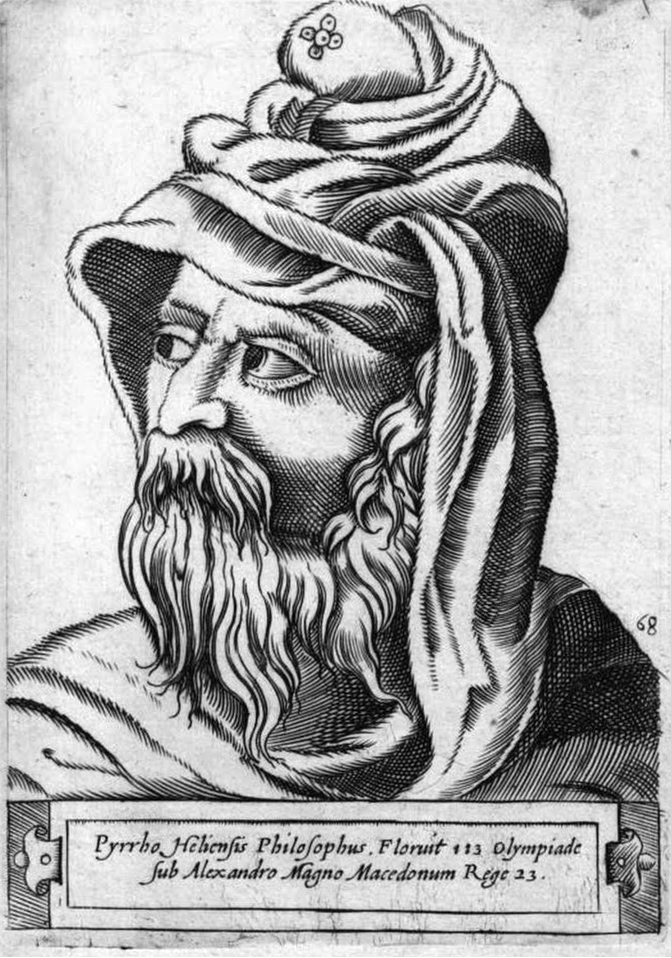
We may turn now to Sextus Empiricus’ Outlines of Pyrrhonism, a text of the Pyrrhonist school rather than of Carneades’ Academy, though the two shared most of their weapons against the Stoa. The structure of this work, and particularly the ten modes of the first book (PH 1.36–163), is fundamentally of this kind. The Pyrrhonist does not tell you what the apple really is. He observes that the same apple presents itself as smooth, fragrant, sweet, and yellow to four different senses, with nothing to say which of these belongs to the apple’s own nature; that honey appears sweet to the healthy and bitter to those with jaundice; and from these conflicting appearances he draws a negative conclusion: nothing in the appearances themselves entitles one to assert that the apple, or the honey, is really such-and-such. The argument rules a claim out without putting another in its place.
The quantum analogue has a slightly later history. A set of quantum states is called antidistinguishable if there is a measurement that, for each of its outcomes, certainly excludes one of the states. When three or more states are in play, ruling one out identifies nothing; the measurement never tells you which state you have. But it sometimes tells you, with certainty, which state you don’t have. The concept was studied in this form by Caves, Fuchs, and Schack at the turn of the century, building on earlier observations; the name “antidistinguishability” came into use somewhat later.
It is, on first acquaintance, a strange notion, and one might wonder what it is good for. A measurement that never identifies anything and only ever rules things out sounds like the punchline of a sceptical joke. In a sense it is. But it is also the move the Sceptics made for centuries against the Stoa, and once it had been properly formulated it became the central step in a theorem about what the quantum state can be.

What Is the Quantum State?
A central debate in the philosophy of quantum mechanics is whether the quantum state, the mathematical object physicists write down when describing a system, corresponds to something real in the world, or merely encodes the observer’s knowledge of something more fundamental. The first position is sometimes called ψ-ontic; the second, ψ-epistemic. The distinction was given its modern formal shape by Harrigan and Spekkens in 2010. The ψ-ontic camp holds that distinct quantum states never describe the same underlying state of reality. The ψ-epistemic camp holds that they need not: two distinct quantum states might describe the same underlying reality, differing only in what one knows or believes about it.
Translated into the Stoic-Sceptic vocabulary: the ψ-ontic view has the structure of a Stoic position about the impressions of physics. The quantum state is the stamp and seal of the system; distinct states require distinct sources. The ψ-epistemic view has the structure of a Sceptical objection. Distinct impressions can in principle come from the same source; what we take for state-of-the-world is at least partly state-of-our-credence. The structural parallel is loose, since the ancient Sceptics did not advance a positive metaphysics. The point is that their negative argument, that one cannot trust the criterion of distinct-states-from-distinct-impressions, has the same shape as the modern ψ-epistemicist’s complaint.
For decades the two camps argued in much the same way the Stoics and Academics had: with thought experiments, with toy models, with appeals to parsimony and intuition. Robert Spekkens’s “toy theory” of 2007 showed that a great deal of what looks quantum can be reproduced by a simple, manifestly epistemic model in which a system has a definite underlying state but the agent has limited knowledge of it. The success of that toy model gave the ψ-epistemic view its strongest pre-theorem case: an enormous amount of quantum strangeness, it seemed, might just be the mathematics of partial information.
The PBR Argument
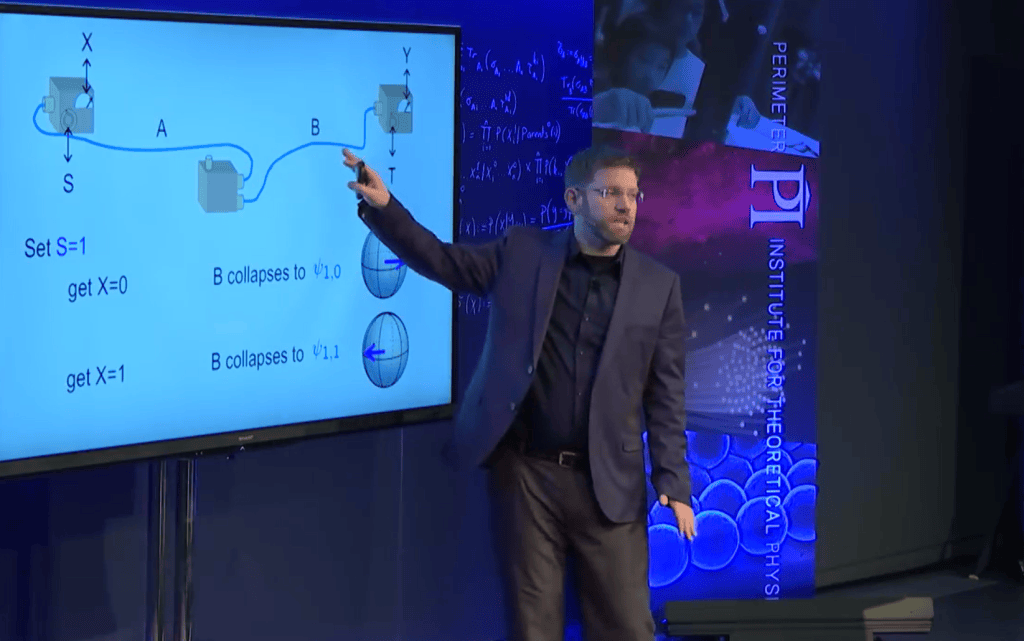
In 2012 Matthew Pusey, Jonathan Barrett, and Terry Rudolph (abbreviated to PBR by their initials) proved, under a particular set of assumptions, that the ψ-epistemic view is untenable. The argument has the shape of a Euclidean proof: a small construction, a claim about it, and a contradiction at the end.
The construction runs like this. Take a quantum system that can be prepared in either of two non-orthogonal states, a pair not too close together; for closer pairs the argument needs more copies, but the idea is unchanged. Take two copies of this system, each independently prepared in one of those two states, so that there are four possible joint preparations in all. Pusey, Barrett, and Rudolph identified a measurement on the joint system with four outcomes, each of which rules out exactly one of the four possible preparations. The four joint states are, in our new vocabulary, antidistinguishable.
Now suppose, for contradiction, that the underlying ontology is ψ-epistemic, that two different quantum states can share an underlying reality. Suppose, further, the assumption that gives the theorem its bite: that when one prepares two systems independently, their underlying realities are themselves independent of one another. This is the preparation independence postulate, the assumption on which the whole argument turns. Then there is some non-zero probability that the two independently prepared systems land in underlying realities that are individually consistent with both of the candidate states they were each prepared in. Their joint underlying reality is therefore consistent with all four of the candidate joint preparations. But now perform the antidistinguishing measurement. It must produce some outcome, and each of its outcomes is strictly forbidden for one of the four preparations. An underlying reality consistent with all four preparations would make every outcome forbidden, and the measurement could produce nothing at all. The supposition fails.
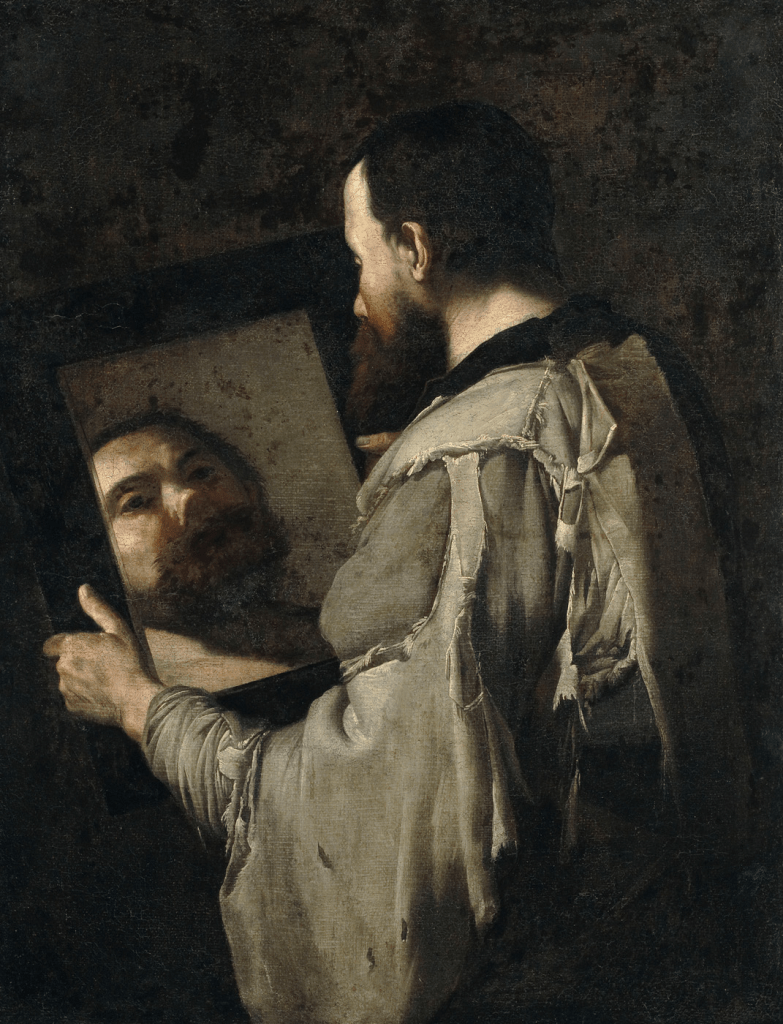
The move at the centre of the proof is the Sceptics’ own, ruling out without identifying. What is new is that it now sits inside a theorem, and the theorem, on its face, goes against the Sceptical metaphysics of the quantum state.
That, at any rate, is the headline. The foundations community has, in the years since PBR, been active in probing the theorem’s assumptions, and the dust is not settled. Preparation independence is the obvious target. It is a substantive metaphysical commitment in its own right, essentially the claim that the world does not maintain conspiratorial correlations between independent laboratory preparations, and there are ψ-epistemic models in the literature that reproduce quantum predictions by violating this assumption. PBR raises the price of the ψ-epistemic view rather than refuting it. Any ψ-epistemic model of the standard sort must accept correlations between the underlying realities of independently prepared systems, which is a non-trivial commitment and which many find unattractive. Whether one should find it unattractive is a further question, and one on which reasonable people in quantum foundations continue to disagree.
The Stoic has not been vindicated. But the Sceptic has been forced to articulate, in a way the ancient Sceptic never had to, the metaphysical cost of his negative project.
What the Ancients Got Right
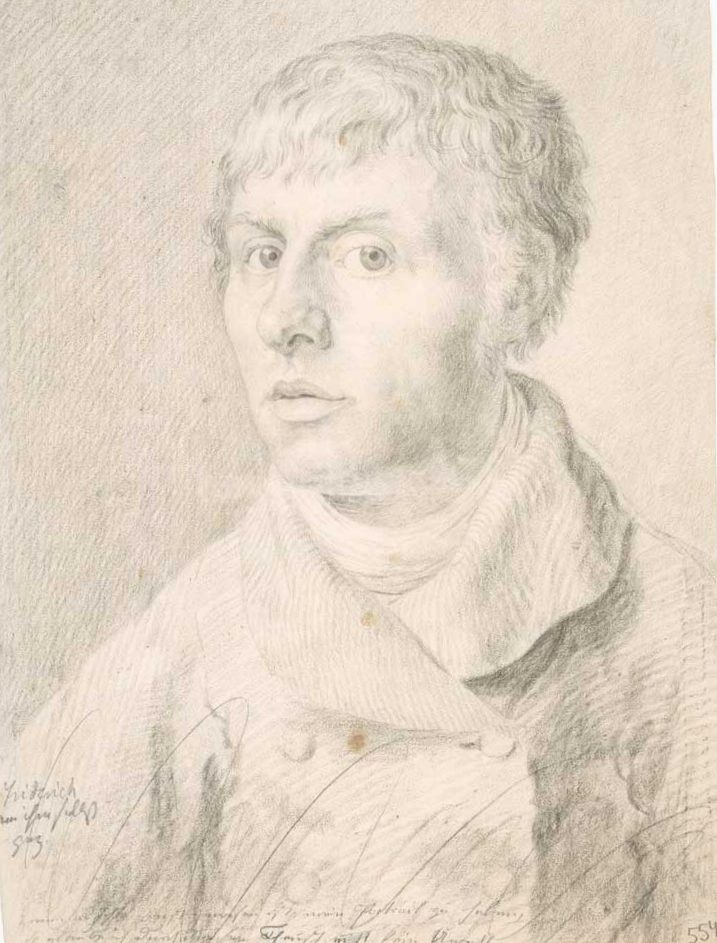
It would overclaim to say that the Stoics anticipated PBR, or that Carneades was a proto-quantum-foundations theorist. They were not. The objects they were arguing about (eggs, twins, the appearances of honey to the sick) are not quantum systems, and the kind of indistinguishability the Sceptics could point to was an in-practice indistinguishability rooted in the contingent limits of human perception. The Stoic theory of the kataleptic impression is a theory of ordinary cognition, not of measurement on entangled qubits. To pretend otherwise would be to fall into the same trap that Lucretius-as-quantum-mystic enthusiasts so often fall into, and which makes serious Classicists wince.
The parallel that does hold is subtler. The Stoics and Sceptics worked out an argumentative structure: the criterion of truth, the indistinguishability counter-example, the discipline of withholding assent, the fallback to the merely probable, the negative method of ruling things out. That structure turns out to have an exact formal counterpart in a domain that was utterly outside their experience. The structure is general. It is the structure of any epistemic situation in which one must reason from impressions to sources, and in which the relationship between impressions and sources is not transparent.
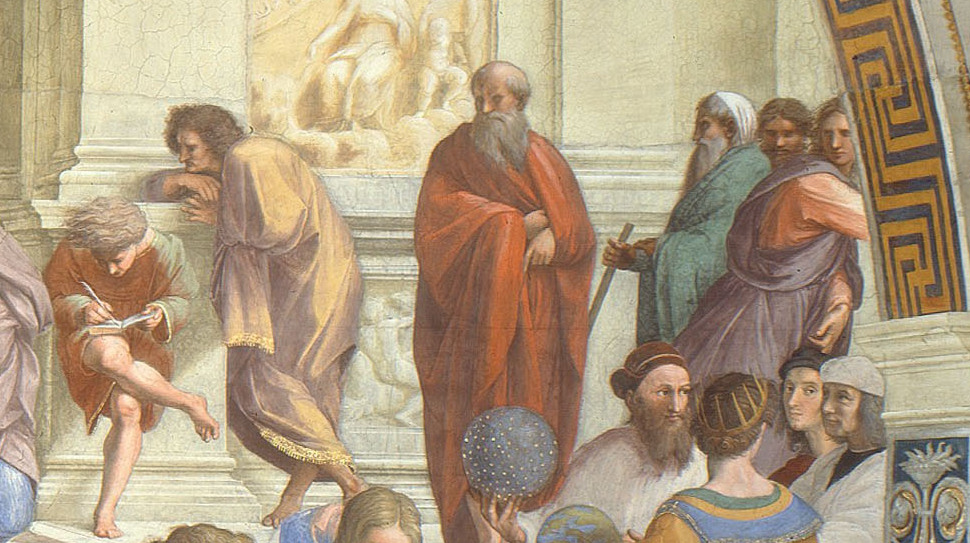
The Stoa was right that there is a useful distinction between the inference one can make with certainty and the inference one can make only with confidence; unambiguous discrimination is that distinction, formalized. The Academy was right that for many impression-pairs no certainty-preserving inference is available, so that one must either commit imperfectly or remain silent, and the Helstrom bound puts a number on how imperfectly. The Pyrrhonist tactic of ruling out without identifying is the case I find most surprising, because the ancient Sceptics used it without naming it and without suspecting that it could be turned around to argue for anything positive at all; yet in the PBR setting it is the lever by which one constrains the metaphysics of the very entities one is reasoning about.
There is, I think, a lesson here for the way we read the Academica and Sextus. It is easy to take these texts as a sort of philosophical sparring match, two clever schools scoring points off each other over a question, what is the criterion of truth, that we no longer phrase quite that way. What the quantum-information re-reading shows is that the question is still being asked, in a domain the ancients could not have imagined, and that the moves they worked out against one another are the ones we still make. The difference is that we now write them down as measurement protocols, on the blackboards of physics departments, and prove theorems about when each of them can succeed.

Vincent Russo is a quantum information theorist whose research concerns the question at the centre of this essay: how, and whether, quantum states can be told apart. He holds a PhD in computer science from the University of Waterloo and is the founder of toqito, an open-source software library for quantum information. His writing and research can be found at vprusso.github.io.
J.A. Bergou, U. Herzog, & M. Hillery, “Discrimination of quantum states,” Lecture Notes in Physics 649 (2004) 417–65.
R.G. Bury (tr.), Sextus Empiricus, Outlines of Pyrrhonism and Against the Logicians, Loeb Classical Library 273, 291 (Harvard UP, Cambridge, MA, 1933, 1935).
C.M. Caves, C.A. Fuchs, & R. Schack, “Conditions for compatibility of quantum-state assignments,” Physical Review A 66 (2002) 062111.
N. Harrigan & R.W. Spekkens, “Einstein, incompleteness, and the epistemic view of quantum states,” Foundations of Physics 40 (2010) 125–57.
C.W. Helstrom, Quantum Detection and Estimation Theory (Academic Press, New York, NY, 1976).
N. Johnston, B. Lovitz, V. Russo, & J. Sikora, “The complexity of perfect quantum state classification,” arXiv:2510.20789 (2025).
N. Johnston, V. Russo, & J. Sikora, “Tight bounds for antidistinguishability and circulant sets of pure quantum states,” Quantum 9 (2025) 1622.
M.S. Leifer, “Is the quantum state real? An extended review of ψ-ontology theorems,” Quanta 3 (2014) 67–155.
A.A. Long & D.N. Sedley (edd.), The Hellenistic Philosophers (Cambridge UP, 2 vols, 1987), esp. §§39–41 and 68–72.
M.F. Pusey, J. Barrett, & T. Rudolph, “On the reality of the quantum state,” Nature Physics 8 (2012) 475–8.
H. Rackham (tr.), Cicero, De Natura Deorum / Academica, Loeb Classical Library 268 (Harvard UP, Cambridge, MA, 1933).
V. Russo & J. Sikora, “Inner products of pure states and their antidistinguishability,” Physical Review A 107 (2023) L030202.
R.W. Spekkens, “Evidence for the epistemic view of quantum states: a toy theory,” Physical Review A 75 (2007) 032110.
