Christopher Stray
A century after his death, Postgate is still a name to conjure with. He helped to spread the magic by having a large family – six children in all. One of his grandsons, Nicholas, is a leading Assyriologist and a fellow of Trinity College Cambridge, as was John Percival himself; he has been heavily involved in the campaign to preserve antiquities in Iraq. Another grandson, Oliver, worked in film and TV and was famous as the creator of the cartoon character Bagpuss. Oliver’s father Raymond was well known both as the writer of popular books on social history and as the founder of the Good Food Guide. Raymond’s brother Esmond taught Classics in schools, but was best known in some circles for attending Classical Association conferences wearing heavily blancoed plimsolls, and with pyjamas protruding from under his clothes. Their sister Margaret, who read Classics at Girton College, Cambridge, married the socialist economic historian G.D.H. Cole.[1] It was she who reported that the first three children were brown-eyed and quarrelsome, the next three blue-eyed and docile. Margaret and her brother Raymond, two of the quarrelsome ones, were singled out in their father’s will. Instead of being left money on his death, they were given £100 a year each from age 55, assuming they reached it. These deferred annuities made the will a difficult one to administer, and this may be why Trinity College, which had first refusal, turned down the sum on offer, about £27,000 (roughly £1.5 million today), so that the alternative recipient, the University of Liverpool, was able to benefit.
Through this bewildering family tree, or rather forest, there are some connecting paths. One path has to do with food. John Percival’s father John Postgate was a pioneering, and eventually successful, campaigner for food purity; his biography was written by another John Postgate, Raymond’s son (1922–2014 ), a leading microbiologist.[2] Raymond was a socialist and founder of the Good Food Guide; his biography, by his son John the microbiologist and his wife, is aptly titled A Stomach for Dissent. But a food-related thread runs through John Percival’s life too. He never wrote, as it were, a digestive tract, but food often appears up in his writing as a metaphor, its purity paralleling the purity of literary value. At the founding meeting of the Classical Association in December 1903, he remarked of translations that though they had their uses, as literature they were “pickled salmon, tinned salmon”. And in the inaugural lecture he gave in 1910 as Professor of Latin, he quoted a letter written to him in Latin by the manufacturer of a brand of carbonated water. “If the beverage is as pure and sparkling as the Latinity,” Postgate declared, “anyone in my audience may imbibe it with the greatest security.”[3]
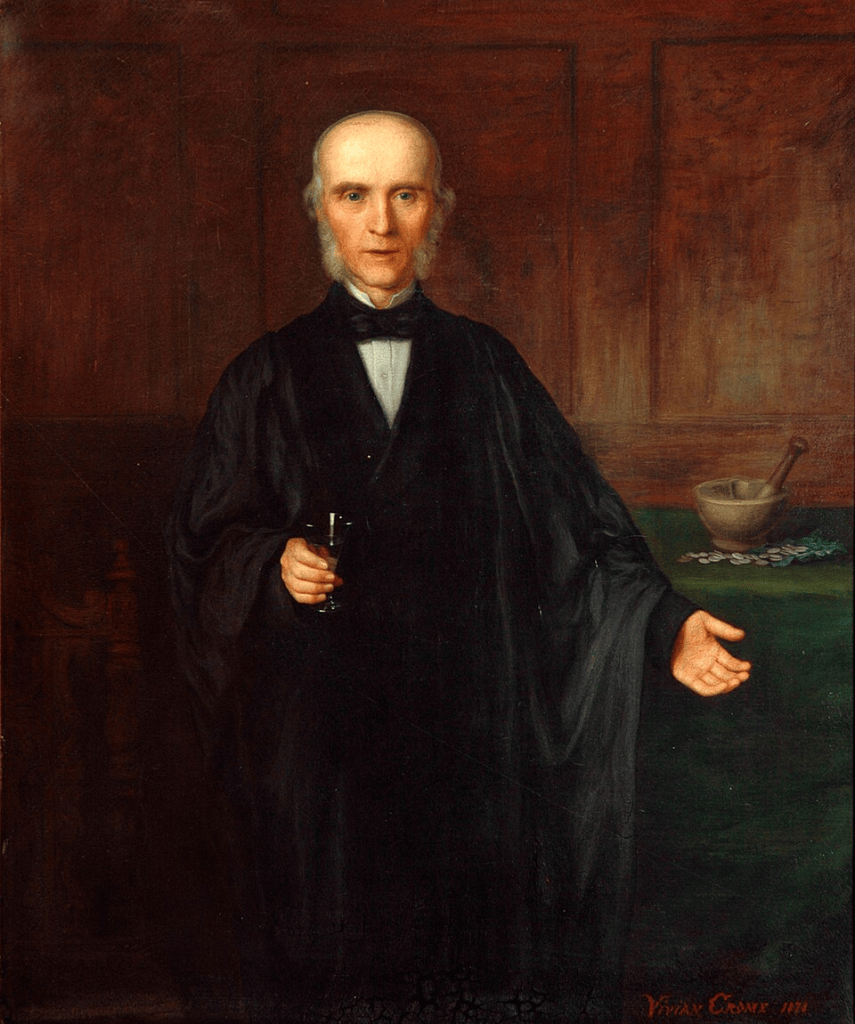
John Percival Postgate was born in 1853. His father, John Postgate of Scarborough, had started his working life as a grocer’s boy, and later conducted a long and energetic campaign against the adulteration of food that he had daily witnessed. He persuaded the Birmingham MPs to introduce bills in parliament, finally triumphing with the passage in 1875 of the Sale of Food and Drugs Act. In 1860 he was appointed Professor of Medical Jurisprudence and Toxicology at Queen’s College, Birmingham. There have thus been three Professor John Postgates: John the food reformer, his son John Percival the Latinist, and John Percival’s grandson John the microbiologist. John the food reformer died in 1881 – in a sad irony, from cancer of the stomach. John Percival went to King Edward VI School in Birmingham. He became Head Boy there, and won a scholarship to Trinity College, Cambridge, in 1872.
In that same year the Senior Fellow of Trinity, Hugh (H.A.J.) Munro, celebrated for his monumental edition of Lucretius, resigned the chair of Latin after just three years in office. His younger colleague Richard Jebb was already well into his stride as a Classical tutor, having with other young Fellows reformed the college teaching system and opened it up to members of other colleges. Postgate thus reached Cambridge at the point when the Trinity system was expanding and when intercollegiate teaching was beginning to take hold. The extra-collegiate perspective this encouraged was perhaps reinforced by the founding in 1871, just before he went up, of the Cambridge Philological Society. The founding president was Edward Cowell, Professor of Sanskrit; the founding secretary was Cowell’s pupil Richard Jebb. It was certainly enhanced by the foundation in 1879 of the Cambridge Review, a discussion and review journal for the university. The Review was founded in James Frazer’s rooms in Trinity; the initial editorial triumvirate consisted of Frazer, Postgate and another Trinity man, Edward Arnold.
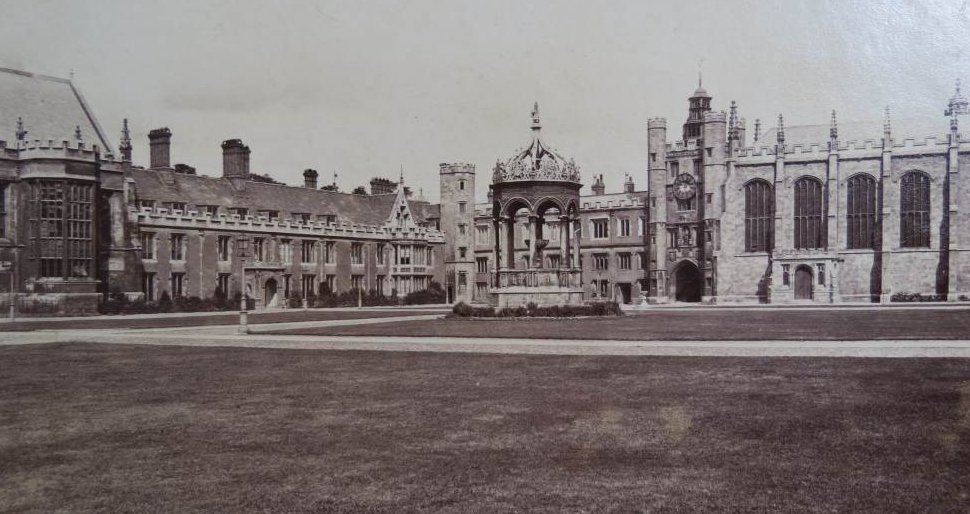
In 1880 Postgate became secretary of the Cambridge Philological Society. Here, as with the Review, we can see him in one of his favourite roles – organiser and energiser. His appointment was surely linked with the announcement in the Review that “The Philological Society is in a process of reconstruction. For some time there has been a feeling that a decided change was necessary, to enable the Society to retain its activity and vigour.”[4] In the following February the change was announced: “The Philological Society will open itself to non-Cambridge members, [and] hire a room (perhaps shared with the Antiquarian Society).”[5]
In the early 1880s Postgate also acted as secretary of the Association of Classical Teachers. a loose grouping of local private tutors (coaches) which published a list of its members so that undergraduates knew who was available and what teaching they offered. The impetus was probably the reorganisation of the Classical Tripos in 1879–80, when it was divided into a traditional first part (Language and Literature) and a second part consisting of specialised sections in Literature, Philosophy, History, Archaeology, and Philology. This will have opened up a need for coaching in special topics which not all tutors could meet. Enter Postgate the organiser.
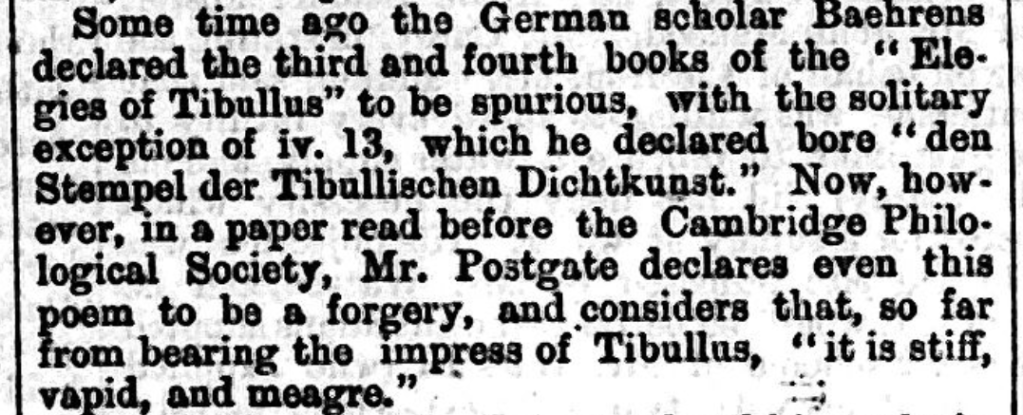
In 1880 Postgate was elected to the Chair of Comparative Philology at University College, London. The lectures required were few and so were the pupils; Postgate probably went down to London once a week to give a lecture. Those were exciting days for comparative philology, as the Neogrammarians – Hermann Osthoff, Karl Brugmann and their allies – were busy establishing the subject on a newly scientific basis. Brugmann’s large work on Indo-European grammar (1886–93) was soon translated into English, most of it by Postgate’s younger Cambridge contemporaries R.S. Conway and W.H.D. Rouse.[6] The year this started appearing, 1888, was an important year also for Latin grammar, as it saw the appearance of Kennedy’s Revised Latin Primer.[7] This arose from the widespread dissatisfaction with the Public School Latin Primer (1866), the book Kennedy had written for the nine leading public schools, the Clarendon schools, in the 1860s;[8] it had been commissioned by the Headmasters’ Conference. For some time it looked as if the headmasters might refuse to stick with Kennedy, and this is presumably why Postgate collaborated with his old schoolfellow Charles Vince, now a headmaster, on the New Latin Primer, published in the same year as Kennedy’s revised primer, 1888. It spawned an elementary version in 1890 and went into several editions, reaching its 55th thousand in 1918; but the imprimatur of the Headmasters Conference kept Kennedy’s book in the lead. This shows Postgate’s concern with Classical learning at school level, something he took up again via the Classical Association after its foundation in 1903.
Postgate was not only a founder of the Cambridge Review but a contributor. In the first issue, in the autumn of 1879, he published a skit entitled “Fiji: A Dream”, which reported a meeting of a “Phi-gy Society”. Textual emendations of Tennyson, Swinburne and Milton were offered, ascribed to local academic heroes and to the great Danish Latinist Johann Nicolai Madvig. One of ‘Madvig’’s emendations was as follows:
Tennyson, In Memoriam xxvii 5–6
‘I envy not the beast that takes
His license in the field of time.’
This is manifestly corrupt. The field of time is no more intelligible than the field of eternity… Read therefore thyme.
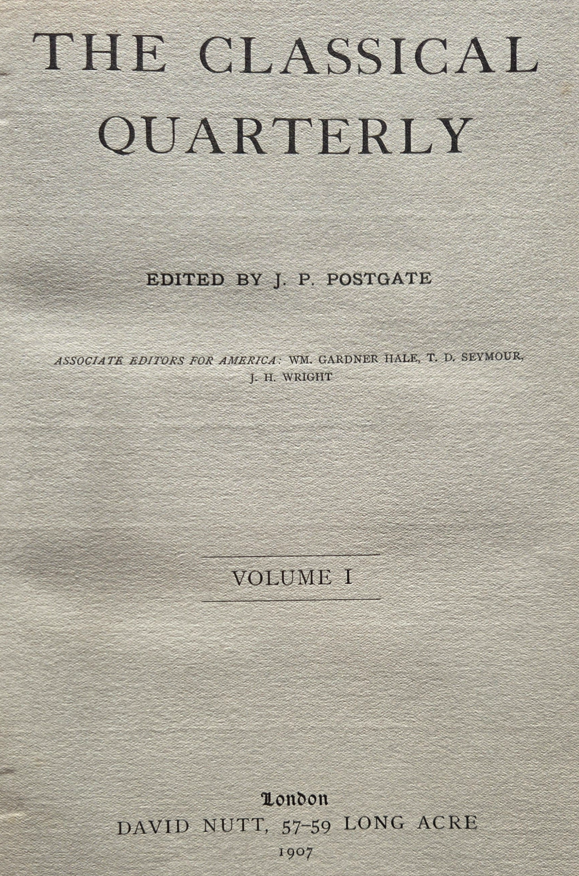
When the Classical Review was founded in 1886 by Joseph Mayor, younger brother of the Cambridge Professor of Latin John Mayor, Postgate was recruited to the group of scholars who supported it by subscribing and contributing. In 1899 he became its editor, continuing till 1907, when he transferred to the newly-founded Classical Quarterly.
Mention of the Classical Association brings me to yet another piece of campaigning and organising – in some ways the most important of all. This is a story available in print, in the Classical Association centenary volume, so I will simply summarise.[9] Responding to the decision of the University of London to make Latin an optional subject for its matriculation examinations, in November 1902 Postgate published an article in the Fortnightly Review entitled, “Are the Classics to go?” The changes in London regulations were part of a broader movement, he thought; the passage of the 1902 Education Act, the first ever intervention by the state in secondary education, was also cause for alarm. The supporters of Classics, he declared, must unite to defend it, or see it disappear. Here we can see concerns which anticipate those raised by the imposition of the National Curriculum in 1988.
Postgate had a full mailbag after his article appeared. Among his correspondents was another organiser, Edward Sonnenschein, Professor of Greek and Latin at Birmingham since 1883. His biography paralleled Postgate’s in several respects. His father Adolf was a liberal who came to Britain after the 1848 revolution, became a mathematics teacher and published works on European educational systems. His concern with the harmonising of these systems was in a way the forerunner of his son’s “Parallel Grammar” series, which included grammars of Latin, Greek, English and even Dutch, all on the same lines. So where Postgate pursued the paternal concern with purity – from food to Classics – Sonnenschein followed his father in identifying standard rules for linguistic exposition and teaching. His object, he said, was to establish in Europe an “entente cordiale grammaticale”.
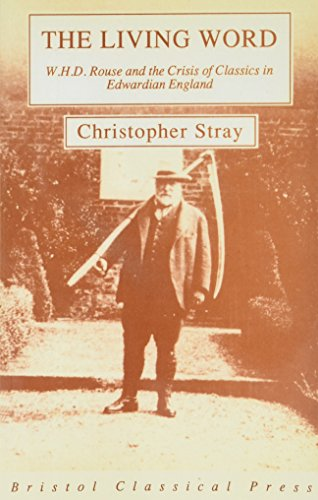
Let me mention also a third figure, W.H.D. Rouse, son of a Baptist missionary, who campaigned for the direct method teaching of Latin and Greek. The father baptised by immersion, the son practised immersion in the Classical languages. All three men continued their fathers’ campaigns in transmuted form and in a different field, that of Classics.
The result of Postgate’s and Sonnenschein’s correspondence was the foundation of the Classical Association in December 1903, just over a year later. Those who have been involved in similar exercises will be able to imagine what happened in between – for example, persuading the Master of the Rolls to agree to chair a founding event, and other grandees to propose and second motions. Postgate and Sonnenschein became the joint secretaries of the new association. Why two secretaries? They were both Latinists, so perhaps the consulship came to mind. More likely, though, was the consideration that the new body should not be seen to be run from Oxbridge – Sonnenschein’s position in Birmingham gave him provincial street cred. And this is something Postgate too acquired six years later, in 1909, when he was elected to the Chair of Latin in Liverpool.
Postgate’s move to Liverpool in 1909 was part of a wider phenomenon: the staffing of new provincial universities by Oxbridge graduates. Of the 30 non-medical professors hired between 1892, when the University College of Liverpool was founded, and 1903, when it became a university, 20 came from Oxbridge; of these 13 were Cambridge men, including 9 from Trinity. The first three principals of the College were all Fellows of Trinity. The first was also Professor of Greek; when his successor was appointed in 1898, the Greek Chair was detached from the principalship, and went to yet another Trinity man, Gilbert Davies. The expanding world of provincial Classics in the 1900s had yet to make a significant impact on the wider world, but it was gradually acquiring a consciousness of its separate identity. This involved teaching Latin and Greek separately, with more Latin than Greek, to students some of whom had little or no experience of either language. This had long been the case in Scotland, but there it was universal, and legitimated in the late 19th century by the ideology of the democratic intellect: the ‘lad o’ pairts’ or bright boy (assumed to be male) who rose from the parish school to university through sheer ability and hard work. The contrast between the transcendent complacency of Oxford and the hard reality of provincial life rose to the surface in 1912 at the annual meeting of the Classical Association. J.W. Mackail – himself a ‘lad of parts’ who had gone from Glasgow to Balliol – urged that ideally one should study both languages, but that if one had to choose, then Latin, the “constructive and conservative” language, must be chosen. He was answered by Ronald Burrows of Manchester, who remarked that “At the Renaissance… the renewed study of Greek… meant new progress and new life. Is it not possible that our young democracy will prefer the study of Greek?”[10] In the talk he gave about his father on the BBC in 1958, Raymond Postgate suggested that, for John Percival, the civilised world was firmly centred on Cambridge; but it also encompassed Oxford, Trinity College, Dublin, Harvard and Yale, and a few foreign universities:
The recognition given to Rome, Athens and Madrid was almost wholly a matter of Christian charity. Outside this civilised world there existed, but were neither understood nor discussed, what were in effect the wild lands. Here people earned their living by working with their hands, trading, owning property or engaging in politics.[11]
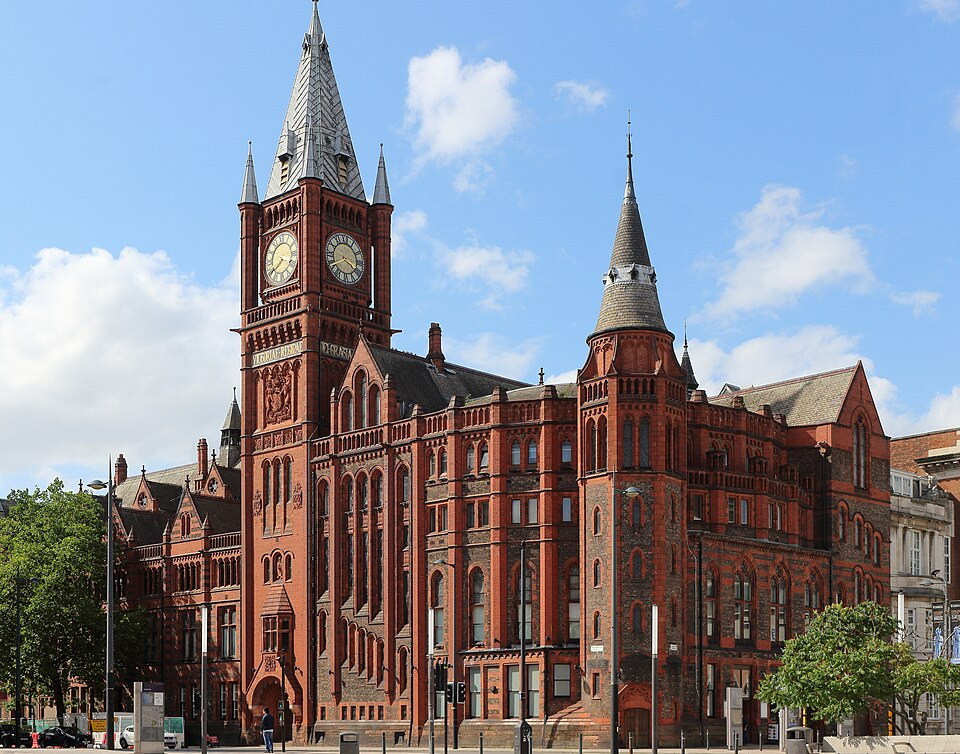
In Liverpool, which according to that vision we might call the Wild West, there was a small academic enclave, located in the middle of a large and prosperous city whose wealth was based on trade and industry. In this it was like the colleges and universities of Birmingham, Sheffield and Manchester, and indeed Glasgow too. In Glasgow a professor was in effect a civic dignitary; in England this was less so, but professors moved in the highest civic circles, and there was intermarriage with leading local families. The problematic aspect of this link with local wealth was that academic independence was fragile; but in the 1890s the dominant figure among the arts dons, John Macdonald Mackay, Professor of History, led a successful move to set up a faculty structure through which the University was run by academics rather than by wealthy sponsors
Thus life in the university was for academics a kind of colonial existence, an extension of their previous Oxbridge existence but increasingly with a character of its own. What character was that? In the 1890s and 1900s, Liverpool pioneered some new subjects – the first British chairs of Spanish and of Russian were founded there. In Classics, most striking is the expansion of archaeology. Local money was secured by John Garstang, Reader in Egyptian Archaeology, to found an Institute of Archaeology in 1904. Four chairs were established, including one in Classical Archaeology to which Reginald Bosanquet, previously director of the British School at Athens, was appointed. Archaeology even seems to have colonised the Greek chair, with the appointment of John Linton Myres in 1907 and then in 1910 the Assyriologist Carl Lehmann-Haupt. Bringing in James Frazer in 1908 clearly belonged to this overall pattern. In fact, only the Latin Chair escaped this archaeological expansion. Postgate is remembered in Liverpool as having been “small, grey, irascible, absorbed in his Latin texts.”[12] Perhaps his absorption was defensive, and his irascibility arose from a sense of being marginalised by the archaeological empire.
John E. B. Mayor, the massively learned editor of Juvenal, died in December 1910.[13] By then Postgate had an international reputation and had become the senior Cambridge Latinist. He had been in Liverpool for a year, but exits and returns were not unknown. Richard Jebb had gone to Glasgow in 1875 and returned in 1889 to the Regius Chair of Greek; he would have come back earlier had not the incumbent, Benjamin Kennedy, refused either to retire or to die – till 1889, when he was 84. Since academic pensions were not yet a reality, incumbents usually died in office similar as also happened with the Latin chair at Cambridge, which Mayor held until his death, aged 86. We might speculate that, in 1909, Postgate gave up waiting for him to die. But another factor has to be considered. Under Trinity College rules, College Lecturers became Life Fellows after 25 years in post, and Postgate reached that point in 1909. Hence a move to Liverpool was a safe bet, since he had the financial and other benefits of a Trinity Fellowship to fall back on while out of Cambridge and later during retirement.[14] When Jebb went to Glasgow in 1875, he held on to his Trinity Fellowship for a year – in effect, he bought a return ticket. Postgate, we might say, already had a season ticket when he moved to Liverpool in 1909.
Had Housman not applied for the Cambridge Latin Chair, Postgate would almost certainly have been elected. Speculation was rife, of course. It can be glimpsed in two letters to another candidate, T.R. Glover of St John’s College. The Master of his college, R. F. Scott, wrote to him on 1 January 1911, noting that Glover had applied for a post which he thought no one was going to take because Postgate and R.S. Conway were too comfortable in their current posts. The fearsome Irishman Sir William Ridgeway, Disney Professor of Archaeology, wrote on 7 January that year, saying that he was glad Glover was standing for the chair, and opining that Conway and Postgate would not apply for it; the chief rivals, he thought, were John Sandys, James Reid of Caius and possibly Housman. The reference to Conway and Postgate being “too comfortable in their current posts” at Manchester and Liverpool may refer to money. We do not know exactly what Postgate was earning at Liverpool, but in 1903, when the college became a university, professorial salaries were fixed at £500 a year, plus a third of student fees, with a minimum of £600 and a maximum of £1,000. Latin numbers were fairly small, so Postgate will probably have been at the lower end of the scale. The Cambridge Latin Chair carried a salary of £300 in 1907, the year in which Postgate was elected to the British Academy; this was raised to £800 (£600 if already a Head of House or Fellow) after Housman’s election.[15] If successful, Postgate would also have had the benefits of his Trinity fellowship.
The issue of salary is not one which is often mentioned in the historiography of scholarship: it should be. If one looks, for example, at the history of the Classical chairs in Scotland, it’s clear that the only one with several non-Scottish holders was the Glasgow Chair of Greek, occupied by Edmund Law Lushington 1838–75, Richard Jebb 1875–89, and Gilbert Murray 1889–99. It is no coincidence that this was the best-paid Classical chair in Scotland – Jebb reported an annual salary, mostly of fee income, of between £1,000 and £1,500. His successor, Gilbert Murray, saw this decline; and in the 1900s, Walter Headlam decided that the money was not enough to tempt him away from the fleshpots of King’s College, Cambridge.
The question of salary would have been of prime importance to Postgate, who lived in fear of poverty, removing coals and light bulbs from his children’s nursery to save on heat and light. A minor treat for them was to have butter spread on a slice of bread with a hole in it, in which the butter could accumulate; but if their father saw this, he grabbed the bread and dug the butter out. Postgate died in 1926, as we have seen, worth about £27,000 – far more than most Classical scholars of the era left behind them. We may compare two other Cambridge Classicists who died in the same year: the archaeologist Sir Charles Walston, formerly Charles Waldstein, who had a house in London and had married a rich widow, left £15,000; Sir William Ridgeway, the pugnacious Irishman best known for his work on the origin of the horse, left less than £8,000.
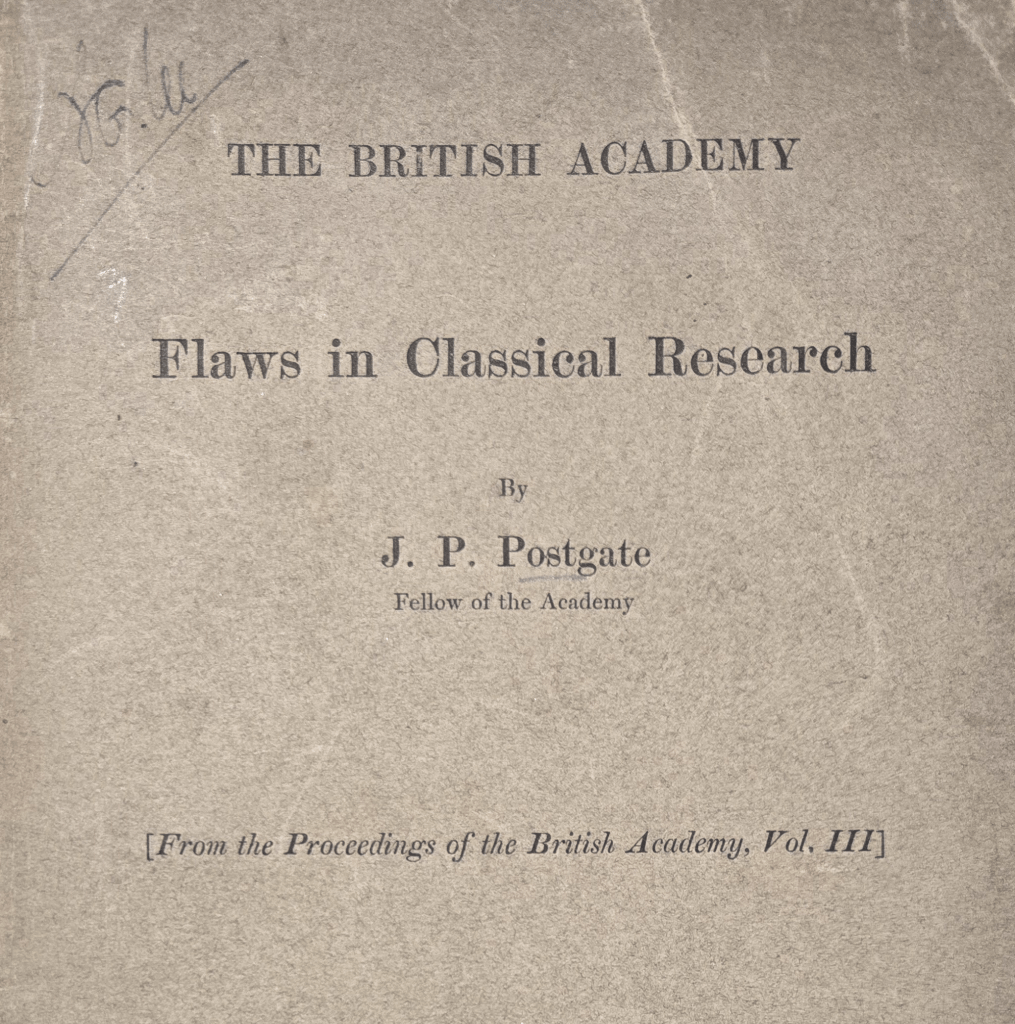
Postgate was a specialist in Latin poetry, indeed among the leading British scholars of the subject. This is what brought him increasingly into conflict with Housman on several occasions, first with disagreements about Propertius [16] The Victorian period, it is worth remembering, was dominated by Hellenism, and Virgil was widely seen as no more than an inferior imitator of Homer. The Latin Chairs at Oxford and Cambridge were founded only in 1854 and 1869 respectively, more than 300 years after their Greek counterparts. The growth of the academic study of Latin literature was to some extent a fairly recent phenomenon, one to which the careers of Postgate, Sonnenschein and Conway belonged.
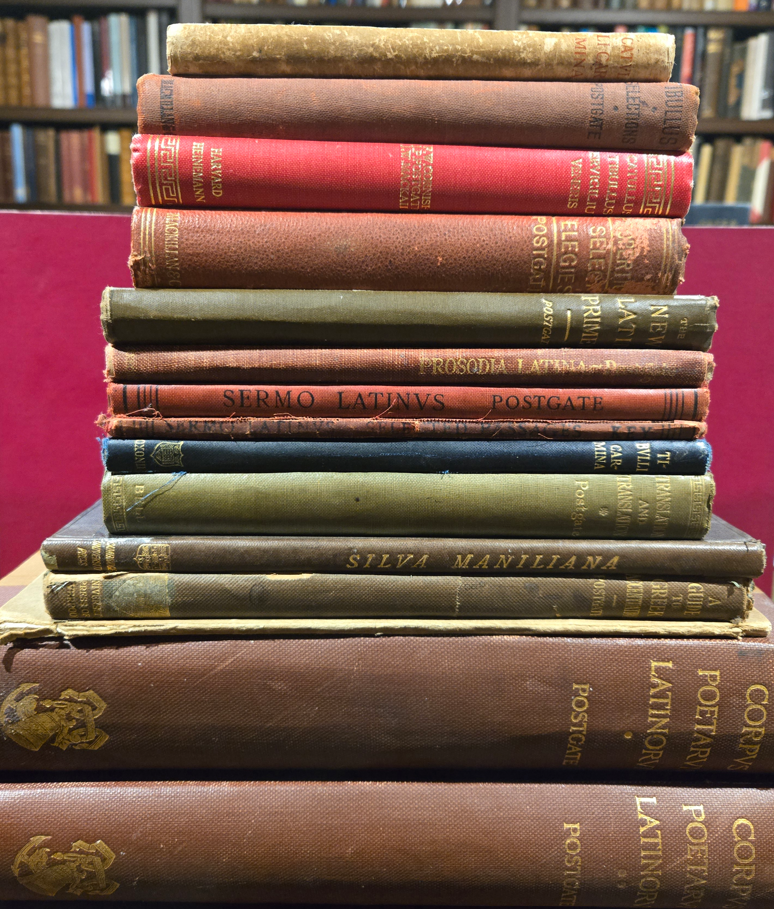
In this newly expanding field Postgate was a significant figure, and but for the rise of Housman’s star in the 1890s would have been its leader. Ironically, Postgate was initially a strong supporter of Housman, backing his application for membership of the Cambridge Philological Society and supporting his application for the Latin Chair at University College, London, in 1892. In this field, too, Postgate the organiser is evident: witness the two large volumes of the Corpus Poetarum Latinorum (1894–1905), for which he whipped a large team of contributors – including Housman. He himself chose to edit Catullus and Propertius, as well as Grattius and Columella Book 10 (these perhaps being a mopping-up operation). Alongside this editing activity runs a thread of exposition – composition, translation, accentuation and pronunciation.
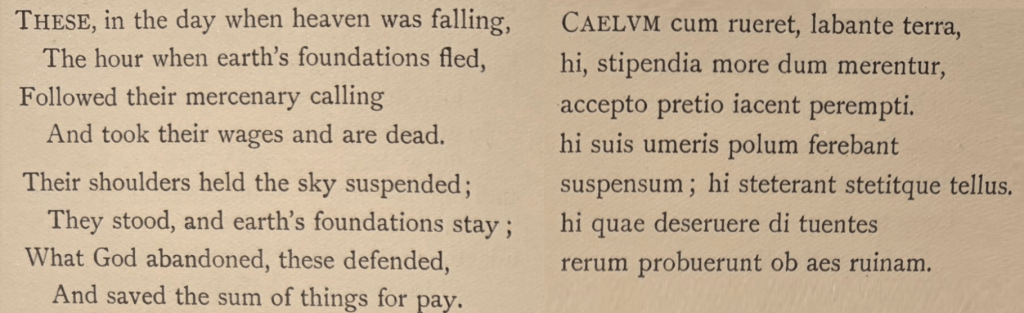
Postgate’s tenure in the Chair of Latin was apparently due to end in 1914, but he volunteered to continue, at a time when it would have been difficult to find a younger successor. He retired finally in 1920. In the intervening years we catch sight of him in the columns of The Times and the Times Literary Supplement. In 1916 he reported finding a verse from Ovid’s Epistulae ex Ponto (3.4.97) with a welcome omen – Perfida damnatas Germania proicit hastas (“Treacherous Germany casts down its accursed spears”). In 1917 he pointed out that the phrase ad tumuli fauces (used by Gilbert Wakefield in his translation of Gray’s Elegy) means the throat, not the jaws, of a hillock. In the same year he defended the English spelling of Virgil with an I rather than an E, as urged by the learned and eccentric Robinson Ellis – and in our own day by the learned and eccentric Harry Jocelyn, as well as Antigone. In 1918 he denounced the misuse of English in his best apocalyptic style:
Disintegration of languages, as of empires, is nothing new. We have the example of Rome. In the coming liquidation of the world two of our greatest assets will be our English literature, the greatest after the Greek that history can show, and our English speech: and these we must use our every effort to conserve. Towards this the editors of journals can do something… though I should hope for little good from the interventions of an editor who composes in the following style: ‘A real transparent block of accurate and animated perpetuation.’[17]
Postgate did apocalyptic well, but then he had had practice, beginning with the Fortnightly Review article of 1902 which led to the founding of the Classical Association.
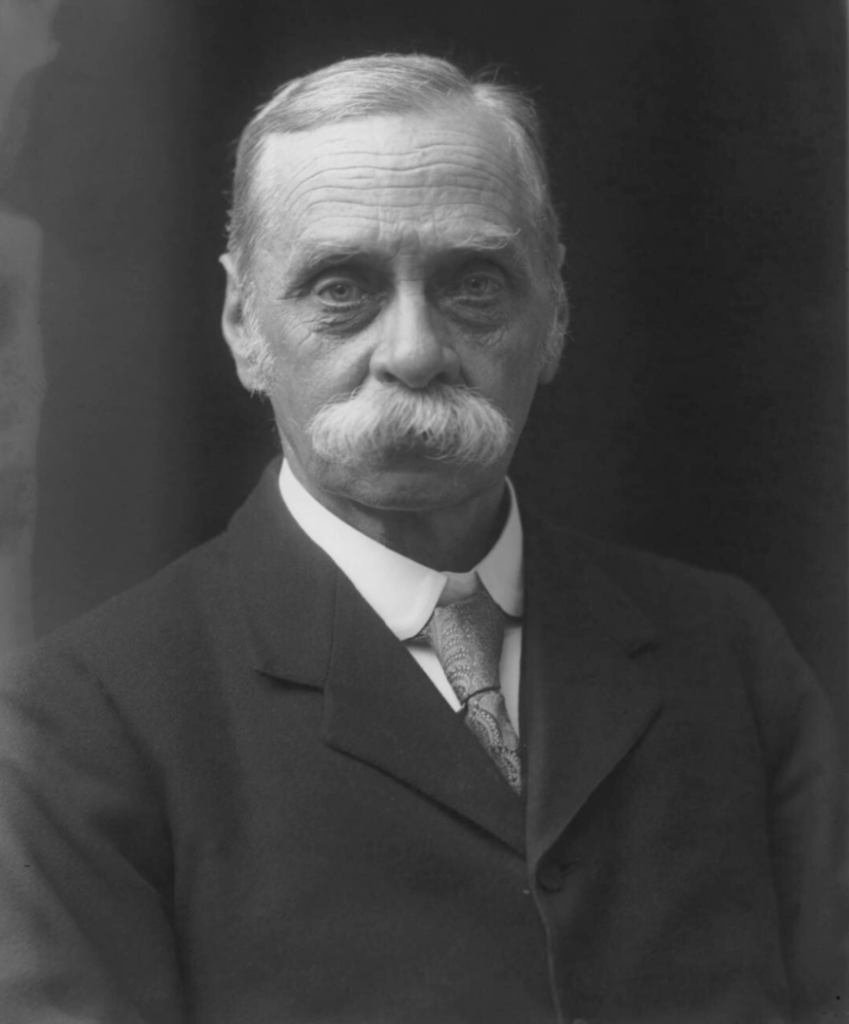
Postgate’s life and career belonged to the end of Victorian Hellenism and of the dominance of Classics in education. It also witnessed the emergence of the provincial or civic university sector alongside, if not yet rivalling, the two ancient universities. I have mentioned Liverpool’s pioneering foundation of chairs of Spanish and Russian – the term ‘redbrick university’ was coined by Allison Peers, appointed to the chair of Spanish in 1920.[18] In the same period, the large urban day schools challenged the dominance of the public schools, even on the home ground of Classics. Postgate, Sonnenschein and others were products of such schools. But if Postgate was a man of his time, and if much of his scholarly production is now little consulted, his campaigning and organising led to the revivifying or founding of bodies which survive and flourish: the Cambridge Philological Society and the Classical Association. He is, I believe, a man well worth remembering.

Christopher Stray works on the history of Classical scholarship, and is Honorary Research Fellow of the Department of History, Heritage and Classics at Swansea University, Wales. He is contributing to a new history of Trinity College, Cambridge, and editing a supplementary volume to the Cambridge Classical Journal on F.M. Cornford. He has previously written for Antigone about a remarkable pupil of A.E. Housman.

Notes
| ⇧1 | She gained a First in the Classical Tripos of 1914. At this point a BA degree could be obtained on the results of Part I alone, but as a woman she was ineligible. Margaret Cole’s autobiography, Growing up into Revolution, was published in 1949. |
|---|---|
| ⇧2 | C. Stray, Classics Transformed (Oxford UP, 1998) 225; J. Postgate, Lethal Lozenges and Tainted Tea: A Biography of John Postgate (1820-1881) (Brewin, Studley, 2000). |
| ⇧3 | J.P. Postgate, Dead Language and Dead Languages (1910) 8. |
| ⇧4 | Cambridge Review (10 Dec., 1879) 132. |
| ⇧5 | Cambridge Review (25 Feb. 1880) 57. This move probably reflects a decline in local membership. |
| ⇧6 | A Comparative Grammar of the Indo-European Languages (5 vols, London, 1888–95). |
| ⇧7 | The book was in fact largely written by Kennedy’s daughters Marion and Julia: see further C. Stray, “Primers, publishing and politics: the classical textbooks of Benjamin Hall Kennedy,” Papers of the Bibliographical Society of America 90.4 (1996) 451–74. |
| ⇧8 | See C. Stray, Grinders and Grammars: A Victorian Controversy (Textbook Colloquium, Reading, 1995). |
| ⇧9 | C. Stray (ed.), The Classical Association: The First Century, 1903-2003. Greece & Rome, supplementary volume (Oxford UP, 2003). |
| ⇧10 | See Stray, Classics Trensformed, 250. |
| ⇧11 | R.W. Postgate, “Portrait of a classical scholar,” The Listener 60 (1958) 378–9. |
| ⇧12 | T. Kelly, For the Advancement of Learning: The University of Liverpool (Liverpool University Press, 1981), 171. |
| ⇧13 | For more on Mayor, see the recent Antigone article by David Butterfield. |
| ⇧14 | The average dividend in 1914 was £360: see further R.R. Neild, Riches and Responsibility: The Financial History of Trinity College, Cambridge (Granta Cambridge, 2008) 111. |
| ⇧15 | Cambridge University Archives, CUR 39.31.30d. |
| ⇧16 | N. Hopkinson, “Housman and J.P. Postgate,” in D.J. Butterfield and C.A. Stray (edd.), A.E. Housman, Classical Scholar (Duckworth, London, 2009) 175–91. |
| ⇧17 | “The corruption of English,” Times Literary Supplement, 15 Aug. 1918. Thanks to Nicolas Bell for identifying this. |
| ⇧18 | Bruce Truscot (=Edgar Allison Peers), Redbrick University (Faber, London, 1943). |