Theodore Nash
<Inevitable spoiler warning!>
Christopher Nolan’s Odyssey does not declare itself post-apocalyptic until the very end. In the film’s greatest twist, perhaps unsurprising from the director of Oppenheimer, it is revealed that the Sack of Troy was such a violent breach of Zeus’ Law of xenia (hospitality) that it has dissolved the entire logic of civilisation. The Age of Bronze is doomed to end, and in future generations “songs will be all they have to remember those of us who wrote”.
The reference to Linear B in Nolan’s Odyssey is as unexpected as the repeated mentions of the “People from the Sea”. Their presence was indicated late in the press tour by Tom Holland (both of them, as it happens). Needless to say, there are no ‘Sea Peoples’ in the Homeric Odyssey. Nor is there any sense that the world is ending; or, in the framing of Nolan’s Odysseus-cum-Oppenheimer, that it already has. This strange, historically-inspired perspective is the heart of the film, and far more essential to Nolan’s interpretation of the poem than any of the tired culture war issues vainly pounced on by the online right.
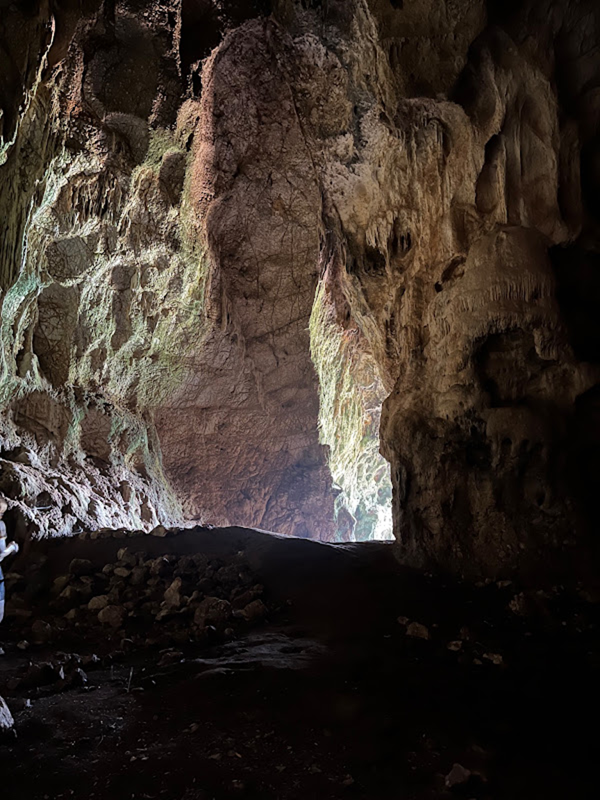
The Sea Peoples are not just alien to Homer; even their connection to Greece is tenuous. Their name itself is modern, coined (in French) by an Egyptologist to refer to various tribes who appear in a series of Egyptian texts from around 1200 BC. The most famous of these is an inscription from Medinet Habu, dating to the 8th year of Ramesses III (by some reckonings, 1177 BC – hence the title of Eric Cline’s excellent book on the end of the Bronze Age). There it is recorded that various regions, including Cyprus and Hittite Asia Minor, had fallen to a group of raiders composed of the Peleset, Tjekker, Shekelesh, Danuna, and Weshesh. Other accounts add another tribe, the Shardana. Ramesses and Egypt, however, repelled the invasions.
Both the obscurity of these peoples – not mentioned in any other contexts – and the odour of royal propaganda make tracing the truth behind these accounts difficult. In general, scholars have been able to do little more than guess at the identities of these tribes on linguistic grounds. But there is no undisputed consensus. Most confidently, the Peleset are probably the Philistines, while the Shekelesh and Shardana may be related to Sicily and Sardinia (although it may be more likely that they gave their names to those islands, rather than originating from them). And the Danuna, intriguingly, may correspond to the Danaans – one of the Homeric names for the Greeks.
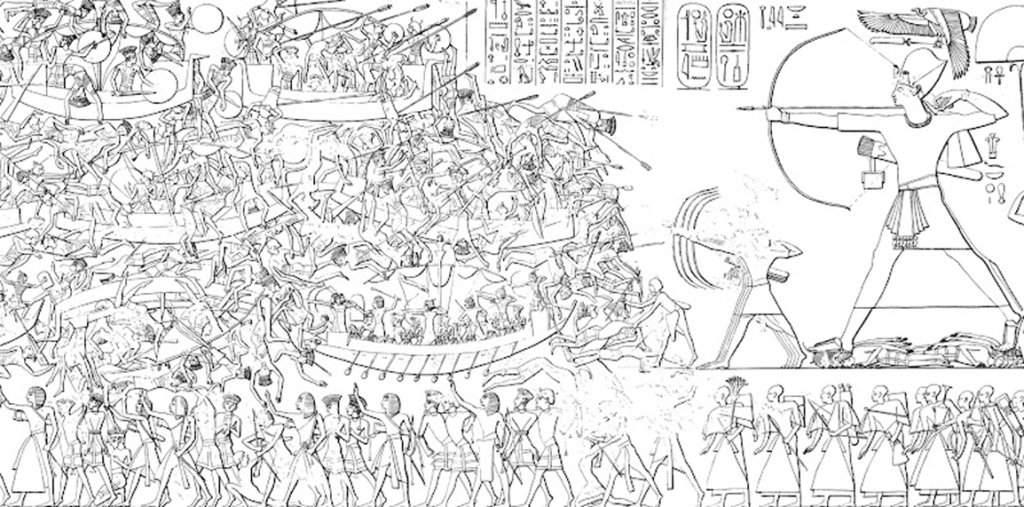
In historical scholarship, identifications of this kind are not treated with the highest confidence. That one word sounds like another is not always proof of anything: Latin habeo is unrelated to English have, even though they mean the same thing (the real cognate, by way of Grimm’s Law, is Latin capio). Artistic depictions are unhelpful, and the lack of other references to any of these tribes means locating them in space is particularly difficult.
Nevertheless, scholars have invented more and less elaborate theories about these peoples. Probably the leading interpretation today is that they are both a cause and effect of the destructions at the end of the Late Bronze Age. If the Danuna truly were Greek, the date of this inscription (~1177, depending on whom you ask) should place it after the destructions of the Mycenaean Palaces in Greece. In this reading, the Greeks among the Sea People were displaced, refugees or pirates. The difficulty here is that we must posit even earlier disturbances which caused the Danuna to become Sea Peoples: they do not serve as a one-size-fits-all explanation for the Bronze Age Collapse.
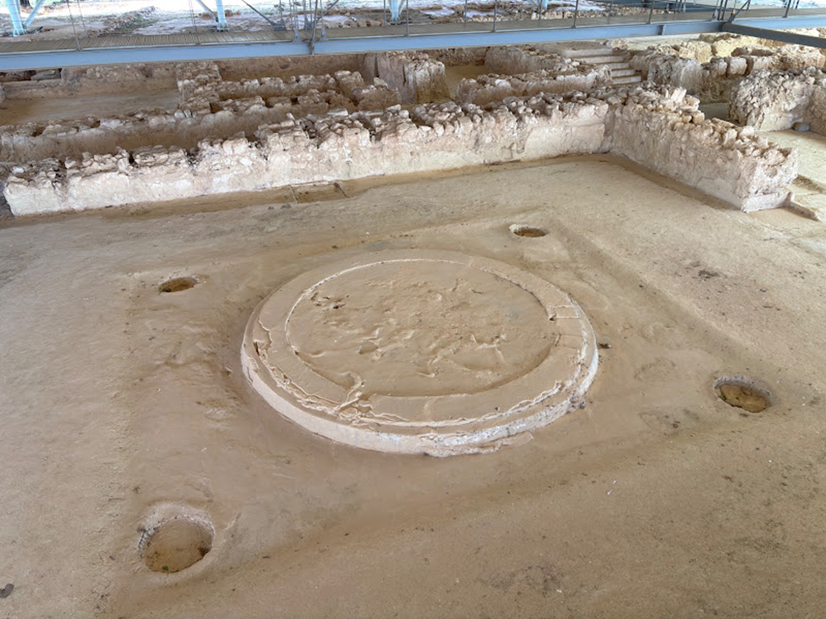
I don’t think that Nolan is playing with all of this, exactly. But there is a real ambiguity in the film about his Peoples from the Sea. On Ithaca and in Sparta they are a scary story and shadowy threat. And on their first stop from Troy, Odysseus and his men are mistaken for them by a village elder who memorably delivers his lines in Modern Greek.
In the film’s climax, however, it is revealed (or claimed?) that Greeks returning from Troy are the very Peoples from the Sea whom they now fear. The Sack of Troy, by means of a trick dressed as a gift, was such a breach of Zeus’ Law of hospitality (xenia) that the entire fabric of civilisation was beginning to unravel. Although the preoccupation with xenia throughout the film is generally accurate to the poem, this is not generally how the Sack is framed. In fact, in Aeschylus’ Agamemnon, it is Paris’ breach of xenia in absconding with Helen which justifies the Sack.

The idea that the Trojan War was an extinction-level event is not entirely alien to Greek thought, however. The beginning of the Iliad (1.5) states that “Zeus’ plan was fulfilled”. In the context of the Iliad itself, it is not exactly clear what this plan was. The usual interpretation is that it refers to the fulfilment of Zeus’ promise to Thetis to favour the Trojans in recompense for Agamemnon’s mistreatment of Achilles.
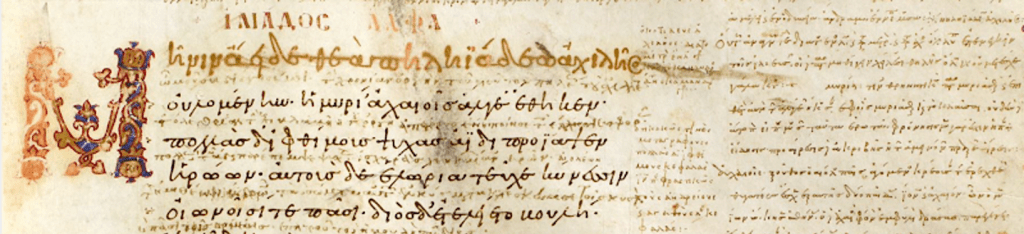
An alternative tradition, however, is preserved in the scholia (the scholarly commentary on the poem). Here, the plan of Zeus is connected with (according to the scholiast) a later tradition preserved in the Cyclic Cypria. This is the idea that the world was burdened by overpopulation, and the wars at Thebes and Troy were devised by Zeus to thin out the population and relieve that pressure. This information is given in one of the longer fragments of the Cypria, which repeats in the same language that “Zeus’ plan was fulfilled” (Διὸς δ᾽ ἐτελείετο βουλή). In this case, the poet refers explicitly to the death of heroes at Troy.
This makes Zeus a rather capricious force, ridding the earth of mortals as we may poison an inconvenient ant colony. The idea that the Trojan War was the end of something is likewise post-Homeric, coming this time from Hesiod. In the Works and Days, as he outlines the ages of men, it is the Age of Heroes, the “divine race of heroes, who are called demigods” (ἄνδρων ἡρώων θεῖον γένος, οἳ καλέονται | ἡμιθέων, 159–60), who die out at Troy. But they are better men than we, and more just (158); their deaths at Thebes and Troy are no condemnation.
So even if the Trojan War was the end of something, it was not the apocalypse. Although the Greeks knew that the Age of Heroes had come to an end, the early poetic traditions did not connect this explicitly with divine rage or retribution. The Greek poets, in general, were not generally aware of the Bronze Age collapse, even if they knew that an end came to the songs. After all, there are a few stories about Orestes, the son of Agamemnon; but none about his children.
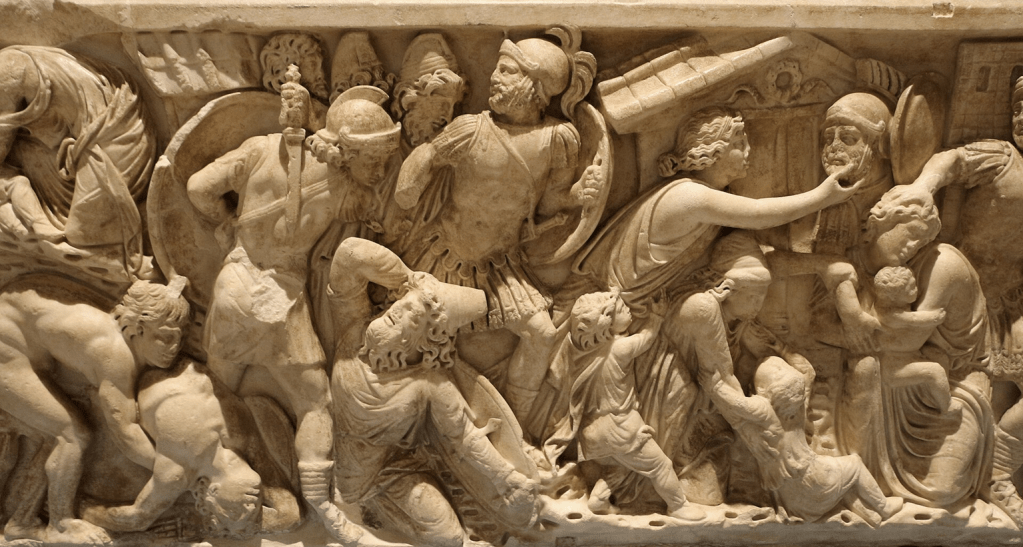
The idea of the Sack as an unholy excess is not unknown in Greek art or literature, however. This tradition is predominantly Athenian, sparked by the sack of Miletus — an old ally — in 494, and of Athens herself in 479 at the end of Xerxes’ punitive expedition. In vase paintings of this and the following period, the Sack is depicted not as triumph but excess, a series of hubristic actions undertaken by the over-zealous conquerors. Focus is placed on the killing of Astyanax, Hector’s infant son, and Priam himself, often through the shorthand of Neoptolemus, Achilles’ avenging spirit of a son, bludgeoning the grandfather to death with his grandson’s corpse. The rape of Cassandra by the lesser Ajax is frequently also depicted, beneath the dispassionate gaze of Athena’s cult statue.
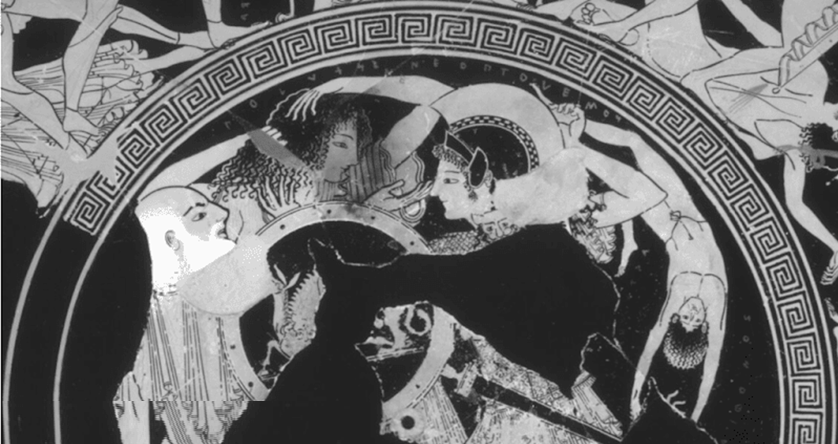
These scenes are given voice by Euripides in his Trojan Women (415 BC), where Athena articulates a view nearly consistent with Nolan’s interpretation. Outraged by Ajax’s rape of Cassandra, and the Greeks’ refusal to punish him, Athena turns on her former favourites and decrees a δύσνοστος (dusnostos), cursed homecoming (75). With the help of Zeus and Poseidon, she will see to it that the sea and sky rebel against the Greek ships, so that “the Greeks know to honour my temples, and revere the other gods” (85–6). Poseidon agrees: “a fool sacks the towns of men, their temples and tombs, the monuments of the dead; and in that ruin he himself is destroyed.”
Still the punishment here is essentially personal: Athena is punishing the Greek men on their return. Many of course do not make it home; others do not like what they find. But the punishment is not societal; she is not dooming an entire civilisation. That is all Nolan, and the most creative and invigorating idea that he introduces in his Odyssey. By marrying literary traditions of the Sack to the historical reality of the Bronze Age collapse, he creates something new which belongs a little bit to Classics, but more to his own fascination with the cost of our greatness: from the exiled hero of Inception, a Batman who cannot escape the mask, an Oppenheimer worried he has destroyed the world, to an Odysseus who already has.

Theodore Nash holds a PhD in Classical Archaeology from the University of Michigan. He has previously written for Antigone on the decipherment of Linear B and the history of Classical scholarship.
