Connor Livingston
There is quite a significant gap between ‘philosophy’ as spoken about by the ancients and how ‘philosophy’ is thought of today. Now, the word ‘philosophy’ often recalls old, dusty classrooms with erudite, bespectacled professors waxing esoterically about some obscurity or other.
Yet philosophy was never meant for the classroom. Its purpose was not lectures, so-called ‘Socratic’ discussions, exams, and essays. Philosophy, if it meant anything at all to the Ancient Greeks and Romans, was intended for the gymnasium, the city square, the chaotic home, the prison cell, the life in exile, and anywhere else a person needed fortifying for the difficulties of life. In other words, each person was supposed to keep philosophy with themselves everywhere; it was a shield against the fickle hand of fortune.
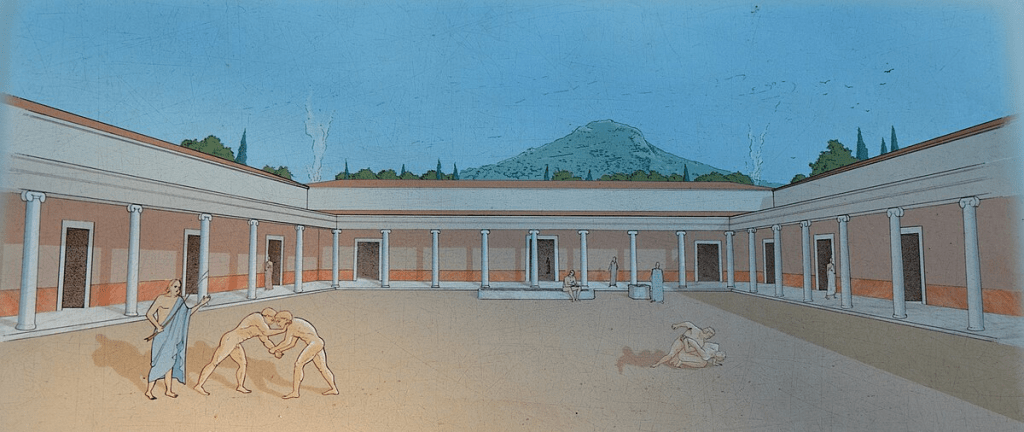
This original meaning of philosophy – as a deeply practical and meaningful way of life – has largely been lost, replaced by a bookish and sterile academic field of study. However, we can restore philosophy to its prior stature. To accomplish this , we must return to where philosophy first began. Philosophy’s much more fitting birthplace was in a wrestling gym, initiated by blows dealt between athletes.
Although there were certainly philosophers who predated Socrates – Pythagoras, Heraclitus, and Parmenides to name just a few – his emergence onto the Athenian scene in the 5th century BC marked a turning point in philosophy’s purpose, accessibility, and visibility. While Socrates himself wrote nothing down when alive, his most famous student, Plato, and Plato’s star pupil, Aristotle, wrote methodically, extensively, and transformatively.
Philosophy’s existence, as an intelligible intellectual tradition in the West, is largely due to the towering intellects and staggering outputs of these two men. Very few others have had such an outsized influence on the development of thought through the centuries. This led the British philosopher Alfred North Whitehead famously to describe the European philosophical tradition as ‘a series of footnotes to Plato’.”[1]

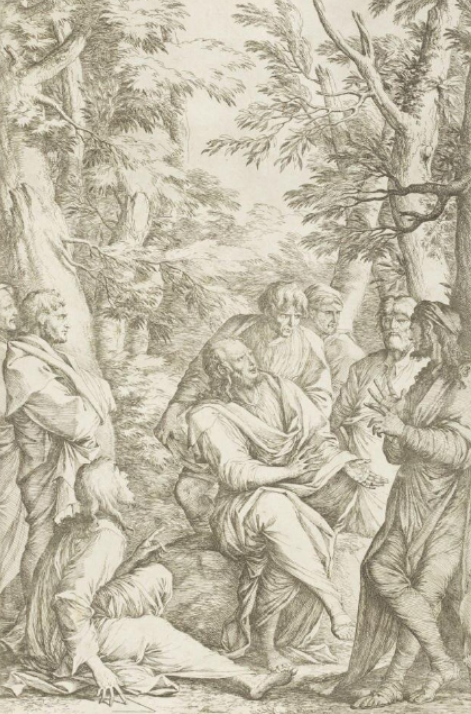
The influence of Plato and Aristotle is not only due to their writings, but also to the institutions of philosophy they created. Prominent philosophers, from Pythagoras to Socrates, had always generated a following but none forged a stable, multi-generational, institutional school. However, a decade or so following Socrates’ execution by the Athenian government in 399 BC, Plato established what would become the first philosophical school of its kind, a site of enduring education known as the Academy.
Where did Plato found this school? In a gymnasium just outside the city center of ancient Athens. This is why Whitehead wrote,
Even if you take a tiny oasis of peculiar excellence, the type of modern man who would have most chance of happiness in ancient Greece at its best period is probably (as now) an average professional heavy-weight boxer, and not an average Greek scholar from Oxford or Germany.[2]

Admiral James Stockdale – a 20th-century American military hero and modern Stoic – remembered Whitehead’s comments this way, “The philosopher Alfred North Whitehead, while teaching at Harvard, said that if Plato were to come to our country today, he would first ask to meet not a philosopher but a championship-class boxer.”[3]
These ancient gymnasia were enclosed outdoor spaces with wrestling grounds, running facilities, cold and hot baths, and a variety of other spaces intended for athletic development. As Whitehead and Stockdale knew, the home of the first philosophy school has more in common today with an elite UFC training facility than a modern university’s philosophy department. The ancient gym was a place of rigorous physical activity, and philosophy was not meant to detract from that rigor but add to it.
Furthermore, few today know that ‘Plato’ was not that great philosopher’s original name. According to the ancient biographer Diogenes Laertius, writing in the 3rd century AD, Plato was born as Aristocles (Ἀριστοκλῆς) but received the nickname ‘Plato’ (Πλάτων) from his wrestling coach because of his broad chest and shoulders.[4] The name derives from the Greek word platus (πλατύς), which means “broad” or “wide”.
So, to sum up:
1) The most influential philosopher in history got his famous name from his wrestling coach for being muscularly broad-shouldered.
2) When this philosopher/wrestler created the first institution of philosophy, he located it in, of all places, a gym.
Following Plato’s death in 347 BC, Aristotle – perhaps disappointed at not inheriting leadership of Plato’s Academy – travelled abroad (to Assus and Macedonia) before starting his own competing philosophical school, known as the Lyceum, in 335. Where did Aristotle set up philosophical camp? In another gym. So Greece’s two greatest philosophers located their schools for philosophical development in the premier spots for athletic advancement. Why? Because these ancient athletes knew that training the body and the mind were two related aspects of the same pursuit.

Philosophy, as conceived by the Greeks and later the Romans, asked the question, “How do I live the best life?” The various Greek philosophical schools – the Platonists, Aristotelians, Epicureans, Stoics, and beyond – all had their own idiosyncratic answer to this question, and they debated it ad nauseam. However, the question “How do I live the best life?” is simply a more profound development of the question, “How do I become the best wrestler?” In other words, the intellectual dialectic of conversation that philosophy ultimately becomes necessarily began as a physical dialectic of wrestlers and boxers.
When two people wrestle they are each moving their body in such a way that they hope to gain control over their opponent’s body and force them into a position of vulnerability which leads to victory for themselves and defeat for the opponent. Any movement is met with a quick response – immediate feedback, as it were – from the opponent. It is a complex game of small, precise combinations of movements and responses between challengers. Each piece of feedback is instant and visceral; moving the left arm just too far, or just not far enough, may swiftly produce an opponent’s painful counter.
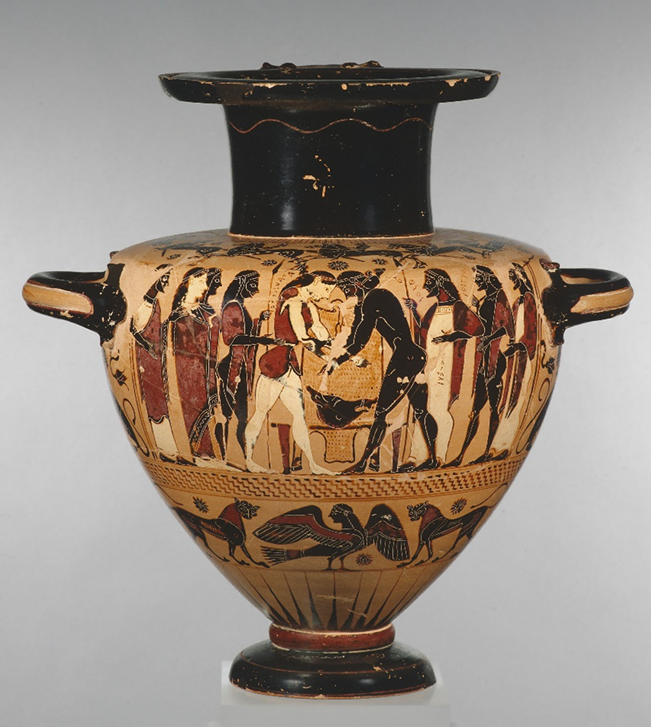
This is a physical dialectic – a dialogue of the body, made not with words but with actions. It is also a form of delimited competition: each sparring partner never wants to injure their partner, so that their wrestling matches can continue . When the wrestlers finish their round and take a break from the ring, their physical dialogue then becomes an actual dialogue. Like modern athletes analyzing the footage, they review their recent competition, ask one another about possible moves and counters, examine the outcome of the fight, and search for potential areas of improvement. This process of careful, goal-oriented action followed by deliberate analysis and reflection is the process of philosophy.
At first, the wrestlers may restrict this philosophical process to the wrestling grounds. But, after a while, they may realize that the same process they are using to become better wrestlers might also make them better warriors, better friends, better leaders and, ultimately, better human beings. The question that began simply with a wrestling move has now become the pursuit of the highest ideal: a happy, meaningful, and fulfilled life. This pursuit includes both mind and body in essential ways. We must act in the world with our bodies; we must deliberate about those actions in our minds. Socrates, Plato, and Aristotle all knew the importance of this, so their philosophizing very often took place in the gym. The Stoics, too, understood the essential connection between physical training and philosophy.

The Physicality of Stoicism
The prominent 1st-century AD Stoic Musonius Rufus “was always urging those who were associated with him to make practical application of his teachings, using some such arguments as the following. Virtue, he said, is not simply theoretical knowledge, but it is practical application as well.”[5] After referencing Musonius’ teachings, the renowned French Classicist Pierre Hadot commented:
These remarks by Musonius are precious because they show that the notion of philosophical exercises has its roots in the ideal of athleticism and in the habitual practice of physical culture typical of the gymnasia. Just as the athlete gave new strength and form to his body by means of repeated bodily exercises, so the philosopher developed his strength of soul by means of philosophical exercises and, thereby, transformed himself. This analogy was all the more clear because it was precisely in the gymnasium – the place where physical exercises were practised – that philosophy lessons were often given as well. Exercises of body and soul thus combined to shape the true person: free, strong, and independent.[6]
The art of philosophy – the art of living well – is the project of forging such a free, strong, and independent person. Musonius’ student Epictetus echoed his teacher’s sentiment in a lecture about how to endure challenges, teaching that a philosopher “brings as proof for each statement his own courage, his tranquility, his freedom, and next his body, healthy and strong.”[7]

For Epictetus, as with Musonius, the proof was in the pudding. In the Stoics’ eyes, a philosopher worthy of the name is someone who cultivates a strong mind and body; who thinks with intention and acts with vigor in the world; who knows the importance of intellectual contemplation coupled with practical application. They understood that if philosophy did not apply to the here and now – to the actual living of human life – it was not worth the name ‘philosophy’ at all. Epictetus repeated this message to his students frequently:
The builder does not come forward and say, “Listen to me deliver a discourse about the art of building”; but he takes a contract for a house, builds it, and thereby proves that he possesses the art. Do something of the same sort yourself too; eat as a man, drink as a man, adorn yourself, marry, get children, be active as a citizen; endure revilings, bear with an unreasonable brother, father, son, neighbour, fellow-traveller. Show us that you can do these things, for us to see that in all truth you have learned something of the philosophers.[8]
If you did not learn these things so as to show them by your action, what did you learn them for?[9]
But what is it to do philosophy? Does it not mean preparing yourself for the things that happen?[10]
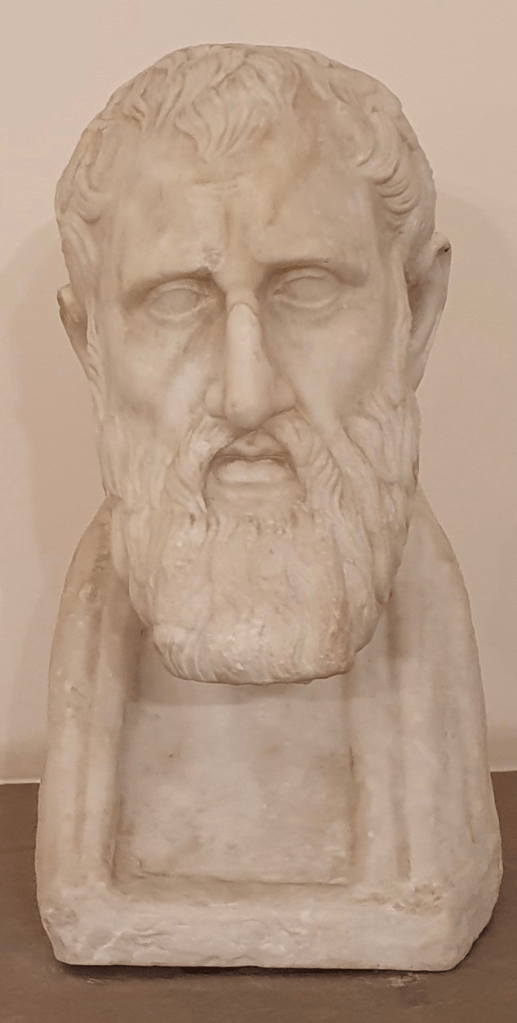
We think, we talk, we practise, we learn, and we train in order to live well. Epictetus saw no use for ideas, books or lectures that do not help us get to the actual business of living. For the Stoics, a philosopher does not merely think differently but, crucially, acts differently. He is prepared for uncertainty, strengthened by training, and fortified by philosophy. The Stoic is who you’d want alongside you in a foxhole: ready and able to face fear with courage and anxiety with tranquility.
None of this is to say that only combat athletes, bodybuilders or others of their ilk can live a happy, flourishing life. It is not to argue for some sort of rigid asceticism. It is simply to point out that the ‘philosophy’ practised today in schools would seem a foreign concept to the creators of the discipline themselves. By removing philosophy from Plato’s academic gym and Aristotle’s wrestling Lyceum, the truly practical purpose of philosophy has largely been forgotten and discarded.

Next time you are in the gym doing pull ups, out on a run, or even just walking (after all, Aristotle’s followers, known for philosophizing as they walked, were called the Peripatetics, from Greek περιπατέω (peripateō), “walk” or “wander”), remember that this is how philosophy began. Or, next time you are struggling with anxiety, with despair, or with any of life’s unforeseen challenges, perhaps intentionally return to philosophy’s birthplace with a workout, run, or walk.
Remember too that philosophy did not start with contemplation but action, not in books but in a wrestling ring. Just as training in the gym not only makes a person stronger but also more capable outside of it, so too is philosophy intended to fortify a person for all the chaos of life. As the Stoic Roman Emperor Marcus Aurelius reminds us, “Fight to remain the person philosophy wished to make you” (ἀγώνισαι, ἵνα τοιοῦτος συμμείνῃς, οἷόν σε ἠθέλησε ποιῆσαι φιλοσοφία).[11]

Connor Livingston holds a BA in Classics from Princeton University and an MA in Humanities from Ralston College. He teaches Ancient Greek and Latin, and writes and lectures on Stoic psychology.

Notes
| ⇧1 | A.N. Whitehead, Process and Reality: An Essay in Cosmology (Cambridge UP, 1929) 63. |
|---|---|
| ⇧2 | A.N. Whitehead, Science and the Modern World (Macmillan, New York, 1925) 286–7. |
| ⇧3 | James Stockdale, Thoughts of a Philosophical Fighter Pilot (Hoover Institution Press, Stanford, CA, 1995) 17. |
| ⇧4 | Diogenes Laertius, Lives of the Philosophers, 3.4. |
| ⇧5 | Musonius Rufus, That One Should Disdain Hardships, trans. Cora E. Lutz (Yale UP, New Haven, CT, 2020) 25. |
| ⇧6 | Pierre Hadot, What is Ancient Philosophy?, trans. Michael Chase (Harvard UP, Cambridge, MA, 2002) 189. |
| ⇧7 | Epictetus, Discourses, 1.24.8 (my translation). |
| ⇧8 | Discourses 3.21.5 (W.A. Oldfather’s translation). |
| ⇧9 | Discourses, 1.29.36 (my translation). |
| ⇧10 | Discourses, 3.10.6 (my translation). |
| ⇧11 | Marcus Aurelius, Meditations 6.30 (my translation). |