John Sellars
Socrates, we are told, was the son of Sophroniscus, a stonemason or marble worker (λιθουργός, lithourgos), and in his youth he may well have been apprenticed to his father.[1] Socrates was born in 469 BC; when he came of age Athens would have been in the full throng of repair and reconstruction after the Persian sacks of the city in 480 and 479 BC. Work finally started on the Parthenon, on the site of an older temple destroyed by the Persians, around 447 BC, when Socrates would have been in his early twenties.[2] It does not feel like too much of a leap to suggest that Socrates’ father and perhaps his young apprentice worked on the construction of the Parthenon. Indeed, a couple of sources claim that the statues of the Graces at the entrance of the Acropolis were made by Socrates.[3]

Did Socrates’ father have a workshop? If he did, where might it have been? The truth is that we have no way of knowing but it is tempting to speculate that it might have been on what is now known as the Street of the Marble Workers, running southwest from the Agora in the centre of Athens. The street is so named because archaeologists have found large quantities of marble chips in buildings along the street that are consistent with what one might expect to find in a sculptor’s workshop.[4] From this spot, both father and son would have had a fine view of the newly emerging Parthenon high above them on the Acropolis.

We have no idea whether Socrates’ early life took shape on the Street of the Marble Workers, but I like to think that it did because we do have evidence to suggest that this street was the scene for important events in his subsequent life.
At one end of the street, where it meets the Agora, we find the House of Simon. Archaeologists have named it such because in it they found the base of a pot with ΣΙΜΟΝΟΣ (Simon’s) scratched on it.[5] They also found, scattered over the floor, hobnails, suggesting that the building belonged to a shoemaker. Quite separate from these archaeological discoveries, Diogenes Laertius tells us that there once lived in ancient Athens a man known as Simon the Shoemaker. He writes:
Σίμων Ἀθηναῖος, σκυτοτόμος. οὗτος ἐρχομένου Σωκράτους ἐπὶ τὸ ἐργαστήριον καὶ διαλεγομένου τινά, ὧν ἐμνημόνευεν ὑποσημειώσεις ἐποιεῖτο· ὅθεν σκυτικοὺς αὐτοῦ τοὺς διαλόγους καλοῦσιν.
Simon was an Athenian and a shoemaker. When Socrates visited his workshop and conversed on any subject, Simon made notes of all he could remember, which is why they call his works the shoemaker’s dialogues.[6]
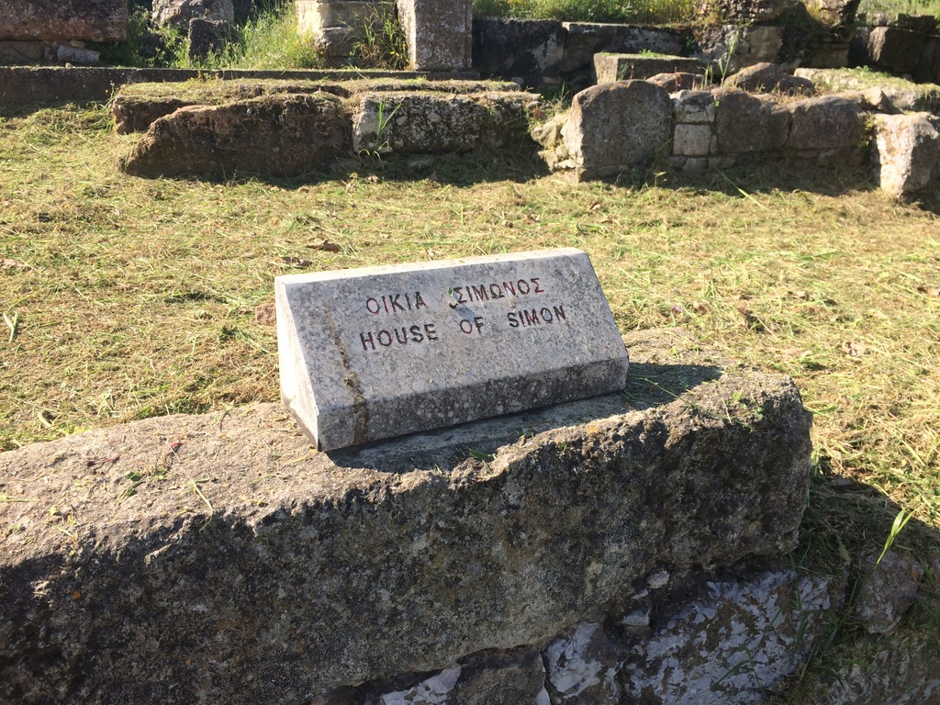

Diogenes goes on to say that Simon was the first person to write down Socratic conversations.[7] It was, then, in the House of Simon on the Street of the Marble Workers that the Socratic dialogue was first conceived. Socrates’ admirer Aeschines also wrote “shoemaker dialogues” and Phaedo, made famous by the Platonic dialogue named after him, wrote a dialogue called Simon.[8] It was also probably in Simon’s workshop that Socrates engaged in conversations with the youth of Athens. Xenophon reports that because adolescents were not allowed into the Agora itself, they tended to congregate in the surrounding streets and workshops, and this is where Socrates would meet them.[9] In other words, it was in workshops like Simon’s that Socrates was “corrupting the youth”, as his later trial charge would claim.
That trial took place in 399 BC not far away on the other side of the Agora, and the events of that day are dramatized by both Plato and Xenophon. As we all know, Socrates was found guilty of the twin charges of corrupting the youth and introducing new gods. After the trial Socrates was taken to the prison located – you guessed it – on the Street of the Marble Workers, just yards away from where he held the conversations with Simon and others that got him into trouble.

Socrates was held in prison there for a month before his execution. A ship was travelling to Delos, in honour of Theseus’ famous rescue of Athenian captives from the Minotaur in Crete. According to Athenian custom, executions were not permitted while the sacred ship was away, so they had to wait for its return. Plato’s dialogue Crito is set in the prison just before the ship arrived back.[10] In it, Crito desperately tries to persuade Socrates to escape before it is too late, but Socrates refuses. Eventually, the man met his fate by drinking the hemlock. Archaeologists have found small vials containing traces of the poison at the site of the prison, which can now be seen in the Agora Museum. This event is also dramatized by Plato, in the Phaedo. [11]
As we can see, the Street of the Marble Workers played an especially important part in Socrates’ life. Perhaps he played in the street here as a young boy, outside his father’s workshop, and perhaps he worked alongside his father, preparing blocks and sculptures for the Parthenon. That’s just romantic speculation on my part. Yet we are on slightly firmer ground to think that it was along this street in and around the workshops that Socrates discussed philosophy, perhaps inspired to compare human excellence or virtue (ἀρετή, aretē) to an art or craft (τέχνη, technē) by the presence of the craftsmen all around him. His attempt to define human excellence not with reference to good birth or physical strength, as was common in his time, but as a craft that can be developed and taught inaugurated the study of ethics as a discipline.

So, the Street of the Marble Workers: the place where Socrates lived and died, where he corrupted the youth, where the Socratic dialogue was born, and where ethics as a philosophical discipline first took shape. It looks fairly inconsequential today, if you can even find it in its neglected corner of the archaeological site of the Agora. But this is where the son of Sophroniscus the stone worker became the most iconic philosopher of all time.

John Sellars is Reader in the History of Philosophy at Royal Holloway, University of London, where he teaches ancient philosophy to students on both the Philosophy and Classics programmes. His upcoming book Stoicism is Not What You Think will be published by Penguin in October 2026. He has previously written for Antigone about the enduring legacy of the Stoics, what was Stoicism, and how to be an Aristotelian.
Further Reading
Mabel L. Lang, Socrates in the Agora (The American School of Classical Studies at Athens, Princeton, NJ, 1978): https://www.ascsa.edu.gr/publications/book/?i=9780876616178
Dorothy Burr Thompson, “The House of Simon the Shoemaker,” Archaeology 13.4 (1960) 234–40: http://www.jstor.org/stable/41663802
Homer A. Thompson & R.E. Wycherley, The Athenian Agora Vol. XIV: The Agora of Athens (The American School of Classical Studies at Athens, Princeton, NJ, 1972): https://www.ascsa.edu.gr/publications/books/open-access-books/athenian-agora-oa
John Sellars, “Simon the Shoemaker and the Problem of Socrates,” Classical Philology 98.3 (2003) 207–16, https://doi.org/10.1086/420717
Robert Sobak, “Sokrates among the Shoemakers,” Hesperia 84.4 (2015) 669–712: https://doi.org/10.2972/hesperia.84.4.0669

Notes
| ⇧1 | See Diogenes Laertius, Lives of the Philosophers 2.18, and also 2.20, where Diogenes reports that Crito rescued Socrates from the workshop where he was working. |
|---|---|
| ⇧2 | For an engaging account of the Persian invasion (reported in Herodotus 8.52–3) and the subsequent construction of the Parthenon, see David Stuttard, Parthenon: Power and Politics on the Acropolis (The British Museum Press, London, 2013). |
| ⇧3 | See Diogenes Laertius 2.19 and Pausanius 1.22.8. |
| ⇧4 | See Homer A. Thompson and R.E. Wycherley, The Athenian Agora Vol. XIV: The Agora of Athens (The American School of Classical Studies at Athens, Princeton, NJ, 1972) 187. This and other volumes in the same series are freely available online here. |
| ⇧5 | See Thompson and Wycherley (as n.4) 174. |
| ⇧6 | Diogenes Laertius 2.122. I quote the translation by Pamela Mensch (Oxford UP, 2018), slightly amended. |
| ⇧7 | Diogenes Laertius 2.123. |
| ⇧8 | See Diogenes Laertius 2.105. |
| ⇧9 | Xenophon, Memorabilia 4.2.1. |
| ⇧10 | Now available online in a fresh translation by David Horan here. |
| ⇧11 | Available online here. |