Eugenia Manolidou
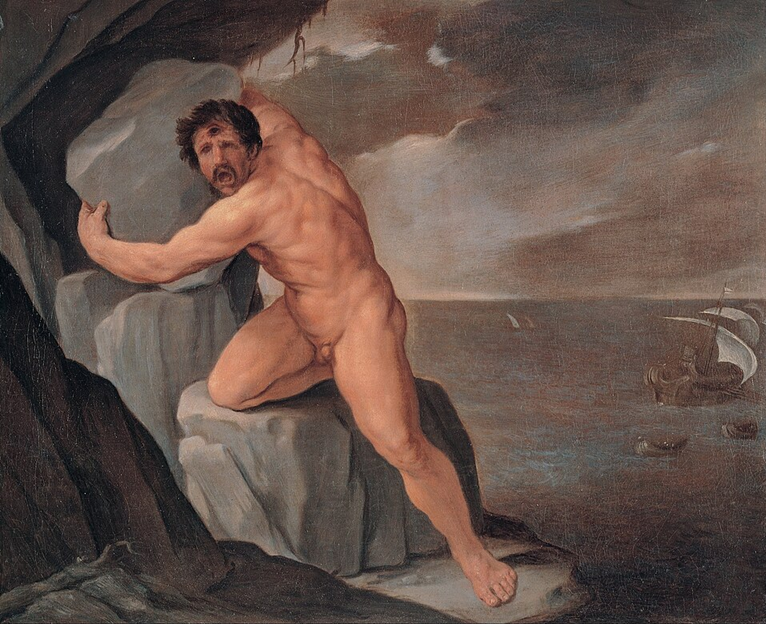
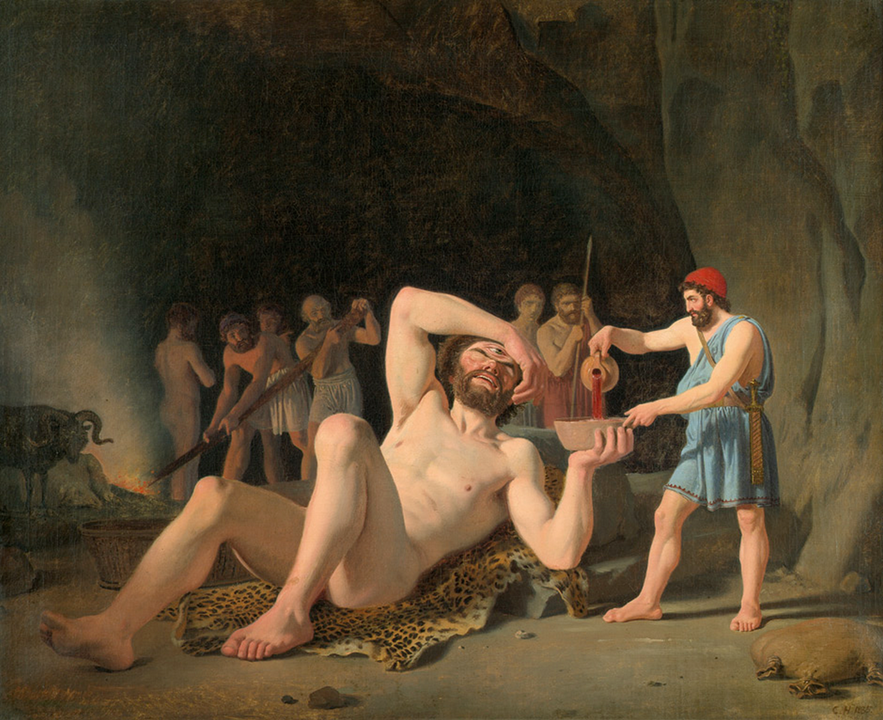
Everyone knows what a Cyclops looks like. From a child’s first encounter with Greek mythology to the most elaborate paintings and cinematic recreations, the creature is immediately recognisable by the single enormous eye set in the middle of his forehead. Polyphemus, the savage shepherd who traps Odysseus and his companions in his cave, has supplied that image with its most memorable story: intoxicated by Maron’s wine, overcome by sleep and pierced by a fire-hardened olive stake, he awakens to a darkness from which all the cunning of “Nobody” will soon escape. The Odyssey, Homer’s epic poem which made this monster immortal, gives us his size, his solitude, his immense strength and his brutal appetite with terrible precision. However, it also allows the feature that later generations would regard as his anatomical essence to emerge through the action itself, without pausing for a formal description of the single eye.
That reticence has occasionally encouraged a startling conclusion: perhaps Homer’s Polyphemus possessed two eyes, while the familiar monocular Cyclops arose through a later conflation of distinct mythical traditions. The suggestion has genuine ancient ancestry, and its long history deserves attention. The language of the episode leaves room for grammatical argument; the architecture of its story leads us, with remarkable firmness, towards the familiar one-eyed figure.
The Eye in Homer’s Story
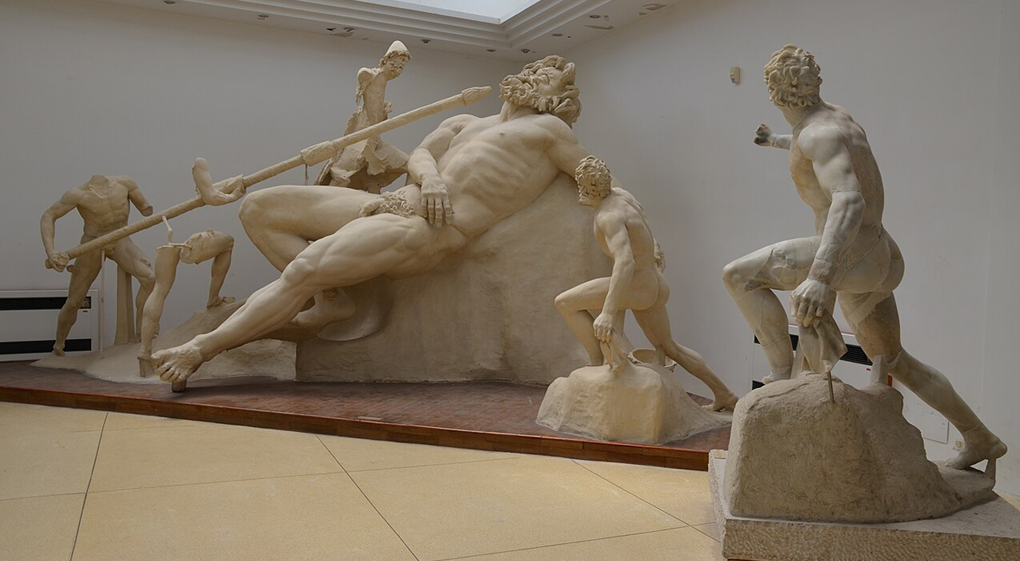
Polyphemus first appears long before Odysseus began his own account of the wanderings. When Athena explains Poseidon’s anger in Book 1, she identifies “the godlike Polyphemus, greatest in strength among all the Cyclopes”, whose eye Odysseus blinded: Κύκλωπος, ὃν ὀφθαλμοῦ ἀλάωσεν (1.69–70). The singular ὀφθαλμός then accompanies the blinding throughout Book 9. Odysseus and his chosen companions drive the stake “into his eye” (ὀφθαλμῷ ἐνέρεισαν, 9.383); they rotate it “in the eye” (ἐν ὀφθαλμῷ, 9.387); the eye hisses around the olive wood (9.394); and Polyphemus tears the stake “from his eye” (ὀφθαλμοῖο, 9.396). Later, Odysseus challenges him to tell any inquirer who inflicted the shameful blindness of his eye (ὀφθαλμοῦ… ἀλαωτύν, 9.502–4); Polyphemus then expresses confidence that his father Poseidon can heal him (9.519–21), only for Odysseus to reply scornfully that not even the Earth-shaker will heal that eye (9.525).
A singular noun provides no complete anatomical inventory: a speaker may refer to an injury to “the eye” of a person who possesses two, and Homer’s repeated singular could, in isolation, identify only the organ under attack. Its full weight comes from the sequence that follows, for once the stake has destroyed this eye, Polyphemus is wholly unable to see. At dawn he sits at the mouth of the cave and feels the backs of his rams as they pass, while Odysseus and his surviving men cling beneath their bellies; the logic of one of the most celebrated escapes in world literature depends upon the darkness produced by that single wound.
Even the famous trick of the name is often remembered less precisely than Homer tells it. When the neighbouring Cyclopes hear Polyphemus’ cries, they ask whether someone is killing him by force or treachery. His answer is Οὖτίς με κτείνει δόλῳ οὐδὲ βίηφιν (9.408): “Nobody is killing me by guile, and not by force.” The familiar modern paraphrase, “Nobody has blinded me”, belongs to the story’s afterlife; explicit reference to the blinding comes when Odysseus reveals his true identity from the departing ship. The difference matters, for it reminds us how easily a memorable retelling can replace the exact words of the poem.
Two Eyelids – And Two Eyebrows?
One verse, however, seems to look in another direction. As the heated stake turns in the wound, Homer describes the steam rising from the burning pupil:
πάντα δέ οἱ βλέφαρ’ ἀμφὶ καὶ ὀφρύας εὗσεν ἀϋτμή
“the hot vapour singed all around his eyelids and brows” (Odyssey 9.389)
Both βλέφαρα, “eyelids”, and ὀφρύας, “brows”, are plural. A single eye naturally has two lids, upper and lower, and βλέφαρα occurs only in the plural in Homer. The brows pose the sharper question. In his recent Cambridge commentary on Book 9, Egbert J. Bakker suggests that ὀφρύας may have been attracted into the plural number of βλέφαρα; he also observes that the eyebrow belonging to an eye already lost would hardly be scorched as intensely as the brow directly above the burning stake. The verse can sustain curiosity more readily than anatomical certainty.
Ancient readers were already troubled by it. A scholion (marginal comment) on 9.383 imagines a naturally two-eyed Cyclops who had lost one eye “through some accident” before the encounter with Odysseus; the proof offered is precisely the pair of eyebrows. A much fuller scholion attached to 9.106 preserves an even more remarkable discussion. Philoxenus is said to have thought that Hesiod had been misled: because the blinding of one eye left Polyphemus unable to see, the poet of the Theogony inferred that the Cyclopes were naturally one-eyed. The scholiast then proposes that Polyphemus had probably lost his other eye for some earlier and entirely different reason, before Odysseus reached the island.
The same scholion preserves the ancient reply. If Polyphemus had already lost one eye, why had Poseidon, whom he regarded as capable of healing the second, left the first untreated? Why does Odysseus speak simply of the shameful blindness “of your eye”? The discussion has the shape of a miniature seminar conducted across centuries: a textual difficulty, an ingenious reconstruction of events outside the poem, and an objection drawn from the poem’s own language. The hypothesis of an earlier accident remains possible in the narrowest sense, though it requires an unwritten episode whose sole purpose is to reconcile the plural “brows” with the complete blindness produced by a single wound.
When Grammar Counts Differently
Modern Greek offers a modest warning against turning grammatical number too quickly into anatomy. A Greek speaker who has spent the night awake may say Μάτι δεν έκλεισα όλο το βράδυ – literally, “I did not close an eye all night.” Every listener understands that sleep, which closes both eyes, never came. An equally familiar proverb says Κόρακας κοράκου μάτι δεν βγάζει, “One crow does not peck out another crow’s eye,” using the singular for creatures naturally equipped with two. Its earlier Byzantine form employs the plural – Κόραξ κόρακος ὀφθαλμοὺς οὐκ ἐκβάλλει, “A crow does not put out another crow’s eyes” – while preserving exactly the same proverbial thought.
Their value lies in the durable linguistic principle they illustrate, since paired parts of the body often acquire generic, collective or idiomatic expression, and their grammatical number need not count the organs before us. English speakers “keep an eye” on someone with their ordinary binocular vision. The Homeric singular ὀφθαλμός accordingly gains its persuasive force from the action surrounding it, while the plural ὀφρύας offers only a slender foundation for reconstructing an otherwise unknown injury in Polyphemus’ past.
Hesiod’s Unequivocal Cyclopes
Hesiod supplies the anatomical description that Homer withholds. The three Cyclopes of the Theogony – Brontes, Steropes and Arges, the divine craftsmen who give Zeus his thunder and fashion the thunderbolt – resemble the gods in all respects except one:
μοῦνος δ’ ὀφθαλμὸς μέσσῳ ἐνέκειτο μετώπῳ
“a single eye was set in the middle of their foreheads” (Theogony 143)
Hesiod then connects their name with the κυκλοτερὴς ὀφθαλμός, the round or circular eye set in the middle of their forehead (144–5). Alongside these divine craftsmen stand the isolated shepherds of the Odyssey and still other Cyclopes, including the builders associated with the monumental walls of Mycenae and Tiryns; the shared name gathers figures of different origins and bodies into one capacious mythical family. Hesiod’s verses show that the one-eyed Cyclops already belongs to archaic Greek poetry itself.
The name remains tantalising. Κύκλωψ (Kuklōps) readily invites analysis as κύκλος (kuklos) and ὤψ (ōps), “circle-eye” or “round-eye”, although roundness leaves the number unspecified; as Stephanie West observes, one might expect the defining name of a one-eyed creature to mean “one-eyed”. She raises the possibility that the apparently transparent Greek formation represents a popular etymology imposed on a non-Greek word. Other explanations have connected the creature with the wheel of the sun or interpreted the name along entirely different Indo-European lines. The uncertainty usefully reminds us that an ancient etymology may preserve a powerful interpretation while leaving a word’s historical birth beyond recovery.
By the later 5th century BC, Euripides could call the Cyclopes μονῶπες (monōpes), “single-eyed”, in the opening lines of his satyr play Cyclops. Monophthalmia was therefore firmly embedded in the Greek literary reception of the Homeric adventure, even as the precise relationship among Homer’s shepherds, Hesiod’s craftsmen and the wall-building giants remained fluid.
The Many Eyes of Ancient Art
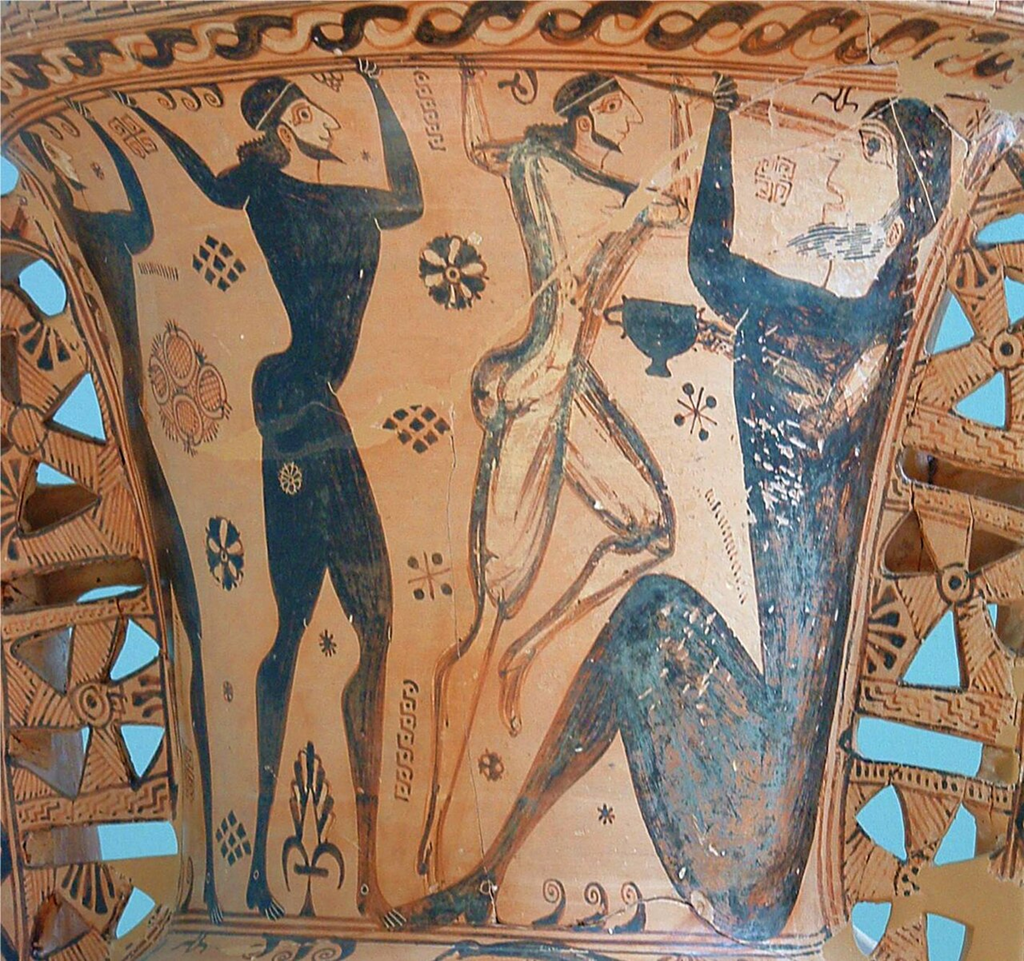
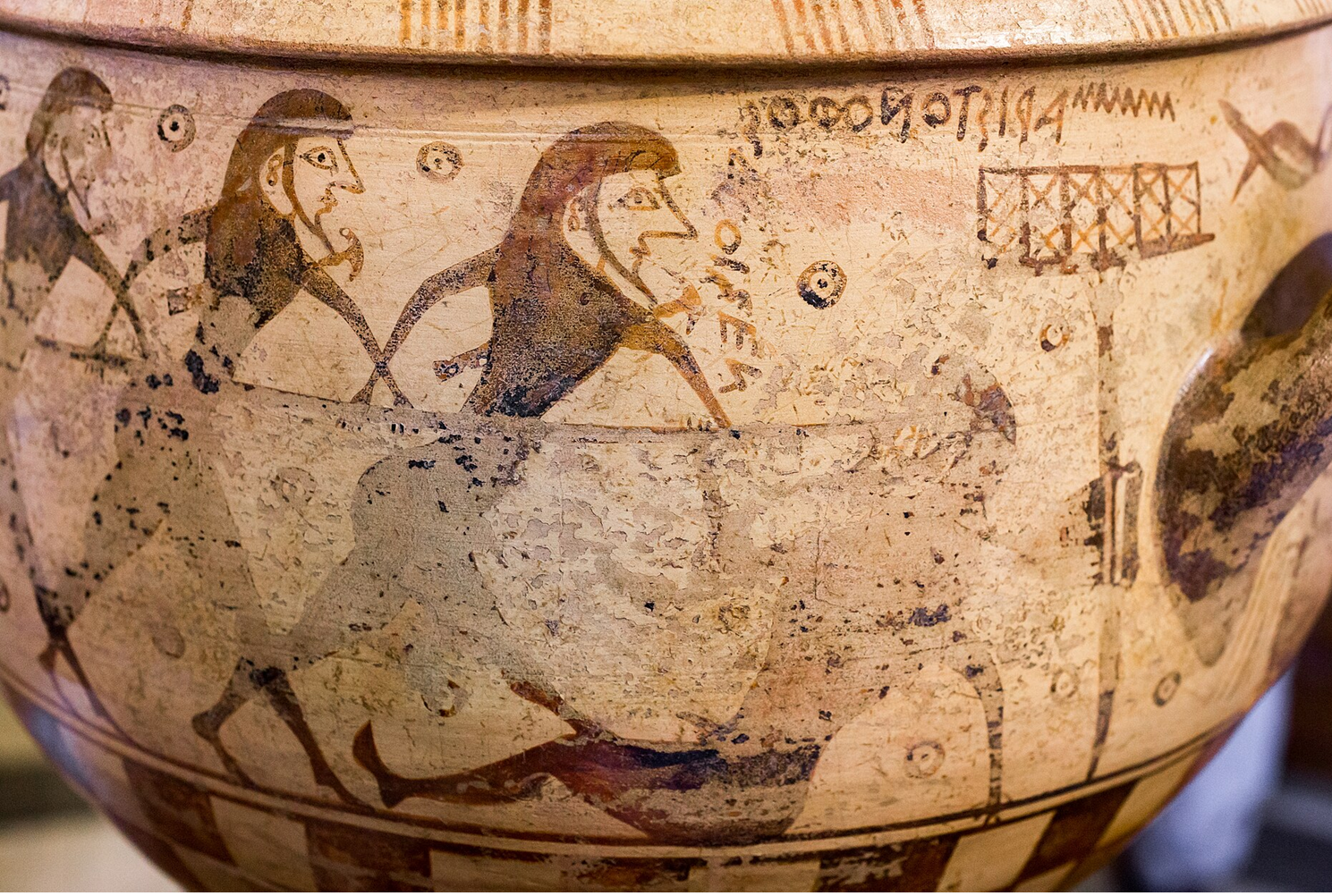
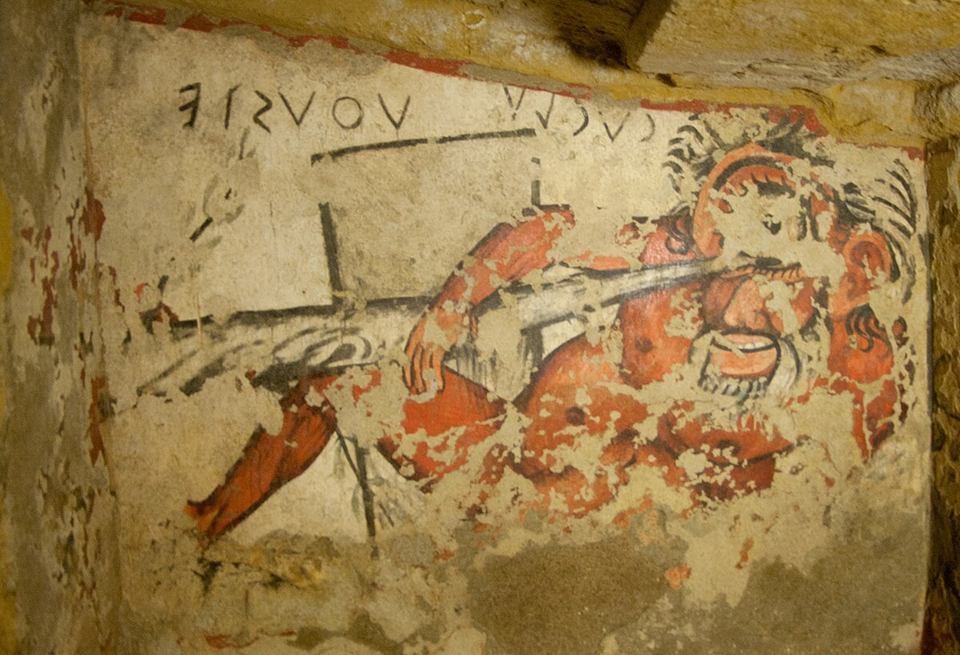
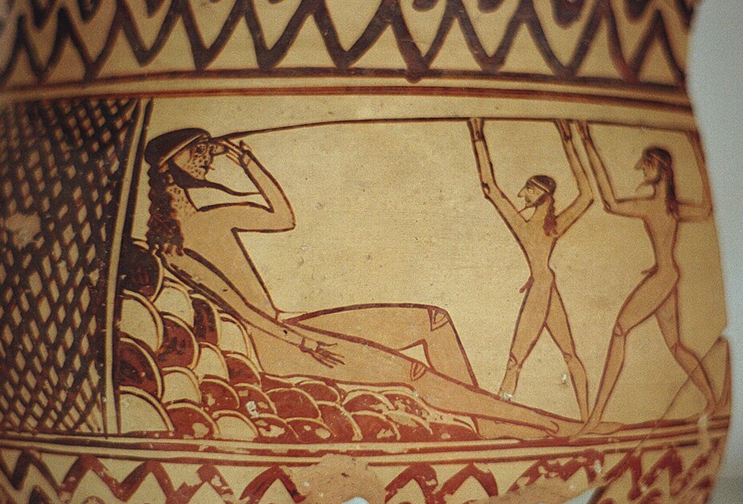
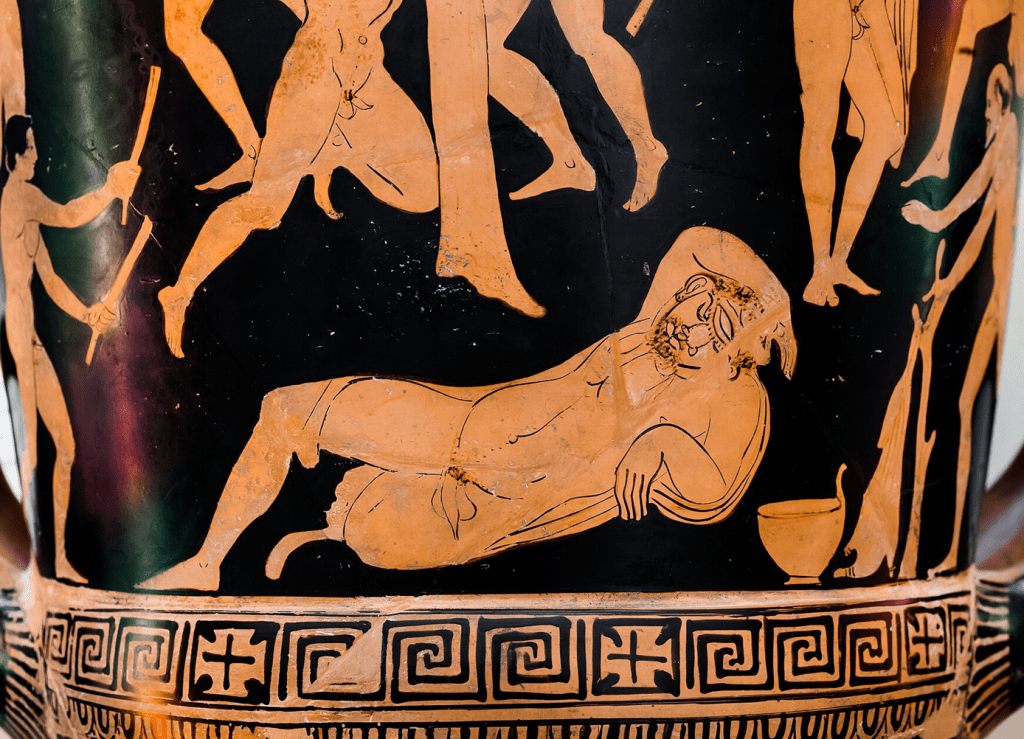
Ancient artists make that fluidity visible. The blinding of Polyphemus appears on the great Proto-Attic amphora from Eleusis, on an early Argive krater fragment, on the krater signed by Aristonothos and on a small but varied company of later vessels. Their Polyphemus may possess one, two or even three eyes. Amy C. Smith’s study of these images shows how strongly the chosen medium and composition shaped the monster’s anatomy. A painter presenting Polyphemus in profile could show a conventional lateral eye, thereby suggesting a matching eye on the hidden side of the face; another could aim the stake towards the forehead; the Lucanian Cyclops Painter, working in three-quarter view, gave the reclining giant two ordinary eyes and the central eye required by the impending action.
Such pictures belong to the history of the myth, shaped by oral narratives, poetic versions, established visual conventions and the practical demands of the surface before the painter. The variety of their solutions records a fluid iconography and counsels caution when a profile eye on an archaic vessel is invoked as decisive evidence for the body imagined by the poet of the Odyssey. Literary and visual traditions meet, separate and reshape one another; their differences reveal the creative life of the myth across centuries and media.
Homer’s Answer
How many eyes, then, did Homer’s Cyclops have? The poem leaves the anatomy to be inferred from the unfolding action, and ancient readers were perceptive enough to explore the small opening created by the absence of explicit description. Their proposal of an earlier accident deserves to be remembered, since it shows how closely they examined the same plurals and singulars that continue to provoke discussion. Its price is an intricate prehistory – a lost eye, an earlier calamity and a failure of divine healing – whose traces have vanished entirely from the narrative.
The episode achieves complete coherence when Polyphemus possesses a single eye. Its destruction brings total darkness; darkness makes the escape beneath the sheep possible; and the name “Nobody” prevents the blinded giant’s neighbours from entering the cave before Odysseus’ plan is complete. Homer allows the body of Polyphemus to become visible through consequence, movement and touch, trusting an audience for whom the one-eyed ogre may already have been familiar. His Cyclops emerges from the poem as he emerges from the cave: immense, wounded, groping towards the sound of a departing voice – and unable to see.

Eugenia Manolidou is the Director of Elliniki Agogi, an educational institution in Athens devoted to the teaching of Ancient Greek, Greek history and philosophy through active and experiential methods. She studied composition and orchestral conducting at The Juilliard School and is currently reading Classics at the Open University. She has written books and developed Classical Greek courses for the children’s programmes of Elliniki Agogi and is actively involved in the growing international movement to promote active and experiential approaches to the teaching of Ancient Greek and Latin. Her work brings together language, music and performance, with particular emphasis on making the Classical world accessible to younger audiences.
Further Reading
The crucial passages in Homer’s Odyssey can be found at 1.68–73 and 9.382–525. The Greek text is drawn from T. W. Allen’s Oxford Classical Text (Homeri Opera, vols. 3-4, Oxford UP, 1917–19). See also Hesiod, Theogony 139–46 and Euripides, Cyclops 20–2. Translations in this article are my own.
Wilhelm Dindorf (ed.), Scholia Graeca in Homeri Odysseam ex codicibus aucta et emendata, vol. 1 (Oxford UP, 1855), scholia ad Odyssey 9.106 and 9.383.
Egbert J. Bakker (ed.), Homer: Odyssey Book IX (Cambridge UP, 2025), notes on 9.389 and 9.503.
Stephanie West, “Odysseus’ most memorable exploit,” Classica Cracoviensia 16 (2013) 189–206, especially 200–1.
Amy C. Smith, “‘Homeric’ art in Ancient Greece: the case of Polyphemos,” Bath Royal Literary and Scientific Institution 27, June 2005.
Robert Mondi, “The Homeric Cyclopes: folktale, tradition, and theme,” Transactions of the American Philological Association 113 (1983) 17–38.
The modern proverb Kórakas korákou máti den vgázei is documented in the Archive of Proverbs and Traditions of the Hellenic Folklore Research Centre, Academy of Athens; for the Byzantine plural form, see Carlos Alberto Crida Álvarez, El mínimo paremiológico griego con correspondencias en español (Centro Virtual Cervantes, Madrid, 2021).
