Karol Wapniarski
François Rabelais (1483/94–1553), “the creator of French literature” as Chateaubriand calls him in his Mémoires d’outre-tombe,[1] was also a distinguished Classicist, thoroughly read in both Classical Latin and Ancient Greek literature. Alongside multiple Greek passages that fill his Gargantua and Pantagruel cycle, his oeuvre includes several translations from Greek, and one independent poetic composition in Greek – a short epigram, which is one of the earliest pieces of Greek composition to survive from Early-Modern France. It is one of Rabelais’ few poems: apart from this, his poetic output includes only two Latin pieces, and a handful of French ones.[2] In what follows, we present an English translation of this piece alongside its original Greek text, together with a short philological commentary.

Before turning to the poem itself in more detail, we should expand on how serious Rabelais was about his Ancient Greek studies. The interest in Greek came to him while he was a member of the Franciscan order of friars at Fontenay-le-Comte, in the province of Poitou in Western France. There he studied Greek language and literature while forming relationships with a burgeoning circle of Classical scholars and humanists. He is said to have translated into Latin (or possibly into French – the translations have not survived) the first book of Herodotus’ Histories, alongside various works by Lucian, most probably Icaromenippus and Hermotimus, both of which are written in a satirical manner that seems to be echoed in Rabelais’ later vernacular works. Through these, he gained a reputation as an outstanding Hellenist.
That was not, however, the end of Rabelais’ direct scholarly involvement with ancient literature. Later in life, he contributed to editing the Aphorisms of Hippocrates, alongside some works by Galen. Moreover, in the 21st chapter of the Quart Livre, written shortly before his death, some passages appear to have been heavily influenced by verses from the Planudean Anthology, a collection of Greek epigrams compiled by the Byzantine grammarian Maximus Planudes; its first European edition appeared in Florence in 1494, and its first French edition in 1531. Although there is some debate as to which exact edition of the Anthology of Planudes Rabelais used, evidence suggests that it was the 1549 Basel edition, with annotations and commentary by Jean Brodeau. This, combined with the fact that the final version of Quart Livre was issued in 1552, suggests that Rabelais kept abreast of recent work in Ancient Greek scholarship up until the very end of his life.
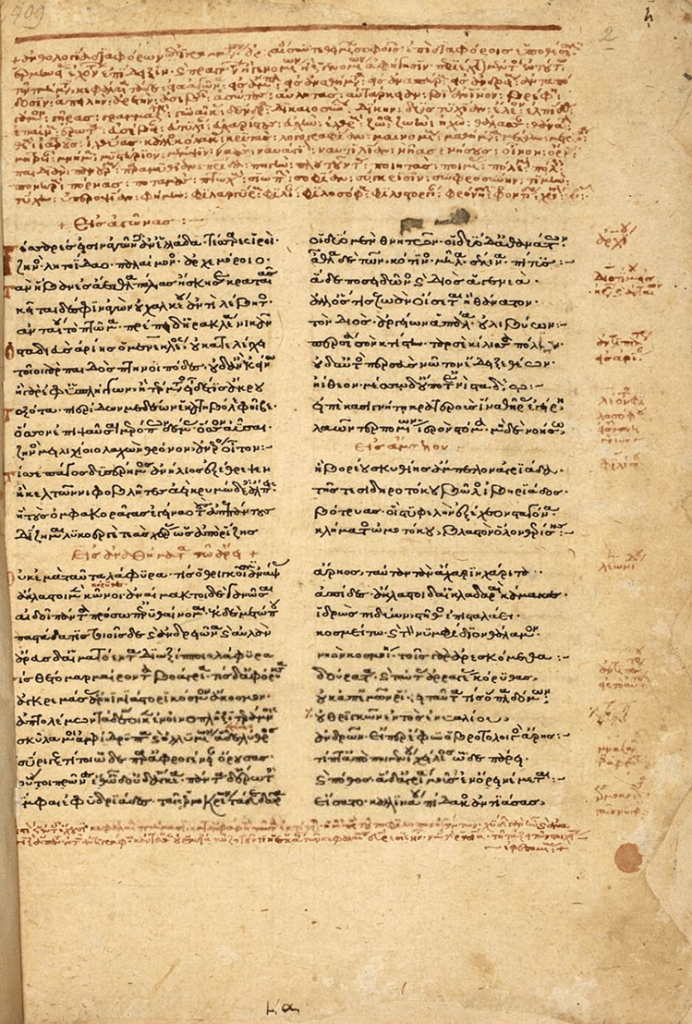
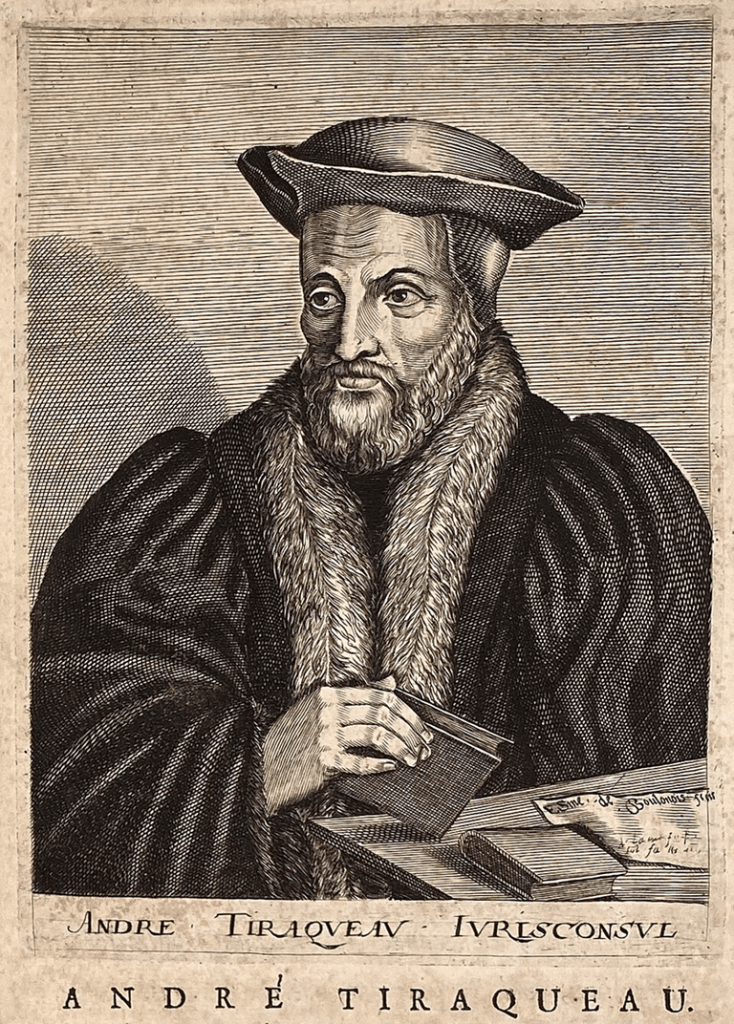
The Greek epigram we are concerned with appears as a dedication in the third edition of De Legibus Connubialibus, a treatise on marital law and women’s legal capacity that was written by André Tiraqueau and first published in 1513. Tiraqueau was a French humanist and jurist based in Poitou, and a patron and close acquaintance of Rabelais while the latter was studying there. In substance, the epigram praises Tiraqueau’s book, and refers directly to its contents while drawing heavily on ancient culture.
The poem was composed in 1524, when Rabelais, most likely in his twenties,[3] was studying Greek literature as a Franciscan friar. It was also at this time that a circle of Greek-oriented humanists formed around Tiraqueau. As we will see, the composition of the epigram was closely related to this circle and its Hellenist sympathies.
The poem itself is composed of elegant elegiac couplets; its lexical choices demonstrate Rabelais’ taste for Ionic and epic forms (ἔῃ, ἡμέας, ἠδέ, συζυγίην). As an occasional and short work, it is by no means an outstanding literary work in its own right; rather, it serves as an important witness, not only to an increasing interest in Greek language and literature in French literary culture, but also to Rabelais’ own literary pursuits and ambitions. Moreover, these two themes seem interconnected, for the choice of Greek over Latin was made by Rabelais at a time when the position of Greek in France was still precarious; efforts to strengthen it, by humanists including Rabelais himself, met with resistance from ecclesiastical authorities.
In 1523, a year before the epigram’s composition, the Parisian Sorbonne, in reaction to Erasmus of Rotterdam’s annotations to the Greek text of the Gospels, officially banned the study of Greek, on the grounds that it would lead to self-directed and unauthorised interpretations of the New Testament. As a consequence, Greek works were confiscated from Rabelais, as well as from other well-known humanists of the time, such as Pierre Lamy and Guillaume Budé. Against this background, the question of why Rabelais chose to compose this in Greek – which was by no means an obvious choice – can be given a tentative answer: the epigram is at once a gesture that emphasises Rabelais’ membership in the humanist circles at Fontenay-le-Comte, as well as an affirmation of autonomy from the ecclesiastical establishment that Rabelais would later mock so vividly in his vernacular writings.

Φραγκίσκου τοῦ Ῥαβελαίσου
Βίβλον ἐν οἴκοισιν τήνδ’ Ἠλυσίοισιν ἰδόντες
Ἄμμιγα τὴν ἄνδρες θηλυτέραι τέ φάσαν·
Οἷσι νόμοις ὅδ’ ἑοὺς Ἀνδρέας[4] τήν γε διδάσκει
Συζυγίην Γαλάτας ἠδὲ γάμοιο κλέος,
Τοὺς ἐδίδαξε Πλάτων ἄν γ’ ἡμέας· εἰν ἀνθρώποις
Κεδνότερος τίς κ’ ἄν τοῦ γε Πλάτωνος ἔῃ.[5]
François Rabelais
As in Elysian fields the book was read,
The men and women there with one voice said:
“The marriage laws by which André makes plain,
To fellow Frenchmen, wedlock’s glorious reign,
Plato himself could teach us in our age –
And who, of mortals, is a surer sage?”[6]
There is one point worth raising about the poem’s canonical French translation, and the interpretations to which it has given rise, especially as it has had a considerable afterlife in scholarly literature. In the Pléiade edition of Rabelais’ Œuvres complètes (Huchon and Moreau, edd., 1994), the two sentences making up the ‘quotation’ section of the epigram are translated as one, so that instead of reading “the laws which André teaches could be taught by Plato” and “who could be greater than Plato”, the French reader is given a single conditional: “if the laws taught by André were taught by Plato, who could be greater than Plato.”
This inflates the praise Rabelais gives Tiraqueau by wrongly conflating the two Greek sentences as one.[7]

Even so, the Pléiade translation has been treated as authoritative by French scholars of Rabelais and his Greek. Romain Menini in particular, in Rabelais et l’intertexte platonicien (Droz, Geneva, 2009), cites it alongside the Greek. Leaning still further on the translation error, Menini argues that Rabelais wished not only to place Tiraqueau’s Laws (De Legibus Connubialibus) alongside Plato’s Laws (which contain a section on marriage in Book 6.771a–785b), but also to elevate Tiraqueau over Plato himself : “le très illustre Platon, qui l’aurait été plus encore si, nous dit Rabelais, il avait écrit le De legibus connubialibus de Tiraqueau” (“the illustrious Plato, who would have been more so still had he, Rabelais tells us, written Tiraqueau’s De Legibus Connubialibus”). The epigram is also read in a similar manner by Plattard. Given the Greek original, the first part of this statement can easily be defended, but the second part cannot – or not in such a strong form, at any rate.

Karol Wapniarski is a doctoral researcher in philosophy at King’s College, Cambridge. Alongside his academic work in logic and analytic philosophy, he has a longstanding interest in Classics, particularly Classical reception and Latin and Greek literature of the modern era. He has previously published verse translations from Latin and Greek in academic journals such as Meander and Symbolae Philologorum Posnaniensium Graecae et Latinae.
Further Reading:
Robert Aubreton & Félix Buffière (edd. and trans.), Anthologie grecque, vol. XIII: Anthologie de Planude (2nd ed., Les Belles Lettres, Paris, 2002).
Romain Cappellen, “Rabelais lecteur des Epigrammatum graecorum libri VII commentés par Jean Brodeau (1549),” in R. Gorris Camos & A. Vanautgaerden (edd.), Les Labyrinthes de l’esprit. Collections et bibliothèques à la Renaissance (Droz, Geneva, 2015) 105–27.
Mireille Huchon & François Moreau (eds.), François Rabelais, Œuvres complètes (Gallimard, Paris, 1994).
James Hutton, The Greek Anthology in France and in the Latin Writers of the Netherlands to the Year 1800 (Cornell University Press, Ithaca, NY, 1946).
Nathaël Istasse, “Un nouveau poème de Rabelais?,” Bibliothèque d’Humanisme et Renaissance 74.2 (2012) 325–31.
Romain Menini, Rabelais et l’intertexte platonicien (Droz, Geneva, 2009).
Romain Menini, “Rabelais helléniste,” Bulletin de l’Association Guillaume Budé 1 (2013) 216–40.
Romain Menini, Rabelais altérateur: “Graeciser en François” (Classiques Garnier, Paris, 2014).
Romain Menini, “Greco-Roman Tradition and Reception,” in B. Renner (ed.), A Companion to François Rabelais (Brill, Leiden, 2021) 121–42.
Jean Plattard, L’Adolescence de Rabelais en Poitou (Les Belles-Lettres, Paris, 1923).
Filippomaria Pontani & Stefan Weise, The Hellenizing Muse: A European Anthology of Poetry in Ancient Greek from the Renaissance to the Present (de Gruyter, Berlin, 2021). Didier Veillon, “Le De legibus connubialibus d’André Tiraqueau,” in M.-L. Demonet (ed.), Les Grands Jours de Rabelais en Poitou (Droz, Geneva, 2006) 195–213.

Notes
| ⇧1 | F.-R. de Chateaubriand, Mémoires d’outre-tombe, vol. 2, ed. E. Biré (Garnier, Paris 1900) 192 (Book IX): “Rabelais a créé les lettres françaises.” |
|---|---|
| ⇧2 | Collected in the Pléiade Œuvres complètes under ‘Pièces de vers’. Arguably, Rabelais wrote a third work in Latin verse, although the evidence of authorship is not entirely convincing; see Istasse (2012). |
| ⇧3 | Three years earlier, in a Latin letter to Guillaume Budé, he described himself as adulescens, a term implying a man no older than 28; Plattard, dating Rabelais’ birth to 1494, makes him 26 at the time of that letter and thus 29 when composing the epigram, though the exact date of his birth is unknown, and remains a matter of speculation. |
| ⇧4 | To be read with an ictus on -ρέ-. |
| ⇧5 | ἔην has also been proposed in place of the subjunctive ἔῃ (as an unreal indicative, again an epic form), as has ἔοι (as a potential optative): see Pontani and Weise (2021) 362. |
| ⇧6 | A literal translation would read: “On seeing this book in the halls of Elysium men and women said in unison: ‘The laws with which this André teaches his own Frenchmen marriage and the glory of wedlock, those Plato would also have taught us; among mortals who could be more trustworthy than this Plato?’” |
| ⇧7 | For comparison, the prose translation in Pontani and Weise (2021) 362: “As they saw this book in the Elysian dwellings, / Men and women together said about it: / ‘The laws by which this man, André, explains to the French / his fellow-citizens, the marriage and the glory of matrimony, / Plato could have taught them to us. And among humans / who could be better than Plato?’” |