E.J. Hutchinson
What can we learn about Vergil as a poet and thinker from one small detail and the reflection on wider themes such a detail can provoke? This essay is an exercise in trying to find out.
As Dido, Queen of Carthage, jilted by Aeneas’ careless love, prepares to kill herself in Book 4 of the Aeneid, Vergil includes a curious detail: Dido removes one shoe or sandal (unum exuta pedem vinclis, “having freed one foot from its bonds,” 4.518) in what A.L. Irvine calls “probably the hardest line in the book”.[1] Various explanations have been offered for this oddity. For example, in the excellent commentary on Books 1-6 edited by Randall T. Ganiban, we read: “Having one foot wearing a sandal and one foot bare may be meant, as Servius suggests, to bind Aeneas and free Dido… but a simpler explanation would be that the bare foot keeps her ‘in touch with the earth and underworld powers’ (Pease, who also mentions other theories).”[2]
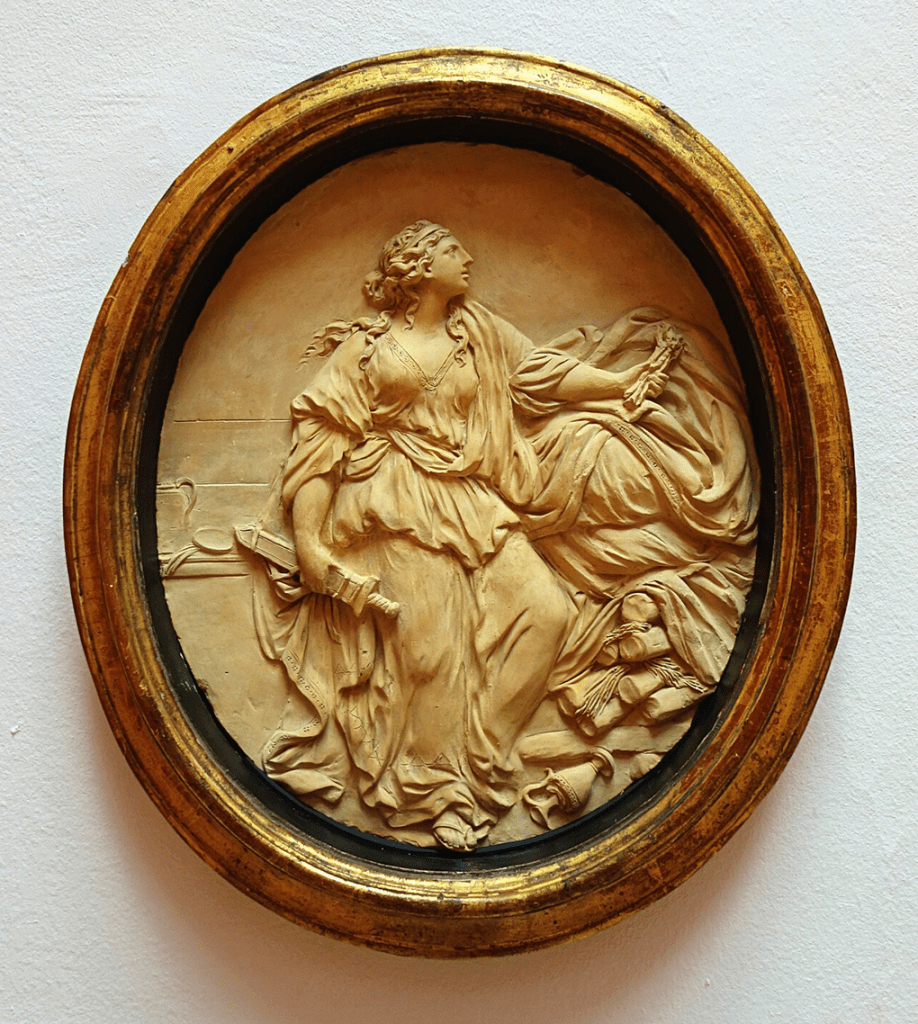
If one consults in turn the 1935 commentary of A.S. Pease just mentioned,[3] he will find multiple theories for Dido’s one shoe that have to do with ancient religion and magic, along with a staggering number of references to the primary literature. But what is, to my mind, the most likely explanation is not given. Irvine cautions that “the layman who ventures upon anthropological ground, whether wearing one boot or two, is always in danger of making himself ridiculous.” If that is so, the reader will be grateful that my explanation is literary rather than anthropological. Irvine may be right that “the question… very possibly does not admit of a complete solution”; but one can be pardoned for thinking it is wrong to say that the passage “possibly loses more than it gains by too close inspection” – at least, I hope he is, because we are about to inspect it very closely indeed.[4]
It is well established that Vergil’s Aeneid is in constant conversation with the Argonautica of Apollonius of Rhodes,[5] and that Vergil’s hero is in many ways modelled on Apollonius’ hero, Jason. On the very first page of the Argonautica, we read this:
τοίην γὰρ Πελίης φάτιν ἔκλυεν, ὥς μιν ὀπίσσω
μοῖρα μένει στυγερή, τοῦδʼ ἀνέρος, ὅντινʼ ἴδοιτο
δημόθεν οἰοπέδιλον, ὑπʼ ἐννεσίῃσι δαμῆναι.
δηρὸν δʼ οὐ μετέπειτα τεὴν κατὰ βάξιν Ἰήσων
χειμερίοιο ῥέεθρα κιὼν διὰ ποσσὶν Ἀναύρου
ἄλλο μὲν ἐξεσάωσεν ὑπʼ ἰλύος, ἄλλο δʼ ἔνερθεν
κάλλιπεν αὖθι πέδιλον ἐνισχόμενον προχοῇσιν.
For Pelias had heard it voiced that in time thereafter
a grim fate would await him, death at the prompting
of the man he saw come, one-sandaled [οἰοπέδιλος], from folk in the country:
and not much later – in accordance with your word – Jason,
fording on foot the Anauros’s wintry waters,
saved from the mud one sandal [πέδιλον], but left the other
stuck fast in the flooded estuary… (Argonautica 1.5–11, trans. Peter Green)
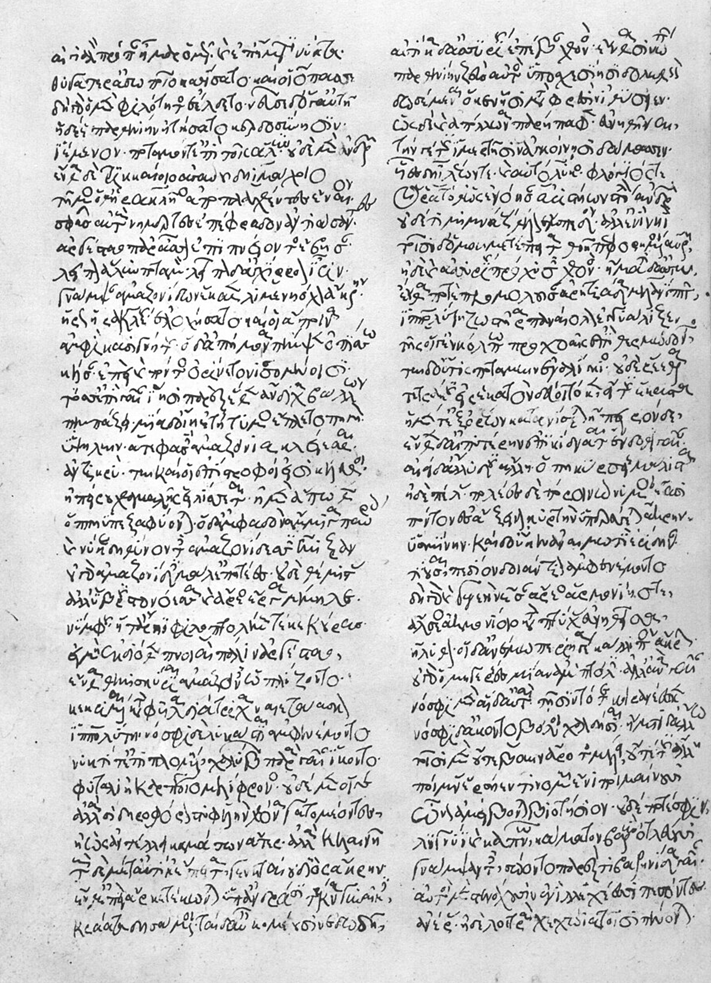
How can we be confident that Vergil is thinking not just of Jason in Aeneid 4.518, but of this passage of the Argonautica in particular? We can be confident – certain even, I daresay – via a complex cross-linguistic (pseudo-)etymological allusion that functions as the verbal equivalent of a wink or the knowing nod. Mark the word that Apollonius uses for “one-sandaled”: οἰοπέδιλος (oiopedīlos), a compound of οἶος (oios), which means “alone, only one,” and πέδιλον (pedīlon), “sandal,” which is in turn derived from πέδη (pedē), a word meaning “fetter” or “bond” (sandals are, after all, “things one binds on one’s feet”), but which also sounds like πούς (pous), ποδός (podos), the word for “foot”.
In Vergil’s scene, we find an exact reflection of this expression, including the pseudo-etymology. Vergil’s unum is equivalent to the οἶος in οἰοπέδιλος; πέδη, “fetter,” is reflected in Vergil’s vinclis (“fetters, bonds”); and the apparent connection to πούς is made explicit in Vergil’s pedem (from pes, “foot”).[6]
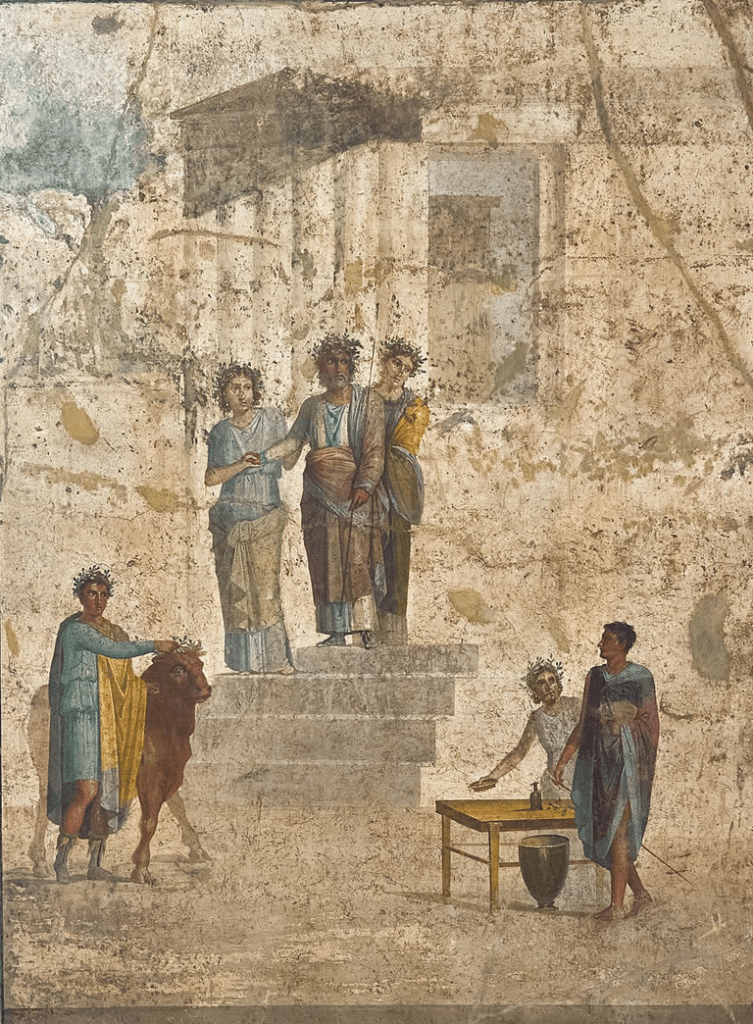
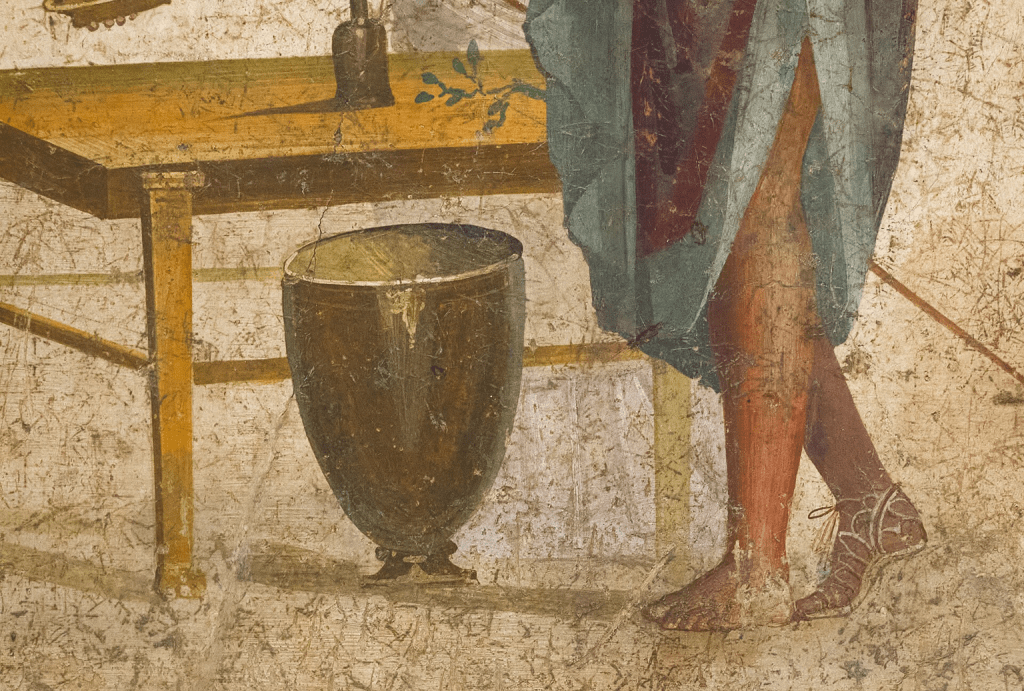
Almost in passing in his nearly five small-type columns on the phrase, Pease mentions Jason and his one sandal (“Of famous persons wearing but one sandal the most famous case was that of Jason, whose left foot was accidentally bare”), and gives a reference to Argonautica 1. But that is only one text he refers to among many, and he says nothing (1) about how close it is to Vergil’s very words nor (2) about the possible significance of that closeness.[7]
Having demonstrated (1), I hope, I now want to say something about (2), that is, the reason why we are made to think of Apollonius’ Jason in particular (and not just Jason in general) here. I mentioned above that Aeneas is in certain respects closely fashioned after the exemplum of Jason. Aeneid 4, furthermore, recapitulates the story of Jason and Medea that begins in Apollonius and ends in Euripides’ Medea.[8] And yet in this passage, it is Dido, not Aeneas, who makes us think of Jason, as if Dido, in killing herself, were killing her one-shoed forebear.
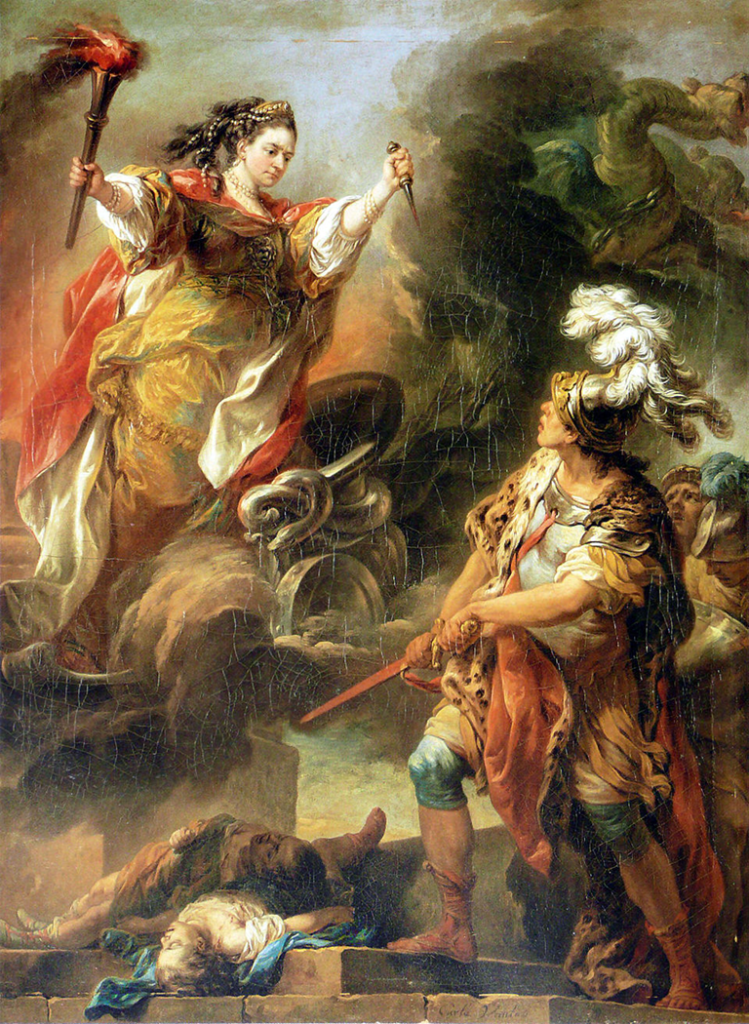
If the matter is put that way, we would seem to have a strange instance of a literary Electra complex. But there is more to the story, and more that is relevant to Vergil’s story, than that. This becomes clear if we employ what we might call the literary transitive property. That is to say, on the basis of “if a = b, and b = c, then a = c,” if Aeneas is Jason, and Jason is Dido, then Aeneas is Dido – and, therefore, when Dido kills herself, she is symbolically killing Aeneas.[9]
Other evidence in the text supports the conclusion that Aeneas is present in Dido’s death even though he has already departed from Carthage. For example, when Dido builds her pyre, she not only puts Aeneas’ clothing on it; she even puts his picture there (effigiem, 4.508). And that is still not all. For the sword she uses is his (ensemque relictum, 4.507). Vergil will say later that Dido had asked for it as a gift (quaesitum munus, 4.647).[10]
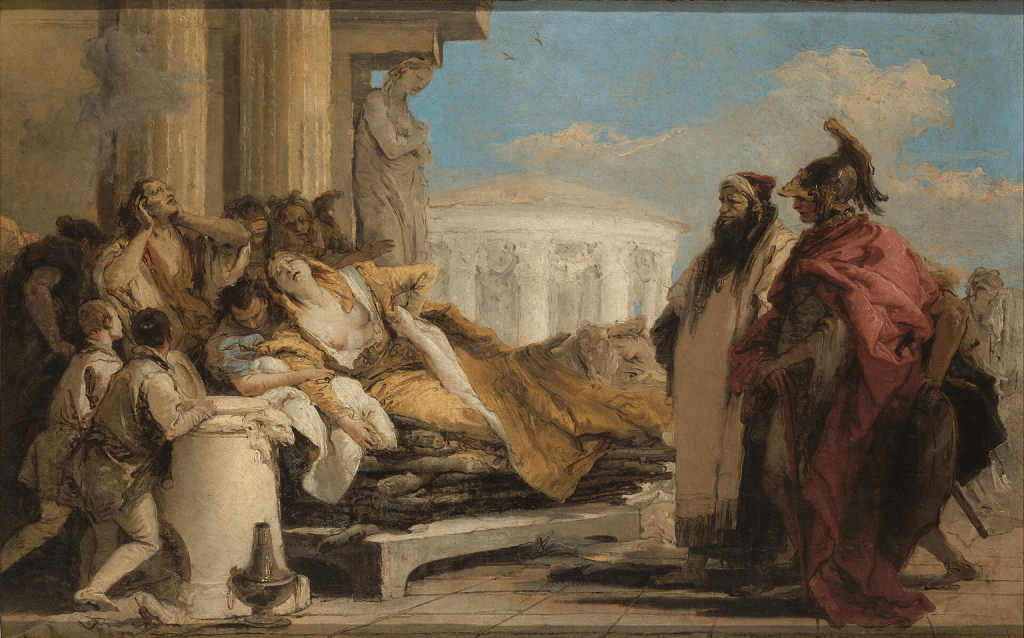
Dido is no mooch, though. She has given Aeneas a sword of hers as well; it is what he uses to cut the cables so his ship can sail away (vaginaque eripit ensem / fulmineum strictoque ferit retinacula ferro, 4.579–80).[11] But where Dido’s sword in Aeneas’ hands is used for separation and sundering (and the words describing Aeneas’ departure may well have a secondary sexual sense), the opposite is true of Aeneas’ sword in Dido’s hands, where it serves to identify the two even more closely with one another.
The identification of Dido and Aeneas is supported by other details in the text, too; and here we move on to the “reflection on wider themes” spurred by small details mentioned in my first sentence. If Aeneas and Dido are linked in the latter’s death, then, from a combination of factors in Books 4 and 6, one might claim that, in the aftermath of Dido’s suicide, Aeneas is Dido’s ghost, Dido Aeneas’s shadow, accompanying him to torment him ever after even as he tormented her in life like a bad dream. Consider the following:
1. Dido says explicitly that she will be the shadow that falls on Aeneas wherever he goes: omnibus umbra locis adero (4.386).
2. The two of them meet in the Underworld during Aeneas’s katabasis in Book 6. There, Aeneas sees her through the shadows or shades (per umbras, 6.452). He tells her that it is at the gods’ command that he goes through the shadows or shades (per umbras, 6.461). When she departs, she goes to the “shadow-bearing grove” (in nemus umbriferum, 6.473). But if the dead are shadows, like Dido, they are also dreams, like Aeneas: the shade of Anchises is described as “most like a dream” (simillima somno, 6.702) when Aeneas ineffectually tries to embrace him.
3. In that same book, when Aeneas famously exits the Underworld, the land of ghosts, he departs not through the Gate of Horn, whence issue “true shades/shadows” (veris…umbris, 6.894) – perhaps because Aeneas already has his true shadow? See (1) – but rather through the Gate of Ivory, whence come “false dreams” (falsa… insomnia, 6.896). This reminds us of how Aeneas torments Dido: she complains to Anna at the beginning of Book 4 of her bad dreams (insomnia, 4.9) caused by her infatuation with Aeneas, and later in the book she dreams (in somnis, 4.466) that “savage Aeneas drives her on in her madness” (agit ipse furentem /…ferus Aeneas, 4.465–6).[12]
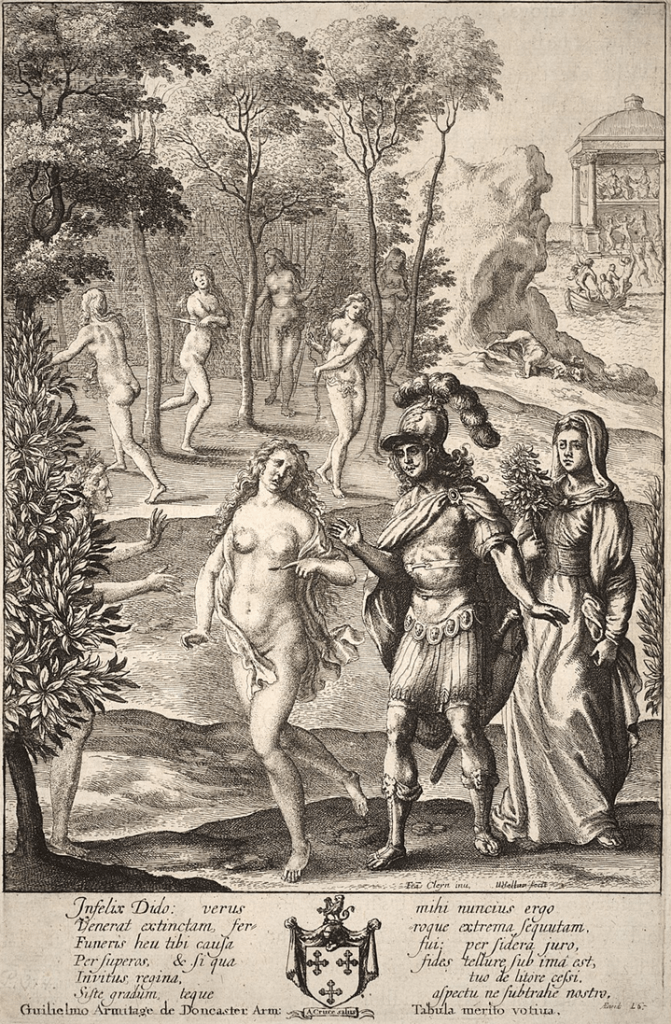
Dido famously does not reply when Aeneas addresses her in the Underworld. Why not? One reason is literary: Dido in the Underworld is modeled on Ajax in Odyssey 11, who similarly refuses to speak to Odysseus. This makes sense, because her death has already been modeled on his.[13]
But perhaps there is another reason as well – literary like the first, but also thematic. If I am right about the inextricable link or merging of the two figures through Dido’s identification with Aeneas in her death, not only via Aeneas’ sword as the instrument and the presence of his picture on her pyre, but also via her identification with him through the mediating character of Jason, she does not speak to him because she does not need to. In some sense, she is him,[14] and vice versa. She is his photographic negative, his guilty conscience, his own silent self-reproach.[15]
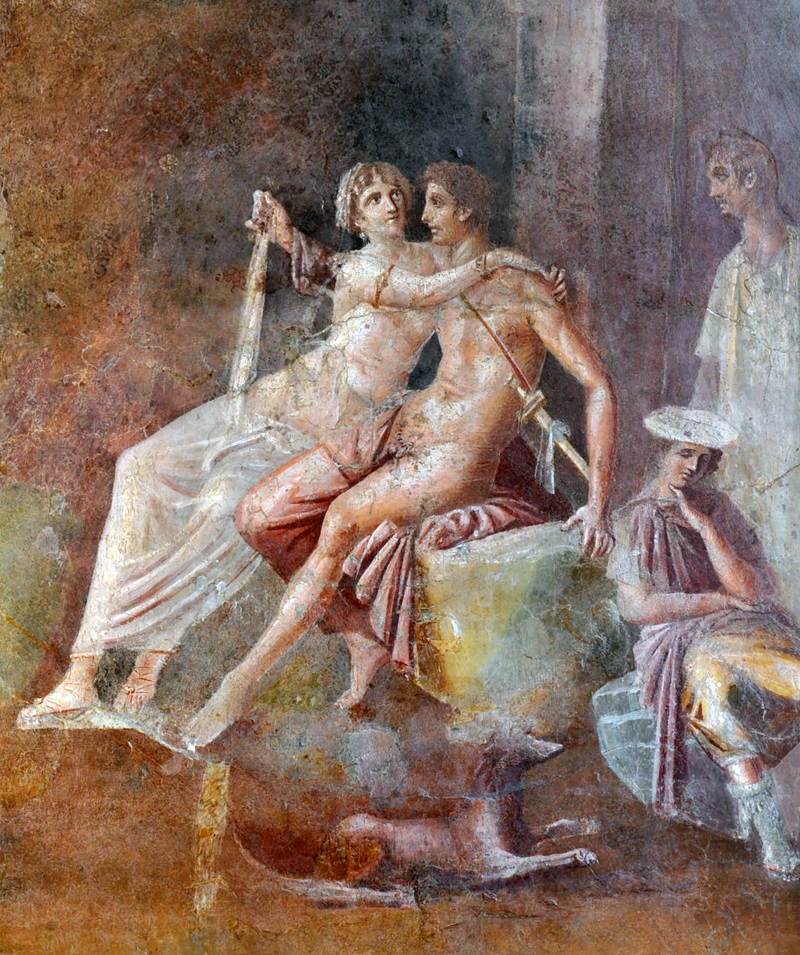
As his shadow or second self, Dido haunts Aeneas in the second half of the poem. Clues are everywhere. For example, the multitude of some of Turnus’ allied forces is compared to the number of waves on the “Libyan Sea” (Libyco… marmore, 7.718). In the next book, when Aeneas comes to visit Evander, he lies on the skin of a “Libyan bear” (pelle Libystidis ursae, 8.368) in the king’s humble home, recalling the kiss that Dido (ominously) had given to her empty bed, bereft of Aeneas, before her suicide (4.659). Too, in Evander’s house Aeneas lies on leaves (foliis, 8.368), recalling the natural setting of his “wedding” to Dido (4.165–8).
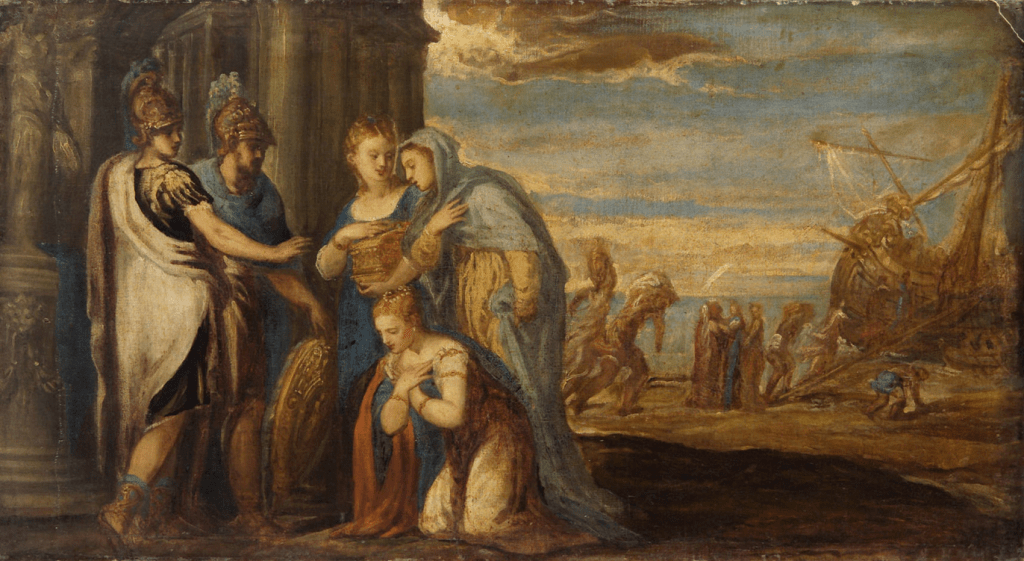
These Libyan reverberations in Aeneid 7–12 are to be related to the curse that Dido utters against Aeneas just before she expires, praying that an avenger would arise from her bones to take vengeance on Aeneas (4.622–9).[16] This curse is usually interpreted as referring to Hannibal and the Punic Wars. The Scipiones, for example, key figures in the Punic Wars, are called the “destruction of Libya” in the “Parade of Heroes” in Book 6 (cladem Libyae, 6.843) in praise of their having saved Rome from the Carthaginians.[17] More to the point, Jupiter says in Book 10 that “savage Carthage will someday let loose great ruin upon the Roman citadel” (fera Karthago Romanis arcibus olim / exitium magnum… immittet, 10.12–13).
More proximately, however, the curse is also Turnus.[18] Vergil signals this to the reader in a simile he uses to describe Turnus at the beginning of Book 12:
Poenorum qualis in arvis
saucius ille gravi venantum vulnere pectus
tum demum movet arma leo, gaudetque comantis
excutiens cervice toros fixumque latronis
impavidus frangit telum et fremit ore cruento…
Just as the lion in the fields of the Carthaginians,
Wounded in the chest with a heavy blow from the hunters,
At last rouses arms,[19] and rejoices, shaking his mane
On his muscular neck, and, fearless, breaks the bandit’s weapon
That has pierced him and roars with his bloody mouth… (Aeneid 12.4–8)
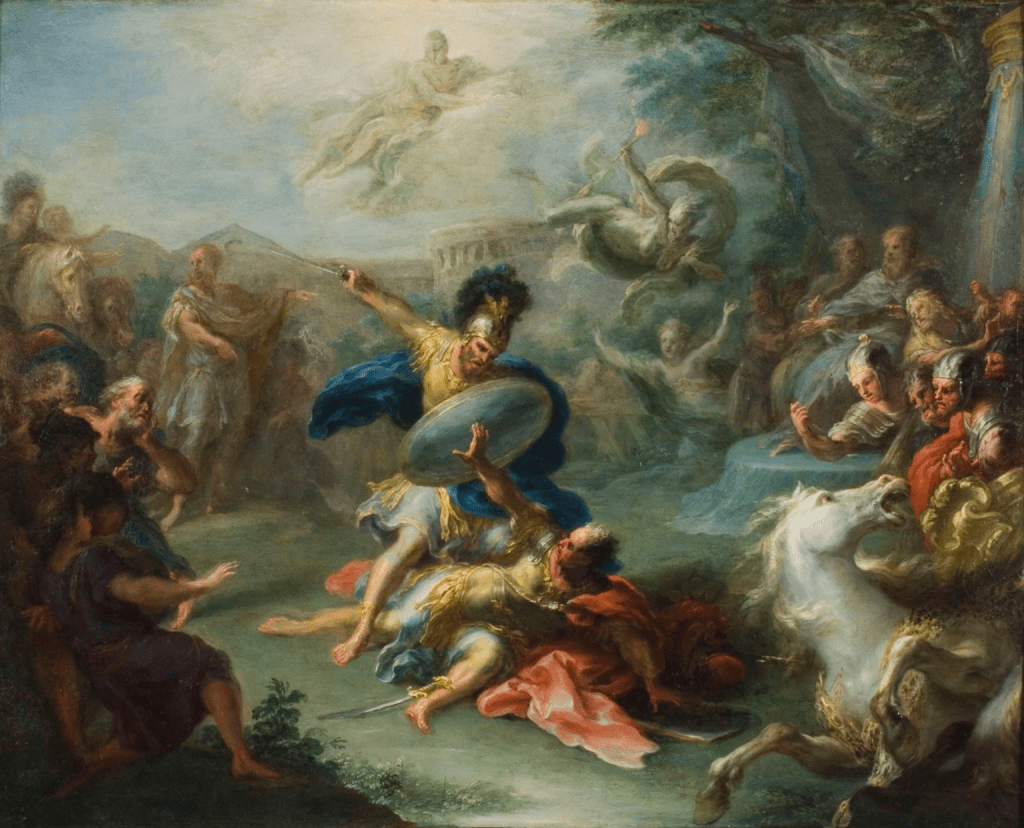
The particularizing epithet Poenorum, unnecessary in itself, sets the scene in Dido’s Africa. This makes Turnus a Carthaginian lion. In terms of this simile, the “bandit” (latro) is Aeneas. He here wounds the lion just as he, likened to a Cretan hunter, had earlier wounded Dido (4.68–73).[20] Like, Dido, too, is Turnus’s state of mind, for he is lovesick (cf. 12.45-46).[21]
But it is suggestive that, if we are in the Punic fields in this simile, and Turnus is a Carthaginian lion, then Aeneas is a Carthaginian bandit,[22] assimilated to the avowed enemy of Rome to whom his enemy Turnus has also been assimilated. In other words, Aeneas is also Dido.
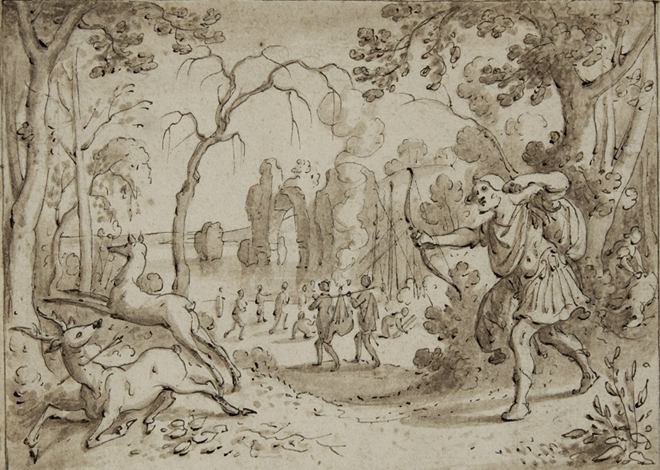
Proof[23] is found in the wounding of Aeneas later in Book 12, when, just as he is calling off his troops so that he can fight Turnus in a duel, he is himself wounded by an arrow (adlapsa sagitta est, 12.319), a reminiscence of the simile in Book 4 just mentioned, in which Dido-as-deer is wounded by the arrow of Aeneas-as-hunter (qualis coniecta cerva sagitta, 4.69).
It cannot be a coincidence that the source of the arrow is shrouded in mystery. Its agent is “uncertain” (incertum, 12.320). It is not even known whether the agent is chance or a divinity (casusne deusne, 12.320). Thus “the notable glory of the deed[24] has been suppressed” (pressa est insignis gloria facti, 12.322). As Frederick Ahl comments, “there is no known tradition of the wounding of Aeneas,” and thus “there is no tradition of who wounded him”.[25] We must therefore conclude that the detail is likely Vergil’s invention.
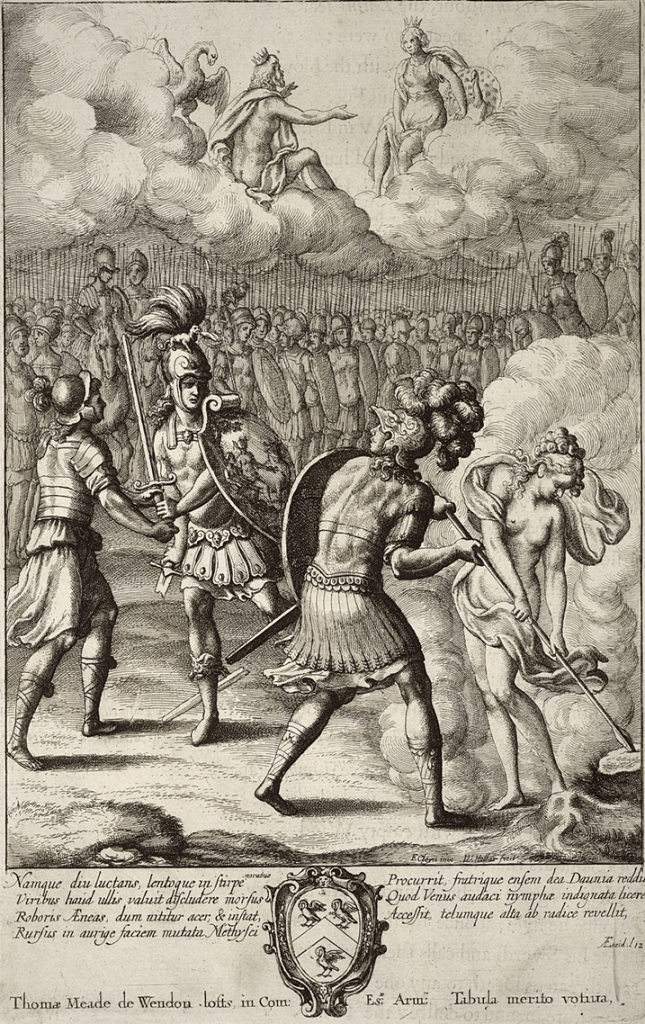
Why does Vergil add this mysterious detail that has no place in the tradition? I suggest that the reason is to aid in the elaborate series of identifications suggested in this essay through a nexus of images going all the way back to the hunting scene in Book 1, in which Aeneas actually does hunt deer (cervos, 1.184) with arrows (celerisque sagittas / corripuit, 1.187–8). There, Aeneas is the hunter, and he kills his (literal) prey. The image is then carried forward to Book 4, where, in the simile, Aeneas as hunter strikes deerlike Dido, wounded by love (tacitum vivit sub pectore vulnus, 4.67), without knowing that he has done so (nescius, 4.72). As the image passes through the simile in Book 12, Aeneas is (as already noted) transformed into a specifically Carthaginian hunter striking a Carthaginian lion, viz, Turnus. Finally, the image is “re-literalized” as Aeneas is wounded by an arrow the source of which – inverting the ignorance in the simile in Book 4 – is opaque to everyone, including the wounded. Aeneas has gone from hunter to hunted.[26]
Well, not quite finally. Let us consider the poem’s controversial conclusion, in which Aeneas kills Turnus in wrath. For, via the same transitive property discussed above, if Turnus is Dido, and Dido is Aeneas, then Turnus is Aeneas. So, on a symbolic level, who is killing whom here? At this point, I’m afraid that all I can say is, “Yes.” But it seems plausible to suggest that all of this relates – somehow – to Dido’s curse and Aeneas’ false exit from the Underworld at the end of Book 6. One observes that the final note struck in the poem is Turnus’ life fleeing “under the shades/shadows” (sub umbras, 12.952). This death is the price, then, of the curse of Dido’s shadow. And so, perhaps part of Aeneas dies with Turnus and returns to Tartarus, from which he never fully and truly exited,[27] as a sort of offering required by Dido’s haunting. If that is so, there is an element of magic in Dido’s incantatory suicide after all, and we are back – by a rather circuitous route – to Servius’ magical account of Dido’s single sandal. As she is loosed from life (the unshod foot), she binds Aeneas to her death (symbolized by her bound foot). Servius, it turns out, may have built better than he knew. Aeneas must, like Allecto,[28] return to the Underworld in some form, to which, like Persephone, he now permanently belongs.[29]
But it is not just magic. Dido’s spell is in response to an injustice, or at least a perceived injustice. For that reason, she calls upon “avenging Furies and the gods of dying Elissa” in her curse (Dirae ultrices et di morientis Elissae, 4.610). Might there be a punitive aspect to Aeneas’ symbolic death in Turnus’ death? I believe so. In so far as Turnus and Aeneas are identified, we see an enactment of the retributive justice that exacts an eye for an eye. Turnus is Aeneas’ substitutionary sacrifice.[30]
If that is so, it puts the run-up to the slaughter of Turnus in a new light as well. Readers of the Aeneid will recall that Aeneas is about to spare Turnus until the moment he becomes cognizant of the baldric of Pallas, stripped by Turnus from the young man’s dead body and worn as a trophy. Once Aeneas has “drunk down the reminders of cruel grief” (saevi monimenta doloris / … hausit, 12.945–6), he is “lit on fire by madness” and becomes “terrible in his wrath” (furiis accensus et ira / terribilis, 12.946–7). Aeneas claims that he is the personification of Pallas taking his revenge (Pallas te hoc vulnere, Pallas / immolat et poenam scelerato ex sanguine sumit, 12.948–9). Aeneas doubtless thinks that is true. And on one level, it doubtless is. But there is more than can be said. Though Vergil does not mention it in Book 12, he has already told us what was on the sword belt in Book 10:
et laevo pressit pede talia fatus
exanimem rapiens immania pondera baltei
impressumque nefas: una sub nocte iugali
caesa manus iuvenum foede thalamique cruenti,
quae Clonus Eurytides multo caelaverat auro;
quo nunc Turnus ovat spolio gaudetque potitus.
nescia mens hominum fati sortisque futurae
et servare modum rebus sublata secundis! (Aeneid 10.495–502)
And with his left foot [Turnus],[31] saying such things, pressed down
On the lifeless [Pallas], tearing off the huge weight of the baldric
And the lawless deed imprinted on it: On one wedding night,[32]
A band of young men foully slaughtered and their bloody bedchambers,
Which Clonus, the son of Eurytus, had engraved in much gold;
Turnus now glories in these spoils and rejoices to have acquired them.
Alas, men’s minds—ignorant of their fate and future lot,
Not knowing how to preserve due measure when carried away by favorable circumstances!
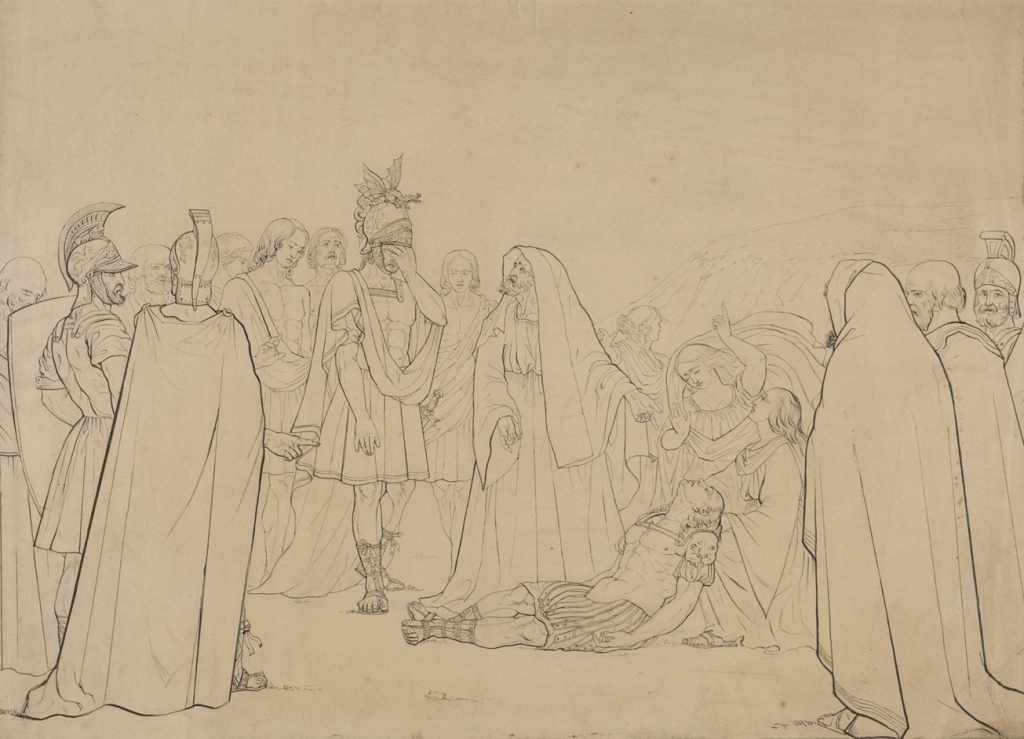
From this brief ekphrasis, we learn that Pallas’ baldric shows the story of the Danaids slaughtering their would-be husbands, the sons of Danaus’s brother Aegyptus. R.D. Williams remarks that “it is a tale of violence suitable for Pallas on the battle-field”[33] – but is it? This is not a scene of warlike prowess or manly heroic exploits. Its subject matter is marital rather than martial, from a tragic war of love rather than from an epic love of war.
But if I am right about the literary equation that occurs between Dido, Turnus, and Aeneas, the image becomes relevant and its aptness apparent. For if the death of Turnus is simultaneously a “death” of Aeneas, and if that “death” comes (somehow) at the hands of a Dido who is exacting vengeance on one who, she believes, is a false husband,[34] then she is a sort of Danaid, albeit in an inverted way: whereas the Danaids kill to avoid marriage, Dido “kills” because a marriage has been betrayed. It cannot be irrelevant that Danaus, the father of the Danaids, was the grandson of Libya.[35] On this reading, Aeneas would become enraged when he sees the Danaids and his guilty conscience is pricked, although he lashes out at an uninvolved third party – a not uncommon feature of the manifestation of guilt. It is almost as if Vergil’s lines might have read instead:
Dido te hoc vulnere, Dido
immolat et poenam scelerato ex sanguine sumit.
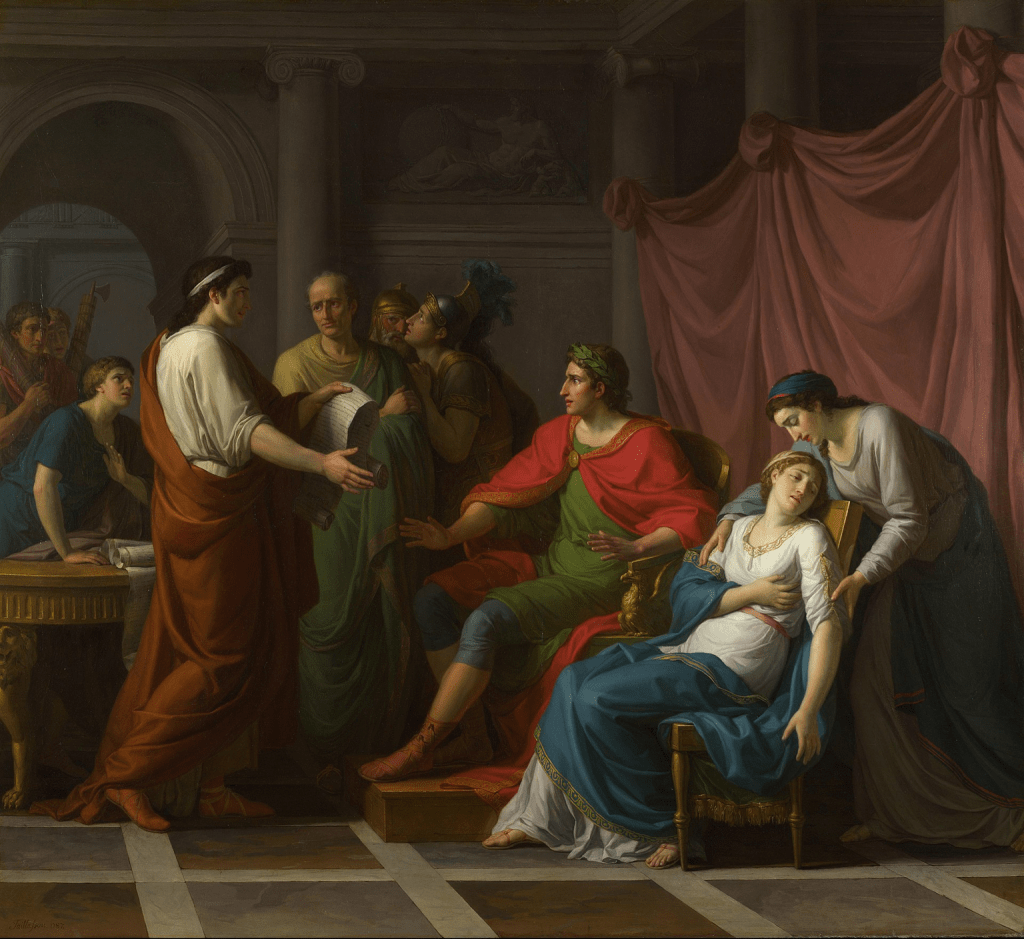
And indeed, we are justified in merging Pallas and Dido here, for Vergil had already done so at Pallas’ funeral, where Aeneas covered the dead boy’s hair with a robe Dido had made (11.72–7).[36] When this occurred, Pallas was lying on a funeral couch (toros, 11.66), recalling the funeral couch of Dido (toro, 4.508), which was also a marital bed and which she kissed just before she died (toro, 4.659). Much vegetation is present in each scene, including “fronds” (fronde, 4.506; frondis, 11.66).
Maybe this is all too subtle. Then again, with a poet like Vergil, maybe not. It would be a consummate act of literary skill and power to have the poem’s three most important mortal figures so impossibly and irresolvably intertwined. If there is a list of poets capable of operating at once on multiple symbolic levels scaffolded upon the sensus literalis, Vergil surely ought to be on it, and he ought to be near the top.
I assert without argument that Vergil is the greatest poet of ancient Rome. T.S. Eliot said, in “Vergil and the Christian World”, that he is “the greatest philosopher of ancient Rome”.[37] I only add that he is also her greatest psychologist.

E.J. Hutchinson is an Associate Professor of Classics at Hillsdale College (Hillsdale, MI), where he also directs the Collegiate Scholars Program. His research and teaching focuses on the Classical tradition from antiquity to the present. He has previously written for Antigone on a striking epigram by the mysterious Palladas.

Notes
| ⇧1 | A.L. Irvine, The Fourth Book of Virgil’s Aeneid: On the Loves of Dido and Aeneas, Done into English by the Right Honorable Sir Richard Fanshawe, Kt (Blackwell, Oxford 1924) ad 518.Unless otherwise noted, all translations are my own. |
|---|---|
| ⇧2 | Randall T. Ganiban et al., Vergil: Aeneid Books 1-6 (Focus/Hackett, Indianapolis, IN, 2012) ad 4.518. |
| ⇧3 | A.S. Pease, Publi Vergili Maronis Aeneidos Liber Quartus (Harvard UP, Cambridge, MA, 1935) ad 518. |
| ⇧4 | Quotations from Irvine (as n.1) ad 518. |
| ⇧5 | Vergil’s dependence on Apollonius is evident already in the Aeneid’s invocation. The Muse is (startlingly) absent from Apollonius’ own invocation, in which the poet, invoking Apollo instead, gives us a first-person verb instead of Homer’s imperatives: μνήσομαι, “I shall remember.” Vergil’s invocation returns Homer’s Muse to her place (Musa, 1.9), but “Apollonianizes” at the same time, using a first-person verb (cano, 1.1) and asking divine aid for memory (memora, 1.8), effectively splitting Apollonius’ μνήσομαι in two. Accipe nunc Vergili argutias et exemplo ab uno disce poetam totum, one might almost say (“Now receive the subtleties of Virgil and learn from one example the entire poet”). Vergil’s invocation can be taken as an instance of what is called “window reference”, in which a poet alludes to one writer through another (in this case, Homer through Apollonius). For more, see Damien Nelis, “Apollonius and Virgil,” in T.D. Papanghelis & A. Rengakos (edd.), A Companion to Apollonius Rhodius (Brill, Leiden, 2001) 237–59 (he discusses “window reference” on 247–8), and Vergil’s Aeneid and the Argonautica of Apollonius Rhodius (Francis Cairns, Leeds, 2001). |
| ⇧6 | The word “foot” [ποδί] is, in fact, used in Pindar’s account of this episode in Pythian Odes 4.96, in close conjunction with the word “only” [μόνον], and thus Pindar’s μόνον… ποδί, precisely recalled in Vergil’s unum… pedem, serves as evidence that we are dealing here with a double allusion, though my focus at present is on Apollonius alone. |
| ⇧7 | Discussion on the link to Apollonius is sparse. It is absent in James O’Hara, Vergil: Aeneid Book 4 (Focus/Hackett, Indianapolis, IN, 2011) and R.G. Austin, P. Vergili Maronis Aeneidos Liber Quartus (Oxford UP, 1955). It is also not discussed in, e.g., Nelis (as n.5). Pease, as noted above, mentions Apollonius, but does not claim that Vergil alludes to him here. J.G. Frazer mentions the two in close proximity, but argues for no poetic link between them, instead including both in his hypotheses about the magic of binding and unbinding (The Golden Bough: A Study in Magic and Religion, 3rd ed., Part II: Taboo and the Perils of the Soul [Macmillan, London, 1911] 310–13). In fact, the only commentary I am aware of that suggests a purposeful link is Lee M. Fratantuono and R. Alden Smith, Virgil, Aeneid 4: Text, Translation, and Commentary (Leiden, Brill, 2022) ad 518, though they do not discuss the etymological connection. |
| ⇧8 | Other tragedies are in the background as well, e.g., Aeschylus’ Oresteia, Euripides’ Hippolytus and Bacchae, and Sophocles’ Ajax. |
| ⇧9 | Of course, as a student pointed out in one of my classes recently, Aeneas is also killing her (via his sword and image). |
| ⇧10 | Dido’s death-by-gift-sword is modeled on that of Ajax (with Hector’s sword) in Sophocles’ play of that name, but discussion of this further allusive level of Dido’s death would take us too far afield in the argument of the present essay. |
| ⇧11 | On these weapons, see R.G. Basto, “The swords of Aeneid 4,” AJP 105.3 (1984) 333–8. |
| ⇧12 | For more on the connection between dreams and death, cf. 4.424 (on Mercury and his Underworld function) and 4.353 (on the visit of the ghost of Anchises to Aeneas while he sleeps). As Tertullian says in De anima 50, sleep is the “mirror of death” (speculo mortis), and its “business is dreams” (de negotiis somni, id est de somniis). |
| ⇧13 | See n.10 above. |
| ⇧14 | I realize this is grammatically incorrect, but “she is he” sounds wrong, which, in my view, means it is wrong. |
| ⇧15 | Cf. the discussion of T.S. Eliot’s “Vergil and the Christian World” in the final footnote. |
| ⇧16 | It is perhaps worth pointing out that the myth of Jason and the Argonauts is connected with Libya through Cyrene’s legendary founder Battus, a descendant of the Argonaut Euphemus: in addition to Pindar, Pythian Odes 4, cf., e.g., Herodotus, Histories 4.150–9; 4.179 connects Jason with Libya. Cyrene and Carthage, however, are not close to each other. Still, Libya’s connection to Greece might worry a Trojan like Aeneas – and remember that “Libyan” Turnus is the son of Daunus, the father-in-law of Diomedes (cf. Pliny, Natural History 3.11.103) and a Greek himself (Antoninus Liberalis, Metamorphoses 31, tells us that Δαύνιος (Daunios) was a son of Lycaon, who in turn, according to Ps.-Apollodorus, Bibliotheca 3.96, was king of Arcadia, whence came also Evander). In addition, “Daunus” sounds suspiciously like “Danaus,” the mythical king of Libya, on whose daughters see below. (I believe a student first brought to my attention the phonological link between “Daunus” and “Danaan”, a connection perhaps evoked in the final duel between Aeneas and Turnus at Aeneid 12.723: Tros Aeneas et Daunius heros.) Curiously, Dido’s father has the same name as the father of Danaus, i.e., Belus (Aeneid 1.621). |
| ⇧17 | Strangely, the Punic Wars are missing from the Shield of Aeneas in Book 8, despite the claim that it contains “the whole family of the future stock of Ascanius and their wars fought in order” (genus omne futurae / stirpis ab Ascanio pugnataque in ordine bella, 8.628–9). I would suggest that Dido and her Carthaginians are there replaced by their doublet, Cleopatra and her Egyptians. |
| ⇧18 | Here, too, Dido’s single shoe may be relevant, for it foreshadows the military accoutrement of the soldiers of Caeculus, who went into war with the left foot bare (vestigia nuda sinistri / instituere pedis, crudus tegit altera pero, 7.689–90); these soldiers are allies of Turnus. |
| ⇧19 | Surely an odd description for a lion, but quite appropriate for Turnus. |
| ⇧20 | Cf. the “dream Aeneas” in 4.465–6, referred to above. |
| ⇧21 | aegrescitque of Turnus (12.46) recalls aegra of Dido, right after she curses Aeneas (4.389). |
| ⇧22 | Poenorum should be taken apo koinou with both arvis and venantum. |
| ⇧23 | I use the term loosely. |
| ⇧24 | Or “the glory of the notable deed”. |
| ⇧25 | Virgil, Aeneid, trans. Frederick Ahl (Oxford UP, 2007), ad 12.322. |
| ⇧26 | He is then healed by Venus, who uses an herb that is normally used to heal goats that have been wounded by arrows (12.414–15). |
| ⇧27 | Not for nothing does Juno make a “shade” of Aeneas (10.636) to taunt Turnus so that he will flee and avoid death – a shade that is compared to a “dream” (somnia, 10.642). Both gates of the Underworld are thus implicitly present in the incident. |
| ⇧28 | It is at least suggestive that her emergence from Hades at the beginning of Book 7 follows so hard upon Aeneas’s emergence at the end of Book 6. |
| ⇧29 | We should remember in this connection that Dido calls upon Underworld deities before she dies: Erebus, Chaos, and Hecate (4.510–11). The last was associated with crossroads, “which ghosts were supposed to haunt” (R.D. Williams, Virgil: Aeneid I-VI (Macmillan, London, 1973), ad 4.511 (though he does not cite any ancient sources). Suggestively, Servius ad 4.609 connects Hecate at the crossroads to the search for Persephone, who has been abducted and taken to the Underworld (see also Pease ad 609). |
| ⇧30 | Cf. immolat (Aeneid 12.949). |
| ⇧31 | Juan Luis de la Cerda argues that it must have been the left foot of Dido that was bare: See P. Virgilii Maronis priories sex libri Aeneidos argumentis, explicationibus notis illustrati (1612) ad 4.518 – the same foot that was left bare by Turnus’ allies in 7.689–90 (n.18 above). This stands in contrast to Thucydides’ description of the Plataeans on their night expedition in History of the Peloponnesian War 3.22, where only the left foot is shod (τὸν ἀριστερὸν μόνον πόδα ὑποδεδεμένοι). As La Cerda observes, Pindar specifies that Jason wore a sandal on his right foot when he came to Iolcus (Pythian Odes 4.96), and therefore kept his left foot bare. |
| ⇧32 | The iugali of the ekphrasis echoes coniugium in the tragedy of Dido and Aeneas (4.172 and 431). |
| ⇧33 | R.D. Williams, Virgil: Aeneid VII-XII (Macmillan, 1973) ad 10.497. |
| ⇧34 | See Aeneid 4.172, 316, and 431. Aeneas disagrees (4.338–9). |
| ⇧35 | See Timothy Gantz, Early Greek Myth, vol. 1 (Johns Hopkins UP, Baltimore, MD, 1993) 203. His father, Belus, is the Phoenician-Carthaginian Baal (see Christoph Auffarth, “Danus, Danaids,” in Brill’s New Pauly Online, here. |
| ⇧36 | Thus Pallas is “clothed” by Dido twice: first in the Danaid baldric, and then in Dido’s robe. |
| ⇧37 | T.S. Eliot, “Vergil and the Christian World,” The Sewanee Review 61.1 (1953) 1–14; quotation on 13. I cited this version of the essay because it uses the correct spelling “Vergil” (against Eliot’s own preference). Eliot seems to provide indirect support for my argument about Aeneas’ bad conscience at the end of the poem: “Nor does destiny relieve mankind of moral responsibility… Aeneas and Dido had to be united, and had to be separated. Aeneas did not demur; he was obedient to his fate. But he was certainly very unhappy about it, and I think that he felt that he was behaving very shamefully” (11). Eliot takes as evidence their meeting in Hades. I concur, and wish to extend the point further. |