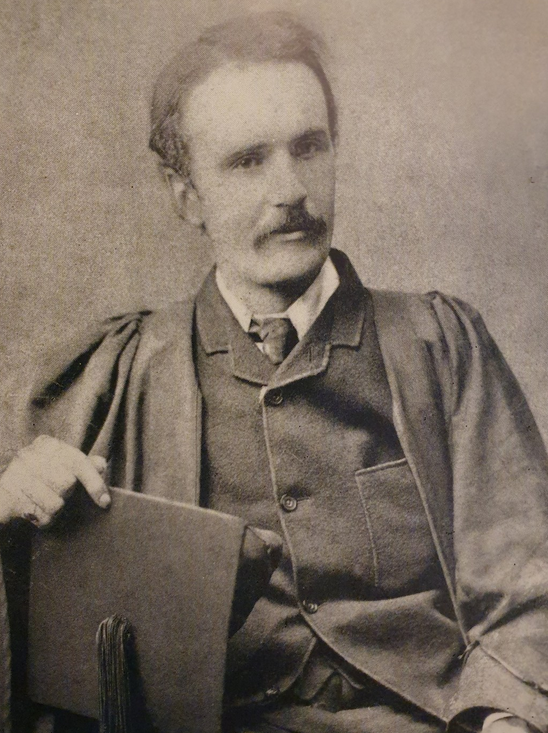
Gilbert Murray
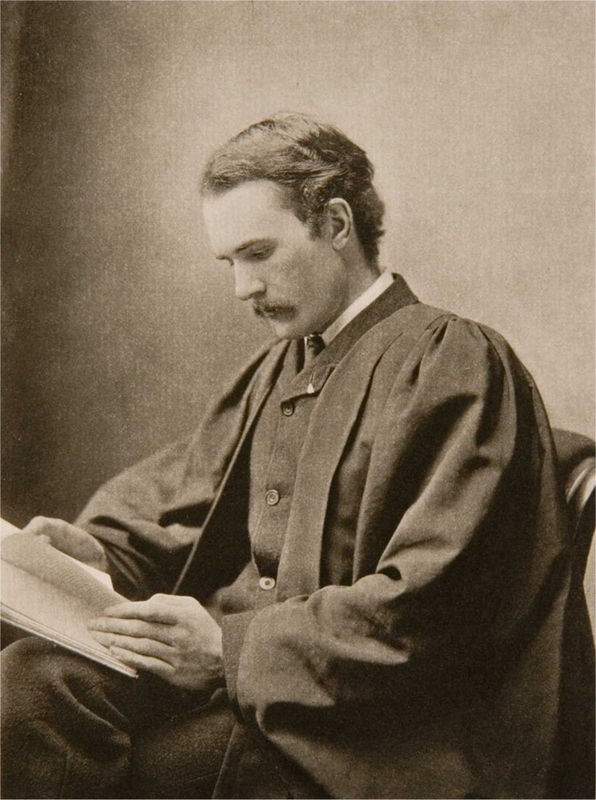
When in 1908 H.H. Asquith, Prime Minister of the United Kingdom, was tasked with finding a new Regius Professor of Greek at Oxford to replace Ingram Bywater, there was only one obvious choice. And although Gilbert Murray would later refuse to become a Knight of the Realm (in 1912), he was more than willing to step forward into this illustrious chair endowed by the bounty of King Henry VIII.
Despite his undeniable status as a Classical prodigy, Murray’s career was unusual in several regards. Born in 1866, in Sydney, Australia, where his Irish father served as a prominent parliamentarian (knighted by Queen Victoria in 1869), Murray was moved to England at the age of eleven. From Merchant Taylors’ School in London he passed to Oxford, where his stellar undergraduate career at St John’s (1884–8) won him a Fellowhip at New College. But before he could get his feet under the desk he pulled off one of the most remarkable appointments in the history of Classical scholarship: in 1889, at the age of 23, he was elected to replace the celebrated Hellenist Richard Jebb (then made Regius Professor of Greek at Cambridge) as Professor of Greek at Glasgow University.
Ten years of 7a.m. lectures and ever-broader duties led to such exhaustion that Murray was given medical advice to retire, rather than expire. In the five year period from 1899 he immersed himself not just in scholarship but also in politics and travel, supporting the Independent Labour Party and studying at the feet of the greatest Greek scholar in the world, Ulrich von Wilamowitz-Moellendorf. Somewhat refreshed, Murray returned to New College in 1905 and was therefore ready and waiting to be installed as the new Regius Professor of Greek.
His 28 years in that chair (1908–36) were remarkable not just for how wide-ranging and public-facing his own prolific scholarship proved to be but also for how actively he applied himself to political causes, whether internal reform within the university or external initiatives such as the League of Nations, of which he was Chairman from 1923 to 1938. Although he married into aristocracy – his wife Lady Mary Howard being the daughter of the 9th Earl of Carlisle – the two of them devoted their energies to a wide range of social causes against the grain, with Mary refusing her mother’s offer to inherit one of the largest stately homes in England, Sir John Vanbrugh’s baroque masterpiece Castle Howard. While in the 21st century no-one would bat an eyelid at a tee-total, vegetarian, atheist academic, Murray was very much a counter-cultural figure in the Senior Common Room.
For the combination of his precise linguistic scholarship, remarkable interdisciplinary learning, and his insatiable drive to bring the Classical world alive to as wide a public as possible, Murray is almost unmatched in the history of Classics. As is clear from an earlier Antigone article, much work remains to be done on him and his legacy, so – as a spur to encourage further such work – we are pleased to republish below his inaugural lecture at Oxford, which so clearly and colourfully sets out his breadth of vision for what the field could achieve, if it was prepared to think hard about what needs doing well.
The Interpretation of Ancient Greek Literature
An inaugural lecture delivered before the University of Oxford
January 27, 1909
Gilbert Murray
Regius Professor of Greek
Just nineteen years ago I was elected to the Professorship of Greek in Glasgow University in succession to Sir Richard Jebb; and now I am appointed to the Regius Professorship of the same subject in Oxford in succession to Dr. Ingram Bywater. Probably few men have ever entered upon the work of those two Chairs without some misgiving, some searching suspicion of the general adequacy of their armour; and in my case all such feelings are deepened when I think of the two great figures in learning and scholarship whom it has been my lot to follow. Jebb was, I presume, the most famous Greek scholar in England: his sure touch, his ‘safeness’, his delicate sense of language and of literary taste, above all his extraordinary power of patient and luminous exposition, made him in the eyes of most cultivated Englishmen the typical representative of Greek scholarship.
Of Professor Bywater it is harder to speak; for to say anything of him here is like praising him to his face. That fine edge of intellect, that urbane and weighty culture of his, are better known to many of my hearers than they were to me; but I should like on this occasion to record the one special impression which I always received from him. It was an impression of great unsounded depths. The severe reticence which was forced upon his books by the accident of their form seemed symbolic of something in his own nature. It was as though one might quarry in him for thought and knowledge with assurance of always finding more, as so many of us have quarried in his edition of Heraclitus. One could quarry even in those small texts of Aristotle. There was no display anywhere, there seemed little that called for notice. Then your eye was caught by something in the footnotes. A well-known emendation, confidently attributed in current books to some recent editor, had here attached to it a name belonging to the sixteenth or seventeenth century. What we thought was new was really three or four hundred years old. Most of us would barely remember the name of the real author of the emendation; but Bywater would have read him, and learned from him. You went on reading the text, and it would perhaps occur to you that some passage was not so hard as you had remembered it, or that the meaning was slightly different and clearer. You looked close, and found that the punctuation had been altered. And behind these slight and silent changes you realized the hours of close and acute thinking, the years of profound and unerring study.

Gentlemen, I am not going to dilate upon the difficulties and misgivings which I feel in taking up the responsibilities of this great historic Chair, the Chair of Bywater, of [Benjamin] Jowett, and of [Thomas] Gaisford. I have much that I could say on the subject, but it is better unsaid; especially because, when a man begins to speak of his own defects, his hearers are apt to find that several of the most obvious have escaped his notice. But it is natural on an occasion like this that a new Professor should say something about the work which he has taken up and the particular ways in which he proposes to set about it. If this were a new University, or if Greek were what it was at the Renaissance, a new and unexplored subject, there would be all sorts of suggestions and prospects of interest to lay before you. But in a University of vast traditions, of long-tried efficiency and fame, the first thing that a new Professor should think of is not to change something in Oxford, but to do his best to be worthy of Oxford. And something similar holds of the subject.
True, research is a necessity to understanding: and no study that is really flourishing can help both seeking and finding new things; true, also, that we have Crete and the Papyri before our eyes. Yet, on the whole, the main work of a Greek scholar is not to make discoveries or to devise new methods, but merely to master as best he can, and to re-order according to the powers of his own understanding, a vast mass of thought and feeling and knowledge already existing, implicit or explicit, in the minds or the published works of his teachers.
The few special projects that occur to me amount to little, but may well be mentioned here. In the first place, it has struck me that in Oxford a young scholar who has just received his degree and perhaps his Fellow-ship, and who wishes to pursue his classical studies deeper, often suffers from a certain lack of guidance. I felt it myself; and I have noticed good effects from the Scotch system, in which a clever assistant sometimes learns a good deal as to method and the use of his books from close association with his Professor. Similarly, I have heard many men here speak with enthusiasm of the good they got from their evenings at the Aristotelian Society, with the constant presence and direction of Professor Bywater. He has most adequate successors in that work. And for my own part, among the great Aristotelians of this University I should be only a trembling learner and not a guide.
The plan which I should like to attempt, if opportunity offers, is this: To form a class or society, something in the nature of a seminar, but less formal, which should collectively study and eventually edit some small and interesting pieces of ancient Greek literature. Some members should undertake to collate the MSS. or a certain number of them; others would take the linguistic forms, and, if the book is in verse, the metre; others the history or the speculative thought involved; all should of course work carefully at understanding every word of the text. If special questions arose which seemed out of our range in the class, we could, I feel sure, depend upon the kindness of a specialist in those questions to come in for an evening and advise us. The selection of the book to work upon will be difficult. It should be a small book, so that not too many generations should pass away before any result of our work is visible. It should present a large number of different problems to be worked at; and naturally it ought to be some-thing outside the immediate range of our regular curriculum. Possibly the long fragment of Hermesianax, leading, as it would, to other Alexandrian fragments, might be enough to begin upon: it is full of questions of form, of mythology, of the development of literature. Or, if that hundred-line fragment is not solid enough, even for a beginning, there is a great deal to be done with the fragments of Tragedy, a great deal with some of the antiquarian Treatises of Plutarch. For my own part I should much like to attack the little- known and extraordinarily interesting work of Sallustius, περὶ θεῶν καὶ κοσμοῦ. That little book cries out for a convenient edition with translation and commentary; and if, in many of the problems of Neo-Platonic philosophy, I should be to my class at best a one-eyed man leading the blind, there are those in Oxford who could, and I am sure would, from time to time be willing to guide us. That is one project which I think may possibly prove practicable and worth carrying out.
There is also another matter. I think that those of us whose work lies in the province of ancient language and literature, especially in ancient poetry, often feel with regret that the sharp division made by our examination system between Moderations and the Final School of Litterae Humaniores tends somewhat to disintegrate the unity of Hellenic studies. The Greats School forms a course of work at once so arduous and so admirable in its educational value that men are absorbed in it. They feel that they have left language and poetry behind them at Moderations, and that there is little serious to study in the Classics except specialized History and specialized Philosophy. I say this not in a spirit of blame. It is the natural result of an effective and highly strung educational system. But I think that, with a view to maintaining the unity of our subject and using each part of it to illustrate the rest, two small experiments might be made.
In the first place, we might have in the Summer Term a course of some seven or eight lectures, of as wide a scope as possible, for men who have just taken Moderations and are beginning to read for Greats. I conceive of the lectures as given by different men of special knowledge in particular branches of Archaeology, Literature, Anthropology, and the like: lectures on inscriptions and their use for history, on coins, on the principles of Greek religion, on the position in the development of Greek literature occupied by certain great historians and philosophers. I think such a course would in many cases broaden the outlook of a good student, and give him some useful clues in his difficult first approaches to the subject-matter of the four great prose writers. And I am happy to say that Professor [Percy] Gardner and other authorities to whom I have applied have responded to my invitation most cordially.
In the second place, by a little specialization, something may be done to encourage an interest in the less well known parts of Greek literature. We classical scholars tend — as critics often tell us — all to have read the same set of authors and all equally to feel less at home when we are asked to move beyond that circle. I believe myself that that is quite as it should be. The essential postulate of classical study is that some books and some ages are much more instructive than others, and we naturally tend to study the best that we know. But, however right in the main, this tendency has an element of weakness in it. Fortunately, it is a weakness easy to overcome in a University so rich in classical students as Oxford.
I have invited various classical lecturers to choose each some quite small and definite portion of the less known literature and give us some public account of it. The plan is that each man should prepare his subject and deliver upon it one public lecture in a finished form, and then be ready to give advice and to answer questions. Questions might come from students who wished from mere general interest to follow the lecture up, or possibly from candidates for the Baccalaureate of Letters or Greats men taking a special subject in Language and Literature. I have applied in the first place, as was natural, merely to men whom I happened to know, and whom I knew to be interested in some portion of Greek literature lying a little off the beaten track. But I shall be most grateful to others who will volunteer for lectures in future courses. Those to whom I have applied have, I am happy to say, taken up the idea with interest. I hope that the first course may be given next October Term.
I have thought it worth while to mention these projects, both from a wish to use the earliest opportunity for taking other classical teachers into my confidence in the matter, and also in the hope that I may receive as early as possible some helpful criticisms or suggestions.
But of course such plans amount to little. They make, even if successfully carried out, only a current this way or that upon the surface of our studies. We English scholars have a great tradition behind us, and our main task is to keep that tradition intact, to know Greek as [Peter] Elmsley and [Richard] Porson knew it. Of course there were things known to them which we shall never learn; and equally there are things familiar and full of illumination to us which they never dreamed of. A tradition can only keep alive by constantly growing. But there is one great characteristic of the scholarship of Oxford and Cambridge which at the present day we should take care not to forget. If my memory does not deceive me, it was once described by the late Provost of Oriel [David Binning Monro]. He pointed out that the English Universities, while they had not the great antiquity of Bologna and Montpellier, while they had not the enormous productiveness and professional finish of Berlin or Leipzig, had performed one remarkable and perhaps unique task; they had made the great Greek writers an integral element in our highest national culture, so that Homer and Sophocles and Plato were living forces continually working upon English thought, almost as our own Shakespeare and Bacon and Milton are. I believe that this is true; and that in some cases — in the case of Plato, for instance— a large part of an influence particularly strong at the present day is definitely due to the Oxford Greats School. I would go further. If you take English political thought and action from Pitt and Fox onwards, it seems to me that you find always present, even in its times of reaction, when repressive and authoritarian tendencies are strongest, certain mitigating and hopeful strands of feeling which are due — of course among many other causes — to this permeation of Greek influence: an unquestioning respect for freedom of life and of thought, a mistrust of passion and a confidence in Sophrosynē a sure consciousness that the poor are the fellow citizens of the rich, and that statesmen must as a matter of course consider the welfare of the whole state.
This permeating influence has not to any very large extent been brought about by conscious popularizing. It has been due to the existence in the two old Universities of a large body of able men devoting much time and thought to first understanding and then helping their pupils to understand the thoughts of the great Greek writers.
The task of understanding has in many ways changed. Notably the amount to be understood has increased upon us enormously. The range of what is meant by Greek is vastly wider than in Porson or Elmsley’s day, notably wider even than when I was an undergraduate. Elmsley was Professor of Ancient History in this University. But how greatly out of his depth he would have felt if he were plunged without preparation into one of our present advanced courses of Greek History! It is not merely that he would have had to re-write his notebooks so as to take in [Heinrich] Schliemann and Dr. [Arthur] Evans and the Ἀθηναίων Πολιτεία [Constitution of Athens]. Many of the actual methods would be strange to him: the use of economics and sociology, the use of Semitic and Egyptian records, the analysis of ancient documents which we have chiefly learnt from Semitic scholars, and all the various means which lie at the disposal of a historian like, let us say, Eduard Meyer. Elmsley used inscriptions both for linguistic and historical purposes; he had even copied some down in situ. But imagine him faced with [Wilhelm] Dittenberger’s Sylloge, and that mass of ordered knowledge drawn from vast stores of which perhaps only one contemporary of Elmsley’s had so much as suspected the existence. He used etymological arguments; he had probably read Sir William Jones, and he may have read [Franz] Bopp. Yet how he would have been overwhelmed by Brugmann and that whole huge and growing science of Comparative Philology! He did not, as far as I remember his work, show any suspicion of the existence of such a subject as Comparative Religion or Comparative Mythology; he would come quite unprepared upon [Edward B.] Tylor’s Primitive Culture and [J.G.] Frazer’s Pausanias or even upon [W.H.] Roscher’s Lexicon. He would feel himself surrounded on all sides by monsters like that of Frankenstein, which classical students had called into being to their own confusion. Even his compositions in Greek would not stand comparison with, say, Dr. [Walter] Headlam’s. Nay, in his own special region, the niceties of Attic form, he would find the results which he attained by keen observation and brilliant insight superseded by [Konrad] Meisterhans’ collection of instances from the stones.
This last case suggests an obvious reflection. If the field of Greek study has increased so greatly, so also have our aids to knowledge. We do understand, or at least each one of us has a chance to understand, the wonderful life and literature which form our study better than our fathers did. Let any one who knows [Christian] Lobeck’s Aglaophamus imagine what Lobeck would make of that subject if he were writing now. Think of the masses of dead unillumined matter through which Lobeck, with his minute carefulness, his massive erudition, laboured steadily and almost ironically, reaching at last little more than a negative result. And think of the light and the vitality that can be infused into that matter now by our leading students of Greek Religion.
Greek Religion is a special and a new subject. But I feel this improvement in our understanding nowhere more clearly or with more certainty than in what seems at first sight an old one, the general appreciation of literature. In my rather prolonged work on the text of Euripides I have been always learning from three men, Porson and Elmsley and [Gottfried] Hermann. Now Hermann himself— the greatest man of the three — said of Porson, in a moment of irritation, that when once a passage would scan and construe, Porson asked no further questions about it. That charge could not be retorted upon Hermann. It could not be made against Elmsley; even less against Jeremy Markland, who said at the end of his life that he was not sure that there was one ode of Horace which he fully understood. Yet, if you turn to the general criticisms of various plays occasionally uttered by Elmsley or Markland or even Hermann, the effect is strange. In spite of their wide and exact knowledge of Greek letters, in spite of the visible joy which they took in their work, one feels their criticisms to be more than inadequate, to be almost childish, in comparison with the average competent work of the last thirty years. As a matter of fact the language of criticism had hardly been invented in their day. And if you turn from Elmsley to the really brilliant achievements of modern literary criticism — say to Dr. [Arthur] Verrall’s analysis of the end of the Choephoroe or the scene with the Phrygian in the Orestes — you feel that the thing itself had hardly been invented. The modern writer sees ten things where Elmsley saw one, and that not the most vital one.
This result is satisfactory. If a study does not advance it is sure to be falling back. True, we have need to take great care that amid the wide additions to our knowledge that come from Archaeology, History, Philosophy, Comparative Anthropology, and the like, we do not lose our close grip of the minutiae of the language which formed the great boast of the old English school; still more that in the reading of learned periodicals and modern books about the Greek writers, we do not forget to read the Greek writers themselves; for without the foundation of a clean and definite understanding of the language and a real knowledge of the books no superstructure can be sure: still, we can on the whole go on our way in confidence, feeling that we are not falling below our standard, not lessening the patrimony we have inherited.
But this widening of the borders of Greek study somewhat alters the position and the definite duties of a Professor of Greek. When I look about me in Oxford I am conscious that, in almost every one of the great branches into which the knowledge of ancient Greece may be divided, I am in the presence of men whose knowledge and judgement is superior to mine. In Philosophy, in History, in the various forms of Archaeology, in Philology and Palaeography, there are men to whose knowledge mine is but the groping of an amateur; yet all these subjects are necessary and essential parts of the proper study of Greek. It seems indeed that the subject of Greek literature, especially the poetical side of it, and of language in so far as it expresses literature, are the subjects that are chiefly set aside for the professor. But of all subjects these are perhaps the least able to stand alone. The business of an interpreter of Greek literature is to understand the full meaning of words uttered and written by great men, dead more than two thousand years ago. The palaeographer and the grammarian must help us to get the words right. And when we have got them their meaning will depend upon all kinds of other questions: the daily lives those men lived, the houses and cities they dwelt in, the historical changes through which they passed, above all on the beliefs and ideas which they received unconsciously from tradition or built up by the labour of their own brains. The Professor of Greek, it is evident, must depend at every turn upon the discoveries or the special knowledge of other workers in the wide field of Hellenic study. All Hellenists must needs work together at the large task that our generation has laid upon us.
For we may fairly ask ourselves — nay, we must, if we have read our Plato with due profit, from time to time ask ourselves — what our business is and what good we are in the world, we historians and antiquarians and γραμματικοί, we laborious students of a far distant literature and art and thought. Doubtless each man’s answer to that question will be slightly different. Yet it seems that in some way or other we are wanted. It seems that Humanity, in the vast and chequered journey on which it labours from a dimly descried beginning to an unsurmised goal, is unwilling to lose the lessons of its experience, or the mere charm of its memories; and, above all, in the ordinary slough of living and in the trough of the wave, wishes to keep as far as may be still vivid and undying the highest moments of its past life. Strip the past naked of all false sentiment and strained idealism, admit to the full the failures of Hellenic civilization and the infection of primitive savagery from which it strove so hard but so vainly to get free: there can remain no doubt whatever that the best life of Greece represents one of those highest moments. The business to which the world has set us Greek scholars is to see that it does not die.
Among the elements that contribute to the higher evolution of human life, it looks as if one might make a broad division: some are progressive, so that each new stage supersedes the last, some are eternal and are never superseded. I will not try to specify the two classes more precisely; one might say roughly that material things are superseded and spiritual things not; or that everything considered as an achievement can be superseded, but considered as so much life, not. Neither classification is exact, but let it pass. Our own generation is perhaps unusually conscious of the element of change. We live, since the opening of the great epoch of scientific invention in the nineteenth century, in a world utterly transformed from any that existed before. Yet we know that behind all changes the main web of fife is permanent. The joy of an Egyptian child of the First Dynasty in a clay doll was every bit as keen as the joy of a child now in a number of vastly better dolls. Her grief was as great when it was taken away. Those are very simple emotions, but I believe the same holds of emotions much more complex. The joy and grief of the artist in his art, of the strong man in his fighting, of the seeker after knowledge or righteousness in his many wanderings; these and things like them, all the great terrors and desires and beauties, belong somewhere to the permanent stuff of which daily life consists; they go with hunger and thirst and love and the facing of death. And these it is that make the permanence of literature. There are many elements in the work of Homer or Aeschylus which are obsolete and even worthless, but there is no surpassing their essential poetry. It is there, a permanent power which we can feel or fail to feel, and if we fail the world is the poorer. And the same is true, though a little less easy to see, of the essential work of the historian or the philosopher.
I remember about twenty years ago reading an obituary notice of [Henry George] Bohn, the editor of the library of translations, written by Mr. [Henry] Labouchere. The writer attributed to Bohn the signal service to mankind of having finally shown up the Classics. As long as the Classics remained a sealed book to him, the ordinary man could be imposed upon. He could be induced to believe in their extraordinary merits. But when, thanks to Mr. Bohn, they all lay before him in plain English prose, he could estimate them at their proper worth and be rid for ever of a great incubus. Take Bohn’s translation of the Agamemnon, as we may presume it appeared to Mr. Labouchere, and take the Agamemnon itself as it is to one of us: there is a broad gulf, and the bridging of that gulf is the chief part of our duty as interpreters. We have of course another duty as well — our duty as students to know more and improve our own understanding. But as interpreters, as teachers, our main work is to keep a bridge perpetually up across this gulf. On the one side of it is Aeschylus as Bohn revealed him to Mr. Labouchere, Plato as he appeared to John Bright, Homer as he still appears to Mr. [Andrew] Carnegie; I will go much further and take one who is not only a man of genius, like Bright, but a great poet and a Greek scholar, Euripides as he appears to Mr. [Algernon] Swinburne; on the other side is the Aeschylus, the Plato, the Homer, the Euripides, which we, at the end of much study, have at last seen and realized, and which we know to be among the highest influences in our lives. This is not a matter of opinion or argument. What we have felt we have felt. It is a question of our power to make others, not specialists like us, feel the same. It is no impossible task. Like most others, it is one in which a man sometimes succeeds and sometimes fails, and in which he reaches various degrees of comparative success. There is not a classical tutor in this room who does not know that it can be done, and that he can himself do it.
Yet it is sometimes surprising to me that we should succeed at all, considering what obstacles of age and language and atmosphere we have to cross, and what a difficult thing interpretation is, even when there are, comparatively speaking, no obstacles. I wonder how much of the meaning of contemporary books in our own language really gets into our minds at first reading. Of course the amount varies widely. Some books may be entirely composed of familiar ideas; some readers may be particularly intelligent. But I suspect that most writers would receive something of a shock if they realized how small a proportion of what they write usually gets through into their readers’ minds. Certainly young examiners do, when they look over their first papers and find what they are supposed to have said in their lectures. Certainly poets and play-wrights do, whenever they see their works acted without much previous supervision by themselves. And remember, both the examinee and the actor are well above the average both in intelligence and training, and both have taken quite special pains to understand. In other cases readers are not subjected to any similar test, and writers write on without any such rude awakening. But these two instances are enough to make us pause before thinking that it is a simple matter to understand and interpret even a book in our own language and belonging to our own civilization, not to speak of one removed from us by great gulfs.
And yet, as I said, we do it. It is a question, I suppose, of caring and of taking pains. I am often struck, when I read controversial literature about Homer, say, or Plato, to notice how comparatively small a part of the field the controversy covers. If you take the whole of what Plato or Homer means to one of the disputants, and the whole of what he means to the other, nine-tenths of the two wholes coincide. And they often coincide in the most important and essential things, those which are felt and do not particularly claim to be talked about. In the language of the stage, the great things ‘carry’ — across the footlights, and across the ages.
It is a strange fact, this carrying power of a thing so frail as poetry, or of that creative effort in philosophic thought which is of the same stuff as poetry, Αὔρα ποντιὰς αὔρα, ‘Wind, wind of the deep sea,’ begins a chorus in the Hecuba, and fifty others could be chosen like it. How slight the words are! Yet there is in them just that inexplicable beauty, that quick shiver of joy or longing which, as it was fresh then in a world whose very bone and iron have long since passed into dust, is fresh still and alive still; only harder to reach; more easy to forget, to disregard, to smother with irrelevancies; far more in danger of death. For, like certain other of the things of the spirit, it will die if it is not loved.
One cardinal fact about great poetry, as about great philosophy, the very secret, perhaps, of what is called their immortality, is that their main value lies in a process, not in a result. A table of the results reached in Plato’s Republic would scarcely even be interesting. The essence of the Republic would be gone. The essence of the Republic can only be reached by the long process of thinking it all through — never quite as the author thought it, of course — that is beyond us — but with some real effort to re-think the thoughts as if they were our own. It is what Lewis Nettleship and our other great Plato teachers in Oxford have habitually tried to make us do. And in just the same way with poetry, and most of all with drama. We do not understand a great poem till we have felt it through, and as far as possible re-created in ourselves the emotions which it originally carried. This is not a light task. But we must do our best.
As was said in this room last year by the great leader of contemporary Greek scholars. Professor [Ulrich] von Wilamowitz-Moellendorff: ‘We all know that ghosts will not speak until they have drunk blood: and we must give them the blood of our hearts. ‘To do this is the great sacrifice and the great privilege of a scholar’s life. It is for this that we are content to become what we are, a somewhat bloodless company, sensitive, low-spirited, lacking in spring; in business ill at ease, in social life thin and embarrassed, objects of solicitude to kind hostesses. We have, more than most people, the joy of having given ourselves up to something greater than ourselves. We stand between the living and the dead. We are mediators through whom the power of great men over their kind may still live after death; through whom the living may catch the tones of more august voices than are now to be heard upon the earth. ‘More august?’ Perhaps that is our illusion, though it is difficult to imagine any contemporary of our own who should be ‘august’ quite as Aeschylus is. But at least different in kind and very noble.
And for us personally it is surely something that our work is cast in such an exquisite material. For a large part of our working life, even if we are only arranging an apparatus criticus, collecting grammatical instances, even looking over exercises and examination papers, the actual subject-matter which we handle, the bricks and mortar out of which we build, are the words and thoughts of these great men of the past. Damaged and one-sided we doubtless are. Most professions damage a man in some way. But if one must suffer some injury, it is not so bad an injury to have one’s mind filled a little too full of the thoughts of Euripides or Vergil or Isaiah.
In conclusion, if I may sum up these general remarks about our work as interpreters of Greek, three main points seem to emerge. In order to understand Greek literature, let us keep our knowledge broad of base and our minds receptive. A true Hellenist may no doubt have his special subject; in the present state of knowledge he practically must; yet he should at the same time be able to say, Graeci nihil a me alienum puto.[1] The time has long passed when the grammarian could afford to turn deaf ears to the archaeologist, or the historian to despise the palaeographer. Or, rather, no such time ever existed.
In the second place, let us realize in dealing with Greek literature, as with every other, that in order to understand we must also feel. In early Greek, after all, the two ideas are expressed by the same word.
I am not here pleading for any mere enthusiasm or Schwärmerei any enticing theory of short cuts by which you can reach ‘the spirit’ of an ancient writer while neglecting ‘the letter’. The letter is the road to the spirit, and it is only through the exactitudes of the letter that the spirit can be made visible. It is not less hard work that I am asking for: I almost fear it is more. But I would say emphatically of Greek literature, what I heard Professor Andrew Bradley say in this room of Shakespeare: that the source of more than half our mistakes and our failures in understanding is the habit of reading with a slack imagination. With a slack imagination no great poetry, no great philosophy, no movement of history, can ever be understood. The difficulty is that at first reading it is often impossible to use the imagination effectively, at least in the right way, because you do not yet know what the right way is. And repeated reading, with its accompaniments of note- making and intellectual analysis, tends with many people to dull the edge of imagination. With a true scholar that is just what it must not do.

And lastly, however unworthy we ourselves may be, let us not despise our calling. It is not to be made light of because it produces no great discoveries or inventions, no stir and change upon the face of the world. It is at least keeping alive things of great value which otherwise would quickly die, and also to some extent maintaining the standard of sensitiveness by which such value can be judged.
Alike in philosophy and poetry, alike, I believe, in all art and literature and history, the profession of a scholar ought to imply in him who makes it a certain special faculty of appreciation and enjoyment, a power of apprehending a long scale of differences. Do we feel clearly, without hesitation and without any regard to external authority, that the Antigone or the Republic the De Rerum Natura or Macbeth, is a thing greater than the last good poem or play or book of philosophy? Do we unfeignedly take more joy in them, and can we go on learning from them more and more? If not, let us take to some other business, not that of a scholar. I say this not in any spirit of depreciation towards the present, nor any wish to glorify the past as past. To be deaf to the speech of his own time is no achievement in a scholar; it is merely a failure of brain, a death in life, like another. Age and country are indifferent; it is goodness of quality that matters.
Only on one hypothesis, as far as I can see, will our profession really stand condemned. Some popular psychologists pretend that the healthy human being is always and everywhere much the same; that it is mere illusion to believe in saints or men of genius or villains, or in the outstanding value of one age over other ages. If that is true, our calling will no doubt be futile; for the labour that we spend in understanding our remote subjects of study will be quite disproportionate to the result. But if such a view is quite false, if the truth is that in the long course of human evolution life has alternately flowed and stagnated, risen and sunk and eddied like a great river, casting up on its waves, now here, now there, in this age and in that, men and deeds of men, growths of beauty and of wisdom, heroisms and virtues, of all variations and degrees of value, so that some stand out as high beyond our powers of measurement, superlative or extraordinary in their kind; then it is worth while for us students in our various branches to devote our lives to the study and preservation of these greatest things; it is worth the world’s while to set apart in each generation a certain number of us — not very many after all — to work as best we can upon them, to understand and to interpret.

Notes
| ⇧1 | An adaptation of the Roman playwright Terence’s famous phrase, “I think nothing human alien to me” (Heauton Timorumenos 77), here changed to “I think nothing Greek alien to me.” [Ed.] |
|---|