Mateusz Stróżyński
J .R.R. Tolkien loved trees. Born in Bloemfontein, South Africa, he experienced the English countryside in Sarehole, where he moved with his mother and brother as a four-year-old, as a true paradise. From the time he started to create his mythology, during the Great War, one of the key symbols of his stories were trees. Among them the most important were the Two Trees of Valinor, Telperion and Laurelin, which were not only living, but also shining Trees, giving light to the earth before the Sun and the Moon came to be.
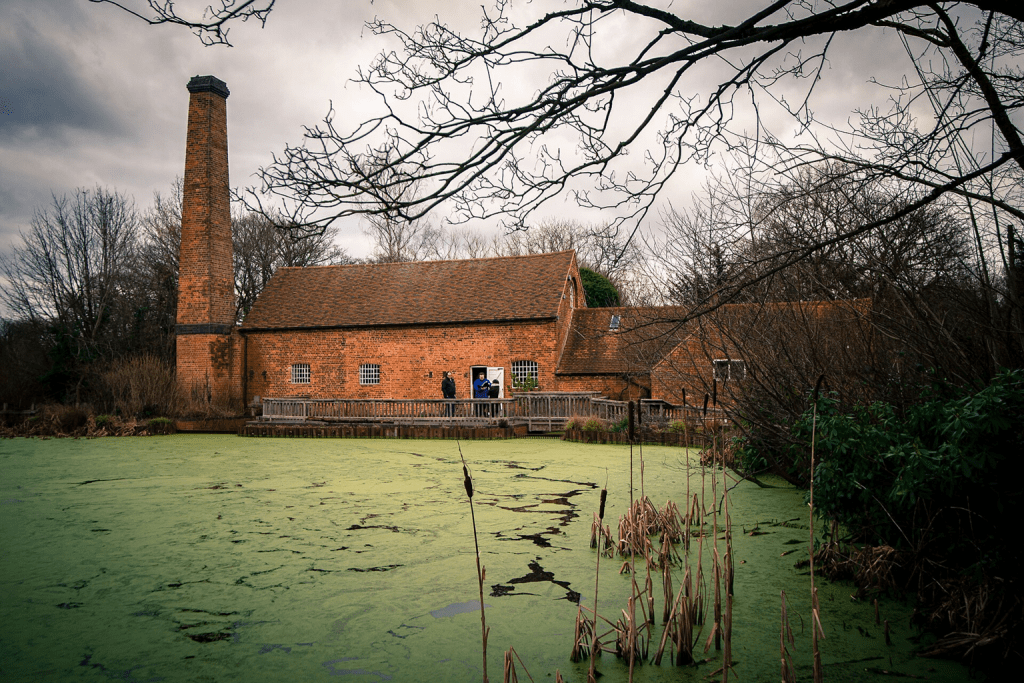
To fully grasp the context of the Two Trees, let us begin with the fact that they were born at the centre of Valinor or the Undying Lands, in the far West, where the Valar or the Gods lived. There was a green mound, called Ezellohar or Corollairë in Elvish tongues, on which Yavanna (the goddess of life) brought the Trees into existence. An important detail is that Nienna (the goddess of sorrow and of purifying weeping) watered the mound with her tears beforehand. When Yavanna began to sing, by the power of her song the Two Trees grew on the green mound. Here is how Tolkien describes them in The Silmarillion:
The one had leaves of dark green that beneath were as shining silver, and from each of his countless flowers a dew of silver light was ever falling, and the earth beneath was dappled with the shadows of his fluttering leaves. The other bore leaves of a young green like the new-opened beech; their edges were of glittering gold. Flowers swung upon her branches in clusters of yellow flame, formed each to a glowing horn that spilled a golden rain upon the ground; and from the blossom of that tree there came forth warmth and a great light.[1]
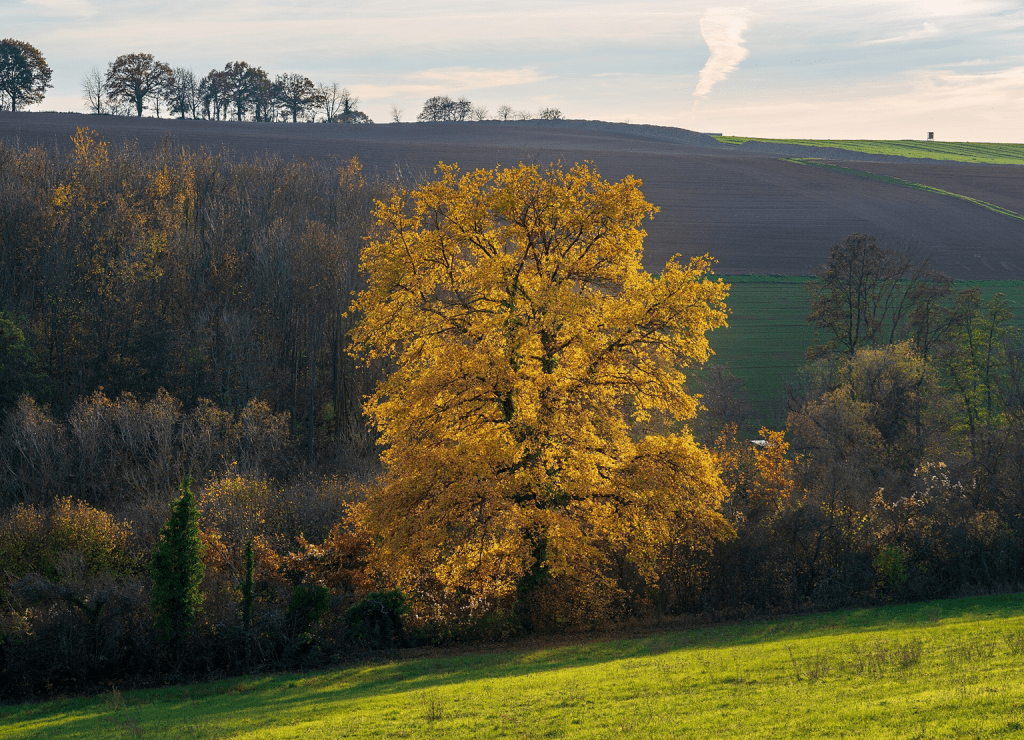
Both of the Trees are giving light that illuminates all the earth and the light is in a liquid form, falling to the ground like a luminous sap, which the Valar collect in vats placed underneath the Trees. Telperion, the Silver Tree, was older and masculine, but its light was weaker than that of Laurelin, the Golden Tree, which was feminine. The first cycle of time was based on the life of the Trees: first Telperion was shining alone for several hours, while Laurelin was sleeping; then Laurelin was awakening and the light of both were mingling for a couple of hours, until Telperion has fallen asleep and Laurelin was shining alone.
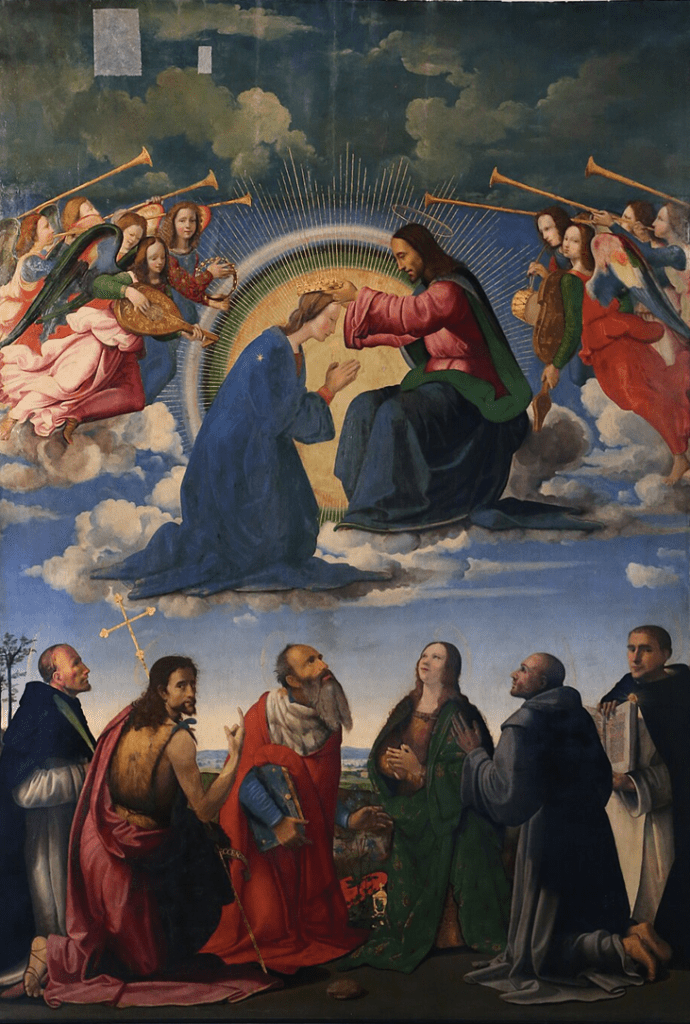
When the Elves, the First-born Children of God, were to awake on the earth, Varda (the goddess of light and a maker of stars) created new, more powerful stars to illuminate the Middle-earth: “Then she began a great labour, greatest of all the works of the Valar since their coming into Arda. She took the silver dews from the vats of Telperion, and therewith she made new stars and brighter against the coming of the Firstborn.”[2] The stars were the first thing that the Elves saw when they woke up to life, so they always loved Varda the most of all the Valar and they called her Elentári or Elbereth, the Queen of the Stars. Tolkien never denied that an association of Elbereth with Our Lady of the Catholic piety was an obvious one. The Mother of God was traditionally identified with the cosmic figure of the Woman crowned with the stars (Revelation 12) and praised in medieval hymns as Stella Maris, the Morning Star, or Regina Coeli, the Queen of Heaven.
If Elbereth made the stars in the image of the light of the shining Tree, the greatest of Elvish craftsmen, Fëanor, used the light of the Trees to create the most beautiful works of art ever made, the three Silmarils, living and shining jewels, which were to symbolise the tragic fate of the Elves, fallen and exiled from the Undying Lands into the Middle-earth dominated by the Enemy. The moment of the fall is preceded by a striking scene of the death of the Two Trees of Valinor.
The Valar and the Elves in Valinor celebrated a great feast in Valmar, the central city of the Undying Lands, when Melkor, assisted by Ungoliant, an evil spirit in the form of a great female spider, came to the holy mound of Ezellohar: “and Melkor sprang upon the mound; and with his black spear he smote each Tree to its core, wounded them deep, and their sap poured forth as it were their blood, and was spilled upon the ground.”[3] Ungoliant was “going then from Tree to Tree she set her black beak to their wounds, till they were drained; and the poison of Death that was in her went into their tissues and withered them, root, branch, and leaf; and they died.”[4] The whole earth was covered in black darkness and horror. The Elves decided to rebel against the Valar and left the Undying Lands into exile and the light was restored only when Yavanna and Nienna were able to bring the murdered Telperion to produce a flower and Laurelin to produce a fruit, which became eventually the Moon and the Sun.
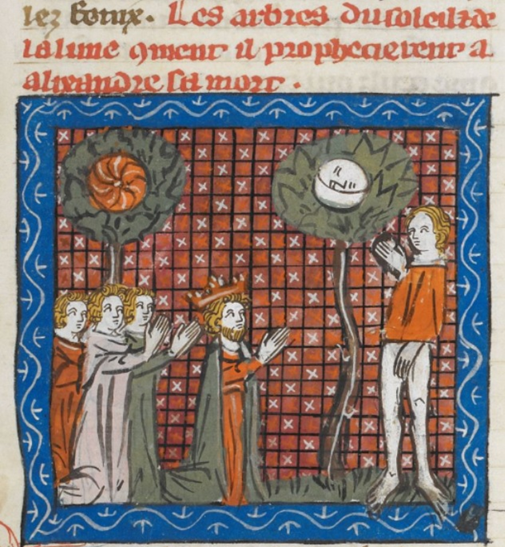
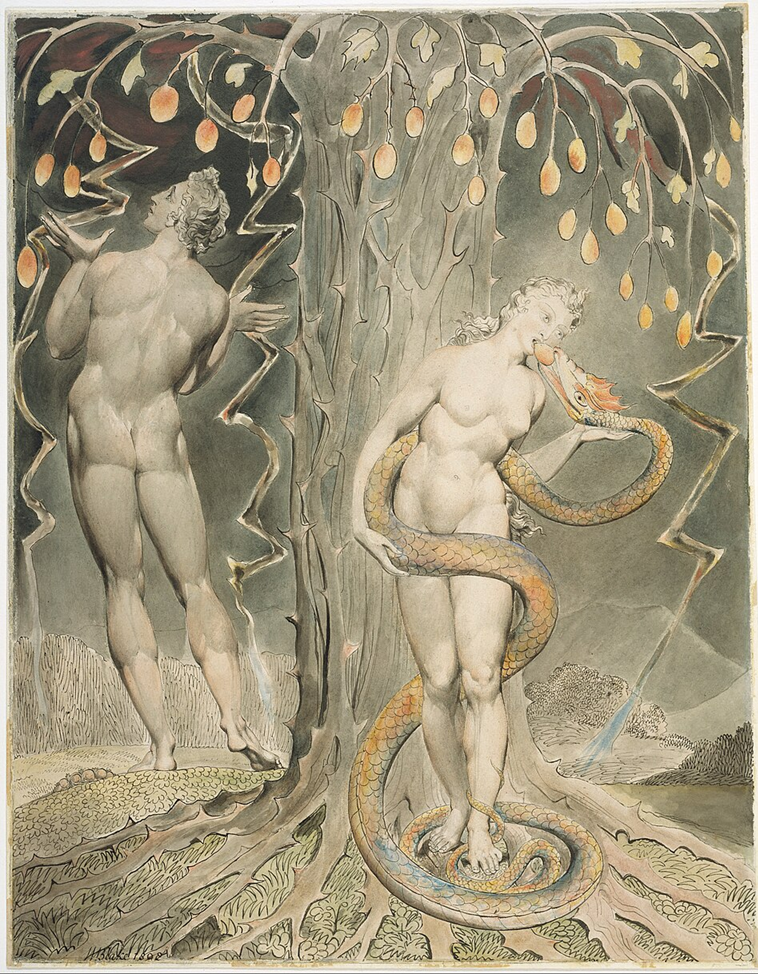
Can we point to some possible sources of Tolkien’s image of the Two Trees? Biblical images are perhaps the easiest to start with, since Tolkien was a devout Catholic throughout his life and participated in the mass in St Aloysius’ Church in Oxford not only on Sundays, but also in the early morning of every weekday. In Genesis we read: “And out of the ground made the Lord God to grow every tree that is pleasant to the sight, and good for food; the tree of life also in the midst of the garden, and the tree of knowledge of good and evil.” (Genesis 2:9). The fact that there were Two Trees in the Garden of Eden and that it was a realm beyond death, were Adam and Eve lived in communion with God, resonates obviously with the Two Trees of Valinor.
As we know God forbade Adam and Eve to eat from the Tree of Knowledge (Genesis 2:17) and it is suggested after the Fall that it was eating from the Tree of Life that gave them immortality (Genesis 3:22). The Serpent lied to Eve, assuring her that she would not die by eating of the Tree of Knowledge, but she and her husband will become gods (Genesis 3:4–5); she ate, gave to her husband, and they were exiled from the Garden, given over to death, suffering, and sin, falling under the dominion of the Enemy.
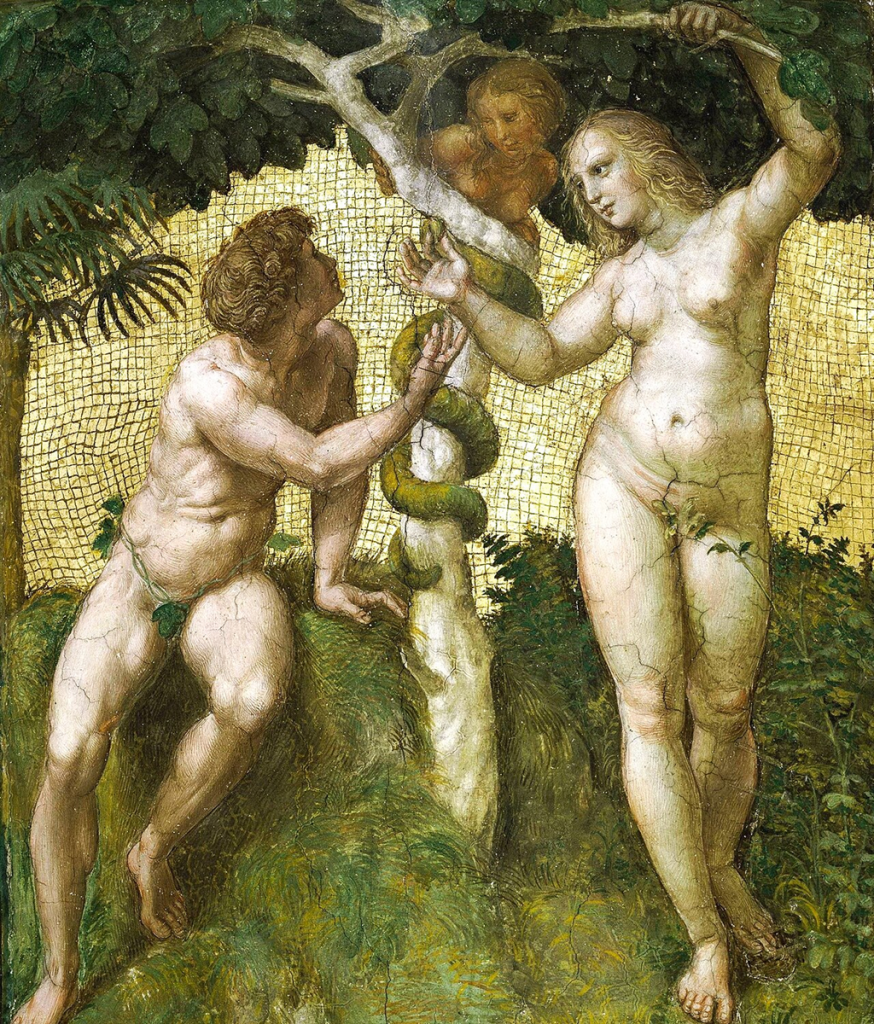
We can see that in Tolkien’s imagination the Two Trees, on the one hand, represent not only the principle of life (Yavanna) and the wounded and fallen state of Nature herself (Nienna), but also the light of God as manifested on earth (Elbereth). They are closely associated with crucifixion and death of the God-Man in Christian imagery. The Trees stand on a green mound (Golgotha) and already their birth is marked by the tears of Nienna, which anticipate what might be called a “Passion of the Trees”. Not only are they murdered by the Enemy, like Christ killed, according to the ancient Christian view, by the cunning of Satan, but the use of a spear by Melkor resonates with the famous piercing of Christ’s side with a spear by a Roman soldier (John 19:34).
In the Synoptic Gospels we read that, when Christ was crucified, there was “darkness over all the land” from the sixth to the ninth hour (Matthew 27:45; Mark 15:33; Luke 23:44), which corresponds with the darkening of Valinor and the entire earth after the killing of the Trees by Melkor and Ungoliant. The Spider represents “the poison of Death” that accompanies the Enemy who is the primary rebel and the inventor of death and darkness (“through envy of the devil came death into the world: and they that do hold of his side do find it,” Wisdom 2:24, and: “He was a murderer from the beginning”, John 8:44).
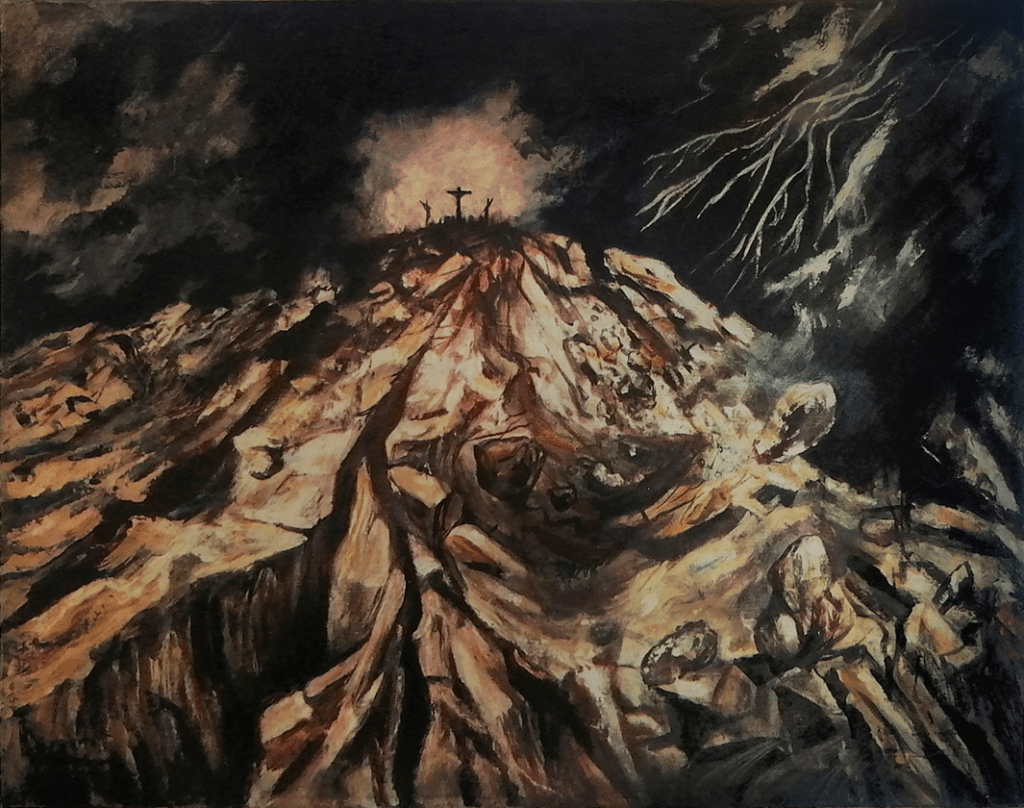
That the Trees of Tolkien represent divine Life is fairly understandable; but why do they represent Light as well? The image of a shining tree is most prominently present and seems to have entered the tradition by Venantius Fortunatus’ famous hymn Vexilla regis prodeunt. Venantius Fortunatus was a Late-Antique poet and bishop, active in the 6th century AD.[5]
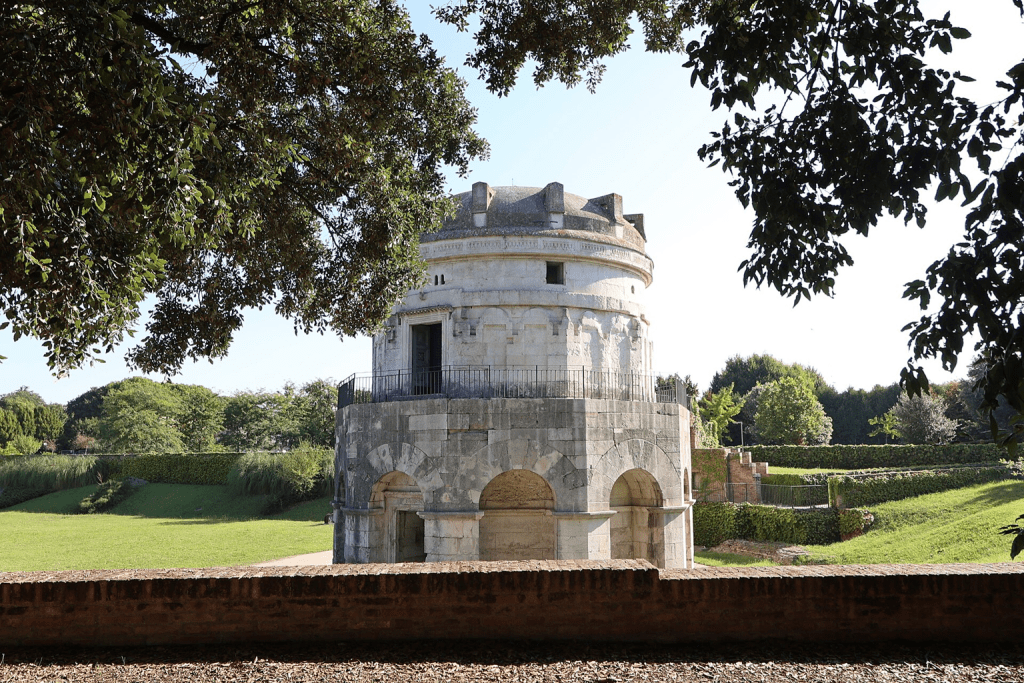
He was born in Italy and educated in Ravenna. During his life Italy moved from the hands of the Goths under the control of the Eastern Roman Empire; Ravenna was the capital of the Western Roman Empire in the 5th century, as it had been during the reign of Theodoric (493–526). Famous for its beautiful architecture and art, the city remained a centre of the remainder of Byzantine Italy also when Constantinople lost control over the entire peninsula.
After receiving his education in Ravenna, Venantius moved to Gaul and settled in Poitiers, where Queen Radegunde founded a religious convent; both she and the abbess Agnes were prominent patronesses of the poet. Towards the end of the 560s Radegunde asked the emperor in Constantinople for a piece of a relic of the Holy Cross. According to Late-Antique legend, it was believed that the very wood (lignum) of the Tree of Life, which stood in the Garden of Eden, through the most incredible vicissitudes, ended up as the lignum of the Cross on which Jesus Christ was crucified.
Two separate Church feasts eventually became associated with the Cross. The Inventio sanctae Crucis (3 May), which commemorated the finding of the relic of the true Cross by St Helen, the mother of Constantine the Great, in Jerusalem in AD 326–8, and the Exaltatio sanctae Crucis (14 September), celebrating the recovery of the true Cross by Heraclius at the Liberation of Jerusalem from the hands of the Persian Sassanids in 630.[6]
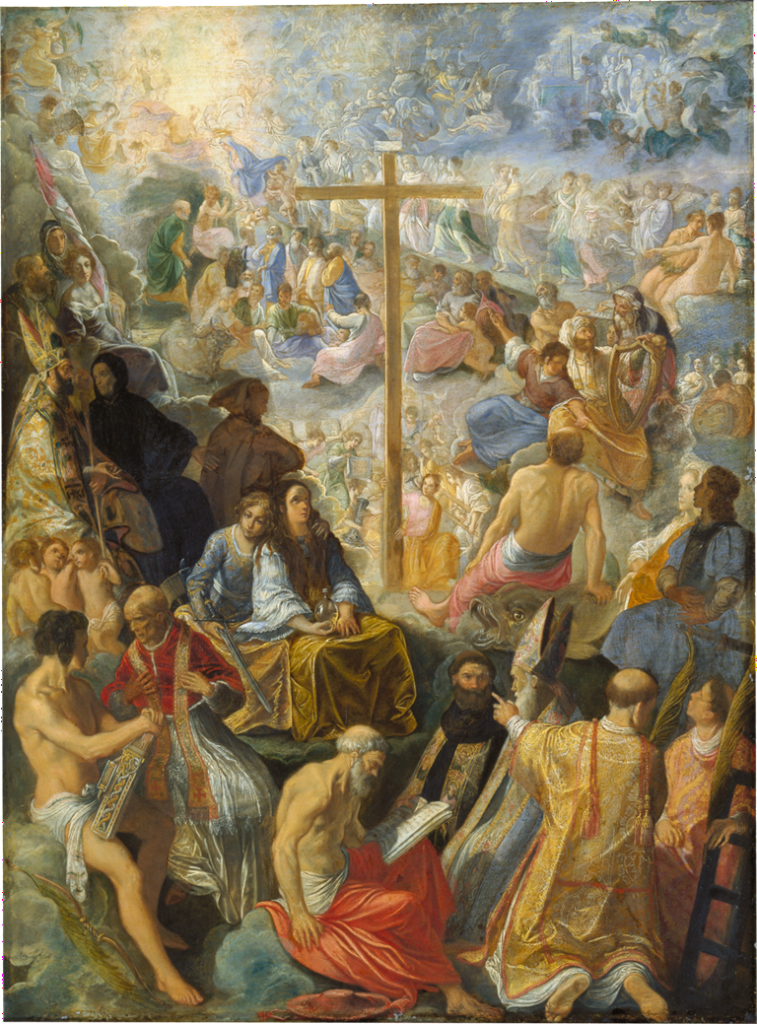
Emperor Justin II and his wife Sophia responded to Radegunde’s request by sending her a piece of the relic in 569. It seems that three of Venantius’ Fortunatus’ hymns were sung during a procession in which the relic was greeted in the monastery in Poitiers. Venantius wrote a total of six poems to celebrate the reception of the true Cross, all included in the second volume of his carmina: (1) Crux benedicta nitet (The blessed cross shines); (2) Pange, lingua, gloriosi (Sing, tongue, [the battle] of the glorious [contest]); (3) Virtus celsa crucis (The lofty virtue of the cross); (4) Dius apex carne (The divine height in flesh); (5) Extorquet hoc sorte (This demands by destiny); (6) Vexilla regis prodeunt (The king’s standards march forth).
Two of these hymns (4 and 5) are carmina figurata, poems which by their very shape on a page represent the Cross.[7] Two (Pange, lingua, gloriosi and Vexilla regis) became popular hymns included during the Middle Ages in the divine office, that is, in the monastic cycle of daily and nightly prayers, as well as in the celebration not only of the aforementioned feasts of the Invention and Exaltation, but also of the important ritual of the Adoration of the Cross during the Paschal Triduum.[8]
Joseph Szövérffy emphasises that Venantius’ Cross poems and their peculiar imagery “left its imprint on Christian hymnody and poetry for more than a thousand years because of the great popularity of his hymns”.[9] Especially the three great poems – Vexilla regis, Pange, lingua and Crux benedicta – were all “dominated by the idea that the Cross is identical with the Tree of Life”.[10] What is, however, more peculiar than this identification, is that Venantius describes the Cross as shining or luminous.
In the first poem, the very first words state that “the blessed Cross shines” (Crux benedicta nitet); later, he addresses the Tree directly: “You, once planted, are glittering” (Tu plantata micas). Most beautifully, this image of a shining tree is expressed in Vexilla regis, the most popular and influential of Venantius’ Cross poems. It begins, in Walter Kirkham Blount’s (1646–1717) translation: “Abroad the regal banners fly, / now shines the Cross’s mystery” (Vexilla regis prodeunt / Fulget crucis mysterium). While it is not the Tree itself that shines out here, but its mysterium, further on Venantius addresses the Tree: “O lovely and refulgent Tree, / adorned with purpled majesty” (Arbor decora et fulgida / Ornata regis purpura). Here the Cross becomes arbor fulgida, a shining tree, but in all his poems the Cross is a tree that is associated with death and the Passion; in Vexilla regis it is the dripping blood of Christ that becomes purpura, the Roman sign of royal dignity and power.[11]
The image of the arbor fulgida, or shining tree, seems to have been emphasised in the medieval imagination also by the fact that the third stanza, beginning with the words Arbor decora et fulgida, was often treated in the Middle Ages as a separate hymn, which is attested, for example, by one of the manuscripts now in Corpus Christi College, Cambridge, where we can find Arbor decora et fulgida with neums (medieval musical notation) and alphabetic notation.
My contention is that it was Venantius’ astounding image of a shining tree that inspired Tolkien to create the Two Trees, Telperion and Laurelin. An interesting question remains as to the origin of that striking image in Venantius’ poem. It is quite surprising that Szövérffy, in his edition of medieval poems to the Cross, doesn’t seem to be interested in the image of a shining tree at all. He merely notes the first appearance of this motif in the first stanza of Vexilla regis and then focuses much more on the identification of the Cross with the Tree of Life.[12]
His only explanation pertinent to our theme is that “decora means decorated with Christ’s body (cf. flore in Pange lingua 8,2); also fulgida, ‘shining’ for the same reason.”[13] When it comes to the first poem by Venantius, in which this striking image makes it appearance, namely Crux benedicta, Szövérffy points out that “nitet corresponds to fulget in Vexilla regis 1,2” and completely omits the later address to the Cross in the poem: tu plantata micas.[14]
We could follow Szövérffy in observing that the Cross is shining because it is “decorated” with Christ, who is Light (John 1:3 and 8:12). However, he fails to take into account not only that the Cross is the Tree of Life, but also that in the Gospel of Luke (23:31) Christ refers to Himself as a green tree that is about to be killed during the Way of the Cross. If Christ is both Life and Light (John 1:4), the Tree that He is would be not only living and green, but also a shining one: arbor fulgida.

There is, however, still another dimension to consider. Barbara Raw pointed out that, already in Late Antiquity, in Ravenna, we find jewelled crosses in churches: “In early Christian art the jewelled cross, like the monogram and the lamb, was a symbol of Christ. This idea is seen most clearly in the apse mosaic at Sant’Apollinare in Classe, Ravenna, which shows a jewelled cross accompanied by three lambs.”[15] It is a detail worth emphasizing because, although Raw doesn’t make that particular connection, Ravenna was a place where Venantius Fortunatus received his education. Without any doubt he knew the jewelled crosses quite well and could contemplate them shining with the reflected candle light during liturgy.
It is also worth noting that the crosses were associated with the stars and with the heavens in general, which, as we have seen, is a prominent element also in Tolkien’s mythology, where the light of the Two Trees becomes the light of the stars, used by Elbereth, or where their death gives birth to the Sun and the Moon (considered in antiquity and the Middle Ages also to be stars). Raw again: “The cross in the mosaic at Sant’Apollinare is framed in a medallion covered in stars, a feature which relates it to a number of fourth- and fifth-century mosaics in which one of the symbols of Christ – the lamb, the χρ or the cross – is displayed against a background of stars.”[16]
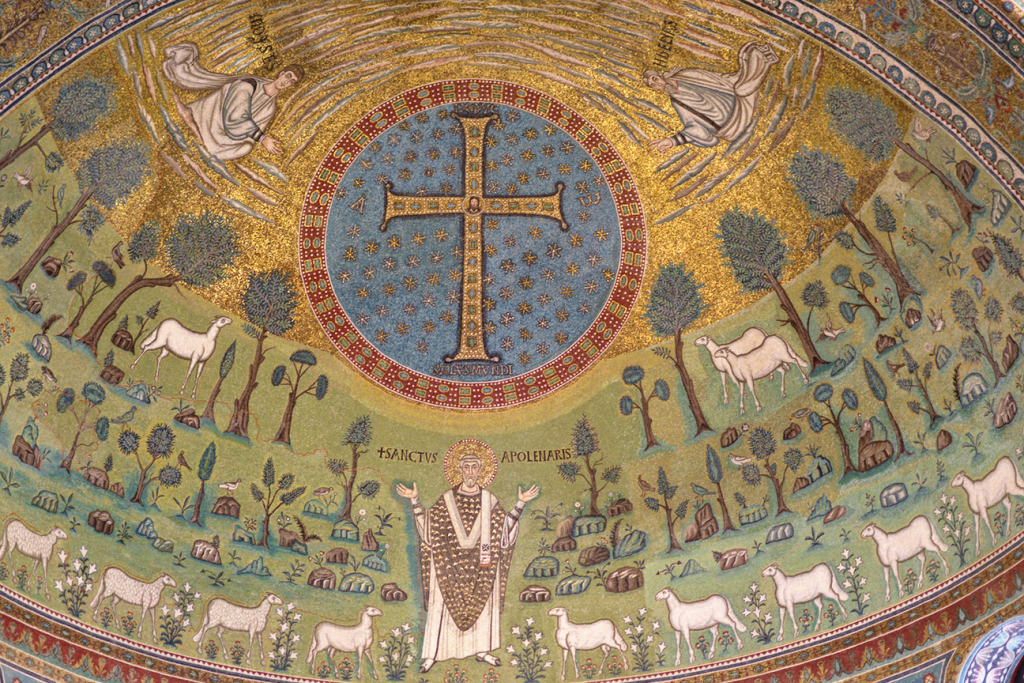
She also suggests that the image of a jewelled cross against the background of the starry heaven was associated primarily with the signum Filii hominis in caelo (Mt 24:30), the eschatological apparition of Christ during His Second Coming. A somewhat daring, but not entirely unlikely, hypothesis could be that, given the ancient Christian association of Christ with Dionysus, the image of Dionysus as the choregos of the dancing stars in Sophocles (already quoted: Antigone 1116), might have contributed to the sophisticated Ravenna imagery and blended with the New Testament descriptions of Christ as the true Light.

Regardless of whether this was what inspired Venantius to describe the Cross as arbor fulgida, it was through the influence of his Vexilla regis in particular that the image of arbor fulgida entered medieval imagery.[17] In the 11th-century manuscript of Aelfwine, the abbot of New Minster, we find a poem O crux splendidior cunctis astris (O star brighter than all stars), where the Cross is associated, again, with the dancing stars, and it shines more brightly than any of them.
The same idea appears also in the Vespasian Psalter, where it is said that the Cross will appear at the end of time shining more brightly than the sun and the stars.[18] This text was used in a beautiful motet by Adrian Willaert (1490–1562), a Renaissance Flemish composer active in Italy.
While we cannot be sure, I think it is very likely that Tolkien was familiar with both Vexilla regis itself and the whole medieval tradition in which the motif of arbor fulgida appears. First of all, the hymn of Venantius was used in liturgy during his life (as it still is in various vernacular translations), so we might expect Tolkien, as an early student of Latin and a practising Catholic, to hear it during the liturgy of the Holy Week or the Paschal Triduum.
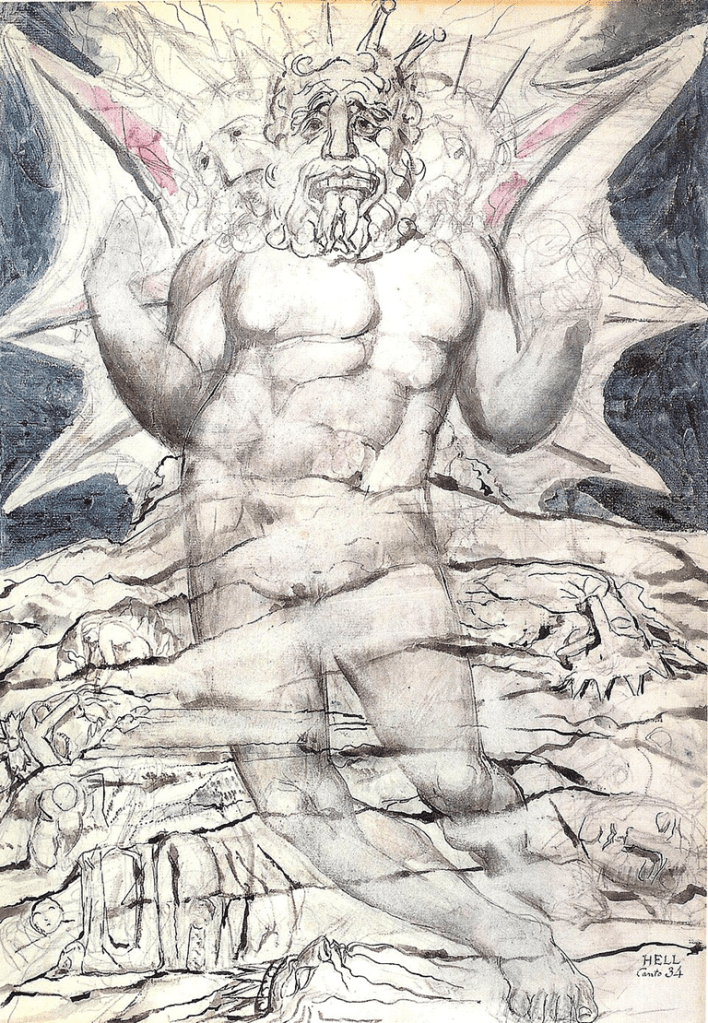
Secondly, Vexilla regis used to be one of the most popular hymns in the Catholic tradition outside the liturgy. Dante dignifies it with a peculiar reference in the 34th canto of his Inferno, which begins, as Dante and Virgil are descending into the abode of Lucifer:
“Vexilla regis prodeunt inferni
toward us; and therefore keep your eyes ahead,”
my master said, “to see if you can spy him.” (trans. A. Mandelbaum)
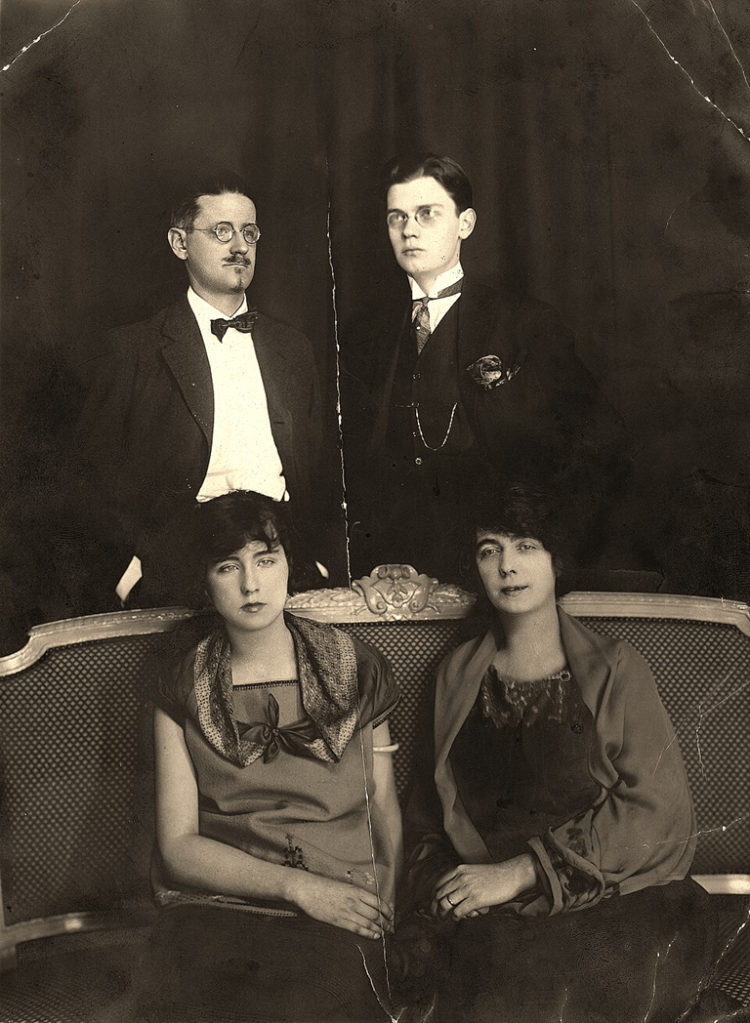
James Joyce (ten years older than Tolkien), in his first novel, A Portrait of the Artist as a Young Man (1916), describes towards the end a discussion of Stephen Dedalus, the protagonist and a student, with his friend Lynch, on the subject of beauty. During the discussion Stephen refers to St Thomas Aquinas:
Who knows? — said Stephen, smiling. — Perhaps Aquinas would understand me better than you. He was a poet himself. He wrote a hymn for Maundy Thursday. It begins with the words Pange lingua gloriosi. They say it is the highest glory of the hymnal. It is an intricate and soothing hymn. I like it: but there is no hymn that can be put beside that mournful and majestic processional song, the Vexilla Regis of Venantius Fortunatus. —
Lynch began to sing softly and solemnly in a deep bass voice:
Inpleta sunt quae concinit
David fideli carmine
Dicendo nationibus
Regnavit a ligno Deus.
— That’s great! — he said, well pleased. — Great music! — .[19]
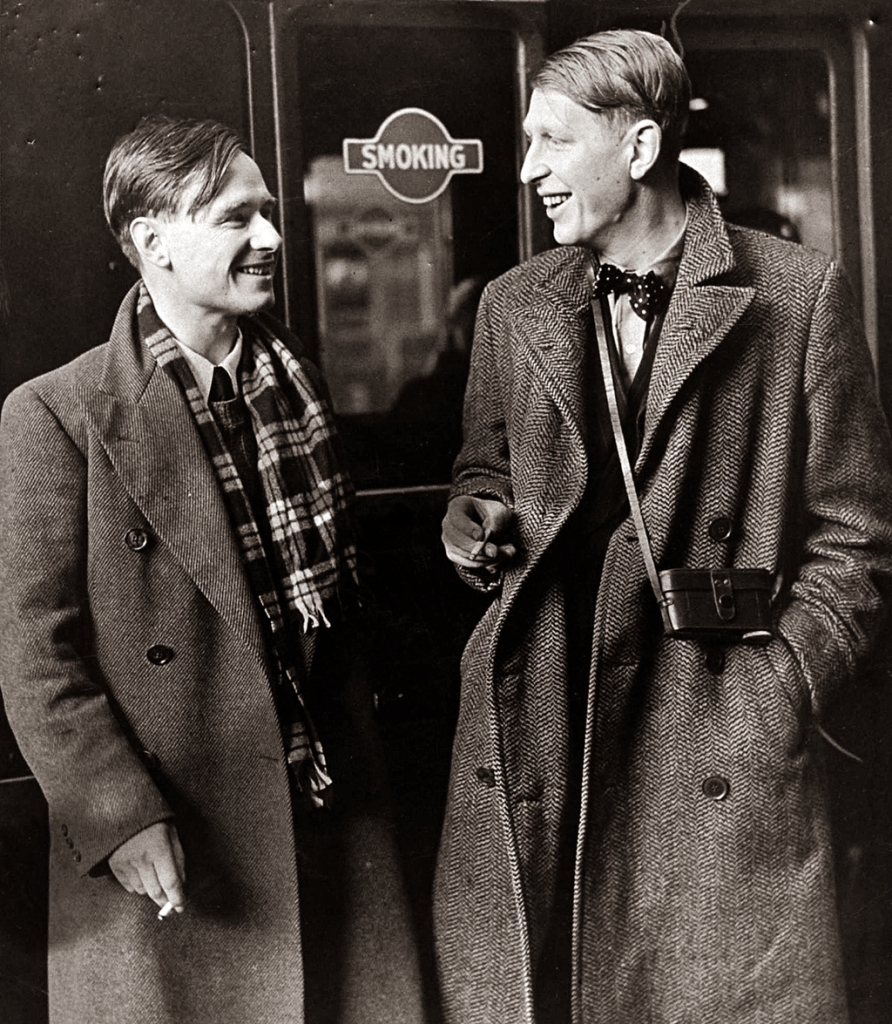
Almost ten years before W.H. Auden, one generation younger than Joyce, read The Lord of the Rings and became an ardent admirer and friend of Tolkien, he became interested in the divine office and was thinking about writing a series of poems based on this traditional, medieval form of prayer. In this period Auden also came across Venantius Fortunatus and used a quotation from one of his poems (Pange, lingua, gloriosi) as an epigraph to his cycle Horae Canonicae, completed in the 1950s. The epigraph was immolatus vicerit (“having been offered as a victim, he was victorious”). At the very end of Compline, one of the poems of the cycle, Auden prays that we:
…may come to the picnic
With nothing to hide, join the dance
As it moves in perichoresis,
Turns about the abiding tree.[20]
Not only is there a reference to the Cross as the Tree of Life, which comes from Venantius Fortunatus, but Auden also adds to it the motif of the cosmic dance of the stars. Here the celestial perichoresis moves around the Cross standing on the hill of Golgotha, where Christ (like Dionysus in Sophocles) is the choregos. He is not moving, but absolutely still, like the famous “still point” of T.S. Eliot’s Burnt Norton II (the image taken, as it happens, from a novel by Charles Williams, one of Tolkien’s fellow Inklings):
At the still point of the turning world. Neither flesh nor fleshless;
Neither from nor towards; at the still point, there the dance is,
But neither arrest nor movement. And do not call it fixity,
Where past and future are gathered. Neither movement from nor towards,
Neither ascent nor decline. Except for the point, the still point,
There would be no dance, and there is only the dance.

Thirdly, Tolkien might have encountered the image of arbor fulgida during his studies of Anglo-Saxon English literature.[21] It seems, pace Inge Milfull,[22] that an early Anglo-Saxon poem The Dream of the Rood was in fact influenced by Venantius Fortunatus’ poems or by the poetic tradition initiated by him.[23] The lyrical “I” of the poem describes a dream in which he saw
a wondrous tree
Towering in the sky suffused with light,
Brightest of beams; and all that beacon was
Covered with gold. (vv.5–8)
He later adds that he saw: “the tree of glory brightly shine / In gorgeous clothing, all bedecked with gold.” (15–16). Although here the jewelled and golden aspect of the Cross are emphasised more than its luminosity, the Tree of Life is, indeed, shining, in the Dream of the Rood, as in Vexilla regis.
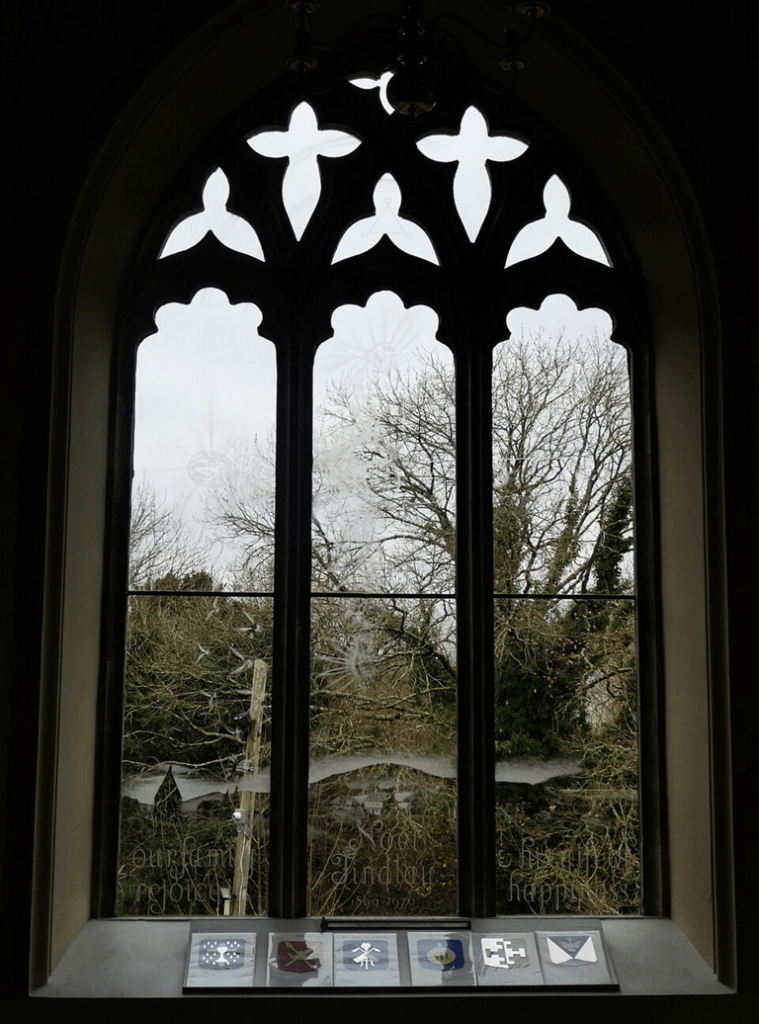
Tolkien could have also encountered this motif in Anglo-Saxon literature. There is a Latin riddle in which the Cross addresses the reader as follows: “Now I appear iridescent; my form is shining now. Once, because of the law, I was a spectral terror to all slaves; but now the whole earth joyfully worships and adorns me.”[24] Rosemary Woolf in an article dedicated to The Dream of the Rood quotes a formula of the consecration of a cross coming from the early 8th century: “Let the brilliance of the divinity of your Only-begotten Son shine here in gold and let the glory of His Passion shine out in the wood” (radiet hic Unigeniti Filii tui splendor divinitatis in auro, emicet gloria passionis in ligno).[25]
Although Tolkien, in one of his first letters to Auden, writes: “I had very little particular, conscious, intellectual, intention in mind at any point,”[26] his mythology shines through with profound, archetypal meanings. That these meanings often resonate deeply with Christianity Tolkien would never deny. He didn’t like allegory understood as a literary representation of ideas by a conscious and deliberate construction of images.
So, for instance, he would never choose a shining tree merely to express an intellectual idea that the Cross is the Tree of Life. He insisted that the images of his mythology were given to him intuitively, as if revealed from above. But they were to Tolkien, ultimately, as everything, theophanic images of the Creator. And his shining Trees of Valinor can also be interpreted as representing the Tree of Life, the Cross, and the Saviour Himself, the God-Man. As he confessed to Auden in the same letter, “each of us is an allegory, embodying in a particular tale and clothed in the garments of time and place, universal truth and everlasting life.”[27]

Mateusz Stróżyński is a Classicist, philosopher, psychologist, and psychotherapist, working as an Associate Professor in the Institute of Classical Philology at Adam Mickiewicz University in Poznań, Poland. He is interested in ancient philosophy, especially the Platonic tradition. His most recent books are Plotinus on the Contemplation of the Intelligible World: Faces of Being and Mirrors of Intellect (Cambridge UP, 2024) and Plato and Jesus, not Caesar: Metaphysics of Freedom and Tyranny in Younger Europe (Brill, Leiden, 2026).

Notes
| ⇧1 | J.R.R. Tolkien, The Silmarillion (C. Tolkien ed.) (HarperCollins, London, 1998) 26. |
|---|---|
| ⇧2 | Ibid., 44. |
| ⇧3 | Ibid., 79. |
| ⇧4 | Ibid., 80. |
| ⇧5 | J. Szövérffy, Hymns of the Holy Cross: An Annotated Edition with Introduction (Classical Folia, Brookline, MA, 1976) 7–20. |
| ⇧6 | Szövérffy (as n.5) 4. |
| ⇧7 | I.B. Milfull, “Hymns to the Cross: Contexts for the Reception of Vexilla Regis Prodeunt,” in C.E. Karkov, S. Larratt Keefer & K.L. Jolly (edd.), The Place of the Cross in Anglo-Saxon England (Boydell, Woodbridge, 2006) 43. |
| ⇧8 | See Milfull (as n.7) 50. |
| ⇧9 | Szövérffy (as n.5) 8. |
| ⇧10 | Ibid., 10. |
| ⇧11 | Cambridge, Corpus Christi College, Ms. 473, f.195v, reproduced in Milfull (as n.7) 53. |
| ⇧12 | Szövérffy (as n.5) 16. |
| ⇧13 | Ibid., 17. |
| ⇧14 | Ibid. 19. |
| ⇧15 | B.C. Raw, “The Dream of the Rood and its connections with Early Christian Art,” Medium Aevum 39.3 (1970) 239–56, at 242. |
| ⇧16 | She continues: “Designs of this kind decorate the recess above the tomb of Constantina in the Church of Santa Costanza in Rome, and cover the vaulting in the Mausoleum of Galla Placidia and the central vaults in the Archiepiscopal Chapel and of the Church of San Vitale at Ravenna.” (Ibid., 243). |
| ⇧17 | Ibid. 245–6. |
| ⇧18 | Ibid., 250–1. |
| ⇧19 | J. Joyce, A Portrait of the Artist as a Young Man (B.W. Huebsch, New York, 1916) 246. |
| ⇧20 | W.H. Auden, The Shield of Achilles (A. Jacobs ed.) (Princeton UP, 2024) 61. |
| ⇧21 | As Milfull points out, “some scholars at least had access to the complete collection including Book II, which contains the six poems to the cross” (as n.7, 55). See also R.W. Hunt, “Manuscript evidence for knowledge of the poems of Venantius Fortunatus in late Anglo-Saxon England,” Anglo-Saxon England 8 (1979) 279–95; S. Coates, “The construction of episcopal sanctity in early Anglo-Saxon England: the impact of Venantius Fortunatus,” Historical Research 71/174 (1998) 1–13. |
| ⇧22 | Milfull (as n.7, 51) writes: “the imagery does not originate with Venantius Fortunatus.” |
| ⇧23 | The Dream of the Rood, in A Choice of Anglo-Saxon Verse, trans. R. Hamer (Faber, London, 1970, available here. |
| ⇧24 | Tatwine, “Latin Riddle 9 (early 8th century),” in Sources and Analogues of Old English Poetry, trans. D.G. Calder & M.J.B. Allen (Cambridge UP, 1976) 53–8. |
| ⇧25 | R. Woolf, “Doctrinal influences on ‘The Dream Of The Rood’,” Medium Aevum 27.3 (1958) 137–53, at 137 n.3; trans. mine. |
| ⇧26 | Letter 164 to W.H. Auden, 7 June 1955: J.R.R. Tolkien, Letters, ed. H. Carpenter (Allen & Unwin, London, 1981) 211. |
| ⇧27 | Ibid., 212. |