Wolfgang de Melo
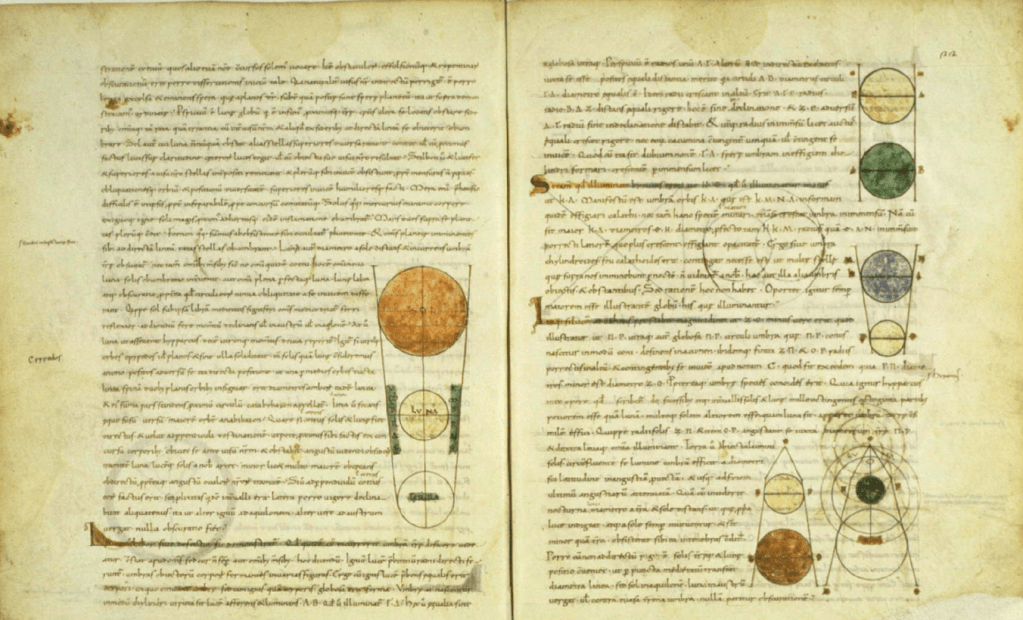
If you don’t know who Calcidius was, you can be forgiven: barely anyone these days has heard of him, let alone read his work, which consists of a Latin translation of the first half of Plato’s Timaeus and a very detailed commentary on its technical aspects. However, for eight centuries Calcidius was the main source of knowledge about Plato in the western world, and he was revered as a Latin Plato.
In the 10th or 11th century, a frustrated library user in Bamberg had requested the works of Plautus, but been given the wrong manuscript, so he wrote an angry letter to the librarian.[1] Here he contrasts phrases from the author he had wanted, Plautus, with phrases from the author he had been given, Plato; but this “Plato” is none other than Calcidius. However, already in the 19th century, Alfred Gercke spoke of the
commentary on the Timaeus by Calcidius, so famous during the Middle Ages, but now almost forgotten, and rightly so, in other words, the stumbling and bumbling translation of (the beginning of) a Greek commentary by a Christian monk barely capable of writing Latin or, as Freudenthal has it, a Jew named Calcidius.[2]
Gercke was still in his twenties and had just started as a language instructor at the Luisengymnasium in Berlin when he made this pronouncement, whose harshness we may ascribe to the author’s youth and his desire to appear as a linguistic connoisseur; but Calcidius has always been a polarising figure, drawing either extravagant praise or excessive scorn.
In this essay, I want to examine whether Calcidius’ language can give us any clues about his origins. But before I do so, I want to give my readers the briefest of introductions to Plato and Platonism, followed by the non-linguistic information we can glean about Calcidius from his work. I hope to show that Calcidius was probably not a native speaker of Latin, but that his language, far from being some kind of debased gibberish, is the educated usage of a skilled second-language learner.
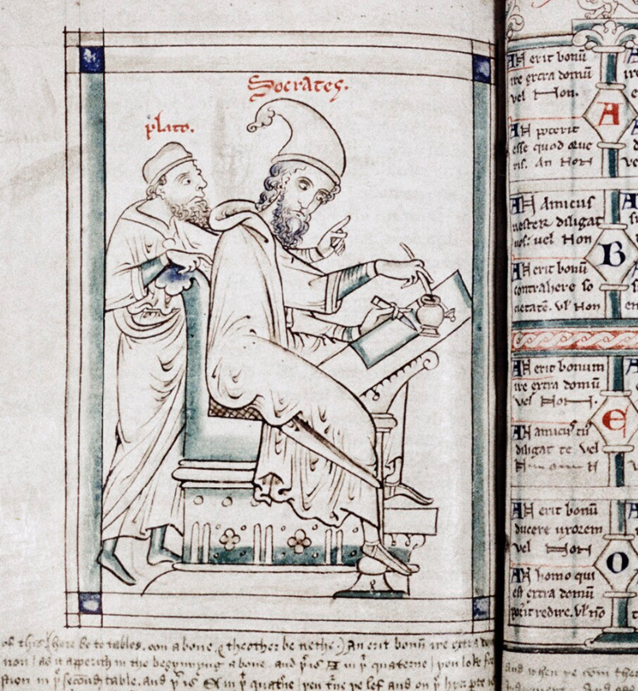
1 Plato and Platonism
1.1 Central Themes of Plato’s Thought
For Plato, just as for all Ancient Greek philosophers, the central goal of philosophy is one’s own εὐδαιμονία (eudaimoniā), a term often rendered as “happiness”, but what is meant is not the fleeting satisfaction that comes from a good meal or other pleasures of the body, but rather, a meaningful life with inner contentment. This kind of happiness is achieved through a virtuous life. Since the world has been created by a just God, and since it would not be just if bad people were happy and good people were unhappy, the Stoics later maintained that virtue on its own must be sufficient for happiness. This view is already found in Plato, but side by side with it he also believes, as outlined in his dialogue Philebus, that in order to achieve happiness, we also require an appropriate, relatively small amount of external goods. However, since virtue plays such a central role for happiness, those who lead bad lives must be doing so out of ignorance.
In the Meno we learn that all humans have innate knowledge, and philosophical thought can bring this innate knowledge to the surface. In the Phaedo, Plato argues that perception through the senses is imperfect and does not lead to deeper knowledge; “sensible” things stand in opposition to “intelligible” ones, the “ideas”, which we can gain access to through thought alone. However, the contrast between sensible and intelligible things is not yet absolute; in the Phaedo, Plato also speaks of knowledge of the sensible world, and belief in the intelligible world, so he is not yet an advocate of the theory of the ‘two worlds’, where we can only have unsubstantiated belief in the sensible things, but true knowledge only of the sensible ones.

1.2 A Few Words on the Republic
Since the Timaeus is presented as a conversation taking place the day after the dialogue about the ideal state, the Republic is, in some ways, the basis for the Timaeus. The overarching question of the Republic is what δικαιοσύνη (dikaiosunē) or “justice” is. The human soul consists of three parts, called λογιστικόν (logistikon), θυμοειδές (thūmoeides), and ἐπιθυμητικόν (epithūmētikón). The first of these is the rational element; the second, the fiery one; and the third, the passionate one. Human beings are just if and only if each of the three parts fulfils its proper function and if they are in the correct proportion to each other. If the passionate element enters into conflict with the rational one, a confusion of the soul can arise. In other words, not all desires and wishes can be explained rationally, a view for which there is still little evidence in Plato’s earlier dialogues.
Just as the soul consists of three parts, the ideal, just state can be divided into three corresponding classes of people, classes which, to a cynical observer, closely resemble some of the original Indian castes: there is a ruling class, a soldier class, and a working class. The fact that government is the duty solely of the ruling class is, at the end of the day, a no to democracy. However, we should not forget that Plato’s low opinion of self-determination for everyone as well as the curtailment of personal freedoms were not meant as a sacrifice for the benefit of the state; rather, the intention was that all human beings, regardless of their class, should be able to achieve their potential and to maximise their happiness.

1.3 The Timaeus
The Timaeus itself begins with the story about Atlantis, narrated by Critias; this story is the connective element that glues the Republic and the Timaeus together, but despite its huge influence on later European literature, it has little relevance to the actual dialogue.
The main part of the dialogue is in fact about cosmology, presented in lecture form by the eponymous main speaker, Timaeus of Locri. The ultimate principle of being is the idea of what is good; unfortunately, cosmology cannot give us direct access to this ultimate principle, but it can give us access to the principle of coming-into-being. Time is to be understood as a moving image of eternity; eternity itself is an indivisible whole, while time has parts, the past, the present and the future. Our world is good; however, it is good not because it is an exact copy of the eternal paradigm, but because it has properties that are analogous to those of the eternal paradigm.
God is the ultimate principle of being; our world is the result of the encounter between the intelligent principle and matter, which is unordered. God brings order into chaos, and in this process, the world is created, and is itself a (lesser) god.
1.4 Enter the Neoplatonists
After Plato’s death, Hellenistic schools of philosophy, and here especially the Stoics and the Epicureans, became popular very quickly, and perhaps that is the ultimate reason why Plato’s thoughts were not considered a complete, independent philosophical system before the 1st century BC. And not before the 2nd century AD can one speak of Platonism as such. The Platonists differ from each other in many ways, but they share certain principles and core beliefs, outlined succinctly in Brittain (2019).
Their core principles could be summarised like this:
(a) Plato’s dialogues are the basis for any further discussion, a corpus comprising correct teachings;
(b) empiricism is insufficient for understanding the world and concepts such as ideas, the soul and God;
(c) religious practices become increasingly important.
These three core principles actually go against Plato:
(a) Plato is presented as more or less infallible, but the Socrates of the dialogues presents everything as open for discussion and criticism;
(b) we reach a transcendental dialectic with complex metaphysical principles that has less and less in common with Plato’s themes and goals;
(c) the gnostic theory of theurgy has more in common with Christian soteriology than with Plato.
But the principles can be explained via three basic assumptions:
(a) Plato’s dialogues create an internally consistent model;
(b) this model is meant as a holistic, all-encompassing one;
(c) Plato’s thoughts are most easily understood via Aristotle, whose thought is not a further development.
In terms of epistemology, the Platonists consider the “intelligible” principles their primary research goal. These principles are to be grasped through cognitive abilities that are not subjected to the senses; in modern parlance, they form a separate ‘module’ of the mind.[3] And since these cognitive skills are not connected to sense perception, we must have access to innate, non-empirical knowledge.
On this note, let us move on to Calcidius himself.
2 What Do We Know about Calcidius?
2.1 When Was Calcidius Active?
It has been known for a long time that the preface to Macrobius’ Saturnalia contains a passage from Calcidius (Transl. 50e), inserted almost verbatim. The Saturnalia date to around 430. But we can go further: there is another passage of Calcidius (Comm. 44) that is almost identical with a passage of Favonius Eulogius (22); until recently, the assumption was that Calcidius and Favonius were using the same source, a section of Adrastus, quoted independently by Theon, but this assumption is no longer tenable.
Dorfbauer (2003, 200–2) managed to prove that Favonius is directly copying from Calcidius, not only because it is doubtful whether Favonius knew enough Greek to read Adrastus, but also because Calcidius failed to understand a musical problem in Adrastus, mistranslated it, and the same error recurs in Favonius; now Favonius, a reasonably good rhetorician, polished the passage from Calcidius, while it would seem unlikely that Calcidius would take a passage from Favonius and make it clumsier. Favonius’ work was probably written between 400 and 420.
If, then, Calcidius was active before those dates, we can also state roughly after which dates he composed his oeuvre. As we will see later, Calcidius also depends on Porphyry, and Porphyry died in 305.
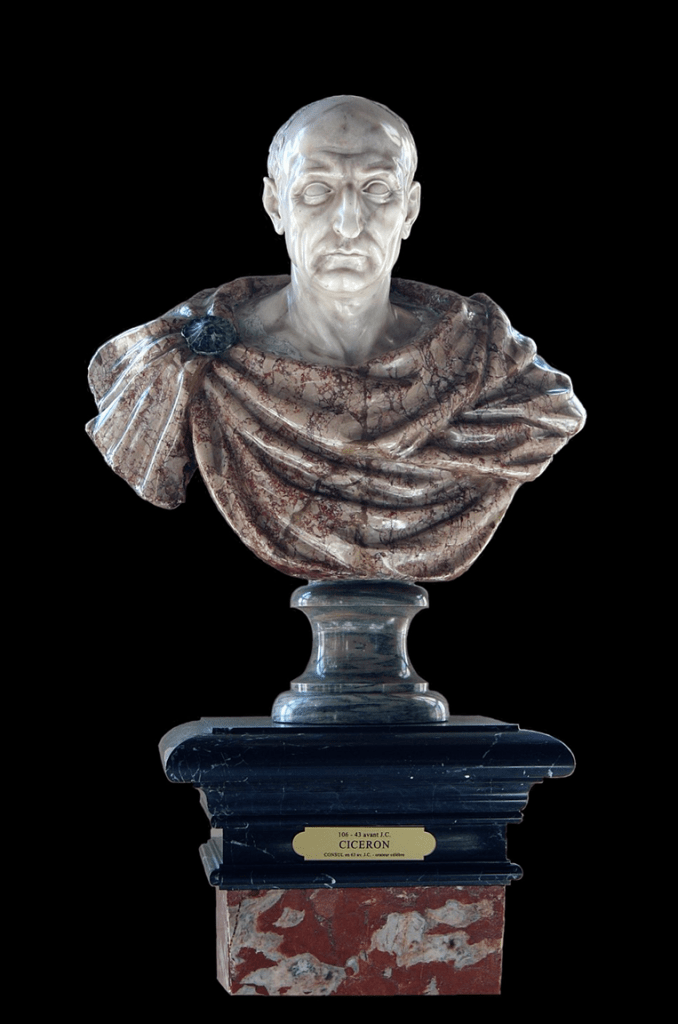
Calcidius dedicates his efforts to a certain Osius. If that Osius was Bishop Hosius of Corduba, then presumably Calcidius was active in the first half of the 4th century because Hosius became bishop in 295 and died in 359.
2.2 Calcidius and Cicero
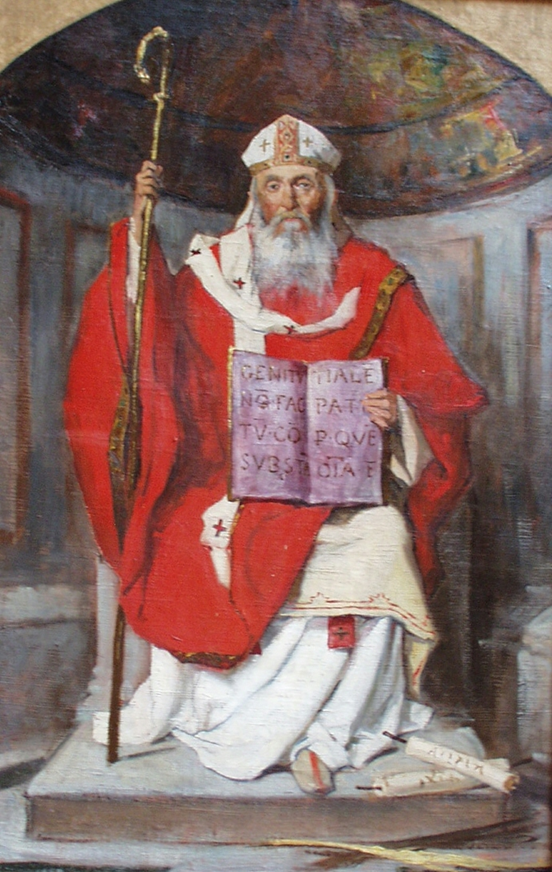
Calcidius was not the only translator of Plato’s Timaeus into Latin: his famous predecessor was none other than Cicero himself. It may seem either very foolish or very brave to attempt a fresh translation when one’s predecessor was the most illustrious model of Latinity, so it is not an unreasonable question to ask whether Calcidius was actually aware of Cicero’s translation. He clearly did not base his translation directly on Cicero’s, and it is perfectly possible that he was blissfully unaware of his predecessor’s efforts. However, I would not want to exclude the possibility that Calcidius knew of, and perhaps even used, Cicero’s translation.
In fact, there would have been perfectly valid reasons for Calcidius to make his own translation. For starters, Calcidius’ translation is far more complete than what Cicero had produced.[4] It is also more literal, which makes the text somewhat awkward, but being literal can also be an advantage: for Neoplatonists, Plato was sacred scripture, and greater fidelity to the original would have outweighed lesser elegance. And finally, Calcidius also wrote an enormous commentary, and from my own experience it is much easier to base your commentary on your own translation; then you don’t have to explain or argue with your predecessors’ translation choices.
2.3 Was Calcidius a Christian?
Much recent research assumes that Calcidius was a Christian; Reydams-Schils (2020) is a notable exception, and I agree with her. It is true that later manuscripts call his addressee Osius an episcopus, “bishop”, and many of them promote Calcidius to a diaconus by association, but if he really was a deacon, then he would have been even less qualified for the job than many politicians are for theirs. In fact, it seems doubtful whether his ideas would have passed muster in an elementary catechism class.
Calcidius, it is true, is familiar with the creation story in Genesis, he has acquainted himself with the basic tenets of Jewish wisdom literature, and he knows about the magi coming to see Mary and Joseph after the birth of Jesus. That said, he opposes the idea that the universe was created out of nothing, he is highly critical of certain aspects of Judaism, and when he mentions the magi, he states that his addressee knows more about this than he himself does.
Whether or not Osius was the famous bishop who presided at the First Council of Nicaea, he was clearly a Christian, but Calcidius was a Platonist, not a Christian, and he merely seeks not to alienate his addressee and to establish common ground wherever possible.
2.4 An Independent Thinker?
Calcidius quotes a vast range of philosophers, and even where he does not name names, the apparatus in Waszink’s monumental edition still overflows with parallel passages; in some of these parallel passages, the similarities may be the result of accidental overlap, but in others, it is clear that we are dealing with very literal translations. Thus, traditionally, Calcidius has always been denied originality. However, Reydams-Schils (2020) is undoubtedly correct when she argues that he still has some independence: the way he structures and digests his material shows a thinker who is not afraid of going his own way.
In one area, however, Reydams-Schils’ assessment has been superseded by an exciting new discovery. Reydams-Schils argued, very intelligently, that Calcidius is unlikely to depend on Porphyry, who had often been assumed to be one of his main sources; where Calcidius and Porphyry agree, she stated, they could both be using common sources going back to Middle Platonism.
It is indeed true that Calcidius never mentions Porphyry by name; and in 2020, when Reydams-Schils’ book came out, her position was still feasible. However, just a year after, in 2021, Arzhanov published his edition of a Syriac text, whose author (probably Severus Sebokht, died in AD 666/7) states explicitly that he is translating Porphyry; and that Syriac text is virtually identical with a chunk of Calcidius’ commentary (302–20)!
Now the writer of the Epistula Bambergensis claimed to quote Plato, but in truth quoted Calcidius’ translation of Plato; but the Syriac author is certainly not translating Calcidius. Calcidius Latinises much of his terminology, while the Syriac text simply transliterates the Greek technical terms.
One may of course wonder why Calcidius quotes so many Greek philosophers, but never even mentions Porphyry by name. But perhaps this is not as unreasonable as one might think: after all, the addressee Osius was perhaps the Bishop of Corduba, but at any rate most definitely a Christian, and Porphyry had written strongly-worded invectives against the Christians. Calcidius probably didn’t want to put off his primary reader!
I don’t teach Plato or Neoplatonism, and so have never recommended Reydams-Schils’ book to my students. But if I were to start teaching these subjects tomorrow, I would still recommend her book (albeit in conjunction with Arzhanov!). Not only is much of what she says still valid, I should at this juncture also point out that when Arzhanov’s work came out, she retracted her statements about Porphyry, and did so with a grace that few scholars in her position would have mustered. In academia, big egos are as common as elsewhere – perhaps even more common. I respect Reydams-Schils’ commitment to finding the truth all the more.
But what can we find out about Calcidius from his language? This is the question we must turn our attention to next.
3 Calcidius’ language
3.1 Philosophical Terminology
For the creation of philosophical terminology throughout the history of Latin we now have the excellent monograph by Chris Dowson (2023), with a chapter dedicated to Calcidius. I had the honour to examine Chris’s doctorate, and I have learnt much from the thesis as well as from the book based on it.
There are three potential problems that I should at least mention. First, later authors may use words from Plato as technical terms, even though they were not used as technical terms by Plato himself; thus, the Neoplatonists Plotinus and Proclus make a strict distinction between ἀίδιον (aidion), “outside of time”, and αἰώνιον (aiōnion), “everlasting”, while Plato himself uses these words interchangeably.
The opposite issue is less common; when later authors conflate two technical terms, they tend to do so deliberately. For example, Plato distinguishes between εἰκός (eikos), “objectively likely”, and πιθανός (pithanos), “subjectively plausible”, but Cicero (Luc. 99–100) uses veri simile and probabile interchangeably, based on the innovative doctrines coming from the New Academy.
And finally, explicit statements by ancient authors may not be reliable. According to Seneca (Ep. 58.6–7), Cicero translated Plato’s οὐσία (ousiā) as essentia, “essence”, but this term is not found in Cicero’s extant works, including his translation of the Timaeus.
New words and expressions can be created in a number of different ways. We can simply borrow a word from another language; English rouge is a loanword from French, and its final sound does not occur in native English words in this position or at the start of a word. We can also ‘calque’: the English phrase it goes without saying is translated from French il va sans dire, while French gratte-ciel is based on English skyscraper. And thirdly, we can also add new meanings to existing words, based on what the donor language does: in English, calling originally meant the act of calling out for someone by using their name, but under the influence of Latin vocatio, which has two meanings, it became a loan shift and additionally acquired the meaning for which we also use the loanword vocation.
All three methods can also be found in Calcidius. Here are three examples from his translation: as a loanword, he uses epogdoos, “the ratio 9:8” (36a, ἐπόγδοος); as a calque, aerivagus, “floating through the air” (40a, πτηνὸν καὶ ἀεροπόρον, ptēnon kai āeroporon); and as a loan shift, serenitas, “smooth surface” (46c, λειότης, leiotēs). However, these three methods are not used equally in the translation and the commentary: in the commentary, loanwords are used freely, but in the translation, they are largely avoided. This procedure does not surprise me at all; like many translators, I do exactly the same: when I am writing a text from scratch, loanwords do not bother me, but when I am translating, I avoid them, not least because I do not want to give the impression that I was lost for words in the language I am translating into.
3.2 Other Vocabulary
Calcidius is very fond of unusual vocabulary and usages. A few examples will be enough. First, there are artificial usages; for example, he never says cotidie, “daily”, or heri, “yesterday”, but always cotidianis diebus, “on daily days” (Comm. 115), hesterno die, “on yesterday’s day” (Transl. 20b, 26a) and praeterito die, “on the past day” (Transl. 20c, 25d). Then there are words that are not attested anywhere else or are at least very rare, such as duitas, “twoness” (Comm. 286, otherwise only in glosses), plectricanus, “lute-playing” (Comm. 72) or scius,[5] “knowing” (Comm. 185).
That said, some usages only appear odd from a Classical perspective, but are not uncommon in later Latin, such as credulitas (Transl. 37b) in the positive sense “trustfulness” rather than the negative sense “gullibility” that is normal in Classical Latin. But there are some genuine oddities out there, for instance solstitialis (Comm. 244) used of the sun rather than the solstice.
I tend to associate the desire to impress with choice vocabulary, and the occasional misuse of said vocabulary, with highly educated second-language learners, but of course there are also native speakers who fit that description.
3.3 Interference from Greek
There are quite a few passages where we can detect interference from Greek: Calcidius’ Latin syntax has gone awry because he was looking at a Greek text or thinking in Greek. Four examples will suffice here, two from the translation and two from the commentary.
Perhaps the most egregious example in the translation is found in 43e: here, Plato uses ὥστε (hōste), “so that”, with the infinitive; Calcidius translates with propterea, “therefore”, and a main clause, and such a main clause ought to contain a finite verb, but the Greek construction leads him astray and he uses an accusative-and-infinitive construction. In Transl. 18a, there are again various accusatives, praeditos… ferociores… sapientes… mites… feroces, “endowed with… wilder… wise… mild… wild”, and these are not syntactically connected with the clause they are in; Plato also uses accusatives, but here they are justified because they are in an accusative-and-infinitive construction dependent on δέοι (deoi).
In Comm. 70, Calcidius uses the genitive Veneris, “of Venus”, as a subject; this seems absurd until we realise that he is translating a Greek passage by Theon (136.25–137.6), who has ὁ δὲ τῆς Ἀφροδίτης (ho de tēs Aphroditēs), “the one of Aphrodite”, short for “the planet of Aphrodite”. “The one” is rendered as the definite article in Greek, but since Latin has no article, Calcidius leaves it out, leaving us with a genitive that does not depend on anything.
For me, the most interesting passage is Comm. 197, because here Calcidius is translating the Greek philosopher-poet Empedocles into Latin hexameters. One of them reads, nec sentit caros mandens sub dentibus artus, “nor does he realise that he is chewing beloved limbs under his teeth”. With sentit, we expect the accusative-and-infinitive construction, accusative se and infinitive mandere; what we get instead is a nominative participle mandens, akin to a Greek nominative-and-infinitive construction that a Greek writer could use with verbs of realising. But this cannot be interference, because Empedocles is not using the nominative and infinitive here! Perhaps Calcidius was trying to imitate Virgil, who uses such a Greek-style nominative and infinitive, also dependent on “he realised” (sensit medios delapsus in hostes, “he realised that he had fallen into the middle of the enemy”. Aen. 2.377); we do know that Calcidius had read Virgil, whom he quotes elsewhere.
3.4 The Ablative Absolute
Latin has a non-finite clause type called the ‘ablative absolute’; a subject and its predicate (formed by a participle, an adjective or a noun) are both in the ablative case, and they are ‘absolute’ or ‘separate’ in the sense that the subject of this non-finite clause cannot refer to any element of the clause it is embedded in. Thus, in “the troops having been left behind, Caesar rushed on to meet the negotiators”, the first half could be translated into Latin as an ablative absolute because the troops are not mentioned in the main clause. But if it were “leaving the troops behind, Caesar wondered what would happen”, the first half could not be rendered as an ablative absolute because the person leaving the troops behind is Caesar, and he recurs in the main clause.
So far, so good; but in reality, not even Caesar, from whom most of the examples of the construction in grammar books are taken, is entirely consistent in keeping the ablative absolute fully separate. But Calcidius is much freer in this regard:
(1) Namque ut cera, quae transfigurata in multas diversasque formas non ipsa vertitur sed figurae, ipsa in propria natura perseverante, cum figurae non sint quod cera est, sic opinor silvam quoque formis figurisque variatam, cum de sua condicione minime recedat, recte patibilem dici. (Comm. 309)
“Just as wax, despite its transformation into many different shapes, is not transformed itself, but only the shapes are, while the wax itself keeps its specific nature (for shapes are not the same thing as wax is), so in my opinion matter does not abandon its original state when it is being modified through shapes and figures; and it is right to call it passive.”
Here we can see a correlative structure with ut and sic. Both parts require a finite verb. The subject of the ut-part is cera; a relative clause introduced with quae depends on it. In this relative clause we find a conjunct participle, transfigurata, then the finite verb vertitur. With sed figurae, we have to understand vertuntur from what precedes. However, the ut clause lacks a finite verb of its own, and then we get the ablative absolute ipsa in propria natura perseverante, whose ipsa is identical with cera.
Alternatively, we could argue that transfigurata is short for transfigurata est and thus finite. In that case, vertitur is the finite verb of the ut clause, and again we have to supply vertuntur with sed figurae. Either way, the problem remains: ipsa in propria natura perseverante is an ablative absolute that isn’t fully absolute. Calcidius could easily have followed our prescriptive rules and written something along the lines of namque ut cera, quae transfigurata in… formas est, non ipsa vertitur, sed figurae, cum ipsa in propria natura perseveret.
Greek has a genitive absolute that works in virtually the same way as the Latin ablative absolute. Whatever Calcidius’ shortcomings with respect to the ablative absolute may be, they can hardly be connected with his supposedly Greek background. Personally, I don’t object to his looser use of the ablative absolute. These ablatives may not always be fully absolute, but they are always clear and easy to understand; conjunct participles would often fit our school rules better, but they would create another layer of subordination and thereby another layer of complication and obscurity.
3.5 The Infinitive fore
Most Latin verbs have a regular future active infinitive in -turum esse; for “to be”, the form in question is futurum esse. But “to be” has an alternative future infinitive, fore. Calcidius uses this infinitive either for the future or the present. Here are some examples from the translation:
(2) Dicimus enim fuit est erit, ast illi esse solum competit iuxta veram sinceramque rationem, fuisse vero et fore deinceps non competit. (Transl. 37e–38a)
‘For we say was, is, will be, but only being fits with this according to true and correct logic, not having been or going to be.’
(3) Memento enim tam me qui loquor quam vos qui iudicatis homines fore.
(Transl. 29d)
‘After all, remember that we, both I, the speaker, and you, the judges, are human beings.’
(4) … expertus sum tenaciorem fore memoriam eorum quae in prima aetate discuntur. (Transl. 26b)
‘… I have experienced that our recollection of things which are learnt in our earliest youth is / will be more solid.’
In (2), fore must mean “going to be” because it contrasts with fuisse, “having been”, and esse, “being”. In (3), on the other hand, fore refers to an omnitemporal situation: we are human now, but we were also human in the past and we will remain human in the future. In such situations, Latin regularly uses the present infinitive, just as English uses a present. (4) is ambiguous. Plato himself uses a present here, and Calcidius’ fore could easily be interpreted in that sense as well, but one could also think of fore as having future reference here; Calcidius tends to be close to his original, but there are deviations elsewhere as well.
Interestingly, Calcidius uses fore mostly as an unambiguous present infinitive; Classical future uses, and ambiguous instances, are comparatively rare. But why does he do this? Parallels from other authors are hard to come by, and Greek interference cannot be the issue, since Greek also has distinct future infinitives. The most likely explanation, it seems to me, is that he had come across fore in his reading, without understanding it properly, and that he created this meaning by analogy.
In Latin, almost all imperfect subjunctives look like the present infinitive with an added personal ending. Thus, next to the infinitives esse, “to be”, and laudare, “to praise”, we have the imperfect subjunctives essem and laudarem. There is also an imperfect subjunctive forem, “I would be”, and from this, Calcidius mistakenly assigned present meaning to fore, the one form that doesn’t fit the rule.
It is time to sum up.
4 So Where Was Calcidius Really From?
When assessing Calcidius’ Latinity, most scholars focus on his philosophical terminology and issues of interference. Neither issue is a bad place to start, but we have to ask ourselves how else Calcidius could have dealt with the terminological issues.
This essay is a heavily shortened version of a piece I wrote as the preface to an edition and translation of Calcidius by Friedrich Heberlein; that longer version is in German, and although German is my native language, I struggled with the terminology, having learnt most of what I know about ancient philosophy while studying at Oxford. Thankfully, it is easy enough to read a few German articles on Plato and pick up the relevant terms, but Calcidius had no equivalent Latin materials when writing his translation and commentary, and so he had to be creative. Similarly, some interference is to be expected in a translation, even if the translator was a native speaker of Latin.
Years and years of marking Oxford students’ translations from Latin or Greek into English have taught me that even intelligent, educated native speakers can commit the most outrageous crimes against the English language when translating. The occasional slips that Calcidius makes seem minor in comparison.
What I find much more revealing are odd usages of vocabulary which cannot be paralleled in late Latin and which show a desire for variation, even where the result may not have been idiomatic. Equally exciting are grammatical oddities that cannot be ascribed to interference. Based on these, it seems clear to me that Calcidius was probably not a native speaker of Latin, but that he was competent enough for us not to be able to guess his background. There are certainly no indications that his first language was Semitic, but he need not have been Greek either, and he was most certainly not a Christian monk.

Wolfgang de Melo is Professor of Classical Philology at Oxford. He has published on early Latin, especially Plautus and Roman comedy, and on Varro. His latest books are Latin Linguistics: An Introduction (De Gruyter, Berlin, 2024) and, with Scott Scullion, The Oxford Handbook of Greek and Latin Textual Criticism (Oxford UP, 2026). He has previously written for Antigone on grammatical gender, Latin spelling, Latin accents, linguistic irregularity, and Classics in translation.
Further Reading
John Magee has given us a serviceable edition and translation into English (On Plato’s Timaeus: Calcidius, Harvard UP, 2016). However, the monumental edition (without translation) by Jan Hendrik Waszink remains unsurpassed (Timaeus a Calcidio translatus commentarioque instructus, Warburg Institute/Brill, London/ Leiden, 1972). Friedrich Heberlein bases his outstanding German translation on Waszink’s text (with slight modifications); the much longer, German version of this essay forms the introduction to the book, which will appear in the series Bibliothek der lateinischen Literatur der Spätantike (Franz Steiner Verlag).
For those new to Plato, I highly recommend The Oxford Handbook of Plato, edited by Gail Fine (2nd edition, Oxford UP, 2019); and here, especially her introduction and the essays by Thomas Kjeller Johansen (on Plato’s Timaeus), David Sedley (on Plato’s theology) and Charles Brittain (Neoplatonism).
Alfred Gercke’s 1886 article is entitled “Eine platonische Quelle des Neuplatonismus” (Rheinisches Museum 41, 266–91); it is an informative, but also highly entertaining read. The best monograph on Calcidius is still Gretchen Reydams-Schils’ Calcidius on Plato’s Timaeus: Greek Philosophy, Latin Reception, and Christian Contexts (Cambridge UP, 2020); however, on Porphyry it now needs to be read in conjunction with Yuri Arzhanov’s Porphyry, On Principles and Matter: A Syriac Version of a Lost Greek Text with an English Translation, Introduction, and Glossaries (De Gruyter, Berlin/Boston, 2021).
The best book on Latin philosophical terminology is Christopher James Dowson’s Philosophia Translata: The Development of Latin Philosophical Vocabulary through Translation from Greek (Brill, Leiden, 2023).

Notes
| ⇧1 | The so-called Epistula Bambergensis, still preserved there (Misc. Class. 18 = cod. Bambergensis Bibliothecae publicae M.V.15). |
|---|---|
| ⇧2 | Gercke (1886: 269): “der einst im Mittelalter so berühmte, jetzt mit Recht beinahe verschollene Timaeuskommentar des Chalcidius, d. h. die radebrechende Uebersetzung (des Anfanges) eines griechischen Kommentars von einem nur mit Mühe Latein schreibenden christlichen Mönche oder, wie Freudenthal will… einem Juden Chalcidius.” |
| ⇧3 | These days, the concept of the modular mind is associated with the American philosopher and cognitive scientist Jerry Alan Fodor rather than with the Syrian Neoplatonist Iamblichus of Chalcis, but that does not mean that modularity of the mind is now communis opinio. |
| ⇧4 | Calcidius starts at the beginning and translates about half of the Timaeus (17a–53c), while Cicero skips the introduction and the Atlantis story and stops quite a bit before Calcidius does (27d–47b). |
| ⇧5 | A back-formation from nescius; Pacuvius Trag. 316, then Hyginus (Fab. 92.3) and Apuleius (according to Priscian Gramm. 2.135). |