Marco Annaloro
We have only scratched the Sparta, the land of order, blood and war, where nothing concerned a citizen except fighting and conquest, and nobody participated in bizarre rites or cross-dressing, never existed. The real Sparta was rich in music and religion, and enjoyed a lively cultural life, especially in the archaic period. Only around 550 BC did Sparta accelerate its process of militarization, and develop its famously austere way of life.
Spartan traditions were often seen as eccentric and strange, if not barbarous, by other Greeks; among these traditions, one appears particularly bloody and bizarre both to us moderns and to the ancients: the cult of Artemis Orthia.

On the east bank of the Eurotas river we can still see the remnants of some ancient walls, and the traces of a Roman-era theatre that was built during the 2nd century AD: this is all that remains today of the sanctuary of Artemis Orthia.
Scholars believe that the sanctuary, excavated by the British School at Athens at the start of the 20th century, was built around 700 BC, even though the area shows traces of cult practices from the 9th century. Frequent floods of the river Eurotas sealed many archaeological strata with sand, allowing us to determine a relatively precise chronology. It seems safe to say that the cult of Orthia began in the 8th century.
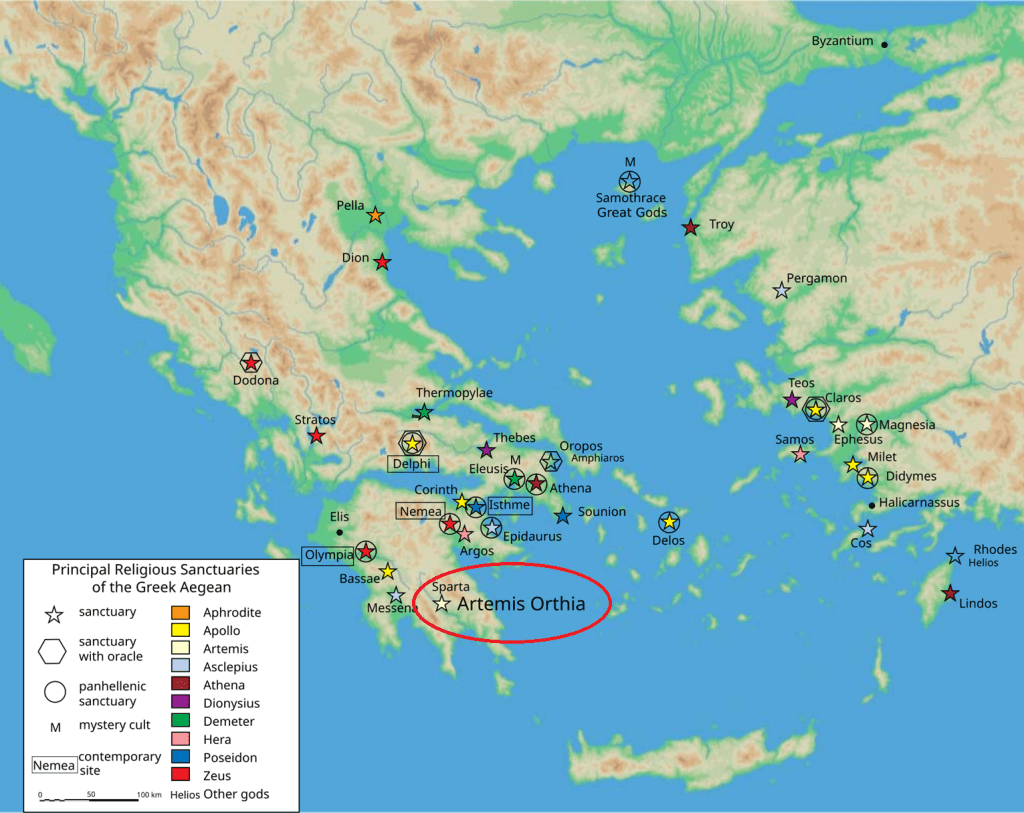
Even though the goddess who was once worshipped there is now known as ‘Artemis Orthia’, many scholars believe that the real name of the goddess was simply ‘Orthia’, meaning “the erect” or “upright”, with the incorporation of Artemis into the cult only taking place in the 2nd century BC. We know little about this goddess. We can, however, reconstruct some of the characteristics and prerogatives of this mysterious and rather terrifying goddess from her association with Artemis, as well as from an enormous number of surviving votive offerings – more than 100,000.
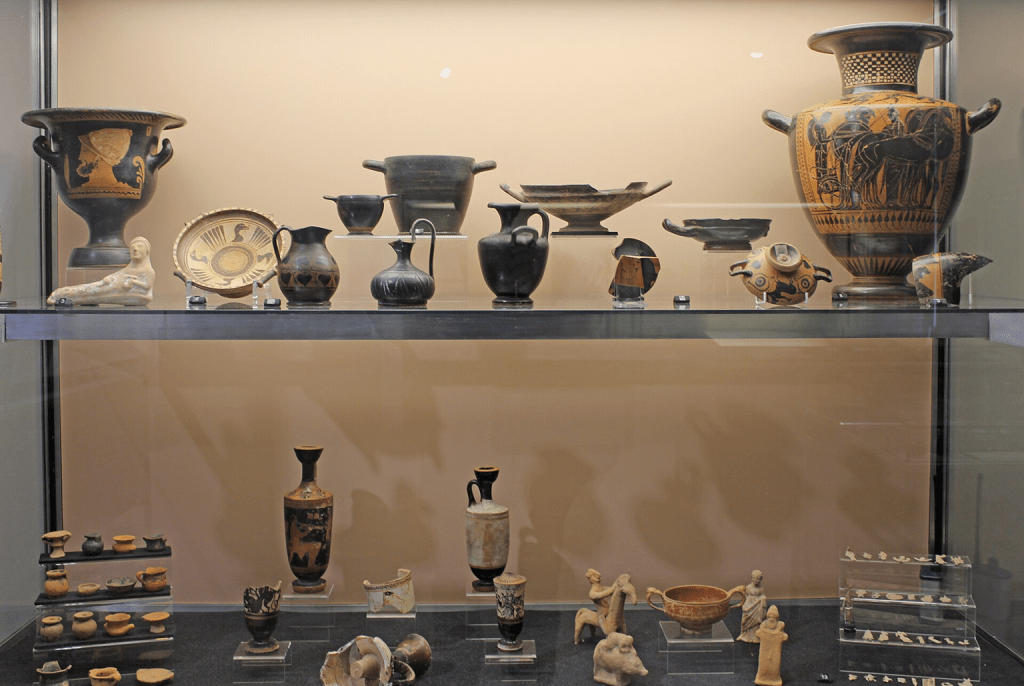
Artemis was the Olympian goddess most profoundly tied to the natural world – even more so than Demeter – being associated with animals and the hunt, as well as with borders and boundaries (both physical and metaphorical ones). We should not be surprised that the Orthian sanctuary stood on the bank of a river. Through this, we can imagine that Orthia had a certain authority over at least some, if not all, these elements.
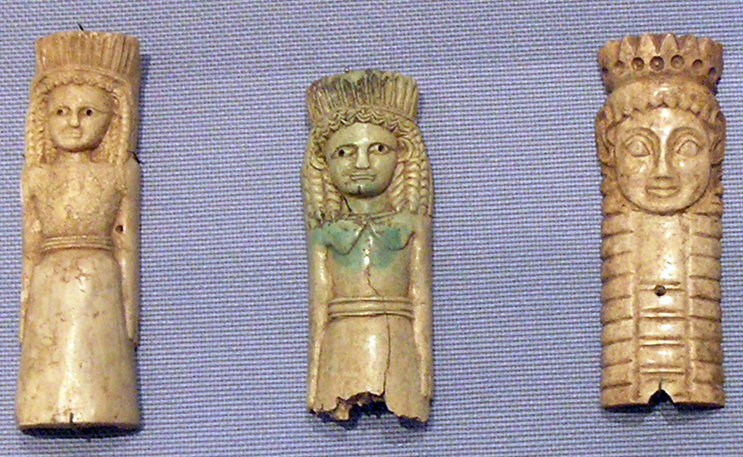
The extant votive offerings, made variously of lead, silver, gold, ivory or terracotta, apparently confirm the associations just mentioned, with an abundance of figurines of horses – which, according to scholars, represent the wealth of the Spartan aristocracy – and of nude females and warriors. These last two types of figurines seem to be associated with the coming of age of both young boys and girls, making Orthia a goddess for rites of passage. Our sources describe the bloody ritual that took place in the sanctuary: the diamastigosis.

The diamastigosis is the ritual flagellation of young Spartans – ‘ephebes’ – in front of the wooden statue of the goddess, the xoanon. The oldest sources to describe this rite are texts of Plato and Xenophon, even though the most interesting for us is Pausanias. In Book Three of his Description of Greece the author describes the origin of the ritual. According to his story, the xoanon was stolen by Orestes and Iphigenia from Tauris. This somehow caused the deaths, whether by violence or disease, of many Spartans. According to an oracle, only staining the altar with human blood would pacify the statue.
After a period where the goddess was satisfied by human sacrifices, the lawgiver Lycurgus changed the custom so that the altar was stained, not with sacrifice, but with the scourged ephebes’ blood. This at least avoided fatal bloodshed. Throughout the ritual, a priestess stood amidst the flagellations holding the xoanon. Every time an ephebe seemed not to be adequately scourged, the statue would apparently become heavier in the priestess’ hands.
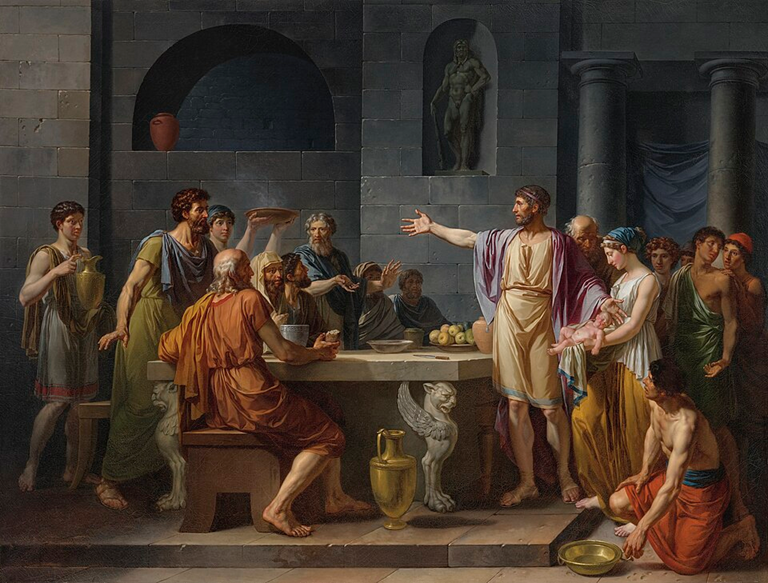
Xenophon gives us another version of the rite. According to his treatise on the Spartan constitution, the diamastigosis was an important part of the agoge, the training program of the young Spartiates. During the ritual, some of the boys who participated had to steal as much cheese as possible from the altar, while another group was in charge of was in charge of defending the cheese by scourging the would-be thieves.
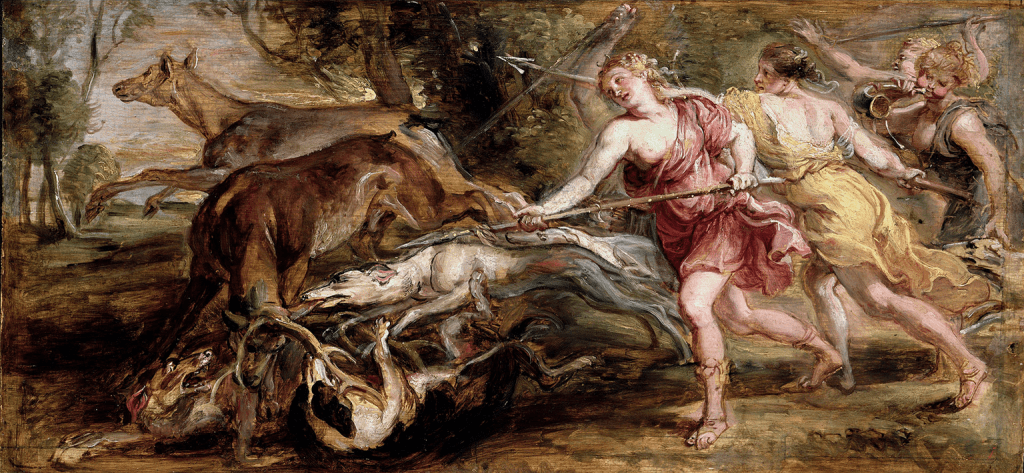
This bizarre ritual allegedly had the function of preparing the Spartiates for the life they would face in the future, where food would not always be provided for them, and they would have to do everything they could to survive, particularly during harsh military campaigns. Ritual hunting also had an important role in rites of passage, especially in the sanctuary of Artemis Orthia, where many figurines of animals or hunters were discovered and where an important hunting contest was held, the kasseratorion.
So far there is no authoritative explanation for the differences between the accounts of Xenophon and Pausanias (who wrote more than five hundred years apart). Some scholars conjecture that each author described the ritual as it was performed during his own time, but we still lack a decisive answer as to what really happened when. At least we know that the ritual was still being enacted until the 4th century AD, by which time the ancient rite had degenerated into little more than a bloody spectacle – a tourist attraction for affluent Roman citizens who could watch the flagellation in the newly built theatre.
Another important element in the study of this sanctuary involves the two deposits, each discovered on opposite sides of the temple, consisting of hundreds of terracotta masks which depict a wide variety of subjects. Scholars have debated about these masks since their discovery without successfully reaching a consensus on why and how they were used. We can, however, make a few safe assumptions, with the aid of modern research as well as ancient sources.
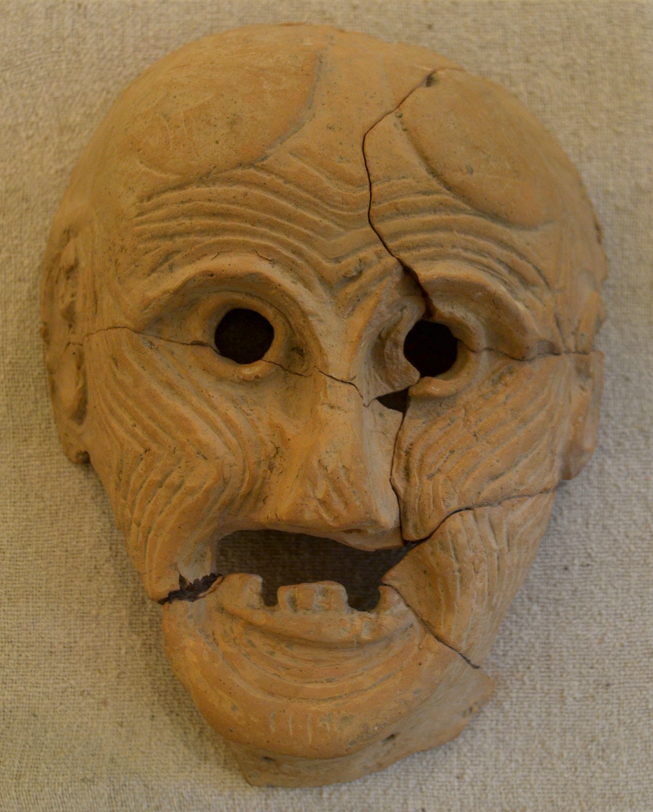
According to many scholars, the terracotta masks were votive reproductions of wooden masks that were used in some sort of ritual recital. Some scholars associate the masks with the semitic cult of Asherah, a fertility goddess and divine consort of El. Others suggest that masks (or at least some types of masks) were worn by the ephebes during the diamastigosis. Many agree that these mysterious masks were used as part of a ritual drama that was performed in the sanctuary.

We have two remarkable accounts regarding the use of masks and ritual drama in this sanctuary. The first comes from Pollux, writing in the 2nd century AD, who tells us that Spartan women practiced indecent dances wearing masks and phalloi; the second is from Hesychius, writing in the 5th or 6th centuries AD, who says that men danced while wearing ugly female masks. The apparent discrepancy between these authors might in fact not be a discrepancy at all, but the result of two descriptions of the same exact ritual from two distinct vantage points.
Following this hypothesis, some scholars have proposed that in the sanctuary of Orthia a form of cross-dressing was practised as part of a broader ritual drama. This is indeed not something we would expect in cold, austere surface of a cult that was mysterious even to its ancient practitioners – a cult that evolved over more than a thousand years and had roots going back in time far beyond the historical period of ancient and archaic Greece as we know it.
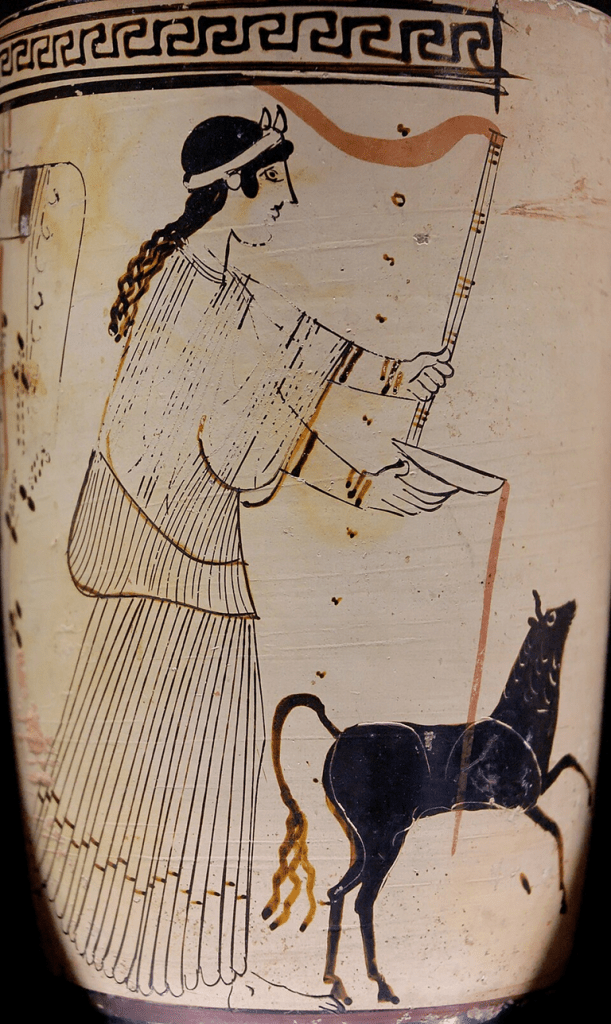
Much more could be said about Orthia, beginning with her relationship with Eileithyiua, a birth-goddess whose temple was near Orthia’s, and who was even worshipped in the same sanctuary; or with respect to her role as a Potnia Thērōn (Mistress of Wild Animals), or even with her paredros (“attendant deity”) who is so frequently depicted alongside her in the votives found in the sanctuary engaged in the act of a sacred marriage (hierogamos). We might even discuss who this mysterious paredros was in Greek myth, but after all we will never be certain of our answers, which will forever remain hypothetical.

Marco Annaloro is an undergraduate Cultural Heritage student at the University of Palermo, with a focus on Classical History and Archaeology. He plans to pursue a master’s degree in Archaeology and become an archaeologist.
Further Reading:
For ancient sources I suggest:
Pausanias, Description of Greece 3.16,9–11.
Euripides, Iphigenia in Tauris (for a classical depiction of Iphigenia and Orestes myth)
Xenophon, Constitution of the Lacedaemonians
For the sanctuary and the cult of Orthia:
Toryn A. Suddaby, “Masks and maidens: women and the Sanctuary of Artemis Orthia,” Constellations 6.1 (2015).
Toryn A. Suddaby, Masks, Maidens and Men: Gender and Interpretations of the Cult of Artemis Orthia at Sparta (MA Thesis, Univ. of Alberta, 2017).
R.M. Dawkins, The Sanctuary of Artemis Orthia at Sparta, Journal of Hellenic Studies, suppl. 5 (London, 1929).
Nicki Waugh, “Visualising fertility at Artemis Orthias site,” British School at Athens Studies (2009) 159–67.
John Boardman, “Artemis Orthia and chronology” Annual of the British School at Athens 58 (1963) 1–7.
Jane Burr Carter, “The masks of Ortheia,” American Journal of Archaeology 91.3 (1987) 355–83.
Jonah Lloyd Rosenberg, “The masks of Orthia: form, function and the origins of theatre,” Annual of the British School at Athens 110 (2015) 247–61.
For cross-dressing practices in ancient Sparta and the role of Spartan women
Sarah B. Pomeroy, Spartan Women (Oxford UP, 2002).
