Emily Wendt
To begin work on any translation project in Ancient Greek, you must first be delusional. You must have the conviction that this text has existed for 2,500 years and then think to yourself, “I am the only one who has ever understood it.” Otherwise, why bother adding yet another translation to the pile? I tell people that I am currently translating Plato’s Symposium, and they say, “Hasn’t someone already done that?” Technically, yes, but I am going to actually do it right.
I’m sort of kidding, of course, but the route of productive delusion is far preferable to the route of paralyzing inadequacy. I began my formal study of Greek over seven years ago during my junior year at Georgetown and have spent a lot of time thinking about and reading Greek since then. In the first year after I graduated, I completed almost all of my translation of Euripides’ Bacchae (productive delusion). The work then sat unfinished for another three years (paralyzing inadequacy) until I came to Ralston College, where my advisor Dr Nicole Blackwood wanted to produce it.

When I first met up with Ralston, I didn’t really know what to expect. I was one of 24 members of the inaugural class – the first students they ever had – and I was hesitant to set my hopes too high, though it promised a lot: two months of intensive Greek language instruction in Greece followed by another six months of philosophy and literature in Savannah, all fully funded.
I thought Ralston might turn out to be a scam of some kind, but it was my only hope. I decided at the last minute to apply out of sheer desperation. I had been living in LA and had recently joined the Screen Actors Guild, a longtime goal of mine, but I was deeply dissatisfied creatively and personally. I thought reinvigorating my relationship with Greek – once so passionate and fulfilling – would relieve me of my malaise.
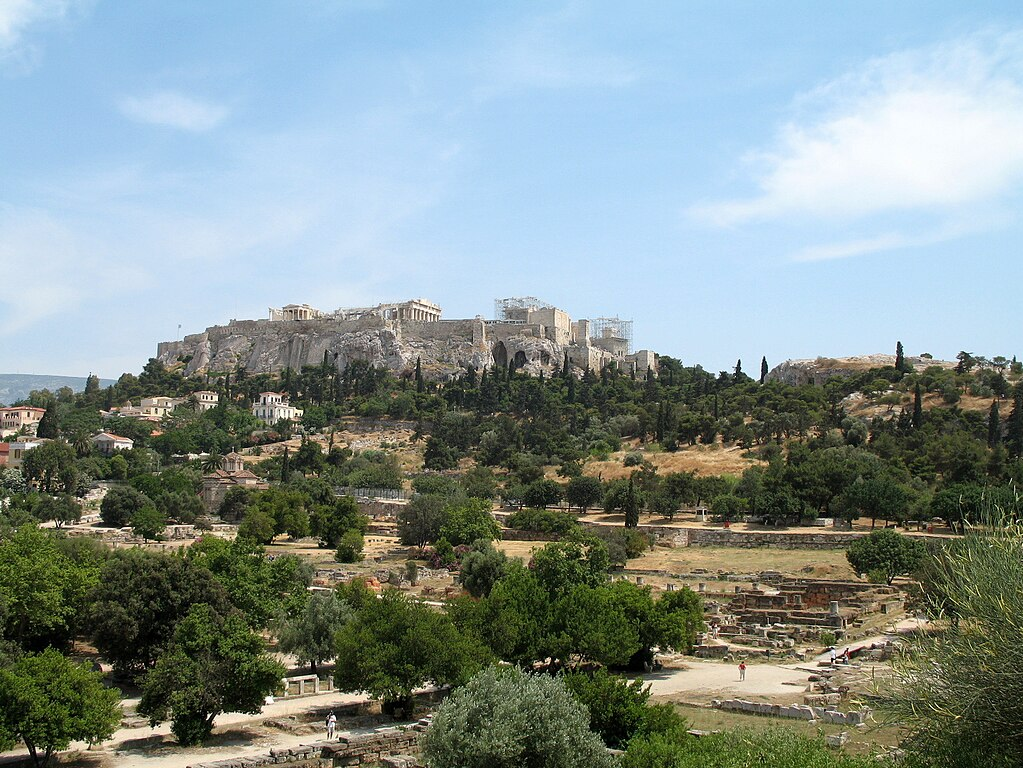
It did not set me at ease that we were given the vague instruction to “meet at the Agora” in Athens, and a few days later, we would start Greek class on the island of Samos. The first weekend there, our cohort piled into a bus to go to a wine tasting of local Greek wine, a fun way to unwind after 40 hours of immersive Greek lessons. On the way, Dr Michael Hurley, External Academic Dean of the college, told me he had heard about my longstanding relationship with Greek tragedy from reports of my admissions interview.
He asked my opinion on which play would be a good introduction to Greek theatre for my classmates, most of whom had not previously studied Classics. He was leaning toward Medea, but I told him that I happened to have my own translation of the Bacchae, and that was how it all started. When we first read the play aloud in Samos, three of us divided the parts the same way they would have in ancient Athens. Naturally, I was Dionysus.

My background is in comedy, so I tend to assume any performance is a failure if I can’t hear people laughing. The audience of students and faculty was dead silent throughout the reading. Since no-one had ever heard my translation out loud before, I was terrified leading up to and during the reading, but I should have put a little more trust in Euripides.
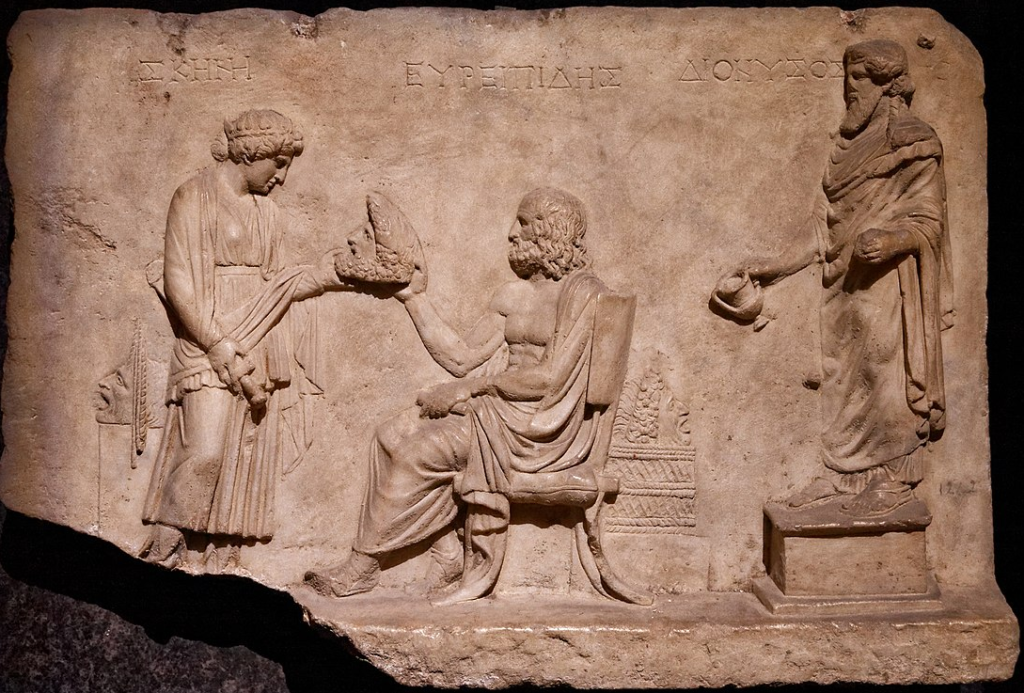
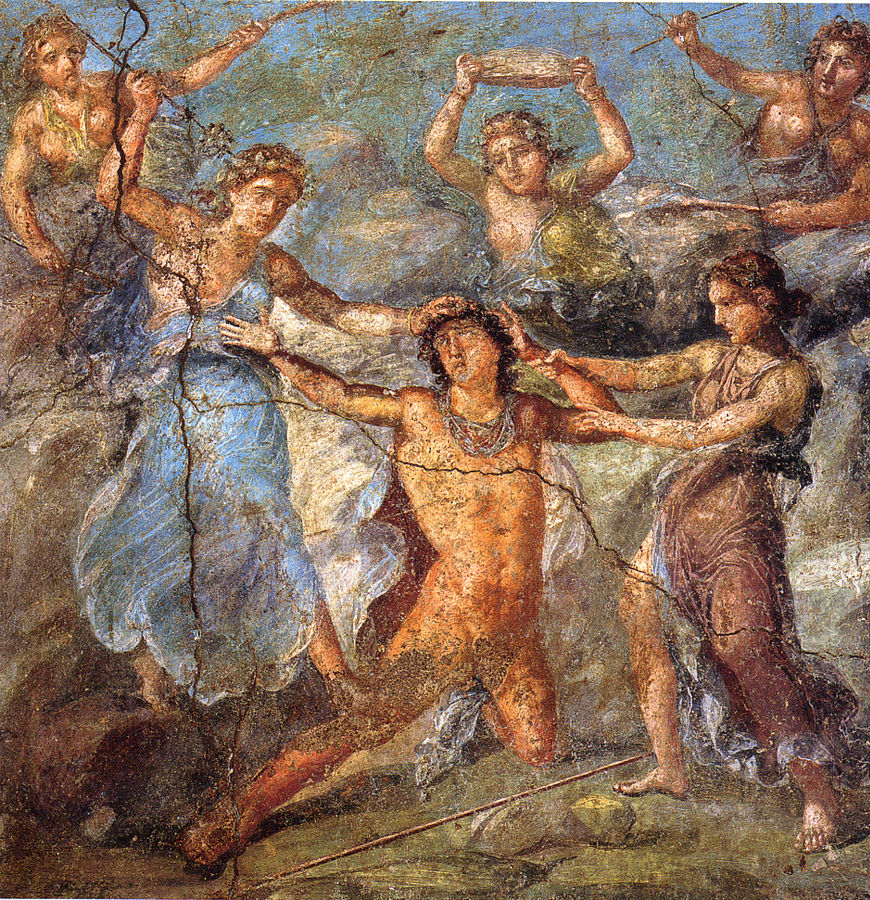
The story is enthralling. Dionysus (god of wine, theatre, and mania) returns to his homeland seeking reconciliation after both he and his mother were long ago rejected by their family, who believed she had lied about conceiving a child with Zeus. The current king Pentheus is young and stubborn, and he thinks the idea of this new god is stupid and evil. Because of this outrageous impiety, Dionysus drives the entire royal family insane, and Pentheus’ last act is dressing up as a woman, parading up a mountain in madness, and being ritually ripped to shreds by his mother and her sisters.
By all reports, the crowd was silent because it was enraptured. In ten days at Ralston College, I had achieved more of my longtime dream than I had in four years of trying to fit in with entertainment types in Los Angeles. I promise this is not an ad, but it is simply the truth that Ralston has redirected my life in a way that would make my 21-year-old self – my happiest, most joyful, most in love with Greek self – beam with pride.

Now back to paralyzing inadequacy. Though I had by all accounts accomplished my goal of rendering a Greek text into English in a way that was comprehensible and engaging, I still don’t know what would have to happen for me to feel that I am good at Greek. The translation project itself was an act of hubris waiting to receive its punishment, especially since the climax of the play (after line 1329) is missing from the manuscripts. So I had to fill it in.
I had in my toolkit five terms of undergraduate Greek, E.R. Dodds’s classic Oxford commentary, and a vague sense that Euripides and I had an understanding with each other, that he would let me be his mouthpiece for the 21st century. Maybe it’s delusion, but whenever I had read or seen other Bacchae translations, I had the sense that it was missing some of what Euripides would have wanted. The play was originally produced posthumously, probably in 405 BC, so even at its premiere Euripides missed out on the production and glory of one of his rare wins at the City Dionysia.

I really wanted to do both Euripides and Dionysus justice. Euripides never quite fits in, and neither does Dionysus. As Euripides composed his last set of tragedies, he had left his homeland of Athens for Macedonia. Despite consistently producing popular plays, he had been the frequent target of comedians such as Aristophanes because of his unusual protagonists, possible blasphemy, and asocial tendencies. Contemporary comedies are our main sources on his biography, which have colored his memory throughout the centuries. His characters are frequently outsiders, as Dionysus is.
This young god brings about one of the most violent ends of any extant Greek tragedy, but he’s not all about gleeful sadism, though it can be fun both to read and to play that. He belongs nowhere. He has no home or family outside the band of revelers he picks up as he passes through non-Greek towns. He hears lies about his mother from her own sisters, and the only person in his family willing to tolerate him is his grandfather Cadmus, who only remains open-minded because he thinks a god for a grandson will make the royal house seem more important. If his cousin Pentheus hadn’t been so prejudiced, the two could have been like brothers.

No one appreciates Dionysus until it’s already too late. In spite of all this, he is the god of revelry, and he brings fun with him wherever he goes. We imagine the actor’s mask in the ancient theatre would have been smiling, and as the action unfolds, the god’s charming smile becomes more and more unsettling. The audience quakes with fear, but the god delights in his own power. The following monologue of Dionysus, which comes right before Pentheus emerges insane in his girlish outfit, has long been my favorite. I dreamed for years about saying that first line.
DIONYSUS: Women, we have a man in our net! He will go to the Bacchae, and as punishment, he will die. Dionysus, the job at hand is yours to finish. You are not far off. Let’s make him pay. First drive him out of his mind. Plunge him into the dizziest depths of insanity. He wouldn’t put on women’s clothes otherwise. However, once we unhinge him, he will get dressed. I crave the sight of him being mocked throughout Thebes as he is led through the city looking like a woman – and after making all those threats before, the ones that were so scary. Now I will go get the outfit that Pentheus will be wearing when he goes to the land of the dead after being slaughtered at the hands of his own mother. He will come to know Dionysus, the son of Zeus. Dionysus, who is in fact a god and was one all along. Dionysus, the most terrifying to mortals, but also the most gentle. (Bacchae 847–61)
The victory of the outsider is the reason I found an intellectual home in the Bacchae, and that is why I had to white-knuckle it through the paralyzing inadequacy for those two and for all the other outsiders who have a hard time finding a home. Not feeling accepted is universal, as gutting then as it still is now. Surely many a Classicist at any level has experienced how isolating it can feel to be in a room of well-intentioned people who think studying Classics means reading Jane Austen or watching Citizen Kane. Part of the true beauty of Classics, though, is how it works as a force of connection. With a bit of effort, anyone can find a place among friends from thousands of years ago.

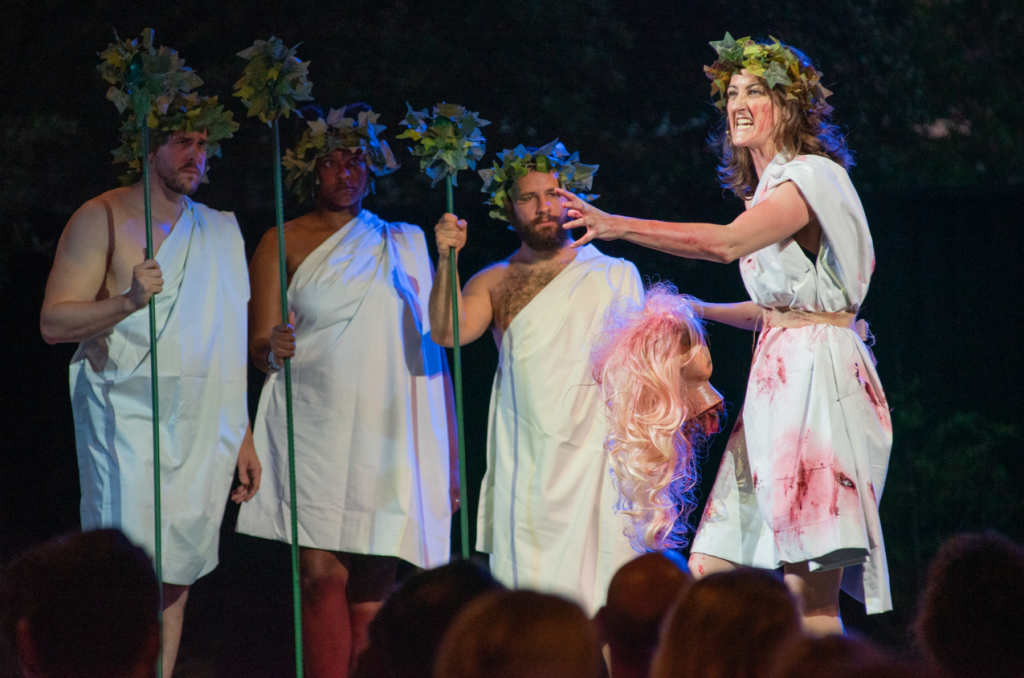
When our cohort moved from Greece to Savannah, Georgia, I had my first meeting with my faculty advisor/guardian angel Dr Blackwood, and it was her idea to bring the play to our new home. Over the next six months, the whole college banded together to stage a full production of the Bacchae. Many members of the cast had never acted before (though no one could tell), and I had never directed before. Our chorus wore robes made out of shower curtains and shook thyrsoi (ritual fennel stalks) made of garden stakes, but we had the sun set over the stage, perfectly timing nightfall to coincide with the ruin of the House of Thebes.
My delusion and inadequacy battled for years over the Bacchae, but delusion eventually triumphed, and now a few more people know about this wonderful play. I understand the power in an introduction to Greek tragedy, which can result in a lifelong bond to the ancients and a promise that Classics will last a little longer. Now that some people have trusted me to facilitate such an introduction for them, I understand a bit more about the source of that paralyzing inadequacy.
Certainly no translator wants to be wrong or stupid, but I really did not want to miscommunicate my love for this play to someone who knows nothing about it. It had to be as beautiful and fun to the audience as it is to me, so that they too can find a home with Dionysus if they need one. If I were only making a translation for myself, I would never finish anything. But my classmates at Ralston were in their early stages of learning Greek, and if I could give them my reason to keep doing such a weird and hard thing, maybe it could motivate them too.

Right before the play, I poured a libation to Dionysus. We were not drinking wine in the dressing room, so it was La Croix sparkling water that I poured, but still. I do not know if he came to watch, but some of my cast mates said they could tell he did.

Emily Wendt is currently a resident Greek Scholar at Ralston College. She is working on a translation of Plato’s Symposium, part of a larger project called Plato – For Girls!
For further information about applying to the MA in the Humanities at Ralston College, visit here. For those interested in joining Ralston’s growing faculty, details about vacancies may be found here. An Antigone essay about how Ralston inspired someone to leave Silicon Valley for a life immersed in the Humanities can be read here.
