Jonathan Kingston
When I reflect, after many years as a professional musician, on the pieces of music which have resonated with me most, I instantly call to mind two works – by the composers Richard Strauss (1864–1949) and Franz Liszt (1811–86) – which broach Classical subject matter. Both pieces represent profound illustrations of how music can be a powerful vehicle for storytelling: for both composers, music in these pieces functions as a narrative, delivering a storyline which brings a Classical myth and its associated characters to life. Although I have read various written accounts of both myths, for me as a musician, it is this musical portrayal which registers most deeply. In this article I will take readers on a journey into the musical world of both myths, as told by Strauss and Liszt.
One challenge for any composer seeking to tell a well-known or time-honoured story is that of putting their own distinctive (and hopefully worthwhile!) mark on pre-existing subject matter. Take the case of Richard Wagner’s Ring Cycle (1874), influenced by Norse mythology, where the listener is presented with four individual operas, totalling some 15 hours of music making. That feat took Wagner 26 years to complete. Stage director Anthony Freud declared that the work “marks the high-water mark of our art form, the most massive challenge any opera company can undertake.”
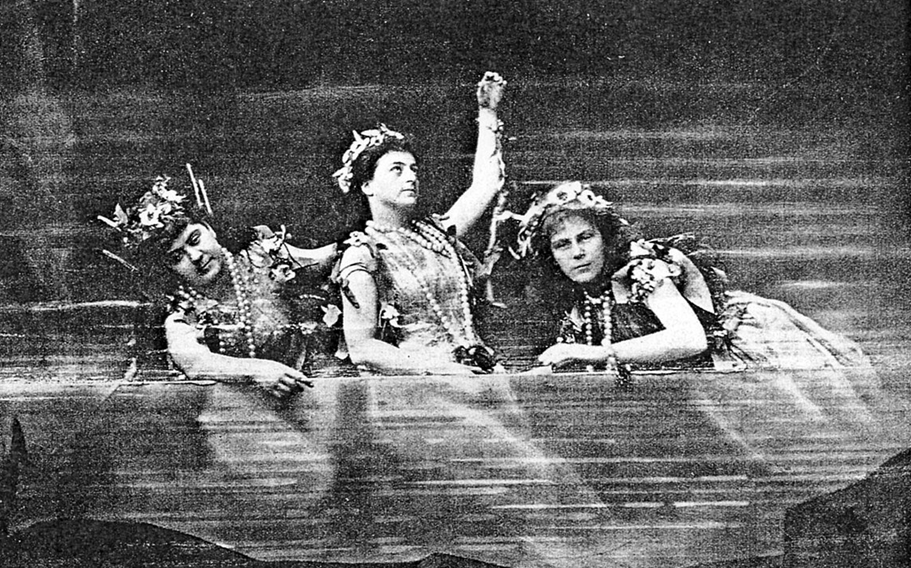
Consider now the case of Richard Strauss (no relation to waltz supremo Johann!), the prolific German composer and conductor born in 1864. He is considered a highly worthy composer of the late Romantic and early 20th-century period with his focus on tone poems and opera. Strauss went on to pen a series of extremely ambitious projects including Also sprach Zarathustra (1896), Don Quixote a year later, and An Alpine Symphony between 1911 and 1915. His compositional and musical journey encompassed periods of professional work at the Vienna State Opera. As well as his Elektra, the composer crafted music for the operas Salome and Der Rosenkavalier.
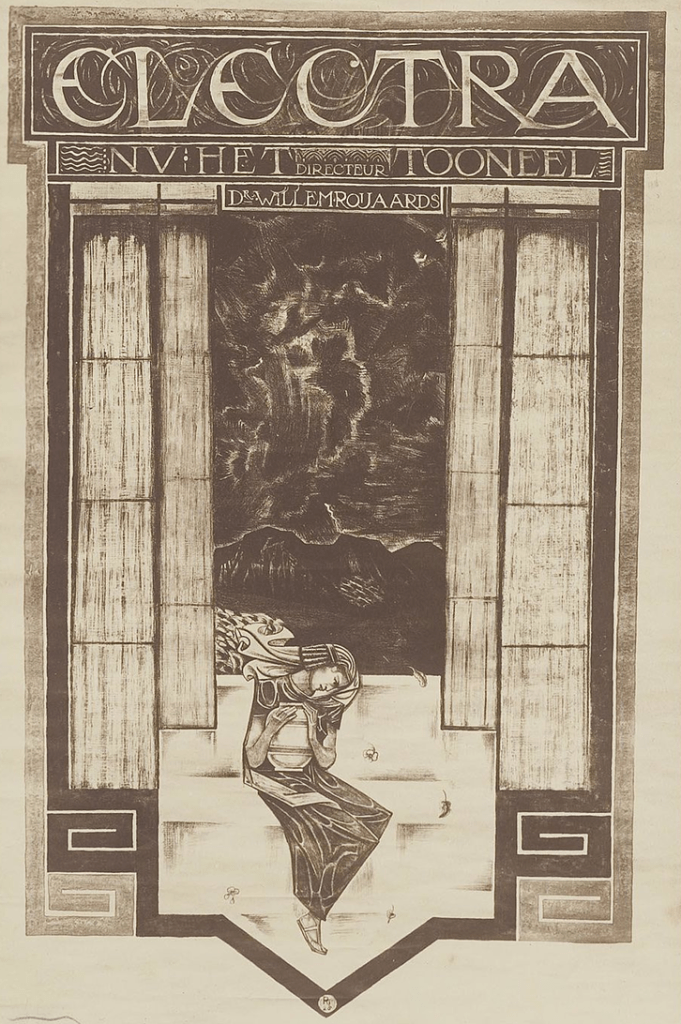
Elektra (op.58) is a one-act opera with German libretto by Hugo von Hofmannsthal. It was to be the first of many collaborations between Strauss and von Hofmannsthal. The work premiered in Dresden in 1909 (and at London’s Covent Garden in 1910). In his telling of the myth of Electra, Strauss aimed to demonstrate how a story evoking deep feelings of anger and sorrow can be heightened through music: themes of revenge, family bitterness and suffering resonate throughout.

Like Sophocles’ 5th-century BC play, Strauss’ Elektra is set in the Greek city of Argos, several years after the end of the Trojan War. It follows the eponymous Elektra,[1] daughter of King Agamemnon and Queen Klytaemnestra. Elektra joins with her brother, Orestes, to exact vengeance on their mother and their stepfather, Aegisthus, for murdering their father Agamemnon. Unlike Sophocles’ version of the myth, Hofmannsthal and Strauss’s version depicts in detail the unrestrained bloodshed and suffering that happens in the wake of King Agamemnon’s murder.

Johannes Debus, the Musical Director of the Canadian Opera Company, provides insight into Strauss’s storytelling, as well as including highly effective musical illustration, in this video:
There is also a wonderfully descriptive synopsis, including visions for staging by Christopher Park of Grand Théâtre de Genève, here:
As Hofmannsthal’s telling of the myth is centred around the topic of identity, Strauss aims to evoke similar outcomes in his musical telling of the tale. The characters in Elektra are represented through leitmotifs (recurrent musical themes associated with a particular person) as well as chords, including the ‘Elektra chord’ which is constructed of a chain of musical intervals each spanning a third and layered in two simultaneous keys (E major & C# major). This evokes an uneasy, dissonant musical effect. This densely formed chord, spanning an interval of eleven notes in total, can have different effects upon the listener depending on how it appears within the orchestral texture (i.e whether it is played simultaneously within a chord, or fragmented in an arpeggio). While Elektra herself will deliver the libretto as a high, dramatic soprano, it is in fact the nature of the orchestral backdrop which governs the emotive steer in any single scene.
Strauss seeks contrast in his methods of instrumentation as Elektra descends into madness. He sometimes chooses to accomplish this in the form of shimmering, ethereal effects led by the string section. At other times, he does so more forcefully, as the brass and full ensemble resources, known in musical circles as the ‘tutti’, are brought forth to achieve a climax. Elektra’s despair takes on many forms: to reflect this, Strauss provides contrast and variety within the orchestration as well as within tempo markers, as the dialogue and story are told.
When Elektra seeks to convey particularly emotive dialogue, Strauss will usually employ one of two techniques. Having announced the character’s presence via leitmotif, he may choose to make the instrumental backdrop very sparse indeed, punctuating only certain beats – thereby allowing Elektra’s vocal line to drive forward. Clashing musical intervals, deliberately at odds with more centred tonal harmonies, may also be used simultaneously in order to communicate anguish and high drama within a scene. In addition, passages can be heard where the tempo slows to an extremely slow pulse, as Elektra’s line soars ever higher and louder, with an enormous orchestral tutti underpinning it. Such mesmerising effects are steered by a musical director or conductor who may take a certain amount of artistic licence in order to bring the scene vividly to their audience.
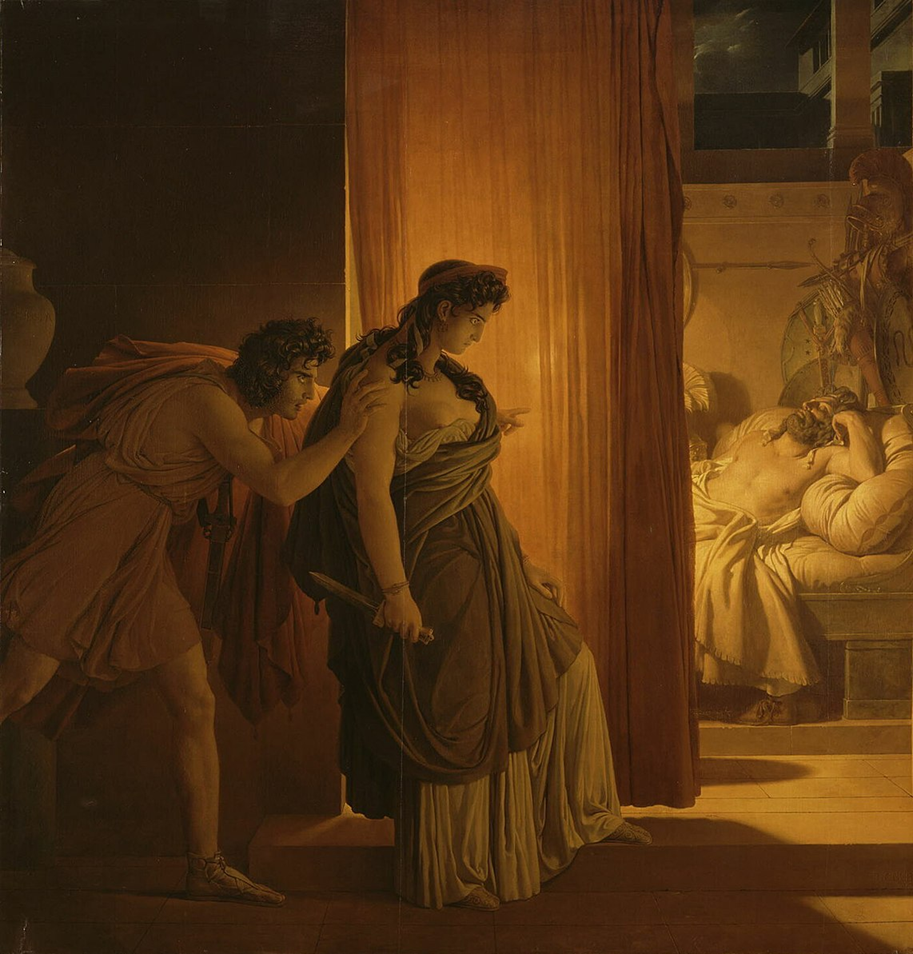
An additional leitmotif to listen for surrounds Elektra’s father, Agamemnon. Though he is dead, his presence is constantly reflected throughout the opera with orchestral motifs presenting themselves rhythmically, rather than harmonically, as is the case with Elektra’s character. It may be argued that the arresting brass fanfare in the opening bars of the opera is a particularly skilful and powerful way to focus audience attention to Agamemnon’s presence in the opening few seconds. Such musical treatments were hallmarks of the high Romantic period. They overlapped with early 20th-century musical techniques but were generally not encountered in compositions of the earlier period.
So, what were Strauss’s musical requirements for this one-act opera? Well, it is undeniably lavish! He calls for an immense orchestra of over 100 players, one of the largest in any operatic situation. Eight horns, ‘Wagner’ Tubas, six trumpets, a full trombone section and six to eight timpani players, all employed for the most heraldic, devastating effects. Forming the backbone is a string ensemble including two harps, 24 violins divided into three groups, eighteen violas, twelve cellos and eight double basses. Add to that recipe a full, extended woodwind section and plenty of ancillary and keyboard percussion and one can gather the scale of the work once and for all.
More usual orchestral resources would have been composed for fewer than half of those players, so this excess represented something quite out of the ordinary. In any fully staged performance, singers will not be amplified, instead relying on their most grounded and assured operatic technique not just to make themselves heard, but also to match those instrumental forces head on. The ensuing effect is electrifying, spellbinding and at times, deeply moving. Various performances are available in the free domain. Two which I commend to you are these:
Let us now step away from Strauss and his Elektra and into a quite different world of sound and storytelling created by the Hungarian virtuoso Franz Liszt. Working as a pianist, conductor and composer during the Romantic period, Liszt’s work encompasses some six decades. While he remains principally celebrated for his legacies dedicated to the piano, his orchestral offerings are rather lesser known.
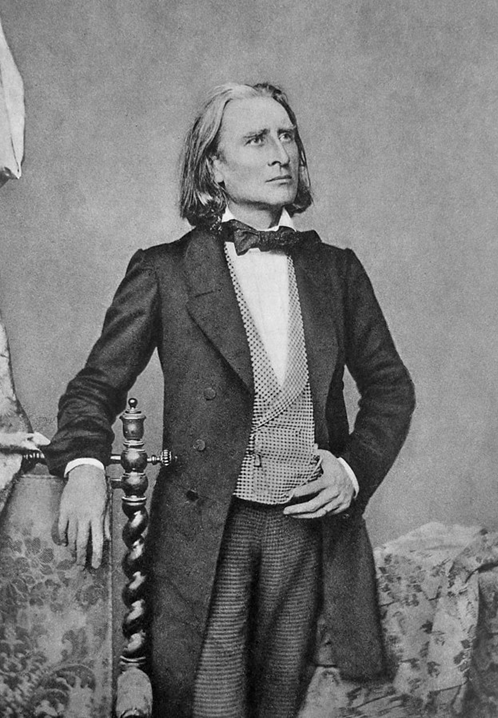
His Orpheus was written in 1854. It is one of four symphonic ‘tone poems’ which Liszt composed as character sketches of men of creative genius, heroism or legend. The other three works in this cycle represent Torquato Tasso, Prometheus and Ivan Mazeppa. In contrast to Strauss, Liszt’s orchestral backdrop is more rationalised, comprising a standard symphony orchestra for the period, though he does call for two harps, perhaps drawing upon the pictorial association of Orpheus with his lyre. The contribution of these harps can be heard most clearly in the opening fourteen bars of the work, which is compact in length, lasting some eleven minutes in total.

The tone poem or ‘programme music’ was a genre which several Romantic Period composers were keen to exploit between 1840 and 1920. It was a direct descendant of the operatic and concert overture. Taking inspiration from the content of a poem, short story, painting or scene, the composer’s task was to construct a single continuous movement in order to provide a concept of emotive, graphic realism in music to an almost unprecedented level. The Musicologist Hugh MacDonald has observed: “In the years prior to World War I, such works were held to be the vanguard of modernism.”
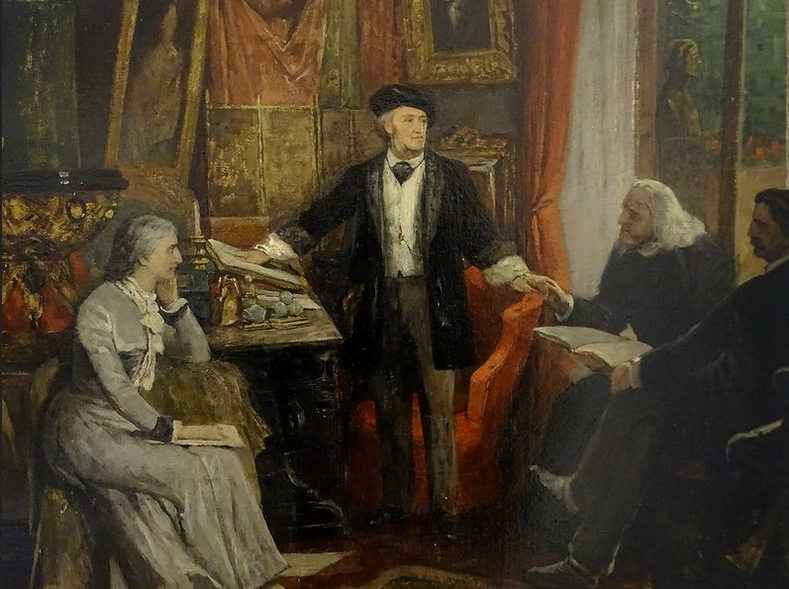
Orpheus is the shortest of Liszt’s tone poems. It comprises an evolving musical theme based upon a slow-moving horn call. That theme is then transformed and developed by the cor anglais, oboe, clarinet and a solo violin, employing techniques such as imitation and rubato with the work bound loosely in a modified ‘sonata’ form. One might deduce from the very soft beginnings of the work and long, drawn-out crescendo which develops that the composer is less concerned with the classical legend of Orpheus and his attempts to rescue Eurydice from the underworld than on the notion that civilisation should prevail over cruelty and brutality. It is therefore perceived as a lyrical, contemplative piece with rich orchestral tone colours as the various instrumental timbres become subtly and seamlessly varied. This work became the favourite piece of Lizst’s son-in-law, Richard Wagner.
The two slow-moving themes associated as leitmotifs of the character Orpheus are as follows:

The second theme above lacks some of the vigour of the first, remaining more static as it lingers over oscillating harmonies in the textures beneath. There is a modal quality to the harmonic language of the work as various measures and motifs shift between major and minor keys. This presents a poignant and, at times, ethereal quality, heightened by some unconventional ascending chords in the final bars of the work, as our principal character disappears into the clouds, leaving humankind the task of developing his teachings of civilisation.

In his preface to the score of Orpheus, Lizst himself wrote:
“I saw in my mind’s eye an Etruscan vase in the Louvre, representing the first poet-musician. I thought to see round about him wild beasts listening in ravishment: man’s brutal instincts quelled to silence… Humanity today, as formerly and always, preserves in its breast instincts of ferocity, brutality and sensuality, which it is the mission of art to soften, sweeten and ennoble.”

I leave it to readers to decide whether Liszt accomplishes this weighty ambition!
Jonathan Kingston is a musical director, organist, and teacher, and examines for the Royal Schools of Music.
Further Reading:
Graham Abbott, “Richard Strauss: A Life of Drama,” Graham’s Music (7 Aug. 2001), available here.
Hugh Macdonald, “Strauss, R.,” in The New Grove Dictionary of Music and Musicians (Oxford UP, 2001).
Horace Reisberg, “The vertical dimension in twentieth-century music,” in Gary Wittlich (ed.), Aspects of Twentieth-Century Music (Prentice-Hall, Englewood Cliffs, NJ, 1975).
Bryan Gilliam, Richard Strauss’s ‘Elektra’ (Oxford UP, 1996).

Notes
| ⇧1 | Here and elsewhere I follow the format of German transliterations. |
|---|