Mateusz Stróżyński
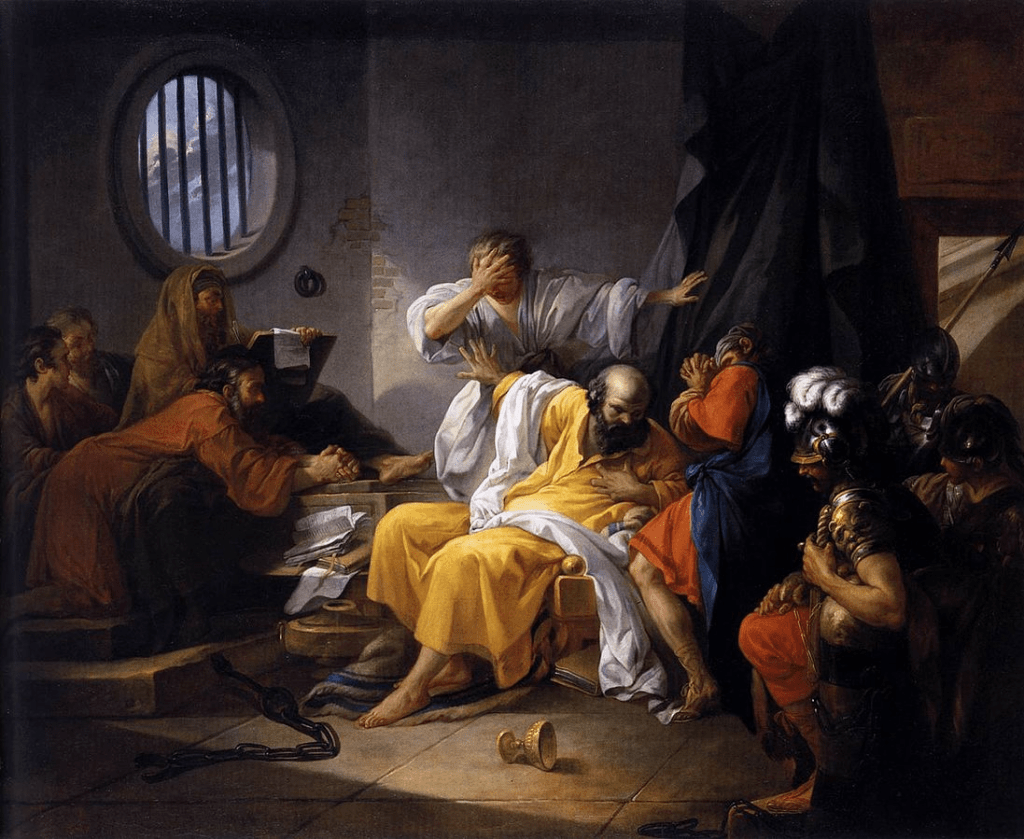
The ancients believed that at the moment of death we are most real, and most fully ourselves. There is no need to run away anymore, or lie to ourselves or others. We can just be. Hence their deep interest in the last words spoken by famous figures. Sometimes these were a puzzle, as in the case of Socrates: “The chill had now reached the region about the groin, and uncovering his face, which had been covered, he said — and these were his last words — “Crito, we owe a cock to Asclepius. Pay it and do not neglect it.” (Phaedo 118a).
There have been countless interpretations both serious and mundane of that strange request to give thanks to the god of healing. Friedrich Nietzsche was enraged by what he took to be Socrates’ morbid claim that life is a sickness and death is the cure. But maybe Socrates was simply referring to some unfinished business, or even making a joke in his final seconds?
Some famous philosophers’ last words were less mysterious. Zeno of Citium, the founder of Stoicism, tripped and fell while leaving his school, breaking his toe. Diogenes Laertius doesn’t tell us why the broken toe killed Zeno, but the Stoic allegedly struck the ground with his fist and quoted Aeschylus’ play Niobe: “I come, I come, why dost thou call for me?” (Diog. Laert. 7.1.28). Epicurus didn’t address his last words to God, like Zeno, but wrote a letter to his friend Idomeneus, beginning with: “On this blissful day, which is also the last of my life, I write this to you…” (Diog. Laert. 10.22).
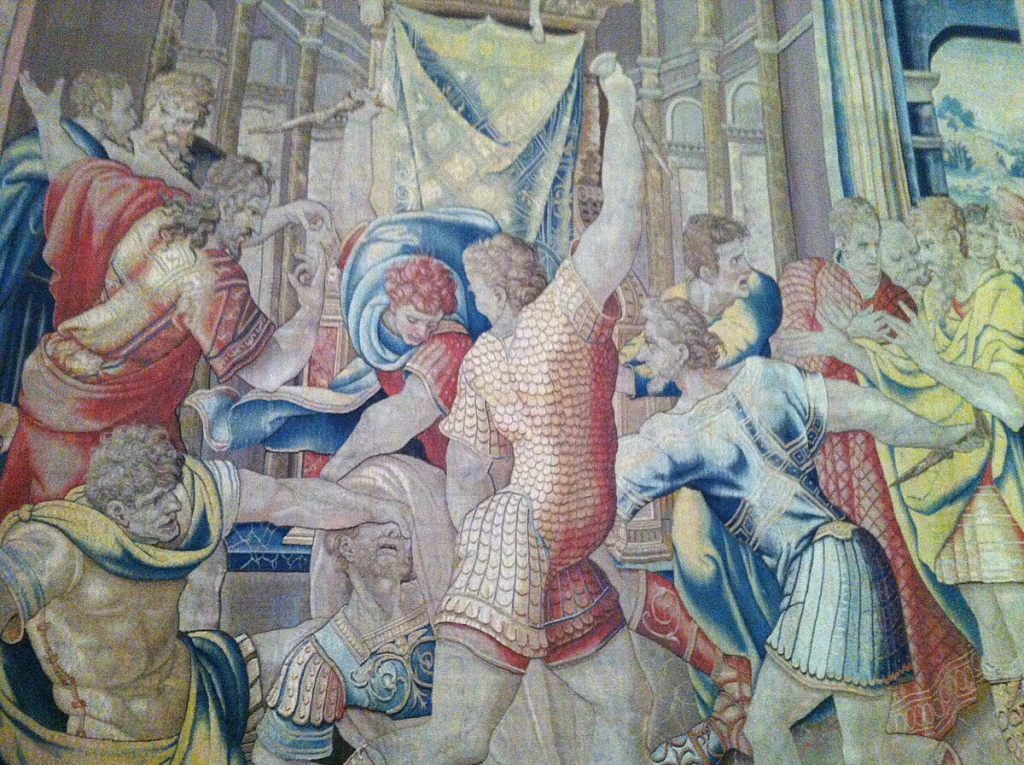
The last words of philosophers were preserved as their last teachings or last expressions of their character; the last words of the powerful, like the Roman emperors, were also recorded. Who doesn’t know the last words of Julius Caesar, Et tu, Brute? Or rather, in Greek, καὶ σύ, τέκνον? (Suetonius, Caesar, 82.2). His adopted son Augustus said to his family and friends: “Since well I’ve played my part, all clap your hands / And from the stage dismiss me with applause.”[1]
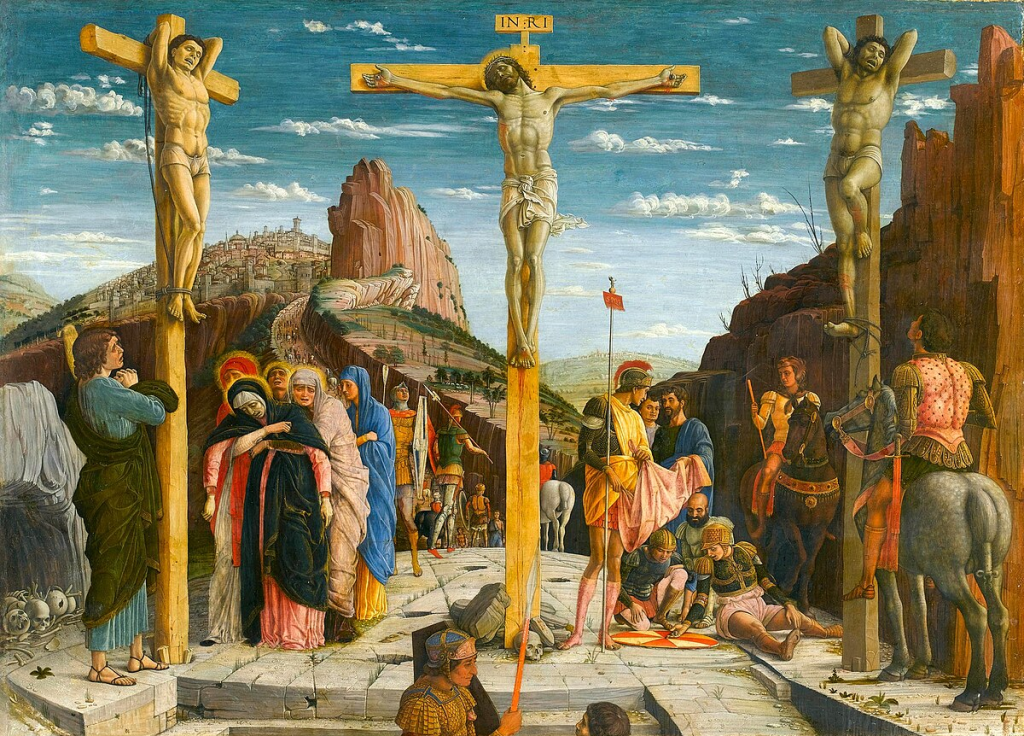
It is no wonder, then, that the last words spoken by Jesus Christ were preserved with care and cherished by Christians. During the late Middle Ages and early-modern period they became part of the Lenten devotion known as the Seven Last Words of Our Saviour on the Cross. The number seven was significant of course, pointing to perfection, like the seven days of creation, the seven gifts of the Holy Spirit, or the seven virtues, sacraments, or deadly sins. The Gospel of Luke transmits four Dominical utterances, John has three, while Matthew and Mark only one.
- Πάτερ, ἄφες αὐτοῖς, οὐ γὰρ οἴδασιν τί ποιοῦσιν (Pater, dimitte illis, non enim sciunt quid faciunt; Father, forgive them; for they know not what they do) (Luke 23:34)
- Ἀμήν σοι λέγω σήμερον μετ᾿ ἐμοῦ ἔσῃ ἐν τῷ παραδείσῳ. (Amen dico tibi: hodie mecum eris in paradiso;Verily I say unto thee, today shalt thou be with me in paradise.) (Luke 23:43)
- Γύναι, ἴδεὁυἱόςσου·εἶταλέγειτῷμαθητῇ·Ἴδεἡμήτηρσου. (“Mulier, ecce filius tuus”.
Deinde dicit discipulo: “Ecce mater tua”; Woman, behold thy son! Then saith he to the disciple, Behold thy mother!) (Jn 19:26-27) - Ἠλὶ ἠλὶ λεμὰ σαβαχθάνι¡ τοῦτ᾿ ἔστιν· Θεέ μου θεέ μου, ἱνα΄τι με ἐγκατέλιπες¡ (“Eli, Eli, lema sabacthani? ”, hoc est: “ Deus meus, Deus meus, ut quid dereliquisti me?”; “Eli, Eli, lama sabachthani?” that is to say, “My God, my God, why hast thou forsaken me?”) (Matt. 27:46), and
Ἐλωΐ ἐλωΐ λεμὰ σαβαχθάνι¡ ὅ ἐστιν μεθερμηνευόμενον Ὁ θεός μου ὁ θεός μου, εἰς τί ἐκγατέλιπές με¡ (“Heloi, Heloi, lema sabacthani?”, quod est interpretatum: “Deus meus, Deus meus, ut quid dereliquisti me?”; “Eloi, Eloi, lama sabachthani?” which is, being interpreted, “My God, my God, why hast thou forsaken me?”) (Mk 15:34)
- Διψῶ. (Sitio; I thirst) (Jn 19:28)
- Τετέλεσται. (Consummatum est; It is finished.) (Jn 19:30)
- Πάτερ, εἰς χεῖράς σου παρατίθεμαι τὸ πνεῦμά μου. (Pater, in manus tuas commendo spiritum meum; Father, into thy hands I commend my spirit.) (Luke 23:46)
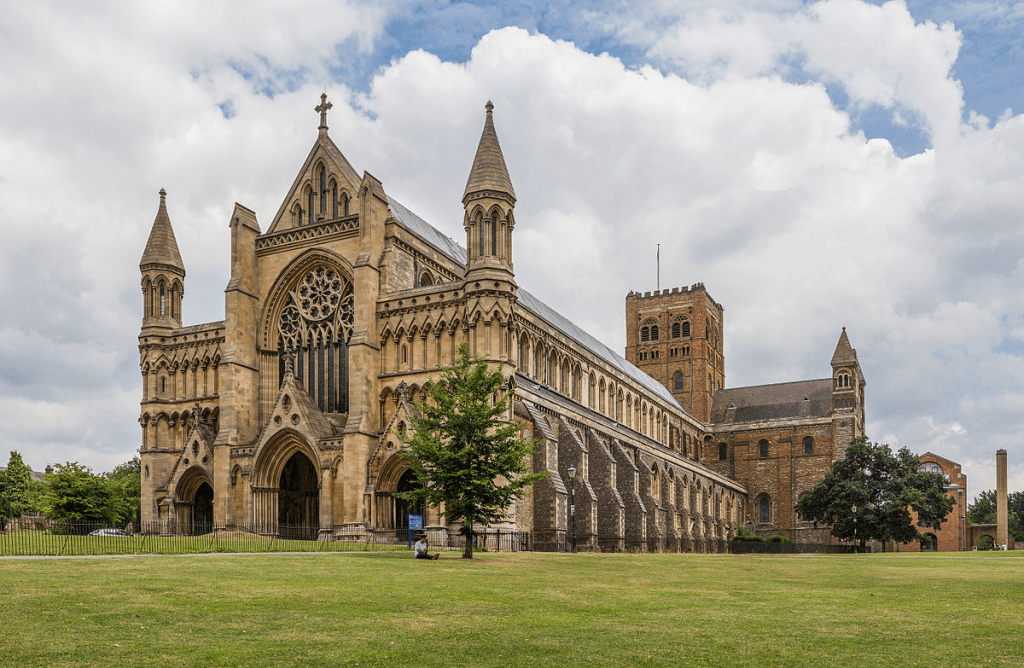
In the early-modern period, the Seven Last Words grew increasingly popular, among both Catholics and Lutherans, not only in terms of private and communal devotion and theological reflection, but also as an inspiration for composers, who provided a musical setting for the Seven Last Words as an aid to meditation and contemplation. The earliest musical setting is a motet Maria plena virtute (Maria full of virtue) by Robert Fayrfax (1464–1521), “one of England’s most significant but least known composers”, as a seminal article on the composer begins.[2] Fayrfax graduated with a Bachelor of Music degree at Cambridge in 1501, and became a Doctor of Music at Cambridge (1504) and Oxford (1511). Maria plena virtute is one of only five fully preserved motets written by Fayrfax; it belongs to his mature period, and may be considered one of his greatest achievements.
The motet was a popular genre of Renaissance polyphony, both in sacred and in secular music. Maria plena virtute is written for four voices (SATB, that is, soprano, alto, tenor, and bass), and foreshadows the mature Renaissance choral music of such English masters of the Tudor era as John Taverner (1490–1545) and Thomas Tallis (1505–85) in its use of the technique of imitation (a musical theme is echoed in successive voices) and dissonance. The latter device is evidently connected to its subject of Christ’s Passion, which the text of the motet approaches not only through the Seven Last Words, but also from the perspective of the Blessed Mother of God, participating in her Son’s sufferings.[3]
The poem is not a stellar accomplishment of late-medieval verse, but is highly personalized and emotional. Not only does it meditate on all the Seven Last Words of the Lord, it also intervenes in the utterances themselves in order to provide context or interpret their meanings, as when it paraphrases the Second Word as In Paradiso cum patribus mecum eris hodie (“Today shalt thou, with the Patriarchs, be with me in paradise”), thus pointing to the Harrowing of Hell. The Seventh Word is never quoted as such, but is rather transformed into a personal prayer addressed to the Lord: Animam meam suscipe (“Accept my soul”).
Those interventions by the author of the text are, perhaps, not particularly felicitous from a literary point of view, but they express a late-medieval piety, which is increasingly personal and affective: it models the spiritual exercise of meditating on the Passion and internalizing it through imagination and the use of Scripture. The sublime music of Fayrfax gives this intimate, if sometimes unsophisticated, poetic treatment of the Golgotha scene a truly moving and even dramatic dimension. The sound colours range from a paradisiacal clarity and delicacy in the sopranos to the truly “clamorous” (“Cum voce raucosa…”) entrances of bass and tenor.
Heinrich Schütz (1585–1672), the greatest German composer before Johann Sebastian Bach (1685–1750), was serving throughout his life as a court composer to the Lutheran Elector of Saxony, but he received his education in Venice from Giovanni Gabrieli, one of the masters of the early Italian Baroque. After Gabrieli’s death, he brought the rich and subtle taste of Italian music to the austerely Lutheran Saxony of the 17th century. In his later years, Schütz would compose his three great Passions (according to Luke, Matthew, and John) – dramatic, musical renderings of the Lord’s Passion – which would inspire Bach to produce the unsurpassed summit of Western sacred music, his St Matthew Passion of 1727. A preparation for Schütz’s three Passions was his amazing 1645 Die Sieben Worte unsers lieben Erlösers und Seeligmachers Jesu Christi, so er am Stamm des Hl. Kreuzes gesprochen (“The seven words of our dear Redeemer and Saviour Jesus Christ, which he spoke on the stem of the Holy Cross”).
This passion-cantata for four voices (SATB) and Christ (an additional tenor) with string instruments is based on Luther’s translation of the Bible as well as Johann Böschenstein’s (1472–1540) Lutheran hymn Da Jesus an dem Kreuze stund (“When Jesus stood by the Cross”), written in 1537. Böschenstein’s hymn consists of nine stanzas. The first introduces the spiritual benefits of meditating on the Seven Words; then each subsequent stanza paraphrases one of the Words, and the last one repeats the poet’s exhortation to meditate on them.[4]
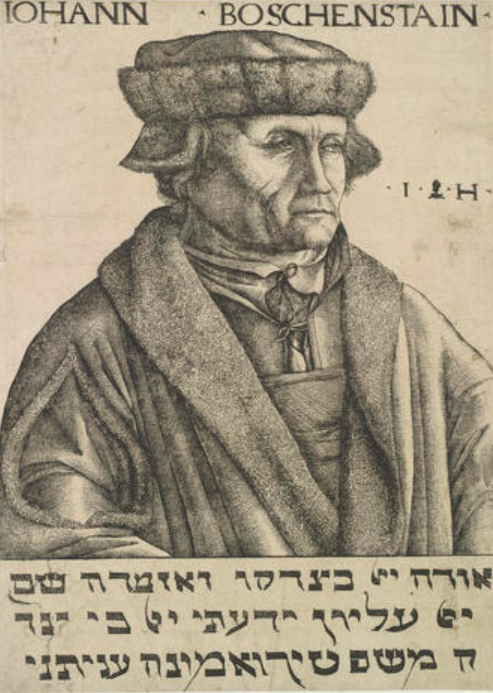
Schütz’s Seven Words has a chiastic structure (ABCBA), which symbolically points to the Christian symbolism of the cross. The first and the last part of his piece is a choral rendering of Böschenstein’s hymn. The second and penultimate part consist of the same, repeated instrumental Sinfonia in Venetian style, while at the centre of the piece stands a dramatic depiction of the Lord on the cross: praying for those who crucified Him; talking to the Good Thief, His Mother and the Beloved Disciple; and, finally, commending His spirit to the Father.
Schütz’s music is sublime. Its meagre use of voices and instruments is due to the horrible devastation of his country during the Thirty Years War (1618–48). But still we can hear magnificent echoes of Venetian opera in the lyrical Sinfonias, or in the recitativos of the central part of the piece. Schütz’s Seven Words is reflective and tender, and the hope of Resurrection constantly shines through the sorrow of suffering and death. It softens the acute pain without eliminating it, and we are reminded of the fact that while one of the most cruel and destructive wars in European history to date was still going on, Schütz was meditating on the Seven Words of the Lord.
The most beautiful of all the numerous renderings of the Seven Last Words is the entirely wordless masterpiece of Joseph Haydn (1732–1809), Die sieben letzten Worte unseres Erlösers am Kreuze (“The Seven Last Words of Our Saviour on the Cross”). Haydn, working as a Kapellmeister of the Hungarian aristocratic Esterházy family, gained international fame by the 1780s. The popularity of his Stabat mater of 1767 contributed to a commission of orchestral reflections on the Seven Last Words by a priest in the Spanish city of Cádiz. Haydn’s Seven Last Words were performed at the Oratorio de la Santa Cueva in Cádiz and, simultaneously, at the Schlosskirche in Vienna, on Good Friday 1787. In Cádiz, it became a part of the annual celebration of the Holy Triduum at the Oratorio. Haydn describes the reported celebration in his personal notes:
The walls, windows, and pillars of the church were hung with black cloth, and only one large lamp hanging from the centre of the roof broke the solemn darkness. At midday, the doors were closed and the ceremony began. After a short service the bishop ascended the pulpit, pronounced the first of the Seven Words (or sentences) and delivered a discourse thereon. This ended, he left the pulpit and fell to his knees before the altar. The interval was filled by music. The bishop then in like manner pronounced the second word, then the third, and so on, the orchestra following on the conclusion of each discourse. My composition was subject to these conditions, and it was no easy task to compose seven adagios lasting ten minutes each, and to succeed one another without fatiguing the listeners; indeed, I found it quite impossible to confine myself to the appointed limits.
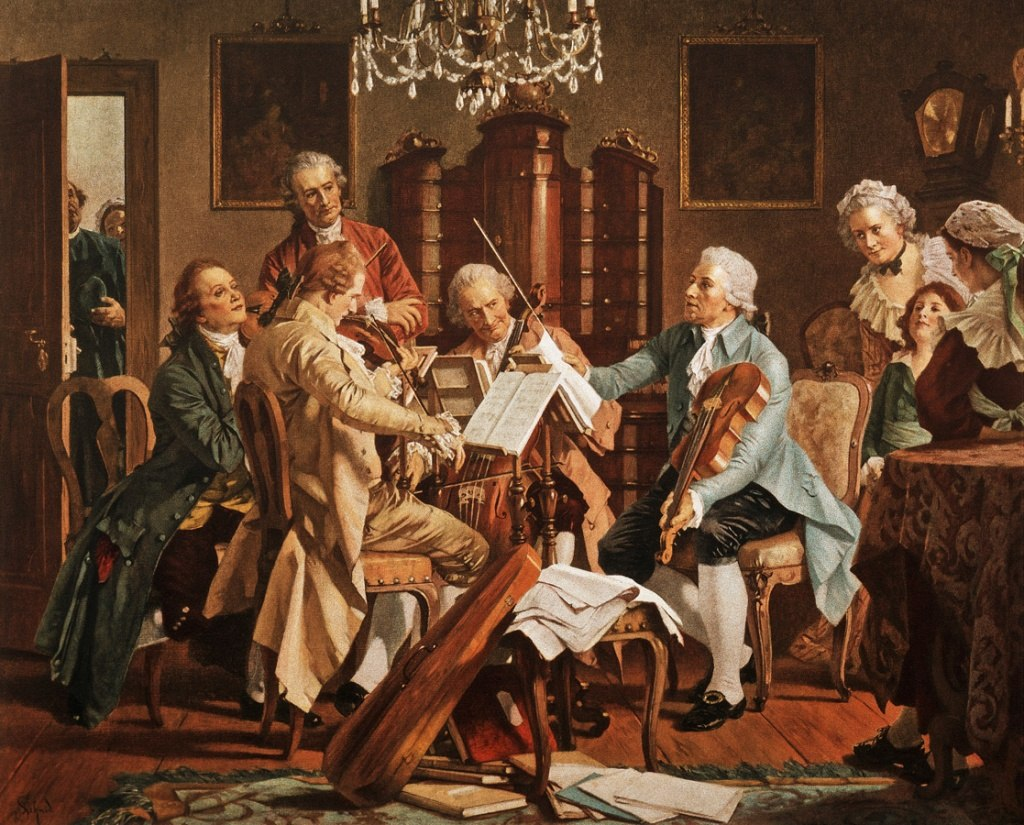
Haydn’s purpose was to stir “all the feelings inherent in each of the words uttered by the dying Saviour”.[5] Early music in Europe had been long accustomed to seeing itself as something akin to speech; the Baroque composers in particular tried to appropriate the ancient tradition of rhetoric even to purely instrumental music, never mind for vocal works. And Haydn was considered to be a great musical rhetorician already by Stendhal.[6] His ability to convey meaning without words is astonishing, and reminds us of Roger Scruton’s view of music as “pure intentionality”, that is, pure meaning which is never specific as to “what” it means, but still suggests something intelligible. [7] From a metaphysical perspective, this wordless meaning of music always points to God, who is the Logos, the source of all meaning. Music thus becomes a symbol in the manner suggested by the early Romantic thinker Friedrich Schlegel (1772–1829), a younger contemporary of Haydn’s, who said that every symbol is ultimately a symbol of God as the infinite Being expressing itself in particular beings.
Haydn’s musical meditations are far from mere “painting with sounds”, which he displayed brilliantly in his later oratorios The Creation and The Seasons. He expresses an affecting atmosphere and an elusive, haunting meaning for each of the Seven Words. David Wyn Jones describes it as “a masterly aural equivalent to the paintings and sculpture of rococo churches throughout Catholic Europe, inducing penitence and peace of mind in equal measure.”[8] Haydn’s English friend, Charles Burney (1726–1814), a music historian and composer, believed that the Seven Last Words was “perhaps the most sublime composition without words to point out its meaning that has ever been composed”.
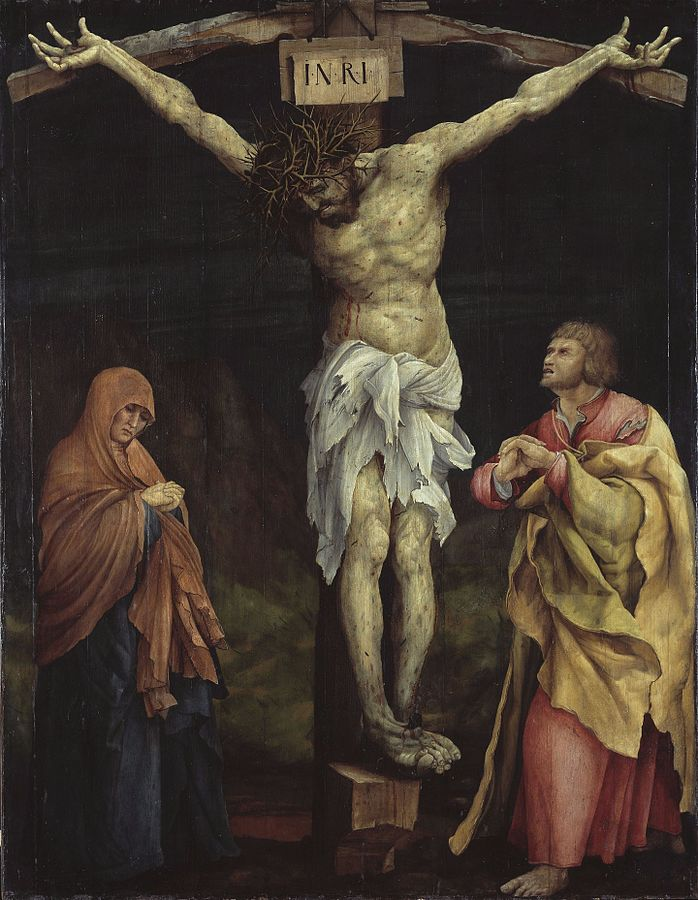
Haydn was also fond of this work. Immediately after composing an orchestral version of the piece, he published a transcription for a string quartet, which became much more popular than the original. He also approved of a piano transcription and, after his two visits to England (in 1791–2 and 1794–5), where he became fascinated with Handel’s oratorios, Haydn added the choir and the soloists to compose an oratorio version, based on a German text by baron Gottfried van Swieten (1733–1803). Although he didn’t use a Latin text, like Fayrfax, or a German one, like Schütz, it is clear that for Haydn the Latin text of the Seven Last Words was of central importance during the composition.[9] He remembered that at the Oratorio in Cádiz the congregation would first hear the Latin words and then be invited to meditate while listening to his music.
In the first, orchestral edition of the Seven Last Words, Haydn insisted on writing a Latin text under the first violin part at the beginning of each of the seven parts or the Sonatas (movements) of his piece.

The text doesn’t always come from the Vulgate; Haydn often uses only the first couple of words for the main theme of each sonata (e.g. “Mulier, ecce filius tuus”). Interestingly, in the case of the last Word, Haydn uses “In manus tuas, Domine, commendo spiritum meum”, rather than the actual words of Christ from the Gospel of Luke: “Pater, in manus tuas…”. His text comes from a responsorium breve in the Latin breviary and, more precisely, from the Completorium, or Compline, which is the last prayer of the day in the Liturgy of the Hours. Just before the Canticle of Simeon (Luke 2:29-32), the Church commends our spirit to the Lord.
The texts of the Completorium suggest that every end of the day symbolizes the end of our life, and that preparation for the night’s sleep should be like a preparation for death. Thus, every day, the Catholic Church practices the Platonic μελέτη θανάτου (“exercise of dying”, cf. Phaedo 64a) after sunset, identifying with Christ commending His spirit into the hands of the Father. Haydn’s choice of this particular prayer rather than the original last sentence uttered by the dying Lord seems to suggest nothing other than our own, personal participation in and identification with Christ, especially at the moment of His death. In Haydn’s Seven Last Words, musical themes and all their subsequent musical elaboration are permeated by meaning, even though this is a transcendent meaning, penetrating to the core of the Words, rather than focusing on emphasizing particular expressions or affects. Haydn’s music speaks to us wordlessly, becoming a mystical, silent prayer, transporting us into the depths of God. The piece has a chiastic, cross-like structure, just like Schütz’s earlier and very different work. It begins with a dramatic Introduzione (in a minor key) and is followed by the seven Sonatas.
The first and the last of them (in major keys) are implicitly connected by the fact that Christ begins the first and the last word by addressing His Father (“Pater…”). Even though, as I have pointed out, Haydn changes the last one to “In manus tuas, Domine…”, both “Pater” and “Domine” are linked by the same dotted rhythm (whereby the middle note is shorter and delayed, as in: “taam-ta-dam”) and by a falling direction of the melody.

The second and sixth words are in minor keys. In both cases the initial, sorrowful “Hodie mecum” or “Consummatum est” is resolved at the end into a hopeful and peaceful conclusion in a major key. “Consummatum est” begins as a series of five, equally measured, heavy notes, falling with a sense of a heart-rending finality and inevitability.

The third and the fifth words, in major keys, are also connected to each other. As Haydn’s biographer, Geiringer observed, “It is of interest that No. 5 (‘I thirst’) is based on the same motive as No. 3. Here Haydn resumed the idea originally used to describe the love of a mother for her son. In his agony the Saviour becomes a child again, asking his mother for help.”[10] I would go even further to point out that the final kenōsis, or emptying of the Lord, here takes the form of His becoming a naked infant, crying for something to drink. The Bethlehem Stable is mysteriously united with the Cross at Golgotha. This time, however, the Blessed Mother cannot quench the thirst of her beloved Son, which is one of the swords piercing her heart, as prophesied to her by Simeon (Luke 2:35.). The slow, gentle, falling minor third in “Mu-lier” and “Si-tio” is made even more poignant by its quiet, undemanding gentleness.


Fayrfax and Schütz follow St Augustine’s interpretation of the “Sitio” in his Enarrationes in Psalmos, where he suggested that it is a desire for the sinners to convert and be saved.[11] In Fayrfax’ text it is explicit (“Sitio salutem gentium”), and in Schütz’s implicit, through a reference to a similar motif in Böschenstein’s hymn (“Das menschliche Heil tät er begehr’n”). In Haydn, however, the “Sitio” has an almost unbearably raw physicality to it.
It reminds me of St Mother Teresa’s devotion to the fifth Word. She insisted that “I thirst” should be displayed in every chapel of her order and that each of the sisters should practise imagining that the Lord says these words directly to her. In fact, Mother Teresa herself experienced a mystical presence of the thirsting Jesus in the first dying woman that she met lying on a street in Calcutta, whom she felt invited to take care of.
This directness and nakedness of Jesus’ thirst is expressed by Haydn in a striking way. After a gently falling third reminding us of the “Mulier, ecce filius tuus…”, we have a strange pizzicato (plucking the strings with a finger) in the second violin and viola parts, followed by a series of obsessive repetitions of the same pitch. I can’t get rid of an association with a kind of Tantalus-like torture by thirst, as if we were listening, together with the Lord, to water drops falling all the time, but always beyond the reach of the One who is dying of thirst.

At the centre of the chiastic structure is the fourth Word, a great cry of abandonment and darkness, which Haydn resolves into hopeful quietude, as if referring to the ending of the Psalm 22, which Christ does not quote, but of course implies in His cry. The whole piece is finished by the abrupt and surprising (especially on the first hearing) Terremoto, depicting the earthquake following Christ’s death.
Haydn was a devout Catholic; his Seven Last Words are the fruit of his own spiritual life. He always began each new manuscript with the words “In nomine Domini”(“In the name of the Lord”) and ended with “Laus Deo” (sometimes extended by “Beatae Virgini Mariae et omnibus sanctis” or “Soli Deo gloria”). Whenever he experienced any problems during composition, he would often take a break to pray the rosary, which, he believed, always helped. Haydn was a very cheerful person by nature, despite the chronic pain caused by his nasal polyps, and later by the diseases of old age; in fact, he is often seen as “Papa Haydn”, a rather simple, jolly fellow, and not a very profound person.
However, the Seven Last Words (just like his Stabat mater or The Creation) testify to incredible depths of faith, expressed in the mystical language of music. On the eve of the violent madness of the French Revolution (1789–95), with its attack on the continuity of the Western civilization (as expressed in, for instance, absurd ideological changes to the traditional calendar), Haydn shows the spiritual continuity of the West. It is not without significance that his violins sing in Latin.

Mateusz Stróżyński is a Classicist, philosopher, psychologist, and psychotherapist, working as an Associate Professor in the Institute of Classical Philology at Adam Mickiewicz University in Poznań, Poland. He is interested in ancient philosophy, especially the Platonic tradition. His new book Plotinus on the Contemplation of the Intelligible World is forthcoming through Cambridge University Press.
Further Reading
St R. Bellarmine SJ, The Seven Words Spoken on the Cross (original Latin edition: De septem verbis a Christo in cruce prolatis libri duo, Paris, 1618), with English translation here.
F.J. Sheen, The Seven Last Words (2nd ed., Garden City Books, New York, 1952).
E.B. Warren, “Life and Works of Robert Fayrfax,” Musica disciplina 11 (1957) 134–52.
H.J. Moser, Heinrich Schütz. His Life and Work (Concordia, St Louis, MO, 1959).
K. Geiringer, Haydn: A Creative Life in Music (Doubleday, New York, 1963).
T. Beghin & S.M. Goldberg (edd.), Haydn and the Performance of Rhetoric (Chicago UP, 2007).

Notes
| ⇧1 | For those interested in last words, there is a chronological list on – where else? – Wikipedia. |
|---|---|
| ⇧2 | E.B. Warren, “Life and Works of Robert Fayrfax,” Musica disciplina 11 (1957) 134–52. |
| ⇧3 | I have not found any information about the author of the Latin text of the motet, which may mean that it’s either anonymous, or else Fayrfax wrote it himself. The text runs: Maria plena virtute pietatis gratiae, mater misericordiae, tu nos ab hoste protege. Clementissima Maria, vitae per merita compassionis tuae pro nobis preces effunde, et de peccatis meis erue. Sicut tuus Filius petiit pro crucifigentibus, “Pater dimitte ignorantibus”, magna pietate pendens in latronibus, dixit uni ex hominibus “In Paradiso cum patribus mecum eris hodie”. Mater dolorosa plena lacrimosa videns ruinosa Filium in cruce, cum voce raucosa dixit speciosa “Mulier clamorosa Filium tuum ecce.” Vertens ad discipulum sic fuit mandatum matrem fuisse per spatium et ipsam consolare; et sicut decebat filium servum paratissimum custodivit preceptum omnino servire. Dixit Jesus dilectionis “Sitio salutem gentium”. Audi orationibus nostris tuae misericordiae, O Jesu. Rex amabilis quid sustulisti pro nobis per merita tuae passionis peto veniam a te. Jesu, dicens clamasti, “Deus meus, num quid me dereliquisti” Per acetum quod gustasti ne derelinquas me. “Consummatum.” dixisti. O Jesu Fili Dei, in hora exitus mei, animam meam suscipe. Tunc spiritum emisit, et matrem gladius pertransivit: aqua et sanguis exivit ex delicato corpore: Post ab Arimathia rogavit et Jesum sepelivit, et Nicodemus venit ferens mixturam myrrhae. O dolorosa mater Christi, quales poenas tu vidisti, corde tenens habuisti fidem totius ecclesiae. Ora pro me, regina coeli, Filium tuum dicens; “Fili, in hora mortis peccatis suis indulge.” Amen. |
| ⇧4 | The German text can be found here. |
| ⇧5 | K. Geiringer, Haydn: A Creative Life in Music (Doubleday, New York 1963) 164–5. |
| ⇧6 | Stendhal, Vies de Haydn, de Mozart et de Métastase (Paris, 1814). |
| ⇧7 | See R. Scruton, Music as an Art (Bloomsbury, London, 2018). |
| ⇧8 | D. Wyn Jones, “Seven Last Words of Our Saviour on the Cross,” in his Oxford Composer Companions: Haydn (Oxford UP, 2009) 360. |
| ⇧9 | On Haydn and Classics see P. Polzonetti, “Haydn and the Metamorphoses of Ovid,” in M. Hunter & R. Will (edd.), Engaging Haydn: Culture, Context, and Criticism (Cambridge UP, 2012). |
| ⇧10 | Geiringer, Haydn, 327. |
| ⇧11 | Et de cruce cum diceret: Sitio, fidem illorum quaerebat, pro quibus dixerat: Pater, ignosce illis, quia nesciunt quid faciunt. Sed illi homines quid propinarunt sitienti? Acetum. (En. in Ps. 68.1.14). |