Samuel Gartland and Constanze Güthenke
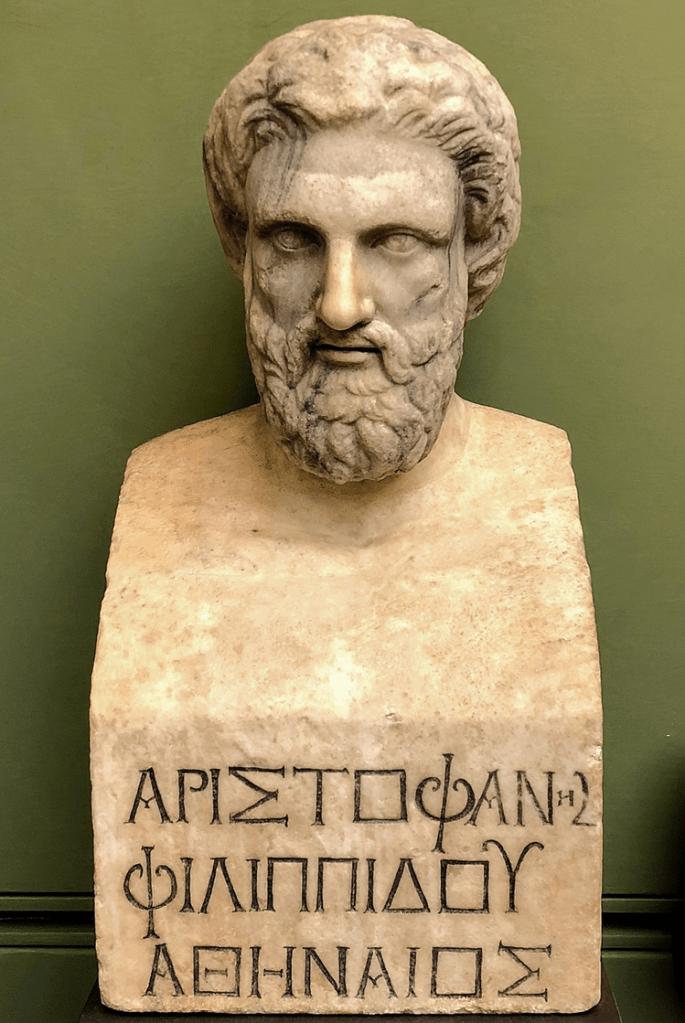
Aristophanes is often presented to students as one of the more ‘accessible’ Classical authors. His comedies are rude, direct, self-aware, and full of jokes about drinking, domestic irritation, political incompetence, and sexual desire. They seem to open a window onto everyday life in Classical Athens. A character on stage grumbling about food he cannot find or afford, or railing against feckless civic leaders, feels uncannily close to us. This is a voice from the 5th century that can sound like someone we might overhear in the queue at the supermarket or on a bus. But that sense of familiarity is deceptive. In fact, the more closely we look at Aristophanes, the more he resists being domesticated.
His plays are full of vivid details: how the Assembly really felt; the gossip of the streets; the layout of the countryside. But placed alongside these apparently realistic touches are choruses of buzzing wasps and croaking frogs, a city in the sky, and elaborate, often violent, erotic fantasies. The effect is not simply humorous, it is destabilising. That unsettled effect is not an accident.
Comedy in a Time of Trauma
Most of Aristophanes’ plays were written during the Peloponnesian War (431–404 BC), during which Athenian territory was repeatedly invaded. During these invasions, rural families fled for safety inside the city walls; as a result, disease swept through the population early during the war, because Athens was overcrowded. For a generation, citizens set out each campaigning season not knowing who among them would return home. War surrounded Aristophanes and his audience throughout most of his adult life.
In Acharnians (425 BC), the earliest of Aristophanes’ eleven surviving plays, war is not described through heroic speeches or tragic lament. Instead, when the protagonist Dicaeopolis is offered a choice of private peace treaties, he can smell and taste their effects:
ΔIK· ἀλλὰ τὰς σπονδὰς φέρεις;
ΑΜΦ· ἔγωγέ φημι, τρία γε ταυτὶ γεύματα.
αὗται μέν εἰσι πεντέτεις. γεῦσαι λαβών.
ΔIK· αἰβοῖ.
ΑΜΦ· τί ἔστιν;
ΔIK· οὐκ ἀρέσκουσίν μʼ ὅτι
ὄζουσι πίττης καὶ παρασκευῆς νεῶν. 190
ΑΜΦ· σὺ δʼ ἀλλὰ τασδὶ τὰς δεκέτεις γεῦσαι λαβών.
ΔIK· ὄζουσι χαὖται πρέσβεων ἐς τὰς πόλεις
ὀξύτατον ὥσπερ διατριβῆς τῶν ξυμμάχων.
ΑΜΦ· ἀλλʼ αὑταιὶ σπονδαὶ τριακοντούτιδες
κατὰ γῆν τε καὶ θάλατταν.
ΔIK· ὦ Διονύσια, 195
αὗται μὲν ὄζουσʼ ἀμβροσίας καὶ νέκταρος
καὶ μὴ ʼπιτηρεῖν σιτίʼ ἡμερῶν τριῶν,
κἀν τῷ στόματι λέγουσι, βαῖνʼ ὅπῃ θέλεις.
ταύτας δέχομαι καὶ σπένδομαι κἀκπίομαι,
χαίρειν κελεύων πολλὰ τοὺς Ἀχαρνέας. 200
ἐγὼ δὲ πολέμου καὶ κακῶν ἀπαλλαγεὶς
ἄξω τὰ κατʼ ἀγροὺς εἰσιὼν Διονύσια.
DIACAEOPOLIS: Well then, have you brought the treaties?
AMPHITHEUS: I certainly have. In fact, I have three samples here for tasting. This one is a five-year truce. Take it and try it.
DICAEOPOLIS: Ugh!
AMPHITHEUS: Well?
DICAEOPOLIS: I do not like it. It smells of pitch and the shipyards where they are fitting out the fleet.
AMPHITHEUS: Then try this one, a ten-year truce.
DICAEOPOLIS: No good either. It reeks of ambassadors trudging round the allied cities and nagging them to keep the war going.
AMPHITHEUS: All right- this last one is a thirty-year truce on land and sea.
DICAEOPOLIS: By Dionysus! This one smells of nectar and ambrosia. It does not whisper prepare rations for three days. It murmurs gently go where you please. I accept it, I ratify it, and I drink it in one go, and I bid a cheerful farewell to the Acharnians. Now that I am free of the war and its troubles, I shall celebrate the Dionysia in the countryside.
(Acharnians 186–202)
Peace here is not an abstraction, it is something you sniff, and sip, and swallow, and it does not always go down smoothly. The audience watching that scene had lived with the stench of a city overcrowded with war refugees and polluted by the smoke of burning farmland. The joke is playfully absurd, but also painfully familiar: peace, when it arrives, carries the taste of past conflicts and the scent of what comes next.
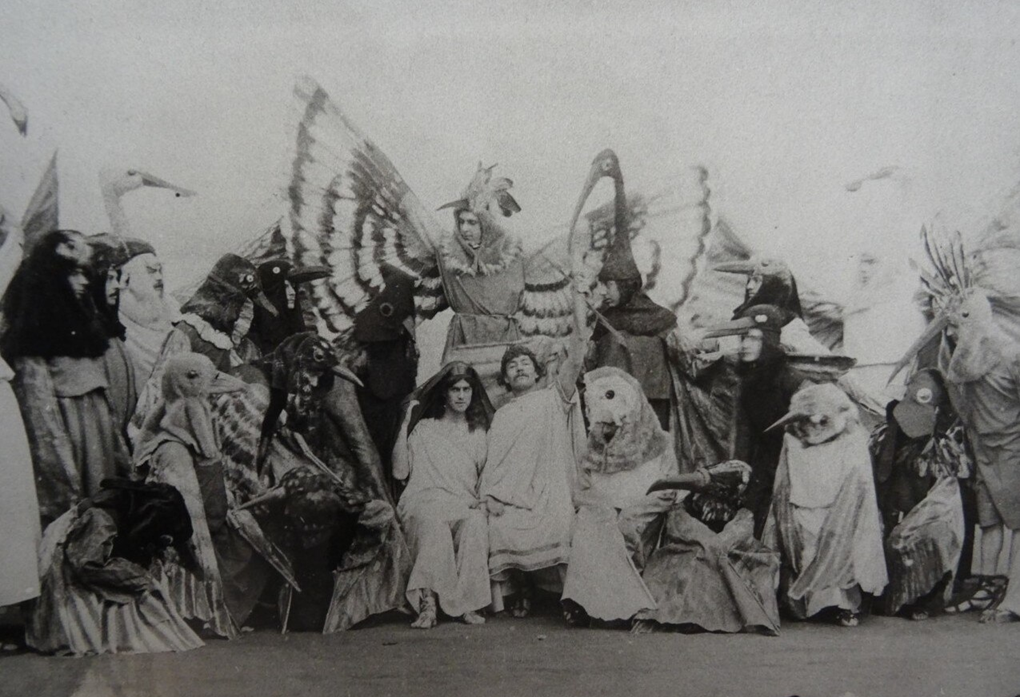
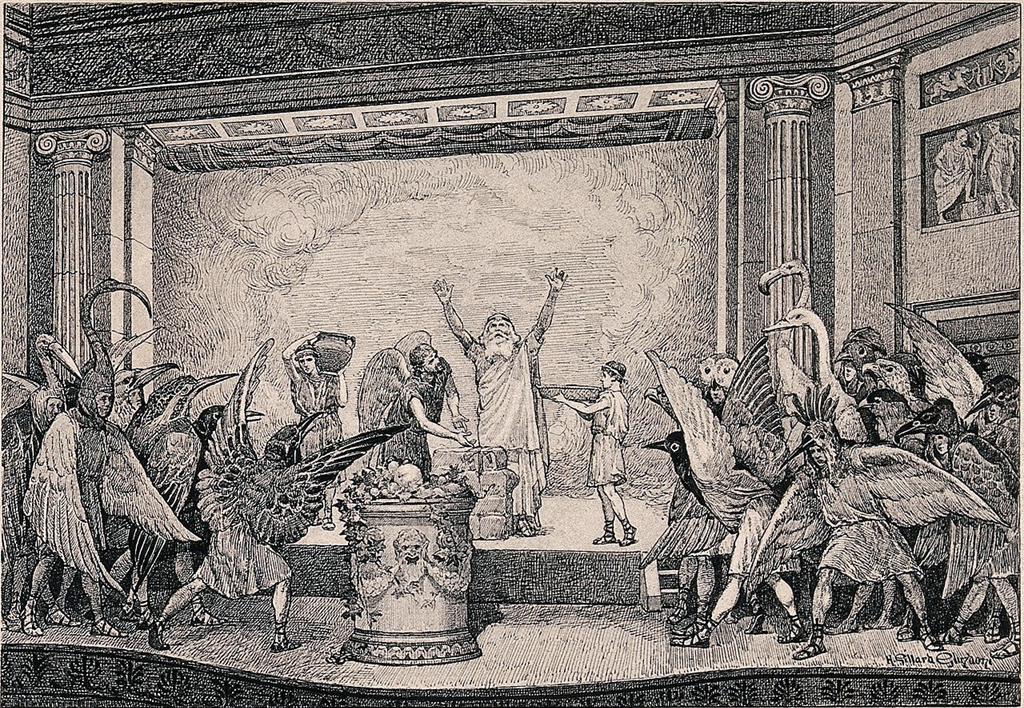
As the war continued, and the disastrous campaign against Syracuse unfurled, Aristophanes’ fantasies of escape grew more extravagant. In Birds (414 BC), two Athenians abandon the city altogether and try to found a new one in the sky, reinventing themselves among nightingales, flamingos, owls, and hoopoes. They build Nephelococcygia – Cloudcuckooland – between gods and mortals, imagining that a different world could be constructed, if only they were able to climb high enough above the old one.
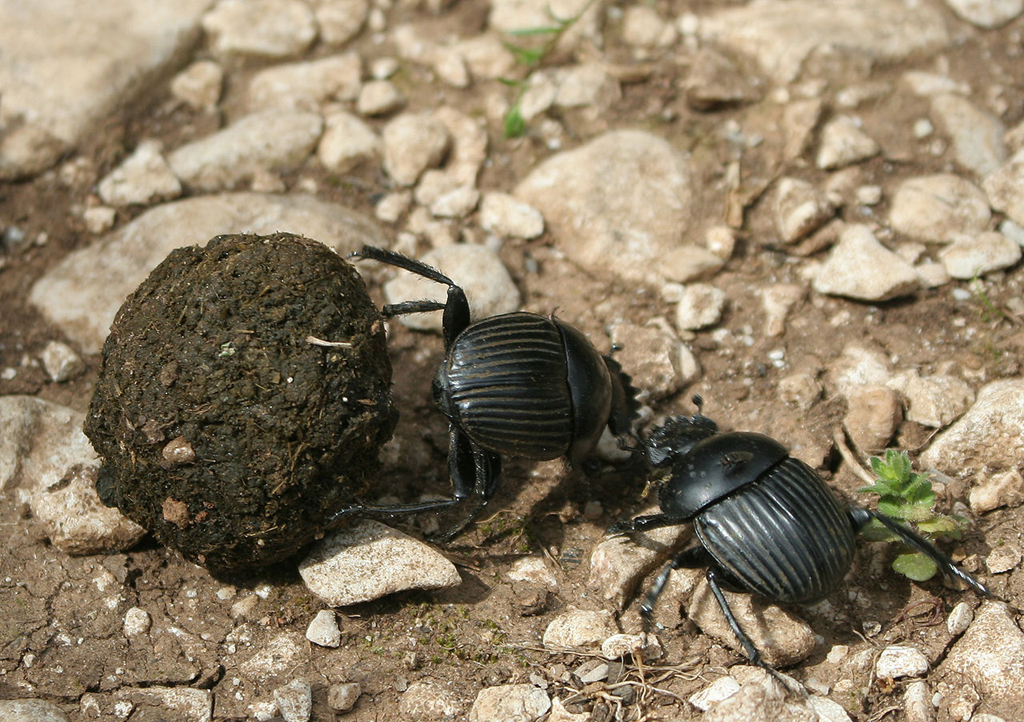
In Peace (421 BC), the farmer Trygaeus attempts to escape the world of war altogether by flying to the gods on a giant dung beetle. His name is Aristophanes’ own invention for the play: it is connected with the Greek verb trygān (“to harvest fruit”, especially grapes), presenting him as a figure whose identity is rooted in agricultural labour, harvest cycles, and simple peasant survival. Nothing could be further from the heroic ascents of tragedy:
ΠΑΙΔ· τίς δʼ ἡ ʼπίνοιά σοὐστὶν ὥστε κάνθαρον
ζεύξαντʼ ἐλαύνειν ἐς θεοὺς ὦ παππία;
ΤΡΥΓ· ἐν τοῖσιν Αἰσώπου λόγοις ἐξηυρέθη
μόνος πετεινῶν ἐς θεοὺς ἀφιγμένος. 130
ΠΑΙΔ· ἄπιστον εἶπας μῦθον ὦ πάτερ πάτερ,
ὅπως κάκοσμον ζῷον ἦλθεν ἐς θεούς.
ΤΡΥΓ· ἦλθεν κατʼ ἔχθραν αἰετοῦ πάλαι ποτέ,
ᾤʼ ἐκκυλίνδων κἀντιτιμωρούμενος.
ΠΑΙΔ· οὐκοῦν ἐχρῆν σε Πηγάσου ζεῦξαι πτερόν, 135
ὅπως ἐφαίνου τοῖς θεοῖς τραγικώτερος.
ΤΡΥΓ· ἀλλʼ ὦ μέλʼ ἄν μοι σιτίων διπλῶν ἔδει·
νῦν δʼ ἃττʼ ἂν αὐτὸς καταφάγω τὰ σιτία,
τούτοισι τοῖς αὐτοῖσι τοῦτον χορτάσω.
DAUGHTER: Why in the world are you hitching up a dung-beetle to ride to the gods?
TRYGAEUS: Aesop tells that it is the only winged creature ever to make it there.
DAUGHTER: Impossible. How could such a stinking beast reach the gods?
TRYGAEUS: Long ago it went up in hatred of an eagle, rolling eggs out of its nest in revenge.
DAUGHTER: Then you should be riding winged Pegasus, so you would look like a tragic hero when you stand before the gods.
TRYGAEUS: Yes, but then I would need double rations. As it is, whatever food I gobble down myself, this fellow will be fed by too.
(Peace 127–39)
This is outrageous: a man fleeing war by riding to the gods on a creature that lives on excrement. Hope, in Aristophanes, is rarely noble. The daughter’s jibe about (not) looking like a tragic hero reminds us that comedy handles suffering very differently from tragedy, whose conflicts move toward resolution, even if that resolution takes the form of ruin or death. In ancient comedy, characters do not die nobly or exit into myth. They endure, they improvise, they make do, and they carry on living through conditions that should, by rights, overwhelm them.
In the Athens of the late 5th century, audiences watching Trygaeus mount his dung beetle, or Dicaeopolis taste his vintages of peace, or Peisetairos fly off to found a city in the air, were themselves living through invasion, plague, displacement, and political fracture. After the performance, they returned to their usual routines of war, shortages, fear, and exhaustion.
This tension is central to Aristophanic comedy: the hero may fling himself into the heavens, but the spectators stay earthbound. Their laughter is shaped by this fact. This is where comedy’s resemblance to trauma becomes most striking. Trauma is not a single catastrophic moment; rather, the phenomenon encompasses the difficulty of living through, and after, catastrophe. War becomes routine, displacement becomes ordinary, grief becomes ambient. One adapts because the alternative is unthinkable. Aristophanes dramatises the fantasy of escape while making palpable the reality that most people cannot escape at all. Because of this, Aristophanes can be seen as a writer of survival, but survival in a world that does not heal cleanly. His world is one where peace can be hollow, and where laughter may be inseparable from cycles of violence and aggression.

Aggression as Energy / Aggression as Damage
Aristophanic comedy is full of noise: shouting, swearing, threats, and jeers. At times this aggression feels exhilarating. There are moments when anger in these plays feels like a kind of civic energy that is invested in a refusal to be cowed, a declaration that one still cares what happens to the city. It is not gentle, but it is alive. In a world frayed by war and anxiety, that liveliness matters. Yet the same aggression can also turn, almost instantly, into something wounding.
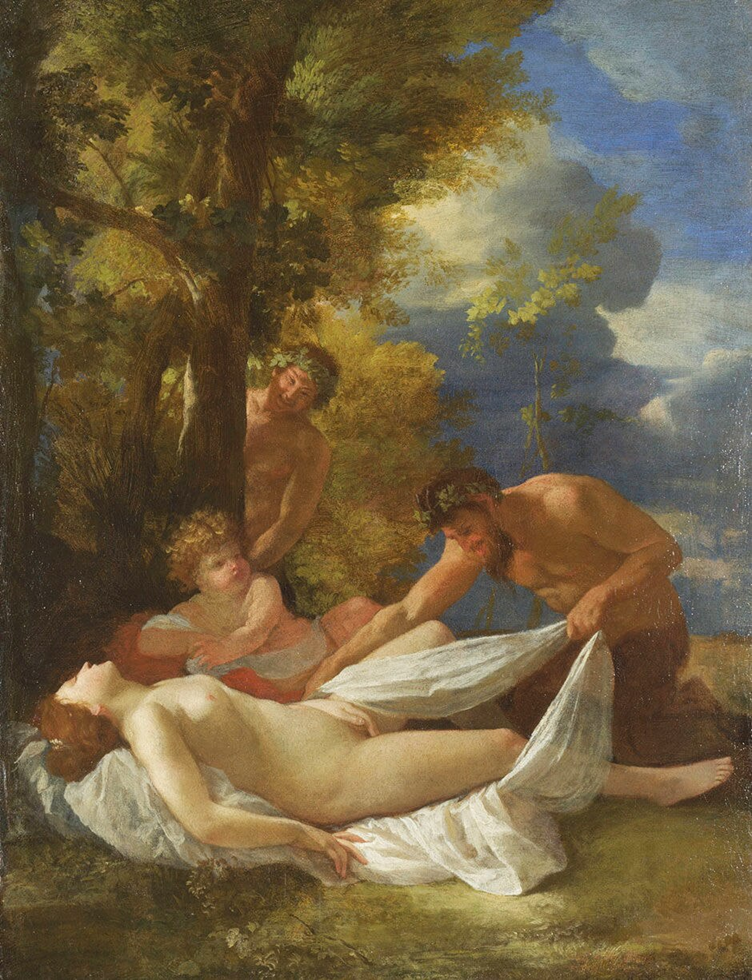
In Lysistrata, the men’s blustering fury at being shut out of satisfying their own desires is played for laughs, but the violence underneath is close to the surface. When peace is finally brokered (Lysistrata 1114–88), a mute, naked figure of Reconciliation is led before them, and Lysistrata has to warn the men not to “grab at her with a rough hand” – an instruction that hints at how easily their exuberance can spill into harm. A moment later, the Athenians and Spartans begin describing different parts of her body as if they were parcels of disputed territory, each demanding the “piece” that they want returned. The joke is brisk and bawdy, but unmistakably unsettling: the men’s political quarrel becomes a comic dismemberment of a woman’s body.
In Acharnians, another celebration of peace collapses seamlessly into an attack on Thraitta, a young enslaved woman. Dicaeopolis imagines what peace will allow him to do, and the very first thing he pictures is the violent assault of a vulnerable girl in the countryside:
ΔΙΚ· … κλέπτουσαν εὑρόνθʼ ὡρικὴν ὑληφόρον
τὴν Στρυμοδώρου Θρᾷτταν ἐκ τοῦ Φελλέως
μέσην λαβόντʼ ἄραντα καταβαλόντα καταγιγαρτίσαι. 275
DICAEOPOLIS: I came upon Thraitta, Strymodoros’ young, fresh-looking wood-gatherer from the rocky highlands, stealing. I caught her round the waist, hoisted her up, threw her down, and pressed her like a grape.
(Acharnians 272–5)
It is a fantasy, but a telling one: the imagined pleasures of peace begin with the rape of an enslaved young woman, presented as an unremarkable extension of the freedom of the comic hero. The jokes work because the plays assume female bodies are available to be handled, claimed, abused. The laughter is energetic, collective, and exclusionary; it binds one group precisely by pushing another out of recognition. Aristophanes is interested in this tipping point. The same comic charge that can unite a free male citizenry can also injure those against whom they articulate their identity. The plays rarely tell us which is happening. Instead, they let us see how quickly delight can shade into articulation of dominance. Comedy does not stand outside these dynamics, it creates them.
Aristophanes Now?
Aristophanes has a way of seeming even more pointed at moments of collective stress, as if his plays wake up when the world cracks. We are living through one of those moments now. The question of what we are allowed to laugh at has become a proxy for the question of what kind of community we are trying to be. Aristophanes speaks into that moment not because history repeats itself neatly, nor because ancient Athens was ‘just like us’, but because his plays understand that laughter is never neutral. Comedy is always a negotiation: of belonging, of vulnerability, of power.
Because Aristophanes seems close to us (he is chatty, direct, occasionally almost matey), readers and audiences often relax into him more than they do with other ancient authors. But this familiarity can blunt alertness to the harm or brutality embedded in the humour. The task, then, is to stay with the discomfort, and acknowledge that Aristophanes is not stable, not consistent, not easily claimed by satire, by anti-war politics, by civic pride, or by joy alone. Aristophanes is not here to reassure us. If these plays unsettle us, frustrate us, or make us wince, that is not a failure of interpretation. It is a sign that we are paying attention. He is here to remind us that living together is always precarious, whether it be in a political community, a classroom, or a public square. And that is why he matters now, perhaps more urgently than ever.


Samuel Gartland is Associate Professor of Greek History and Culture at the University of Leeds. His research centres on the social histories of Ancient Greece; he is co-editor of Reassessing the Peloponnesian War (Cambridge UP, 2025).
Constanze Güthenke is Professor of Greek Literature at the University of Oxford. Her work focuses on the afterlives of antiquity and on how and why Classicists read the past; her most recent monograph is Feeling and Classical Philology: Knowing Antiquity in German Scholarship, 1770–1920 (Cambridge UP, 2020).
Further Reading:
S. Gartland & C. Güthenke (edd.), Aristophanes and the Current Moment: The Politics of Comedy (Bloomsbury, London, 2025).
J. Robson, “Fantastic sex: fantasies of sexual assault in Aristophanes,” in M. Masterson, N.S. Rabinowitz & J. Robson (edd.), Sex in Antiquity: Exploring Gender and Sexuality in the Ancient World (Routledge, London, 2015) 315–31.
R.M. Rosen & H.P. Foley (edd.), Aristophanes and Politics: New Studies (Brill, Leiden, 2020).
M. Telò, Resistant Form: Aristophanes and the Comedy of Crisis (Punctum, New York, 2023).