Roger Kimball
Although the Victorian Classicist Jane Ellen Harrison has now pretty much faded into that limbo populated by authors whose work is occasionally cited but not much discussed or read, it was not so long ago that she was a staple in any serious liberal arts diet. Indeed, until the 1950s Harrison was a vivid and controversial intellectual presence both in America and in England, particularly among writers (W.B. Yeats, T.S. Eliot, D.H. Lawrence, and Virginia Woolf are among those who acknowledged her influence) and literary critics of certain ‘advanced’ tastes. And since almost any literary reputation – particularly that of a female writer – is a candidate for academic rehabilitation these days, it is hardly surprising that so substantial a figure as Jane Harrison is undergoing the process of reconstruction and reclamation.
An early sign came in the late 1980s with Sandra J. Peacock’s Jane Ellen Harrison: The Mask and the Self, a psychoanalytic portrait of the Classicist that manages to combine a heavy dose of Freudian analysis with a smorgasbord of feminist clichés about a woman struggling in a man’s world. The book was valuable less as a biographical or intellectual study than as symptom of renewed interest in Harrison’s ideas.
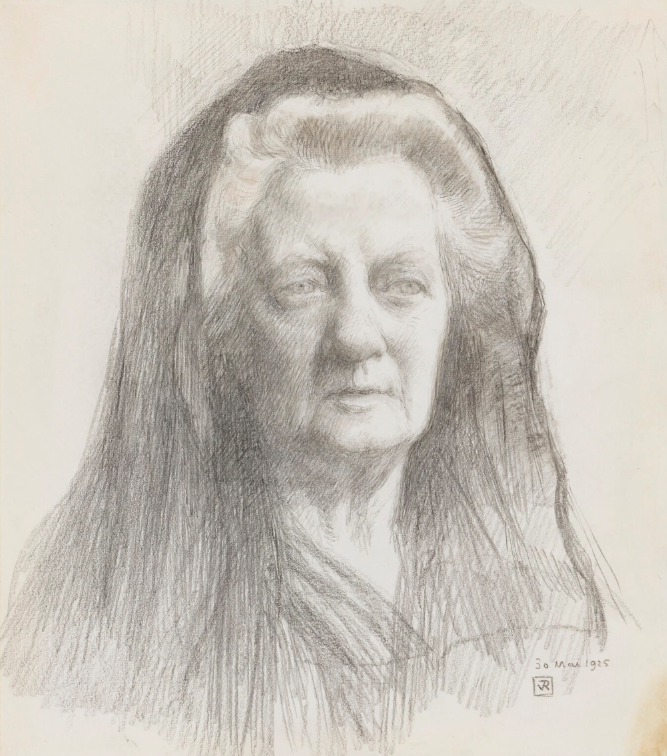
More reliable was the synopsis “Jane Ellen Harrison, 1850-1928” contributed by Hugh Lloyd-Jones to the 1996 compilation Cambridge Women: Twelve Portraits (edited by Edward Shils and Carmen Blacker). Then came Mary Beard’s The Invention of Jane Harrison (2000), part biographical sketch, part canny meditation on the fickle vicissitudes of literary reputation. There have been sundry other essays and reflections on Jane Harrison. The best full-length intellectual biography is Annabel Robinson’s The Life and Work of Jane Ellen Harrison (2002).
The third of three daughters from her father’s first marriage, Harrison was born in Cottingham, Yorkshire, in 1850 to a reasonably prosperous merchant family. Her mother died of puerperal fever a month after giving birth. Five years later, her father married Gemini Meredith, the sternly evangelical Welsh governess whom he had engaged a short time before. Harrison showed a marked aptitude and passion for languages from an early age. As one commentator noted, she “collected languages like butterflies”. She was fluent in Greek, Latin, French, and German, and had a good working knowledge of Spanish and Italian. In later years, she devoted herself to Russian and along the way dipped into Sanskrit, Cuneiform, Hebrew, Persian, Swedish and Icelandic.
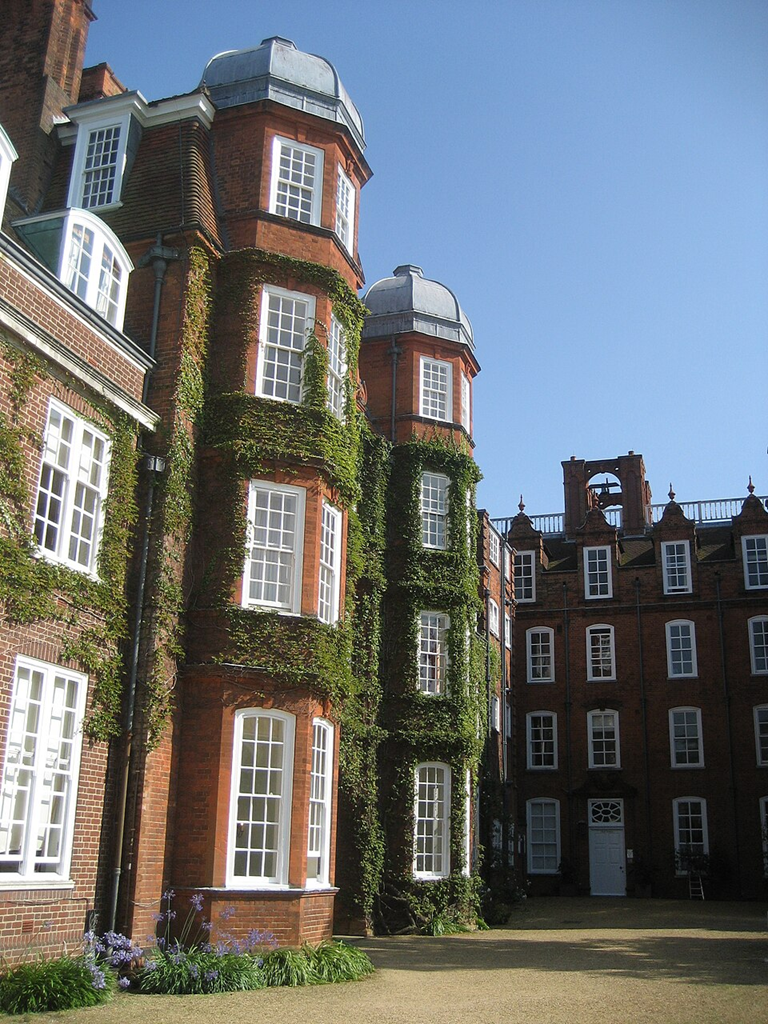
Harrison was among the first women to be educated at the University of Cambridge. She was matriculated at Newnham College in 1874, two years after the women’s college opened its doors, taking – to her lifelong regret – a Second in the Classical Tripos of 1879.
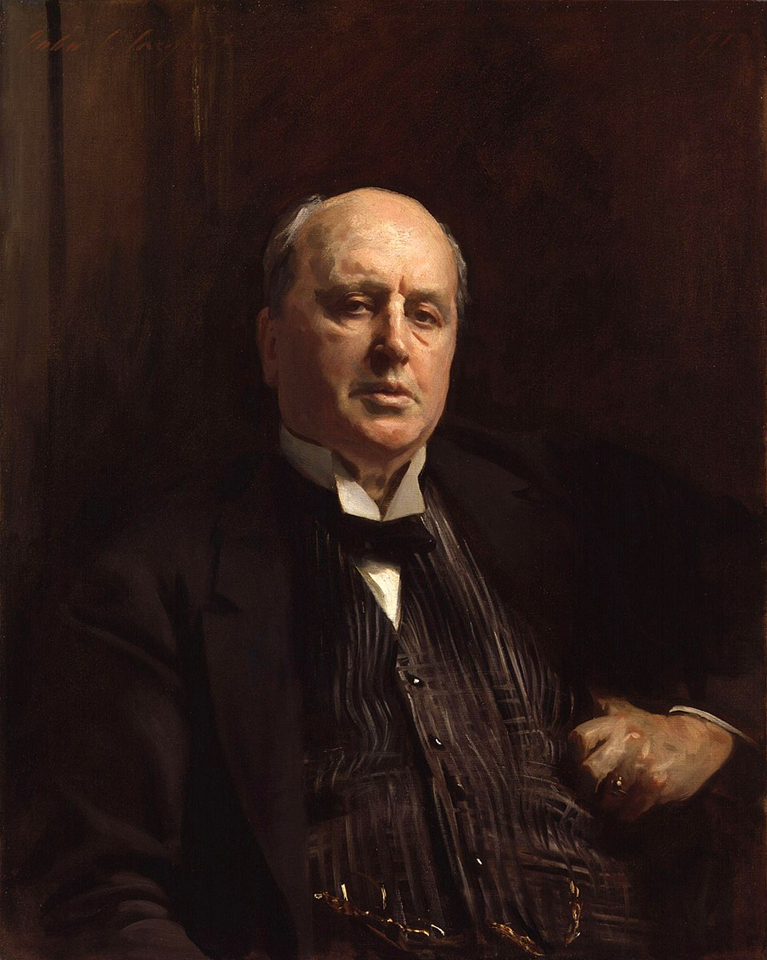
After spending a term teaching Latin, Harrison went to London, where she devoted almost twenty years to studying, lecturing, and writing at the British Museum, and traveling abroad whenever she could. During this time she flirted with the Aesthetic Movement and met many leading figures of the day, from Henry James – whom she described as an “ingenious spider” – to that “vain old thing”, Alfred, Lord Tennyson. In 1898, Harrison returned to Newnham College after winning a fellowship, remaining at Cambridge until she retired in 1922. Immediately after retiring, she went to live in Paris. She returned to London in 1926. Though she suffered from an impressive battery of “nervous complaints” at least from adolescence – headaches, shortness of breath, fainting spells, even bouts of blindness – she lived on until 1928, dying of leukemia five months shy of her 78th birthday.
In addition to being among the first women to enjoy a Cambridge education, Harrison was also part of the first generation of Classical scholars to draw upon the fledgling discipline of anthropology and the unplumbed archaeological evidence of vase paintings, inscriptions, and funerary art in her search for the origin and significance of Greek religion. She visited Arthur Evans at the excavation of Knossos in 1901 and traveled to many archeological sites in Greece with the great German archaeologist Wilhelm Dörpfeld.
While her early works on Greek art and mythology were quite conventional, her best known books, formidably titled Prolegomena to the Study of Greek Religion (1903) – at almost 700 pages, a weighty prolegomenon indeed – and Themis: A Study of the Social Origins of Greek Religion (1912), were instrumental in overturning the received view of Classical Greece as the serene citadel of lofty rationality and unruffled aesthetic perfection. As Harrison’s younger Oxford colleague and spiritual ally Gilbert Murray noted,
It would be hard to overestimate the effect on the whole study of Greek religion of the first chapters of the Prolegomena… They showed once and for all how the base of any sound study of Greek religion must no longer be the fictional, largely artificial figures of the Olympian gods but the actual rites in which religion expressed itself and, so far as we can divine them, the implications of those rites.
Looking behind the glittering pantheon of the Olympian deities to the dark, elemental rituals out of which they arose, Harrison helped to provide a new appreciation of the place of ritual and of the irrational in the formation of Greek religion and the Classical Greek ethos. As Beard put it, the “basic message” of her work is that “somewhere underneath the calm, shining, rational exterior of the classical world is a mass of weird, seething irrationality.” Before the Christian era, Harrison writes, “the real religion of the main bulk of the people [was] a religion not of cheerful tendance but of fear and deprecation.” Its formula, she notes, was not supplicatory – do ut des, “I give in order that you may give” – but apotropaic – do ut abeas, “I give that you may stay away.”
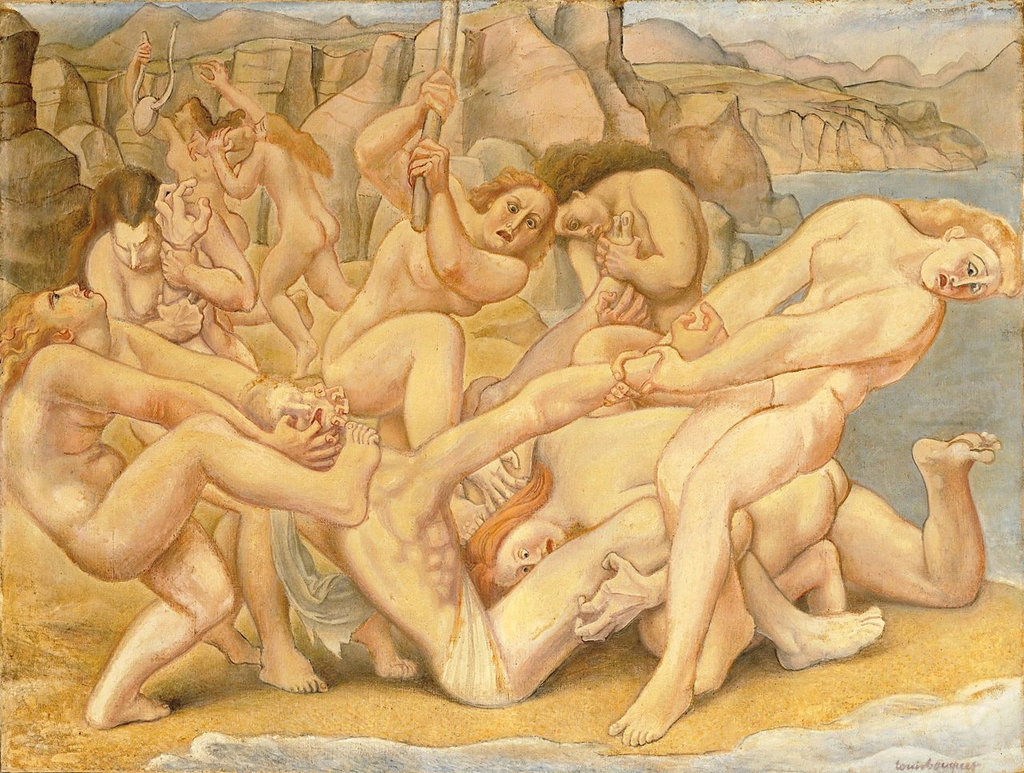
Of course, Harrison was not alone in perceiving the importance of ritual and the irrational in the origins of Greek myth. Contemporary influences on her work include the Swiss scholar Johann Bachofen, who had published, in 1861, his famous speculations on matriliny and matriarchy in ‘organic’ primitive societies, and Nietzsche, whose description of the Dionysian origins of Greek tragedy and critique of ‘Socratic’ rationalism in The Birth of Tragedy (1872) were custom-made to appeal to Harrison.
Then, too, many other scholars had been led by new archaeological evidence to realize that often savage, orgiastic communal rituals stood at the origin of much Greek mythology – “myths cruel, puerile, obscene,” as one scholar put it, “like the fancies of the savage mythmakers from which they sprang.” In anthropology, perhaps the greatest figure popularizing such insights was James G. Frazer, whose multi-volume study The Golden Bough had begun to appear in 1890. This monumental exploration of the fertility cults in the Near East revolutionized scholarly – and even popular – understanding of mythology. And while Frazer himself remained skeptical of Harrison and her circle (“The Cambridge Ritualists”), his work in comparative mythology exerted an enormous influence on her and her colleagues (as well as on many others). Harrison recalled in her late autobiographical sketch, Reminiscences of a Student’s Life (published in 1925 by the Hogarth Press), that “at the mere sound of the magical words “Golden Bough” the scales fell – we heard and understood.”
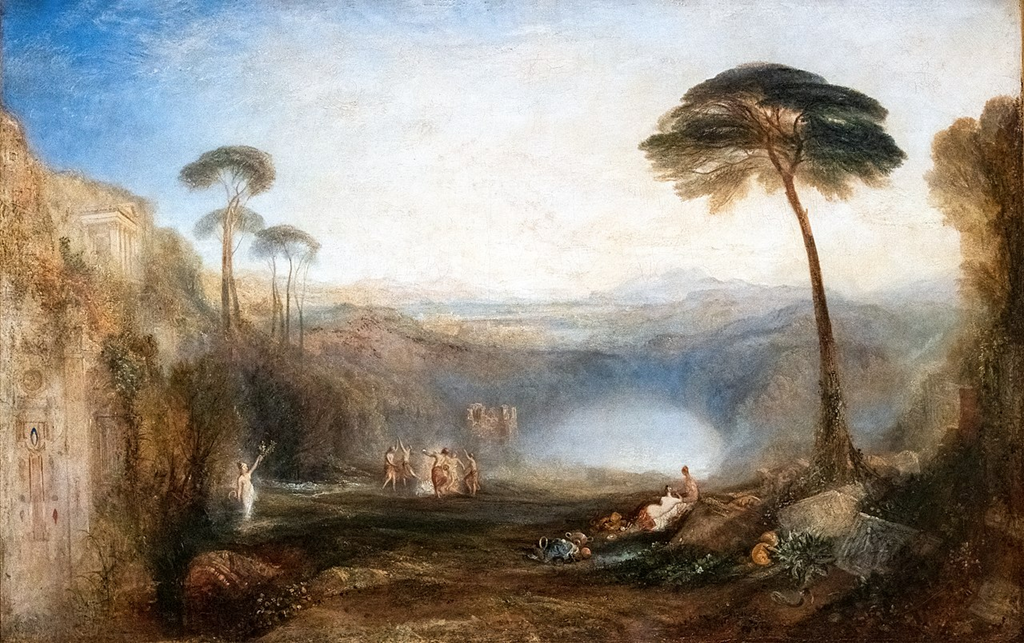
Yet, among British scholars anyway, Harrison was unusual in that she not only recognized but also championed the chthonic, ritualistic origins of Greek myth as a source of emotional richness and immediacy that she believed later, more rationalistic ages – Victorian Britain no less than 5th-century Athens – had neglected to their diminishment. For her, as Frank Turner observes in his encyclopaedic overview, The Greek Heritage in Victorian Britain (1981), “rationalism and propriety were incommensurable with the full expression and realization of the human spirit.”
In her quest for the essence of the religious impulse, Harrison turned away from the idealized image of the Olympian gods embodied in the canon of Greek literature toward the cult of Orpheus and the ritual festivals commemorated in vase paintings, sculptures, and other ancient artifacts. Thus she announces near the end of the Prolegomena that “the religion of Orpheus is religious in the sense that it is the worship of the real mysteries of life… [I]t is the worship of life itself in its supreme mysteries of ecstasy and love.” And in Themis, she disparagingly compares the gods of Olympus to “a bouquet of cut-flowers whose bloom is brief, because they have been severed from their roots.” It was in this context that Gilbert Murray observed that Harrison had made the word ‘Olympian’ “almost a term of reproach”. Though late in life she regretted her “intemperate” antipathy to the Olympians, she never ceased to regard the Olympian gods and the rationalism they represented as highly artificial creations, out of touch with the deepest human concerns.
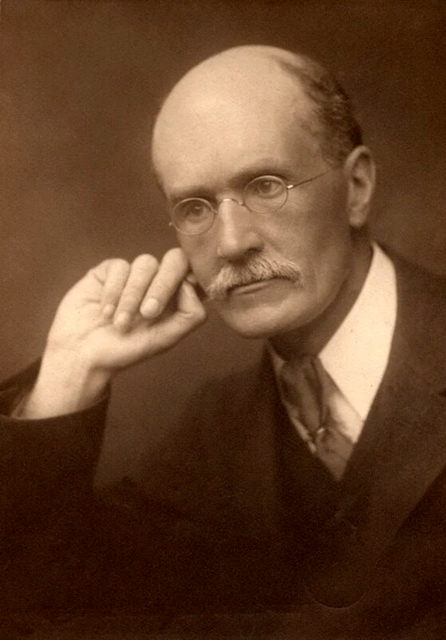
To some extent, it was novelty that formed the foundation of the appeal of Harrison’s work among her contemporaries. She wrote and lectured with a pathos and engagement rare among her academic peers, and her whole approach to the Classics – for those susceptible to its spell – seemed to open up new worlds of thought and feeling.
Today, when every junior professor sitting down to write an article taxes his readers with endless agonizing over his or her critical “methodology” (the more radical the better) and when any subject is deemed fit for academic scrutiny, it may be difficult to appreciate how fresh and original Harrison’s turn to anthropology and her brief for ritual seemed at the time. When in the opening pages of the Prolegomena she argued that “what a people does in relation to its gods must always be one clue, and perhaps the safest, to what it thinks,” she was not simply asking that her colleagues entertain an alternative perspective of the nature of Greek religion: she was challenging the entire basis of traditional Classical studies, which until then had been firmly grounded in textual analysis. As Beard put it, Harrison believed that “ritual must always come first, that the things done have precedence over the things said.”
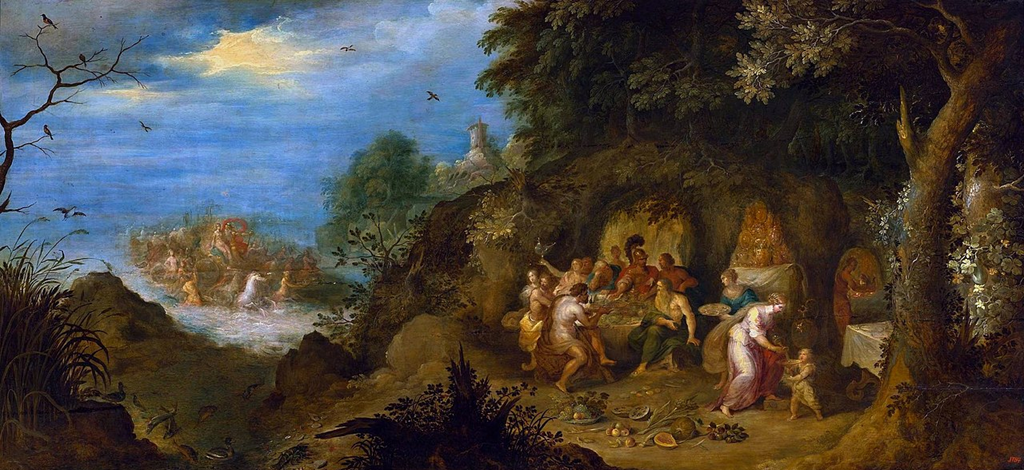
Perhaps the most important effect of Harrison’s approach was a downgrading of the place of literature in the study of antiquity. “Literature as a starting-point for my investigation,” she wrote in her preface to the Prolegomena, “I am compelled to disallow; yet literature is really my goal.” How close she ever came to that goal is a matter of dispute. Especially in her later work, it often seems as if Harrison’s chief interest in Greek religion is as a source of corroborating evidence for her own ideas about social psychology and the way society should be structured. Her fascination with the specifically social origins of Greek religion – and of the religious impulse generally – became more pronounced in her later work as she came under the sway of Henri Bergson’s philosophy and Emile Durkheim’s sociological theories.
Durkheim’s contention that religion had its origins in collective thought and feeling proved particularly attractive to her. In Themis, in which she propounds a sociological theory under the guise of analyzing the recently discovered Hymn of the Kouretes, Harrison develops the notion that religious group identity arose in ancient matrilineal societies that were dissolved with the later triumph of patrilineal (and patriarchal) society and its enshrinement in the pantheon of the Olympian gods. In this respect, at least, her work may be seen as a precursor to those contemporary academic theories that deliberately eschew the literary study of literature for the sake of sundry methods and insights drawn from the social sciences. Nevertheless, however controversial it was at the time, Harrison’s mature work breathed new life into Classical studies and provided inspiration for scholars, critics, and writers for decades.
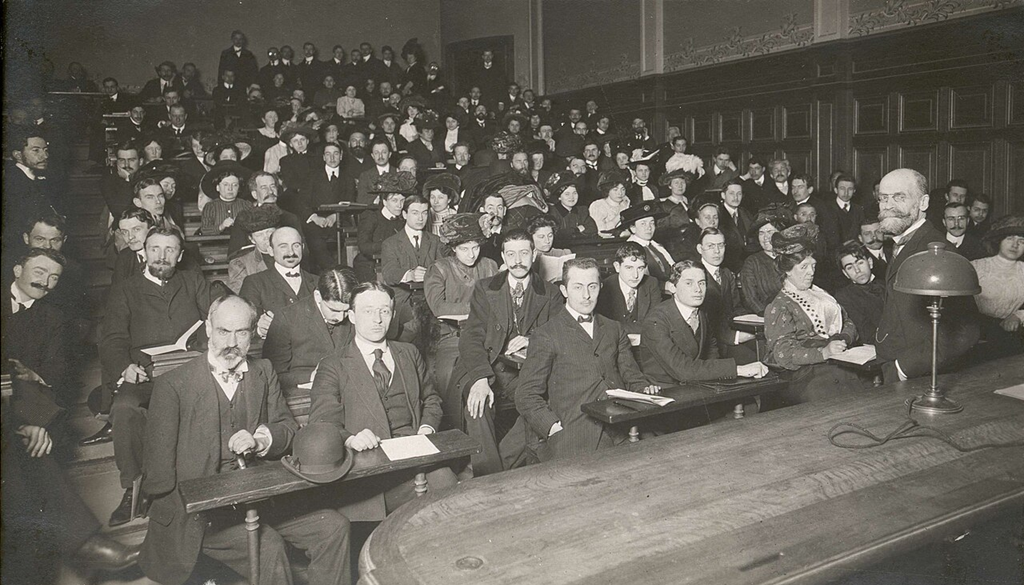
Along with inspiration came a fair measure of personal devotion and notoriety. Typical of the former are Gilbert Murray’s acknowledging his “great and obvious” debt to “Miss Harrison” in the preface to his classic study Five Stages of Greek Religion (1925) and the dedication that the philosopher Francis Cornford – another of Harrison’s younger colleagues and for many years her intimate friend at Cambridge – provided for his Thucydides Mythistoricus (1907), a book, he wrote, that was “a dream which but for her help and understanding would have gone up in smoke”.
After the Prolegomena appeared, Harrison became something of a figure in Oxbridge intellectual society, a position attested to as much by the often violent attacks on her work from conventional scholars as by the multitudinous testimonials from students and disciples. A token of her celebrity was her cameo, ghostlike appearance in Virginia Woolf’s A Room of One’s Own (1929):
Somebody was in a hammock, somebody, but in this light they were phantoms only, half guessed, half seen, raced across the grass—would no one stop her?—and then on the terrace, as if popping out to breathe the air, to glance at the garden, came a bent figure, formidable yet humble, with her great forehead and her shabby dress—could it be the famous scholar, could it be J—— H—— herself? All was dim, yet intense too, as if the scarf which the dusk had flung over the garden were torn asunder by star or sword—the gash of some terrible reality leaping, as its way is, out of the heart of the spring.

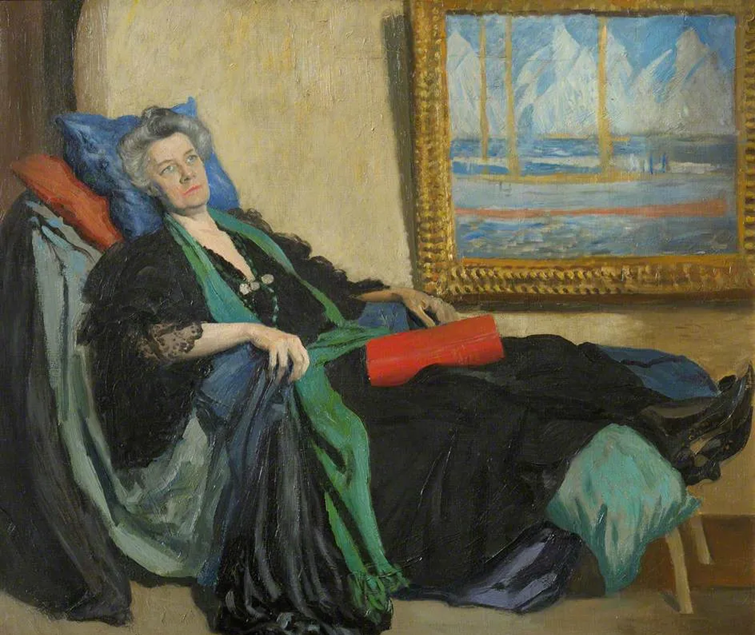
The 1909 portrait of Harrison by Augustus John, reproduced at the top of this essay, depicts its subject in late middle age, lounging back on a long chair amid an abundance of pillows, a heavy red tome resting closed on her lap. Swathed in a lacy black dress and a kind of flowing robe in her favorite acid blue-green color, she is staring off into space with weary concentration, her right hand tensely gripping the arm of the chair.
The portrait strikes one as a study in overwrought melancholy. Nothing we know of her character contradicts that impression, though it is worth noting that Harrison was also said to have been capable of infectious charm and ebullience. Bertrand Russell wrote in his journal that she was “envied for her power of enduring excess in whiskey and cigarettes”. The latter was an especially daring habit for a proper Edwardian lady – though one might of course wonder if a Cambridge bluestocking could ever be accounted a proper Edwardian lady. In any case, Harrison was remembered by many as a gifted teacher and brilliant lecturer.
In his article on Harrison for the Dictionary of National Biography, Cornford noted that she regarded her lectures as “dramatic event[s]”, both for herself and her audience. “Once,” Cornford wrote, “she enlisted two friends to swing bull-roarers at the back of a darkened lecture room in order that the audience might learn from the ‘awe-inspiring and truly religious’ sound what Aeschylus [in the Edonoi] meant by ‘bull-voices roaring from somewhere out of the unseen’.”
Our knowledge of the details of Jane Harrison’s life is fragmentary and hampered by her discretion and that of most of her friends and acquaintances. There is also a relative paucity of material: Harrison burned the bulk of her correspondence in 1922 when she left Cambridge, thus erasing much firsthand evidence about her personal life. Though she suffered through several abortive romances – apparently none of them proceeded far enough to be described as ‘love affairs’ – she never married and seems finally to have renounced any interest in sex: “I starved the physical side of my nature,” she wrote in a letter, “& as sometimes happens with ascetics grew into a certain distaste for it.”
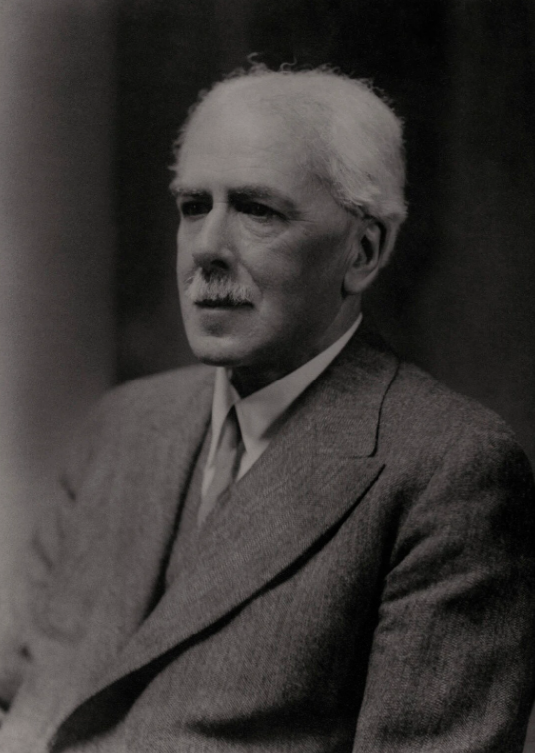
Perhaps the greatest love of Harrison’s life came late, around 1900, when she met Francis Cornford, who at 26 was almost 25 years her junior. Their acquaintance deepened into an intimate intellectual friendship, but Cornford seems not to have reciprocated – if, indeed, he was aware of – his mentor’s warmer feelings. Harrison introduced him to Frances Darwin, the naturalist’s granddaughter, in 1907. Though she seems to have encouraged their friendship, she was devastated when they were married in 1909. Two of her most devoted students, Jessie Stewart and Hope Mirrlees (who was Harrison’s close companion from 1909 until her death) collected material for a biography, but only Stewart published anything.
Her brief book, Jane Ellen Harrison: A Portrait From Letters, appeared in 1959 and (though littered with typographical errors) is still a trove of material on her life. Consisting of scores of letters from Harrison to Gilbert Murray and others, interspersed with commentary by Stewart, it provides a discreet but reasonably full sketch of Harrison’s life, travels, and work, usefully supplementing her own discreet recollections in Reminiscences of a Student’s Life.

Of course, the durably interesting thing about Jane Harrison is her work, in which she has claim to be a genuine pioneer. Despite her mild eccentricities (that whiskey, those cigarettes) and – as she grew old – her inveterate loneliness and hypochondria, after moving to Cambridge she led a scholar’s life: quiet, cloistered, externally uneventful, given over largely to reading, writing, and endless conversation. In her memoirs, she revealingly remarks that “until I met Aunt Glegg in the Mill on the Floss I never knew myself: I am Aunt Glegg” – though, one wants to add, Aunt Glegg with a twist, Aunt Glegg with a Cambridge education.
True, as one of the first female academics at Cambridge – as well as one of the first prominent female Classicists – Harrison’s career also possesses a minor sociological interest. One might, for example, wish to ask to what extent her career was hindered – and to what extent it was aided – by her sex. Taken all in all, I suspect that in the end it was aided rather more than hindered, but that is one of those imponderables that can never really be settled. And in truth, given her achievements, it seems a trivial question.
Mary Beard is probably right that Jane Harrison is “the most famous female classicist there has ever been, an originary and radical thinker, a permanent fixture in the history of scholarship.” One sign of her continued fecundity is the central place she occupies in the work of scholar-polemicists like Camille Paglia. Harrison’s insights about the Dionsyian-Orphic origins of art run like a leitmotif through Paglia’s rambunctious Sexual Personnae: Art and Decadence from Nefertiti to Emily Dickinson (1990) and her wickedly brilliant destruction of “deconstruction” and other silly French imports, “Junk Bonds and Corporate Raiders: Academe in the Hour of the Wolf” (1991).
At a moment when the discipline of Classics is deliquescing like the Wicked Witch of the West, Paglia invites us to turn our gaze away from that spectacle of rancid self-immolation and ponder the achievements of Jane Harrison, “one of the greatest women writers” and author of the Prolegomena, “one of the books of the century.”

Roger Kimball is Editor and Publisher of The New Criterion and President and Publisher of Encounter Books. He writes regular columns for American Greatness, The Spectator, and other periodicals. He is the author several books, including The Fortunes of Permanence: Culture and Anarchy in an Age of Amnesia, Art’s Prospect: The Challenge of Tradition in an Age of Celebrity, and Tenured Radicals: How Politics Has Corrupted Our Higher Education.