Gavin McCormick
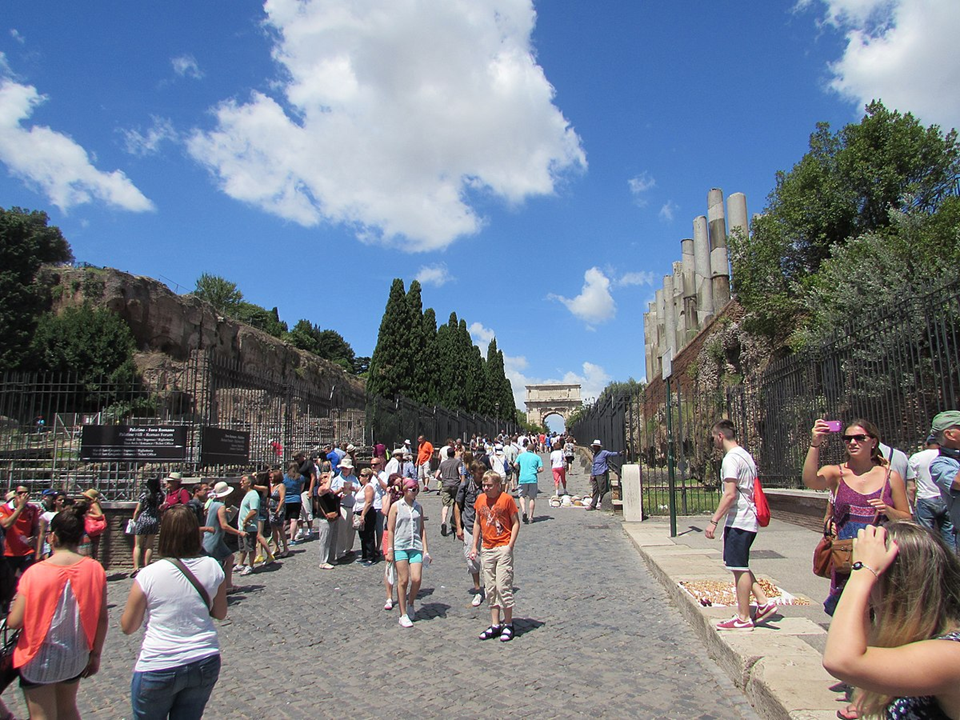
Horace’s Satire 1.9 is easy enough to summarise because it is short. A well-connected poet – portrayed indeed as Horace himself – ambles aimlessly down the Via Sacra, one of the main thoroughfares of ancient Rome. To his surprise, he is accosted by an upstart poet – a pest (I picture him as young, though the text does not make this clear). This parvenu peppers Horace with questions and some mild flattery, before promising that he won’t leave him in peace until they reach the other side of town. Horace despairs but seems incapable of issuing a flat-out dismissal, preferring to illustrate his discomfort in a not very direct way.
The pest soon reveals that he wishes to be introduced to Maecenas, Emperor Augustus’ minister of culture and the best possible patron for aspiring poets in the city. Horace tells him sardonically that he should approach Maecenas himself: if he does this, he’s sure to take him by storm! The pest does not appear to spot the wryness. A friend of Horace’s walks up; he knows the pest. Horace rolls his eyes and pulls his friend’s sleeve: “Get me out of this,” he pleads, without saying the words. His friend pretends not to understand, conjuring a deliberately weak excuse to leave Horace and the pest together again. But Horace’s salvation soon arrives. The pest catches the eye of someone who is looking for him: a plaintiff who has a case against him and wishes to drag him off to court. Chaos ensues: the pest is hauled away, and Horace is relieved of his suffering.
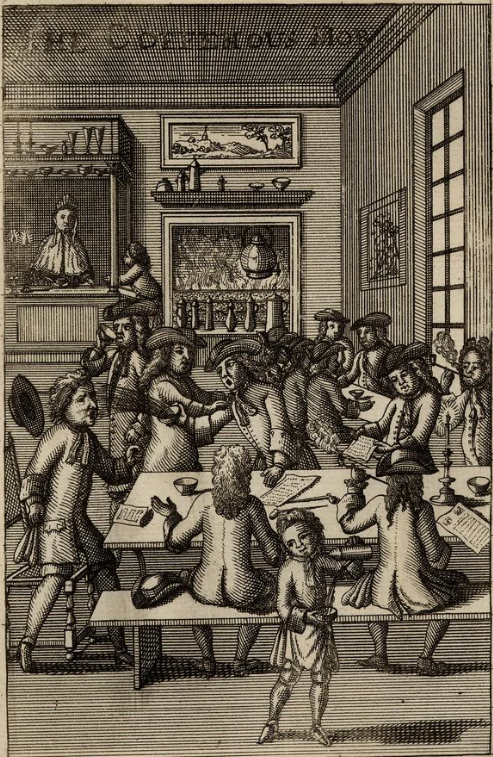
This short text has attracted readers over the centuries with its memorable and punchy storyline, and its memorable characterisation of Horace, the pest, and Horace’s friend Aristius Fuscus. It is a prime example of Horatian satire, replete with authorial pathos and self-consciousness; and its cleverly arranged poetry bears considerable close scrutiny (Horace uses numerous literary and stylistic effects to bring his story to life). The poem is also – fascinatingly – a very early case of a story which broaches the topic of city-walking. It would be a stretch to claim that the satire stands in a tradition which foreshadows by millennia Dickens and his night walks, or Virginia Woolf and her narrative framing of Mrs Dalloway, but Horace’s picture of social interaction on the Via Sacra offers a rare depiction of urban walking in antiquity.
Horace’s relationship to imperial power, through the person of Maecenas, is an underlying pretext of the poem. Our poet has an important connection; the pest wants the same. Horace attempts to play down his connection, and the nature of it, even as it occupies centre stage in his interaction with the pest. He presents a picture of himself as awkward, as lacking assertiveness, as insufficiently muscular to fend off the unwanted attention of his unwanted interlocutor.
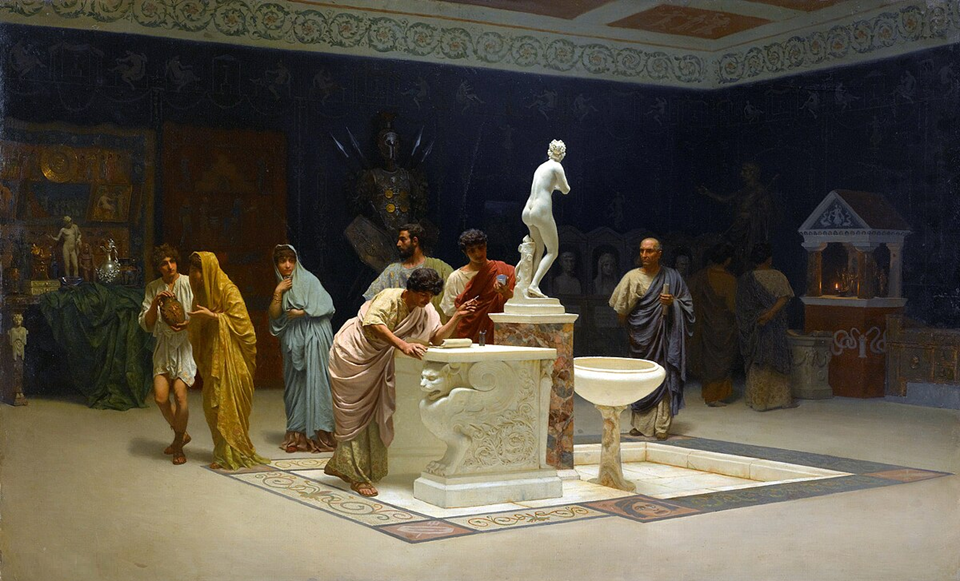
If we imagine his satire being read to a crowded room in Maecenas’ household, should we imagine his listeners being charmed and wryly amused by the poet’s effete posturing, or would they instead have collapsed into guffaws for other reasons?
To what extent is the persona Horace creates for himself in the satire precisely that – a persona? Would his listeners (or readers) have recognised the ‘real Horace’ in the poem? Recent scholarship has been more alive to the possibilities of literary and social construction than much past writing has been. But the sort of scepticism this sort of scholarship can indulge may – for instance, here – be overcooked. A straightforward interpretation would be that Horace’s early listeners would have encountered an all-too-recognisable Horace (and pest!) in this poem, and been amused.
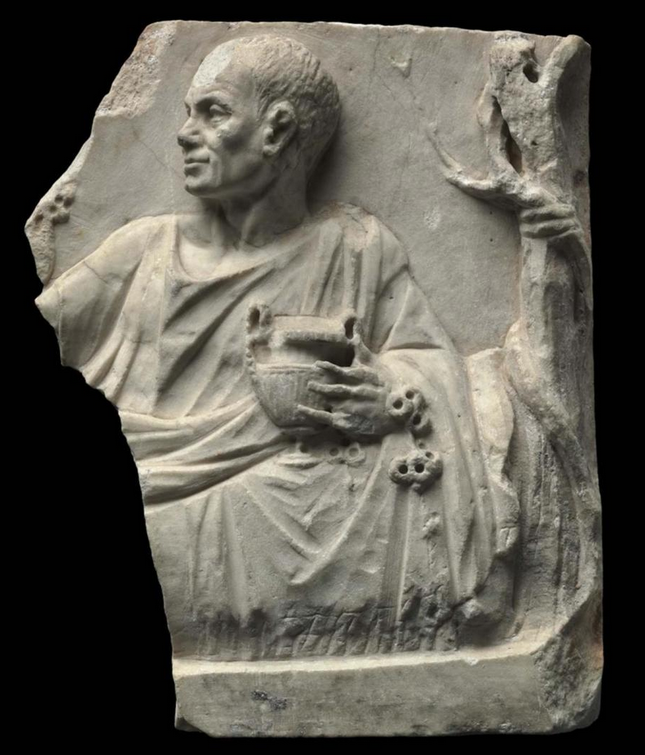
A more interesting question concerns Horace’s apparent modesty in the satire. He aims to deflect the pest while always, implicitly, maintaining that he himself is made of the right sort of stuff to enjoy Maecenas’ exalted company. Some readers detect in this pose traces of smugness: after all, Horace himself had not always had the connections he now enjoyed. There is no sense, however, that he sees inklings of the younger Horace in the pest’s aspirant (if not fervently ambitious) character. The humour in the poem lies instead in his evasive but inadequate manoeuvring to escape the pest. Picture a charmless but obsequious graduate student bombarding a distinguished and awkward (yet faultlessly polite) professor at some post-seminar drinks do for a modern scene of approximate similarity.
In analysing the opening section of the poem a few years back, I alighted upon its deployment not of two voices (that of Horace and the pest), but of three at play in the poem: the third is the voice of the narrator, which also conveys elements of Horace’s subjective consciousness, rather than what he ‘says’ out loud to the pest. Horace’s achievement in juggling between these voices – often with humorous consequences – is to highlight the awkwardness of negotiating everyday encounters: there is what we say, what our interlocutor(s) say, and what we ourselves might in fact be thinking to ourselves, to contend with. Satire 1.9 makes all too clear that we might be thinking one thing when dealing with an awkward or unwanted conversation, but feel bound to say quite another. This is an experience almost every adult will recognise.

Here is how the poem begins:
Ibam forte Via Sacra, sicut meus est mos,
nescio quid meditans nugarum, totus in illis:
accurrit quidam notus mihi nomine tantum
arreptaque manu “quid agis, dulcissime rerum?”
“suaviter, ut nunc est,” inquam,”et cupio omnia quae vis.” 5
cum adsectaretur, “numquid vis?” occupo. at ille
“noris nos” inquit; “docti sumus.” hic ego “pluris
hoc,” inquam, “mihi eris.” misere discedere quaerens
ire modo ocius, interdum consistere, in aurem
dicere nescio quid puero, cum sudor ad imos 10
manaret talos. “o te, Bolane, cerebri
felicem,” aiebam tacitus, cum quidlibet ille
garriret, vicos, urbem laudaret. ut illi
nil respondebam, “misere cupis,” inquit, “abire:
iamdudum video; sed nil agis: usque tenebo; 15
persequar hinc quo nunc iter est tibi.” “nil opus est te
circumagi: quendam volo visere non tibi notum;
trans Tiberim longe cubat is prope Caesaris hortos.”
“nil habeo quod agam et non sum piger: usque sequar te.”
demitto auriculas, ut iniquae mentis asellus, 20
cum gravius dorso subiit onus.
I was going along, by chance, on the Via Sacra, as is my habit, thinking over some or other unimportant matter, fully absorbed in such things. A certain man known only to me by name ran up to me and, seizing my hand, said: “How are you doing, sweetest of things?” “Pleasantly, for now,” I said, “and I wish you everything that you want for yourself.” When he pursued me, I got in first: “Nothing else, was there?” But he said: “You know me. I’m learned.” At this point I said: “You’ll be all the better to me for it.” Desperately seeking to leave, to go on my way more quickly, sometimes I stopped to say something or other into the ear of my slaveboy, while sweat was trickling right down to my ankles. “Lucky you, Bolanus, in your hot temper!” I was saying silently, when he was gabbling[1] on about something or other – praising the neighbourhoods, the city. When I didn’t reply to him at all, he said: “You want to get away desperately; I have seen it for a while. But it’s no use: I’ll keep with you the whole way. I’ll follow you from here to where your journey ends.” “There is no need at all to go out of your way. I want to visit someone not known to you; he’s resting in bed far away across the Tiber, near the gardens of Caesar.” “I have nothing to do and I’m not lazy: I’ll follow you there.” I drooped my ears, like a donkey in a baleful state, when a heavier load weighs down on its back.”
When the pest makes his initial approach to Horace, he is met with “notionally civil but obstructive responses”.[2] The pest is over-familiar in his initial greeting (dulcissime rerum, “sweetest of things”): Horace makes clear that this is someone he barely knows. In line 5, the phrase suaviter, ut nunc est (pleasantly, as it is now) begins with an expression of warmth but subtly uses an impersonal construction to denote a sense of social distance and to intimate that the pleasantness Horace enjoys is very much a product of how things are now (so that any change of affairs may constitute a disruption). Similarly, the passive voice had been already deployed in line 4 (arrepta manu, literally “with my hand having been grabbed”) to convey a sense that Horace is being swept up by events beyond his control.
Horace’s attempt at a polite dismissal in line 5 (cupio omnia quae vis, “I wish you everything that you want for yourself”) is, on the surface, well-meaning, but in its generality and vagueness – and its lack of interest in exactly what it is the pest wants – strikes a passive-aggressive tone. In line 7, the pest uses the rather grand first-person plural to describe himself (noris nos… docti sumus, literally “you know us… we are learned”), which contrasts with Horace’s persistent use of the more humble first-person singular in respect of himself.

Again, Horace attempts to conjure an effective polite dismissal but fails. He describes his inward misery, voicing to the reader what he does not voice to the pest, who nonetheless notices his forlorn state and comments on it. The invocation of Bolanus in line 11 is obscure but presumably refers to a well-known figure who would be happy to deal more abrasively with the pest and send him packing. Horace’s stop-start activity, as described in lines 8–11, is conveyed by clever use of metre: the rapid dactyls with elision at the start of line 9 are used to signal the quicker (ocius, “faster”) pace that Horace is aiming for, until he hits the slower plodding spondees later in the line (interdum consist(ere)) that highlight his stopping to whisper to his slaveboy.
In line 14 the pest reads Horace’s mind, mirroring the exact language Horace has used (misere) to describe his inward state. Unnervingly, the pest also asserts control: he will decide when this interaction ends. Horace again sends subtle hints that the pest really should be on his way: he is going to visit someone far away whom the pest doesn’t know (line 17). But he does so inadequately, failing again in his attempt at polite dismissal. In lines 20–1 Horace compares himself rather pathetically to an uneven-tempered donkey, as it carries a heavier load – a striking image of a leading poet of the Augustan age, albeit (as one commentator notes) an image which may recall the poet’s own servile origins.

Horace is trying to navigate a particular form of awkward and unwanted interaction in this poem. We soon find out that his interlocutor is trying to charm him with a very simple utilitarian aim. The pest wants status, power, and an introduction to the best literary circle in town. He wants to use Horace as a means to these ends. The experience of feeling used – and trapped – in a conversation is one to which many modern readers will relate (even if most lack exposure to exalted literary circles!). This will feel especially familiar wherever it becomes transparent that the aim of one’s conversation partner is simply to satisfy some simple functional purpose, or to extract some detail, which advances their own self-interest.
How might we approach such conversations? Certainly, it is important to do so as realists. It would be impossible to try to treat all human conversations in the world as we find it as ones where people are dealt with entirely high-mindedly, purely as ends rather than means. In a busy world, where things need to get done, some conversations must have a functional or utilitarian character. Equally, there is clearly something to be said for charm, subtlety, modest understatement and the correct reading of (and acting upon) social cues – not least where a functional purpose is in view, and, in particular, where that functional purpose involves (of all things) the climbing of a greasy pole.

Earlier this year, I went with a small group of students to a morning of talks on ancient literature. One of the talks was by Llewelyn Morgan on ancient satire. The gist of one punchy observation in the talk was: “Nothing is safe from the ancient satirist’s barbs, not even the satirist himself.” The overall focus of the talk had been on the Roman satirist Juvenal, but wider ruminations were offered throughout, and references were made to the output of Lucilius, Horace and Persius, the other major authors of Roman satire. The lecture remained with us after we’d left the lecture theatre: over lunch it became clear that the satire talk had been the students’ favourite of the morning. Despite having never studied this literary form – or perhaps because of this – they found themselves drawn in, not only by the speaker’s delivery, but by the nature of the satirical art form itself: its seemingly remorseless energy, its literary mischief, its impudent brazenness, its manifest tension with regimes of cant and hubris.
Perhaps, at its best, satire can fascinate also for its capacity to show how – in spite of the recurrent obstacles – we might aim to treat people as ends not means, and to converse with others with at least some charm whenever we can. And where we can’t, it might at least encourage us to turn to a droll internal monologue to sustain us where actual speech seems destined only to fail.

Gavin McCormick teaches Classics at Stowe. He has previously written for Antigone on a range of topics, including Virgil’s Aeneid and the work of Giorgio Bassani.
Further Reading
Michael Brown, Horace: Satires Book 1 (Aris & Phillips, Warminster, 1993)
Emily Gowers, Horace: Satires Book 1 (Cambridge UP, 2012)
K. Freudenberg, The Cambridge Companion to Roman Satire (Cambridge UP, 2005).
Tadeusz Mazurek, “Self-parody and the law in Horace’s Satires 1.9,” Classical Journal 93 (1997) 1–17.