Connor Beattie
The literature of Ancient Rome is full of famous soldiers, from the competing centurions Pullo and Vorenus in Caesar’s Gallic War and the HBO series Rome to the semi-mythical Lucius Siccius Dentatus who apparently fought 120 battles, won 8 single-combats, had 45 scars, captured spoils 34 times, gained 10 slaves and was awarded 18 hastae (spears), 25 phalerae (medallions), 83 torcs, and 26 crowns.[1]
Yet one figure stands out, not only because of his achievements but because we have a very reliable account of his life and accomplishments. That man is Spurius Ligustinus. He lived and took part in the most remarkable period of Roman expansion during the 2nd century BC. Through Ligustinus’ military career we can tell a story of Roman expansion from the perspective of one of its leading soldiers.
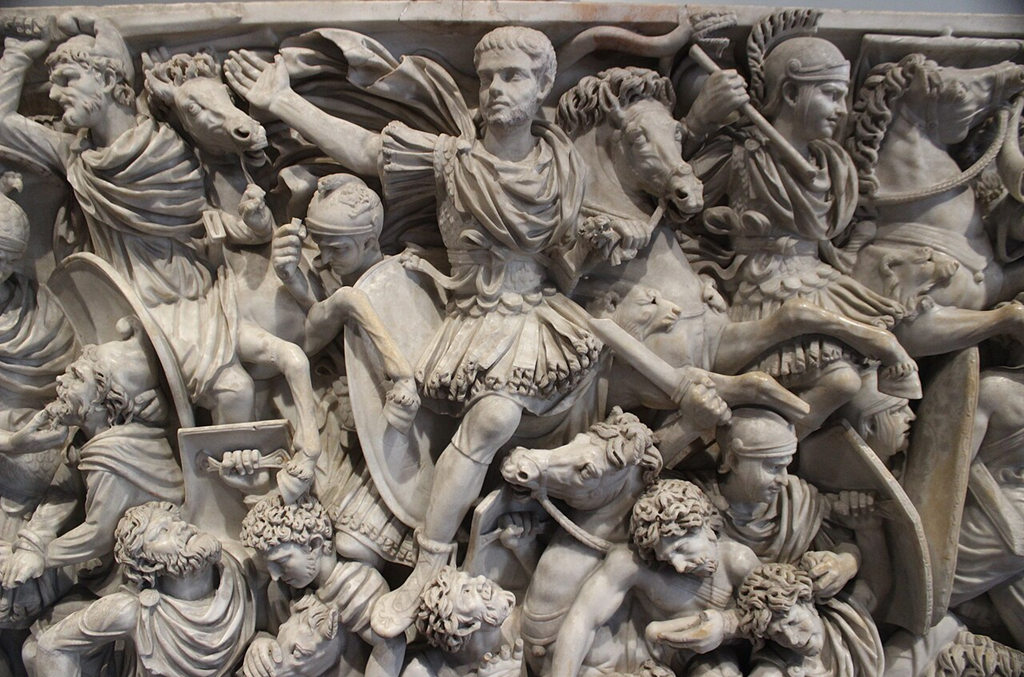
I will open the story at its close. We know so much about Spurius Ligustinus because in 171 BC he gave a rousing speech during a disagreement about the military levy. It must be remembered that the Roman legions of the Republic were quite different from those of the Principate. Whilst in the latter the army was professional with fixed terms of service upon entering, and permanent legions which men joined, in the Republic the Roman army was a citizen militia. Roman male citizens who owned property of a certain value were liable to serve in the military for a total of 16 years between the ages of 17 and 46, increasing to 20 years in an emergency, according to our most reliable source Polybius.[2]
In 171 the Romans were about to wage war against King Perseus of Macedon, whose father Philip V had been defeated by the Romans nearly 30 years before but who had recently revolted against the Romans. The Roman senate wanted to ensure as many experienced men as possible were in the army sent to fight the Macedonian king. But 23 centurions who had previously held the rank of primus pilus, the chief centurion of the legion, complained about being enlisted in a lower rank than they previously held. Spurius Ligustinus was one of these men. He gave a speech to the gathered crowd which Livy, a Roman historian from the Augustan period and our main source for the Middle Republic, preserves (Livy 42.34.1–15).

There has been debate in scholarship about how reliable this speech actually is. Did Livy simply make it up? Was it based on a genuine record? Whilst many historians err on the side of caution in thinking it an invention, I do not think this can be the case. In the first place there is no parallel in Livy when describing the Middle Republic for such a detailed account of a soldier’s career. Why, in this single instance, would the Augustan historian simply invent an individual and so many details about his life and career in order to create a speech that does not serve any fundamental need of the narrative? I tend to the view that there must have been, preserved in the historical tradition, an account of this speech, recorded by Roman historians writing in the late 2nd century, perhaps by someone who witnessed the speech or heard about it through the oral tradition. Yes, Livy might have reconstructed and embellished the speech to make it read better, and some of the details may have changed or been forgotten in the retelling of the story, but this would not have changed the basic account of Ligustinus’ career he preserves.[3]
According to Ligustinus he was first enlisted into the army in 200 BC. This was a critical year in the story of Roman imperialism because the senate had decided, against the wishes of the Roman people, to declare war against Philip V of Macedon and begin Rome’s first major and sustained military intervention into the eastern Mediterranean. Ligustinus served in the army that was sent to Macedonia and must have displayed conspicuous courage, because in his third year he was promoted by the consul Titus Quinctius Flamininus to centurion of the 10th maniple of the hastati.
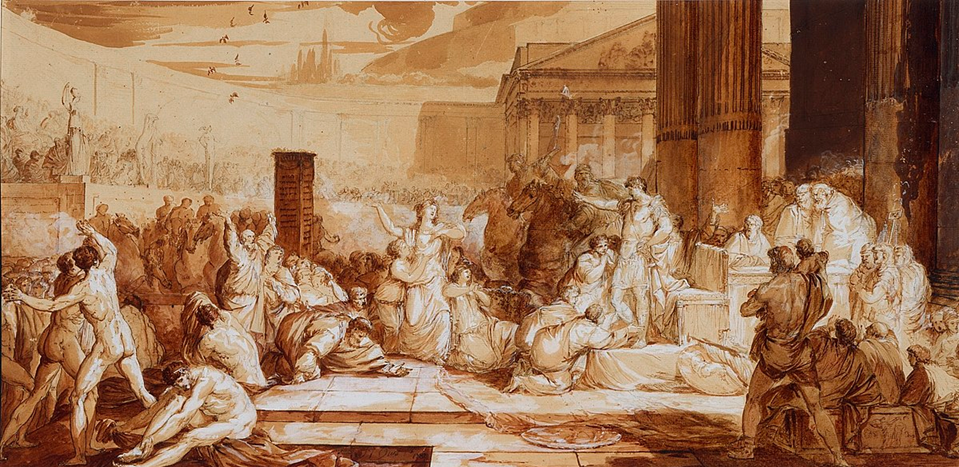
The Roman army in the Republic was divided both vertically and horizontally. In the first place, it was divided into four discrete lines of infantry. The first line was made up of light-infantry called velites who skirmished before the battle and retreated behind the heavy infantry before the main fighting began. They were composed of the youngest and poorest soldiers. The heavy infantry was then divided into three lines, the famous triplex acies, made up of the hastati who were the youngest, then the principes and finally the triarii who were the oldest and most prestigious. Each of these three heavy infantry lines was subsequently divided into ten maniples (literally handfuls) of around 160 men each, or two centuries called prior (the senior century) and posterior (the junior century). To be the posterior centurion of the 10th maniple of the hastati was thus to be the most junior centurion of the legion, whereas to be the prior centurion of the first maniple of the triarii was to be the most senior centurion of the legion.
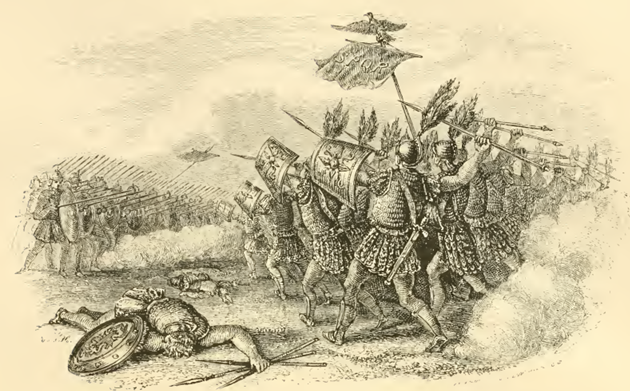
Under the command of Flamininus, Ligustinus was part of the victorious army at the Battle of Cynoscephalae in 197 BC. This was the first time in living memory that the Romans had faced the dreaded Macedonian phalanx: a dense formation of soldiers using long pikes called sarissae. Polybius, an Ancient Greek writer living through the Roman conquest, explained that, when cohesive, nothing could withstand it.[4]

Later, the Roman general Lucius Aemilius Paullus would say that he had never seen a sight more fearful than the phalanx in action.[5] As a centurion in the hastati, Ligustinus must have been amongst the very first Romans on the battlefield to face this terrifying battle formation. And yet the Romans were able to persevere and defeat the phalanx by taking advantage of its disorganisation whilst proceeding uphill and despatching troops to attack it in the rear.
After this victory Ligustinus returned to Rome and immediately set off on a new expedition in 195. This time he went to Spain, under the command of Marcus Porcius Cato, that is Cato the Elder. Cato was a keen judge of bravery – or at least Ligustinus claimed he was – and again made Ligustinus a centurion of the hastati. The Spanish were a very different enemy from the Macedonians. They fought ferociously as tribal warriors with javelins, swords and shields, much like the Romans themselves. Yet Cato and his legions, with Ligustinus amongst them, successfully battled these Iberians.
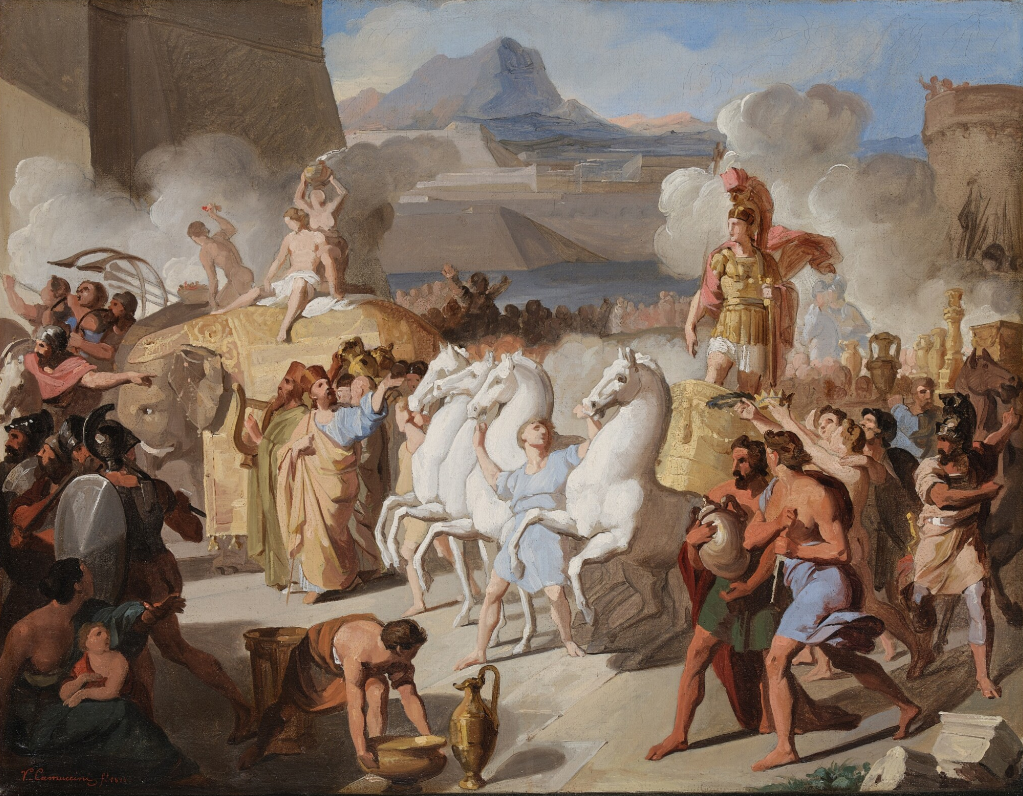
Livy, who may have been using Cato’s own account of the battles he had with the Iberians, describes how in one battle there were exchanges of javelins and incendiary spears before the battle became hand-tohand, sword-and-shield against sword-and-shield, where everything depended on the courage and physical strength of the combatants.[6] This is where the Romans particularly flourished, with strong chainmail armour (lorica hamata), long shields which covered most of their body (scutum) and the deadly Spanish sword (gladius Hispaniensis) which they had adopted from the Iberians during the Second Punic War.
After his role in the victories in Spain, Ligustinus returned to Italy, his farm and his family – which we are told consisted of his wife (who was also his cousin!) and eventually six sons and two daughters. He remained in Italy for a few years before once again heading eastwards in 191, to serve in the army against Antiochus the Great. Ligustinus was now given a promotion, being made a centurion of the principes. Antiochus was king of the Seleucid Empire and probably the most powerful individual in the ancient world at the time. His empire spanned from modern-day Turkey in the West all the way to the borders of India in the East. And yet, again, the Romans were able to defeat him in two conclusive battles: first at Thermopylae in Greece in 191 and then again at Magnesia in Asia Minor in 190.

Ligustinus probably returned to Italy in 189 or 188. His story then becomes quicker-paced but he notes that he served many more years in the legions in Spain at the end of the 180s and the beginning of the 170s under two different commanders: Quintus Fulvius Flaccus and Tiberius Sempronius Gracchus. It was during these or subsequent campaigns that he was finally appointed primus pilus or chief centurion. By the late 180s Ligustinus must have become well known amongst even the Roman aristocracy as a distinguished and experienced soldier, for Tiberius Gracchus asked for him, specifically, to accompany him to Spain.
At multiple points in his mini-autobiography, Ligustinus calls himself a voluntarius (volunteer). Given Rome was a conscript army, this might appear strange at first. Yet Ligustinus is just the best-known example of a core of essentially professional soldiers who would volunteer to serve in campaigns beyond what was required of them. Ligustinus, for example, served in total for 22 years. The motivations of these men will have been diverse. Some will have considered the army a means to improve their economic condition. Soldiers were provided with a basic wage in the Republic (the stipendium), but this was not substantial and certainly would not have allowed poorer soldiers to improve their economic circumstances. Booty, however, provided opportunity. This could take the form of material wealth, such as gold and silver, items that could be sold for money, such as jewellery or artwork, and also human capital, in the form of slaves.
Notably, there were many volunteers in 171 for the Third Macedonian War, because the Romans had seen how wealthy men who had served against Philip and Antiochus (Ligustinus surely amongst them) had become through the campaign.[7] Others may have been in search of glory and cultural capital. By defeating their enemies Roman soldiers could capture spolia (spoils) – often the arms and armour of these defeated enemies. The Romans would then display these captured spolia in their houses as demonstrations of their virtus (courage). Soldiers also had the opportunity to win military awards if they exhibited acts of bravery. For example, if they were the first to climb the wall during a siege, they received the corona muralis or mural crown. If they saved a citizen in battle then they would receive the corona civica or civic crown. Spurius Ligustinus himself was awarded distinctions for bravery 34 times. He won 6 civic crowns. This does not quite match the numbers attained by the legendary Dentatus, but it would have made him a figure of respect and authority in the militarised culture of the Roman Republic.
Ligustinus ended his speech by emphasising that, no matter his past achievements, he would still serve in the army in any capacity the military tribunes saw fit, and that he would ensure that nobody would surpass him in bravery. Yet clearly the narrative of his past accomplishments had a serious impact. He was praised by the Senate and given a posting as primus pilus in the First Legion. After this, we do not know what happened to him.

The Roman army campaigned against Perseus for several years before finally defeating him at the Battle of Pydna (in northern Greece) in 168. Ligustinus must have been one of only a few men in the army that had campaigned against all three of the great Hellenistic kings the Romans had defeated in the 2nd century: Philip V, Antiochus the Great and Perseus. And, if he was present at Pydna, he would have served in armies that had defeated all three. Certainly, across the course of three decades of campaigning, Ligustinus had travelled as far west as Spain and potentially as far east as Asia Minor (Turkey). He must have come to experience, and to understand, a great deal about the diverse nature of the Mediterranean and the places where he helped establish Roman power.

Connor Beattie is currently the Haworth Research Fellow at the Pharos Foundation and studied at Oxford for his BA, MPhil and DPhil. He specialises in Roman politics, imperialism and warfare in the Middle Republic. He has previously for Antigone about Roman gladiators.
Further Reading
C. Beattie, “Volunteer soldiers in the Roman Republic: the case of Scipio Africanus’ veterans,” Journal of Ancient History (2025) 1–21.
F. Biglino, ”Rethinking second-century BC military service: the speech of Spurius Ligustinus,” Journal of Ancient History 8 (2020) 208–28.
J. Briscoe, A Commentary on Livy Books 41-45 (Oxford UP, 2012), esp. pp.261–7.
F. Cadiou, “À propos du service militaire dans l’armée romaine au IIe siècle avant J.-C.: le cas de Spurius Ligustinus (Tite-Live 42, 34),” in P. Defosse (ed.), Hommages à Carl Deroux II (Latomus, Brussels, 2002) 76–90.
K. Milne, Inside the Roman Legions (Pen & Sword, Barnsley, 2024), esp. p.5.
M. Taylor, “A census record as a source in Livy? The life and career of Spurius Ligustinus,” Mnemosyne 73 (2020) 261–78.
C. Wolff, “Les volontaires dans l’armée romaine jusqu’à Marius,,” Latomus 69 (2010) 18–28.
Notes
| ⇧1 | Caesar, De Bello Gallico 5.44; Pliny, Naturalis Historia 7.102; see also Valerius Maximus, Facta et Dicta Memorabilia 3.2.24, Aulus Gellius, Noctes Atticae 2.11.1–4. |
|---|---|
| ⇧2 | Polybius, Histories 6.19.1–4. |
| ⇧3 | Michael Taylor (2020: see Further Reading) has argued alternatively that the speech itself is fabricated but was based on genuine data about Ligustinus taken from the archived census records and tribal muster roles. This is certainly a possibility and, whilst it would suggest that Ligustinus may not have given the speech as its recorded in Livy, the details of his career which we are tracing would remain the same. |
| ⇧4 | Polybius, Histories 18.29.1–7. |
| ⇧5 | Plutarch, Life of Aemilius Paullus, 19.2. |
| ⇧6 | Livy 34.14.11. |
| ⇧7 | Livy 42.32.6–7. |