Nicholas Stone
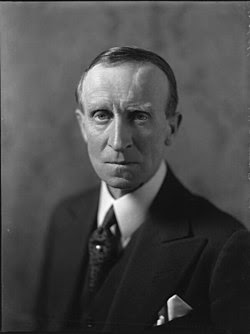
John Buchan was born 150 years ago, on 26 August 1875, in Scotland. He is best known today for his contributions to adventure literature, and best of all for the character Richard Hannay, of The Thirty-Nine Steps (1915), whose habit of rising to the occasion in extraordinary circumstances, with nothing more than his native cunning and courage to protect him, provided a model of heroism for generations growing up in Britain and beyond.
But Buchan (1875–1940) was himself an extraordinary man who rose to many occasions, in the world of literature and beyond. In addition to the career as a novelist for which he is still celebrated, he wrote histories, worked as a journalist, practised as a barrister, served as a soldier, was Head of Intelligence at Britain’s Ministry of Information during the First World War, served as a Member of Parliament for the Combined Scottish Universities, and was eventually made a peer and Governor General of Canada. He died in office in that last role in 1940, doing his duty to the end.

His contributions to poetry have attracted less attention than his novels, but are worth commemorating. Committed to making the most of his training in the Classics, he was already distinguished for his poetic ability at both Glasgow and Oxford, at the latter of which he won the Newdigate Prize (established in 1806 and awarded for the best poem by an undergraduate) in 1898, and established the Horace Society with his friends, which met to share verses inspired by that poet’s oeuvre and to eat meals modelled on those Horace might have eaten (its other members included Maurice Baring, Laurence Binyon and Hilaire Belloc).
To honour his legacy 150 years on, I offer a translation into Latin hexameters of a sonnet he wrote while at the University of Glasgow between 1892 and 1895.
Death
Why should a brave man fear the warrior Death,
Who cometh girt as strong man for the fray,
O’er the hilltops when the skies are gray,
Ere the fair sunrise comes, he hasteneth.
And all green things are withered at his breath.
He with clear voice and welcome words doth say,
‘Thy time has come, rise, let us haste away’,
And o’er the mountains back he followeth.
While men of sinking faith and courage small
He guides by dismal alley and hard way,
By dark woodpath where never sunbeams fall,
Men of stout heart, to whom the world is fair,
With no sick soul nor any weary day,
Pass o’er the mountains in the cool bright air.
De Morte
Quis timor impavido sit Mortis, militis acris
qui venit ut fortis bellator, tectus ad arma,
trans tumulos virides glauci sub nubibus axis,
sole latente premens, torrensque vigentia flatu?
illic clarisonus dicit gratissima verba:
“nunc tibi tempus adest, et nos abeamus, amice”,
et comitem certum montis trans saxa reducit.
cum minime audaces animos virtute cadente
ille per angustos calles durosque recursus
silvosasque vias perducat sole fugato,
tum fortes animi, quis vitae est integer orbis,
spiritibus fessisque die lassoque carentes
transcendunt apices, spirantes aetheris auras.

Nicholas Stone has written for Antigone about rhythm in Latin poetry, and has published various Latin poems, which can be found here, here, here, and here.
Further Reading
John Buchan’s Collected Poems, edited by Andrew Lownie & William Milne, (Scottish Cultural Press, Aberdeen, 1996).