Nicholas Romanos
The Orestes is one of the latest plays of the last of the great Attic tragedians, Euripides (c.480–407/6 BC). It was first performed in 408 BC and stands at the pinnacle of Euripides’ dramatic innovations and peculiarities; if not the most profound of his plays, it is certainly the most exciting, the cleverest, and perhaps the most outrageously ‘Euripidean’. It is also very difficult to interpret coherently.
This essay about making sense of the Orestes was written to accompany the Oxford Ancient Languages Society production of the play, on which see this introductory piece, and a forthcoming essay on how we approached setting Euripides to music.
Μενέλεως· τί χρῆμα πάσχεις; τίς σʼ ἀπόλλυσιν νόσος;
Ὀρέστης· ἡ σύνεσις, ὅτι σύνοιδα δείνʼ εἰργασμένος.
Menelaus: What is wrong with you? What malady is destroying you?
Orestes: Understanding: the awareness that I have done dreadful things.
(Orestes 395–6, transl. D. Kovacs)
These two lines are amongst the most memorable passages of the Orestes and are instantly recognisable as Euripidean. Menelaus seeks the cause of Orestes’ despair and dishevelment, and Euripides, the poet who reputedly sat beside Socrates and the sophists, and was parodied in antiquity as prizing above all mental subtlety, makes him reply: the faculty of understanding. Not the ancestral curse of the Atreidae, not the force of the Furies or the vengeance of the gods, not even the wrath of the Argive citizens, but the inner processes of his mind – we might say ‘conscience’. Orestes σύν-οιδε, he is con-scius – in the know, sharing in his own inner secrets. Orestes’ deepest fear and haunting spectre lies in the abysses of his own mind.
When Aeschylus wanted to show Orestes tormented by the Furies, he put a whole chorus of Furies on stage. When Euripides’ Orestes sees the Furies, we see only his madness, and so does his sister Electra. Orestes cries out to his dead mother, he seeks a bow to shoot down the Furies, Electra describes his swirling eyes – and then tells him to stay in bed, for you see none of what you think you clearly know you see.[1]
When Orestes’ bout finishes, he remembers nothing of it. The external reality of the Furies is ambiguous throughout the play. But readers of E.R. Dodds will prick their ears: there is more than a hint here of Euripides the psychologist, Euripides the ‘irrationalist’, who is deeply concerned with the dark, hidden areas of the mind and their influence, the irrational ‘forces’ that drive and possess us and that we readily conceive in the guise of gods. Guilt has been internalised and given demonic force.
But σύνεσις (synesis) is not simple, for it is above all linked to the active, reasoning parts of the mind. Orestes suffers so excessively from his synesis, his guilty understanding, precisely because he is so quick to understand. His synesis is able to reach beyond itself and open up the gaps to the madness that reigns below. Euripides’ Orestes, who, we should add, actually seems in his words and deeds less intelligent than his sister Electra and his friend Pylades, and possesses a certain arrogance, values understanding highly.
When the Phrygian slave has come out of the palace, and is begging Orestes not to kill him, Orestes spins a cunning question, asking if a slave can really fear death, which for him must be but an end to his woes. The Phrygian, who is the most quick-witted of all the play’s clever characters, replies that every man rejoices in “seeing the light”, in life, even if he be a slave. Orestes is impressed: You speak well: you are saved by your synesis; and he spares the Phrygian.[2] Orestes, who himself is extremely eager to hang onto life, sees in the Phrygian a spark of insight mixed with quickness of speech, and is prepared to let him live for this. He releases the slave, of course, with no less contempt than when he threatened to kill him.

The Orestes is an exceedingly difficult play to make sense of – and this despite its obsession with cleverness, clever tricks and clever words. What is clear is clever, not what is obscure, Menelaus says to Orestes.[3] There are very few moments in the play that are unclear. But the whole seems unintelligible.
Until line 1099, the Orestes makes sense: Orestes and Electra have killed their mother, and the Argives are angry. They seek help from Menelaus, but he does nothing for them. They are condemned to death. They wallow in their shared misery and fraternal love, and prepare to kill themselves. The whole story is of course unexpected, since it is Euripides’ own invention (“The story does not occur in any other author,” says the second hypothesis, attributed to Aristophanes of Byzantium). We expect Orestes to be helped by Apollo and tried on the Areopagus, not to kill himself. But it is internally coherent, and Orestes and Electra have our sympathy.
Then comes the twist. Pylades, their friend, comes up with a clever plan: to kill Helen, the ruin of Greece, and thus at least die a glorious death in arms, having committed a great deed, rather than die in a forced suicide. Electra has a better plan still: having killed Helen, kidnap Hermione – the daughter of Helen and Menelaus – and use her to bargain for release. If it fails, kill her and burn down their ancestral palace.
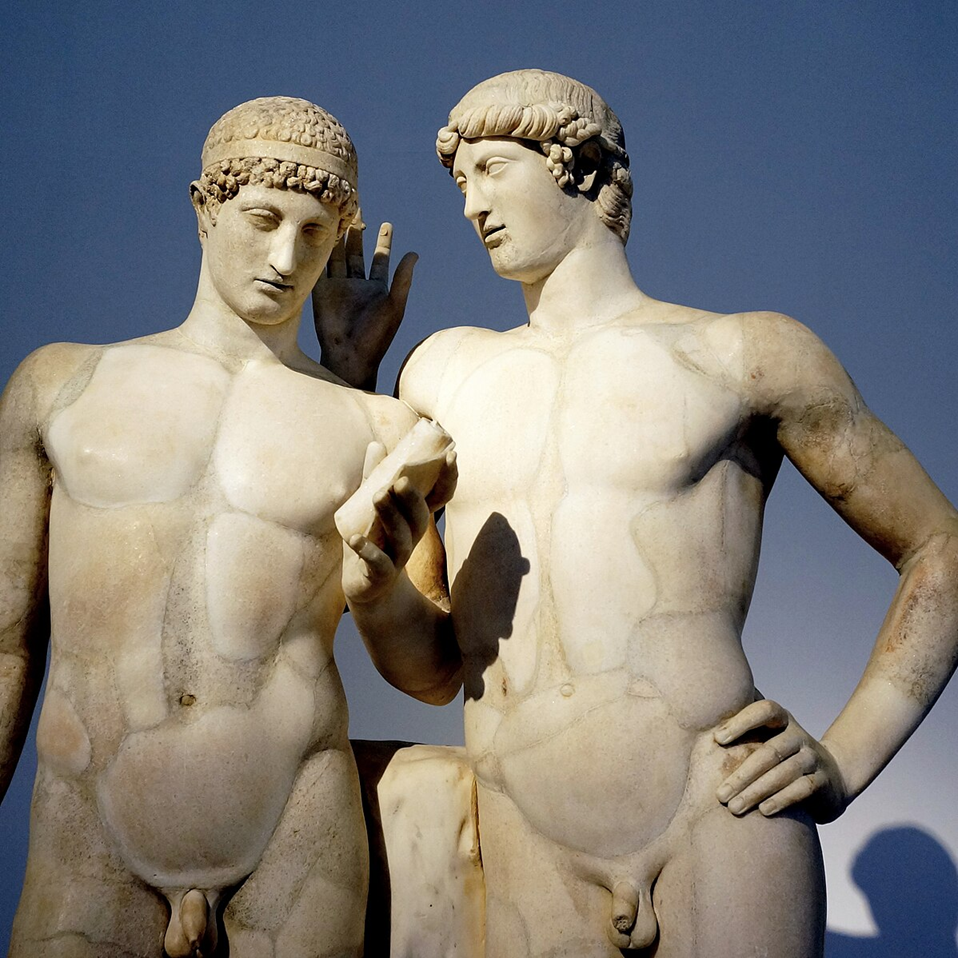
What are we to think of Orestes, Electra, and Pylades now? Is this really an act of heroism? The second hypothesis to the Orestes claims that, though it is successful on stage, the play’s ethics are dreadful: apart from Pylades everyone is bad. This is very revealing of popular Greek morality, or at least of the ethical intuitions of Hellenistic grammarians. Pylades is the archetype of a loyal friend, that most admirable human type. He would rather die with Orestes than abandon him, and will do everything he can to save him. But a modern audience is likely to be horrified by his suggestion that they slaughter Helen (a helpless woman) and thus die nobly.
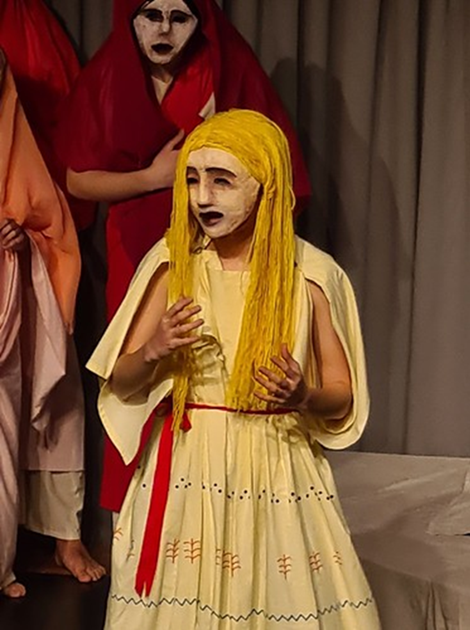
What about Electra, the loving sister, battered by fate? She is likeable enough until she concocts the appalling plan to kidnap the young Hermione, the ‘prey’ whose good-will she abuses in order to secure her destruction. And what about Hermione herself? If we had to pick one ‘good’ character, it would surely be her. In wide-eyed innocence, she promises a secretly murderous cousin Electra that she will talk to her mother Helen and sort everything out; she won’t let her relatives die. You’re saved as far as I can help it![4]
We are left in astonishment, wondering how on earth this could all end. Then the confusion descends: Helen vanished, though Orestes claims he killed her – but that’s just a ploy, and since Menelaus doesn’t believe the truth, Orestes is free to say whatever he likes and even admit his failure. Menelaus, the character Aristotle thought Euripides had made unnecessarily bad – presumably because he was after all secretly intent on the throne of Argos, Orestes’ birthright – is helpless. But suddenly Apollo appears, along with Helen – who has become a god! – and makes a happy end of it all.
Orestes won’t kill Hermione, but marry her (after spending some time abroad and going through the familiar trial in Athens). Menelaus accepts this. “The dénouement is rather of the comic sort,” says the hypothesis. Happily ever after indeed! Hearing that Orestes will marry the terrified girl at whose neck he is holding his sword, the modern spectator shivers to the bones in horror.
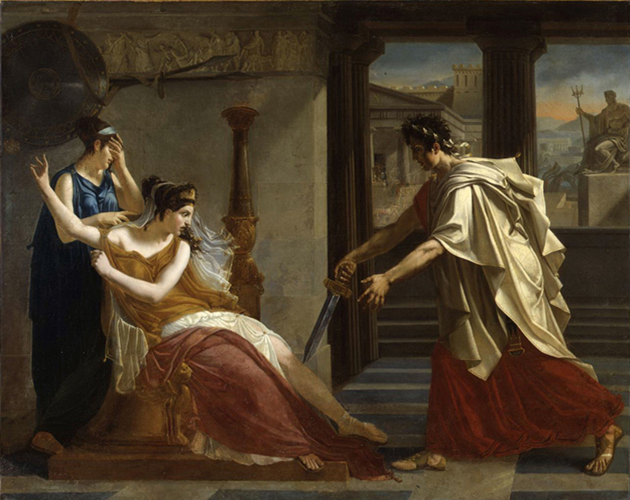
So what on earth is going on? Is this parody? And if so, of what? Perhaps self-parody? Euripides has created an ultra-dramatic, innovative, bold opera of a tragedy and pushed dramatic conventions to their edge. Cue clever metatheatrical references to and dramatic appropriations of the constraints of the Athenian theatre: Electra will keep her gloomy expression so Hermione doesn’t realise what is going on – or is that because the expression on her mask cannot change throughout the play?
Pylades speaks in his silence – because Orestes wants to do the talking, or because Pylades was played at this point by a ‘mute’, non-speaking actor, since the third of the three speaking players (beside Orestes and Menelaus) was needed for Apollo? Euripides did not have to mention Pylades at all here, but he chose to, only to point out that Pylades cannot speak. Is this all just cleverness for its own sake?

Martin West’s conclusion was that Euripides had simply written “first-rate theatre, a rattling good play” – whilst lamenting that scholars had wasted their time producing “interpretations” of Greek tragedies when they could have been collating manuscripts. Certainly the Orestes is high drama, and was popular as such in antiquity.
Karl Reinhardt, a subtle and deep critic, read the play as a document of the “intellectual crisis” of late-5th-century Athens, when the sophists and Socrates called into question received norms of thought, religion and morality, and the old ideals lost their meaning – as memorably described in a famous passage of Thucydides (3.82).[5] Euripides, Reinhardt argues, intentionally takes the old social morality of Tyndareus, the political realism of Menelaus, and the ‘heroic’ desire for action and glory evinced by Orestes and his friends, and demonstrates how they degenerate into sheer absurdity. The heroes become criminals, but “never for one moment in the whole crime do they lose the consciousness of their heroic morality”.

Orestes and Pylades are able to justify everything in terms of aristocratic morality (he is a benefactor of Greece, indeed!), and the three friends pray to Agamemnon for help in “a murder which is psychologically comprehensible but, seen in human terms, utterly repulsive.” The prayer, which has echoes of Aeschylus, “is the degeneration of the heroic and religious heritage taken to absurdity.”
We end up with, not a proper messenger, but an exaggeratedly foreign Phrygian slave who sings a long aria (such low-status figures almost never had sung lyric monody in Greek tragedy), and finally Apollo’s miraculous appearance. The high drama, the music, the clever dramatic tricks, are there to add to the absurdity of it all. “Where is the sense in it? It is part of the greatness of Euripides that he liked to pose the question but not to provide the answer.”
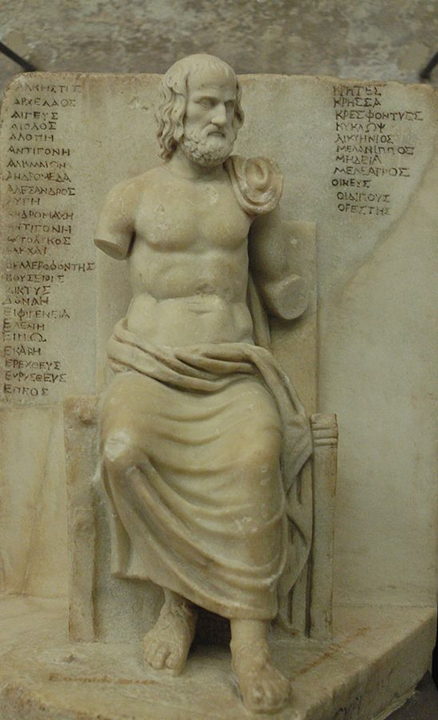
Reinhardt’s interpretation is clever in that it gives sense to the very senselessness of the Orestes. His Euripides becomes darkly familiar, a shadow of the crisis of Reinhardt’s own age – Europe of the early and mid-20th century – when an age of anxiety and nihilism was followed by social and political disaster. The Orestes is keenly sensitive to political and social issues that occupy many of us urgently right now.
Tyndareus, the venerable old man, speaks well at first, defending sage custom and repudiating the spiral of retribution, but in the end proves eager for Orestes’ – and especially Electra’s – blood. The Argive assembly is stirred up by a nameless demagogue: an Athenian might think of Cleon or his type; we may fill in whatever name we choose. Menelaus keeps quiet. (“We have experienced this ‘keeping quiet’,” comments Reinhardt potently.) The masses are dangerous when they have wicked leaders, warns Orestes.[6] Who now would have the faith of Pylades, to add: But when they get good ones, their counsels are always good?[7]

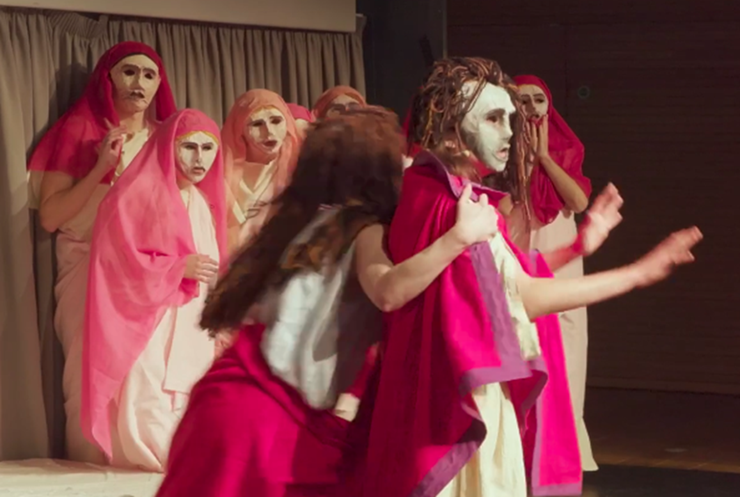
And what are we to make of the consistent vein of misogyny put into the mouth of the chorus leader – an Argive woman? We should certainly be wary of attributing to Euripides so simplistic a motive as plainly expressing contempt for women through the voice of a character, in strange dramatic contexts; he could, after all, have conveyed a misogynist message far more effectively if he had wished to. One wonders if this is parody – perhaps a response to the popular caricature of Euripides as a woman-hater because he portrayed women (no less than men!) doing terrible deeds on stage? And yet Helen is drawn as vain and shallow, if not worse. And then there is the strange mix of sympathy and self-conscious prejudice in the portrait of the Phrygian.
Perhaps, in the end, Euripides just wants to peel away the glitter and show us that the old heroic legends are nothing but stories of criminals, angry old men, and pathetic kings. Apollo’s finale would thus be so intentionally incredible as to make us revolt against the whole mythological paradigm itself. Or else merely a theatrical device, bringing back the story more or less to traditional lines simply because that was what convention demanded, but doing so as outrageously as possible.

I confess to being most attracted by Reinhardt’s reading of the Orestes, which seems to me to offer us a better and more profound play than many other interpretations. But after all I admittedly share many of Reinhardt’s broader intellectual sympathies and points of reference.
The Orestes ultimately resists our making sense of it: this plays into Reinhardt’s story, if we accept the bold hermeneutic step that he takes of making this lack of meaning the very point of the play. One could object to this on methodological and historical grounds.
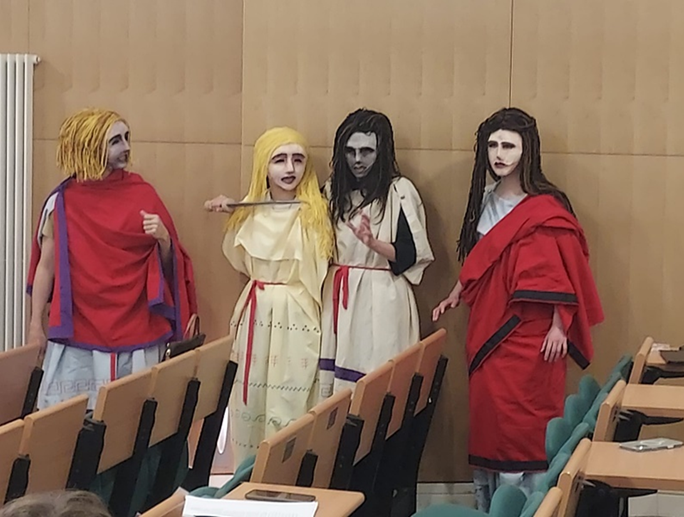
My own intuition is that, whatever else it is, the Orestes is fundamentally a drama of synesis – of understanding, and mental quickness – pushed to its extremes, on several levels. In the Orestes, Euripides pushes dramatic cleverness and musical innovation as far as he dared: this is summed up in the figure of the Phrygian, exaggeratedly, even ridiculously ‘foreign’ and slavish, singing a very long song of exceptional complexity. One has the feeling that he is seeing how far he can go; in any case, the audiences loved it. (In his final two tragedies, the Bacchae and the Iphigenia in Aulis, Euripides would in this respect step back from the brink.)
At the same time, he dramatises synesis and its limits through the characters and actions of the play. It may save the fawning Phrygian but, as we have seen, synesis makes Orestes go mad and leads him and his friends to terrible crimes. Orestes is eager to hear Electra’s shocking plan because he knows that she possesses the syneton: understanding and quickness of mind. The people of Argos lack proper understanding and are swayed by demagogues – apart from the honest peasant who is synetos and speaks out for Orestes. Tyndareus, on the other hand, lambasts Orestes as the most asynetos of all men – the most deficient in understanding.
Menelaus keeps his craftiness hidden, but is secretly triangulating his own goals. I wonder if the importance of synesis in the thematic structure of the play should not be connected to the exceeding cleverness of its drama. The character of the Phrygian might point to this: he is the archetypally ‘clever’ figure (though, of course, in a bad way), and he is an almost infuriatingly cleverly written character.

We are left with the ending, and Apollo’s intervention – always the stumbling block. Apollo is a prophet-deity, whose divine knowledge surpasses the possible bounds of human understanding. He also appears as the most notorious type of deus ex machina – his intervention utterly reverses the course of events as naturally proceeding from the rest of the play. As such, Apollo is also the perfect image of that which surpasses the bounds of narrative comprehensibility, or, if you like, shows where poetic synesis self-destructs.
Whether this last leap can be maintained in a thoroughgoing manner, I am not sure. It perhaps fails to convey the importance of the gut-wrenching fact that Orestes will marry Hermione, who doesn’t say a word. (Reinhardt deals with this more effectively, though perhaps his reading is compatible with the thoughts sketched here.) In any case, Euripides was surely using a self-conscious sleight-of-hand when he brought on Apollo at the end of his play, and it seems to me that in some important sense we are meant to be dissatisfied with the ending. But what questions does Euripides want us to ask in response to the deus ex machina? That this is all so obscure constitutes the principal difficulty in making sense of the Orestes.

Nicholas Romanos is the current president of the Oxford Ancient Languages Society, and the director, (co-)composer, and coryphaeus of its production of Euripides’ Orestes. He is a student of Classics and Sanskrit at the University of Oxford, and has recently written on Racine and Virgil (Arion), and August Wilhelm Schlegel’s edition of the Bhagavadgītā (Warwick Journal of Philosophy, forthcoming). He is also a member of Oxford Latinitas.
Further Reading:
David Kovacs’ Loeb edition (Euripides: Helen, Phoenician Women, Orestes. Harvard UP, Cambridge, MA, 2002) is probably the best place to start with the Orestes: a reliable text (in some places more attractive than James Diggle’s OCT, which is, however, indispensable due to its extensive apparatus), perhaps the best English prose translation available, and a (very) brief orientation in issues of interpretation and scholarly controversy.
Alongside this, M.L. West’s edition, translation, and commentary (Aris & Phillips, Warminster, 1987) makes for a very useful resource. Alongside its (uncharacteristically but often justifiably) conservative text and occasionally cheeky translation, it contains a very helpful introduction addressing the interpretation of the play – whence West’s comments cited above – its textual history and issues of performance. The volume’s brief commentary is also worth consulting.
An English translation of Karl Reinhardt’s penetrating essay on “The intellectual crisis in Euripides’ can be found in J. Mossman (ed.), Oxford Readings in Classical Studies: Euripides (Oxford UP, 2003) 16–46. Another classic paper addressing the Orestes is R.P. Winnington-Ingram’s “Euripides: Poietes Sophos,” is also reprinted in this volume and well worth reading.
Those who wish to study the play in depth will not forgo the standard commentary by C.W. Willink (Oxford UP, 1986).
For E.R. Dodds’ readings of Euripides (alluded to above), see “Euripides the irrationalist,” Classical Review 43.3 (1929) 97–104, and, of course, The Greeks and the Irrational (Univ. of California Press, Berkeley, CA, 1951).
Notes
| ⇧1 | 259: ὁρᾶς γὰρ οὐδὲν ὧν δοκεῖς σάφ’ εἰδέναι. |
|---|---|
| ⇧2 | 1524: εὖ λέγεις⸱ σῴζει σε σύνεσις. |
| ⇧3 | 397: σοφόν τοι τὸ σάφες, οὐ τὸ μὴ σαφές. |
| ⇧4 | 1345: σώθηθ’ ὅσον γε τοὐπ’ ἔμ᾿. |
| ⇧5 | K. Reinhardt, “The intellectual crisis in Euripides,” in J. Mossman (ed.), Oxford Readings in Classical Studies: Euripides (Oxford UP, 2003) 16-46. |
| ⇧6 | 772: δεινὸν οἱ πολλοί, κακούργους ὅταν ἔχουσι προστάτας. |
| ⇧7 | 773: ἀλλ’ ὅταν χρηστοὺς λάβωσι, χρηστὰ βουλεύουσ’ ἀεί. |