Damian Domke
Since ancient times, people have felt both great compassion and enormous fascination for blind people. It is therefore unsurprising that Homer was so often depicted as a blind old man in ancient biographies. And this perception has persisted into modern times, and indeed modern portraits.
In 1972, the English rock band Deep Purple released “When a Blind Man Cries”, depicting the misery of a lonely blind man left alone with his pain: “truly there is no sadder tale,” they sing. The Roman poet Statius takes this “saddest of all tales” as the occasion and starting point for one of the most tragic myths of antiquity.

Publius Papinius Statius (AD c.45–96), an exceptionally gifted Latin poet and connoisseur of Greek literature, was once a celebrated author, but in recent times he has enjoyed little enthusiasm from an interested public. The satirical poet Juvenal has the following to say about the popularity of Statius among the Roman people in the time of Emperor Hadrian (r. 117–38):
curritur ad vocem iucundam et carmen amicae
Thebaidos, laetam cum fecit Statius urbem
promisitque diem: tanta dulcedine captos
adficit ille animos tantaque libidine volgi
auditur. sed cum fregit subsellia versu
esurit, intactam Paridi nisi vendit Agaven.
When Statius has made Rome happy by fixing a day, everyone rushes to hear his gorgeous voice and the poetry of his darling Thebaid. Their hearts are captivated by the sheer lusciousness he inspires and the crowd listens in sheer ecstasy. But when he’s broken the benches with his poetry, he’ll go hungry unless he sells his virgin Agave to Paris. (Juv. Sat. 7.82–7, tr. S. Braund)
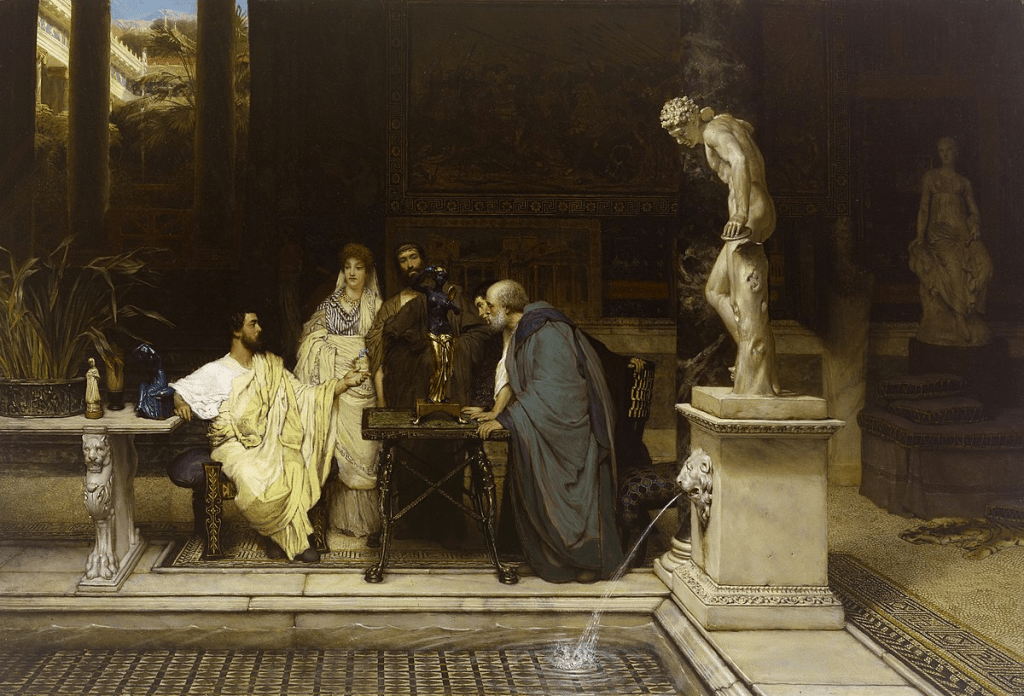
In imperial times, his Thebaid was so popular that entire crowds formed in Rome to hear him read from it, who then went into ecstasy. And even if the claim that the seats were broken during his readings may be a typical exaggeration of Roman satire, it does reveal something of the effects that the poet could create through his writing. Willy Schetter, the great Statius connoisseur, even felt compelled to call him an alter Vergilius, a second Vergil.[1]
Nevertheless, it is unfortunately not the case that the poetry of Statius is part of the basic canon of Classical studies. Research on the poet and his work is also rather limited and by no means comparable with the work on Virgil or Ovid. However, his surviving corpus, which includes a complete epic poem on the War of the Seven against Thebes (Thebaid), a fragmentary work on the history of Achilles (Achilleid) and a five-book series of miscellaneous poems (Silvae), offers a whole series of breathtakingly fine and trenchant descriptions that have made him one of the most celebrated authors in post-Classical Latin literature. Not for nothing did Dante include him alongside Homer, Ovid, Horace, Lucan and Virgil in Limbo. This short essay will focus on a small section from his main work, the Thebaid, in order to illustrate these literary subtleties.

In the Thebaid, Statius tells the story of the Theban War between Oedipus’ two sons Eteocles and Polynices. After the death of their father, both had agreed to take over the kingship of Thebes on an annual rotation. However, triggered by the vengeful curse of their father Oedipus in the Underworld, the Fury Tisiphone sows discord between the brothers, whereupon a bloodthirsty civil war is unleashed. Statius describes this curse scene of the blind father at the beginning of Book 1:
impia iam merita scrutatus lumina dextra
merserat aeterna damnatum nocte pudorem
Oedipodes longaque animam sub morte trahebat.
illum indulgentem tenebris imaeque recessu
sedis inaspectos caelo radiisque penates
servantem tamen assiduis circumvolat alis
saeva dies animi, scelerumque in pectore Dirae.
tunc vacuos orbes, crudum ac miserabile vitae
supplicium, ostentat caelo manibusque cruentis
pulsat inane solum saevaque ita voce precatur.
Oedipus had already probed his impious eyes with guilty hand and sunk deep his shame condemned to everlasting night; he dragged out his life in a long-drawn death. He devotes himself to darkness, and in the lowest recess of his abode he keeps his home on which the rays of heaven never look; and yet the fierce daylight of his soul flits around him with unflagging wings and the Avengers of his crimes are in his heart. Then does he show the sky his vacant orbs, the raw, pitiable punishment of survival, and strike the hollow earth with bleeding hands, and utter this wrathful prayer. (1.46–55, tr. D.R. Shackleton Bailey).
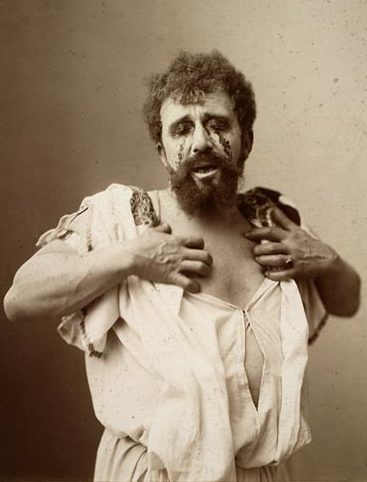
The catastrophe of Thebes begins in the darkest, indeed deepest of all places. Statius describes in detail where Oedipus had retreated to after his death due to his disgrace. His surroundings are the eternal night (aeterna nocte, v. 47), an allusion to the desolation and hopelessness of the Underworld, but also to Oedipus’ blindness, which could never be reversed. After all, he searched for his eyes (scrutatus lumina, 46), but could not find them. So he carries a memory of his personal dishonour around with him for all eternity, or rather not around, because the nefarious eyes (impia lumina, 46) are missing.
Ashamed of his own shame, he withdrew even further into the deepest retreat of the Underworld (imaeque recessu | sedis, 49–50), where the daylight no longer shone (inaspectos caelo radiisque, 50). One would think that Oedipus, who could no longer see anything anyway, no longer cared about the sun’s rays. But Statius wants to take us, the readers, into this deepest abyss of human existence and visualise, for those of us – his readers – who still have their eyes, what dark companions bitterness and resentment can be for us.

For Oedipus’ heart was filled with fierce light (saeva dies animi, 52). Yes, there is still light in the blind man, but it does not illuminate him from the outside nor could he perceive it from the outside, but it fills him from within. The Church Father Lactantius (c.250–325) says of this passage that it refers to the light of his conscience and his rage (lux conscientiae atque furiarum). He is filled with rage, with anger, with resentment at his own crimes (scelerumque in pectore Dirae, 52), which are constantly circling around him (adsiduis circumvolat alis, 51). All the blind man can see and wants is revenge.
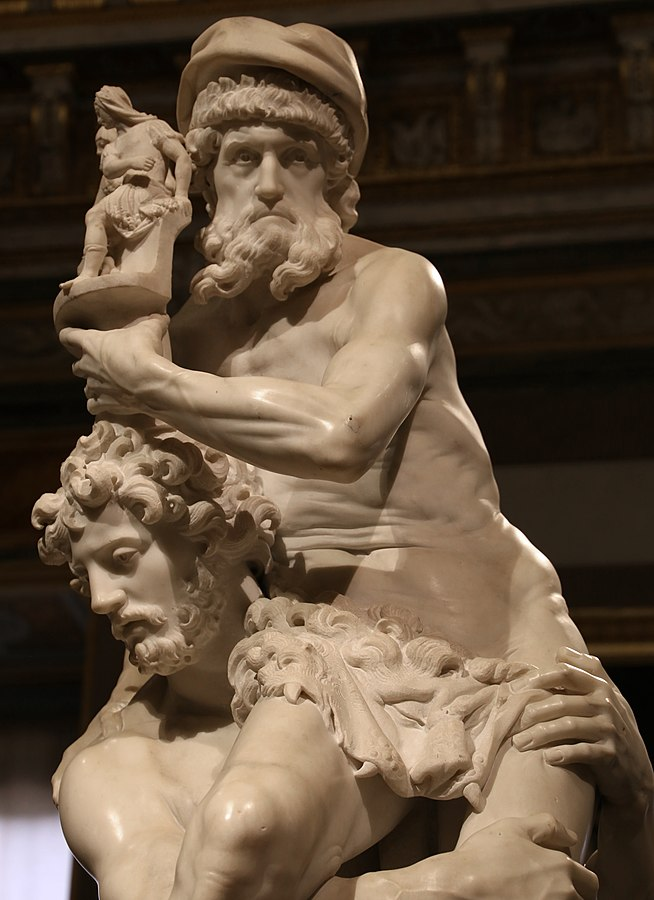
But what does Oedipus actually want revenge for? Isn’t he the one who disgraced himself, his family and the entire city of Thebes when he killed his father, King Laius, married his mother and fathered children with her? Oedipus gives the reason for his revenge later in his actual prayer for revenge. His sons would not have comforted him after he had lost his sight and his kingdom (orbum visu regnisque carentem | non regere aut dictis maerentem flectere adorti, 74–5). What may seem exaggerated and almost trivial to modern readers was a serious violation of piety (pietas) in antiquity, a virtue that meant parents were to be held in especially high honour. Think of the virtuous Aeneas – regularly called pious (pius) throughout Virgil’s Aeneid – who carried his old and frail father Anchises on his shoulders out of the burning city of Troy instead of leaving him to the Greeks or conflagration.
Out of revenge, the pathetic Oedipus now begins to take refuge in prayer to the gods. Not to any gods, however, but to Tisiphone, the Fury, the goddess of vengeance. He turns his gaze, or rather his eye sockets, to heaven (tunc vacuos orbes… ostentat caelo, 53–4) and also reminds the outside world of the miserable punishment for his disgraceful life (crudum ac miserabile vitae | supplicium, 53–4).
Why does Statius begin his Thebaid with Oedipus’ curse prayer? Because with the murder of his father Laius, the inbred marriage to his mother Iocaste and the conception of the twins Eteocles and Polyneices as well as Antigone and Ismene, Oedipus has triggered a family guilt which he now continues – this time in full consciousness – driven by his desire for revenge through this prayer. For Tisiphone carried out her supplicant’s wish and sowed discord between Eteocles and Polynices, which led to the conflict between the Seven and Thebes in the first place (123–64). And the symbol of this family guilt par excellence is Oedipus’ self-blinding and his missing eyes.
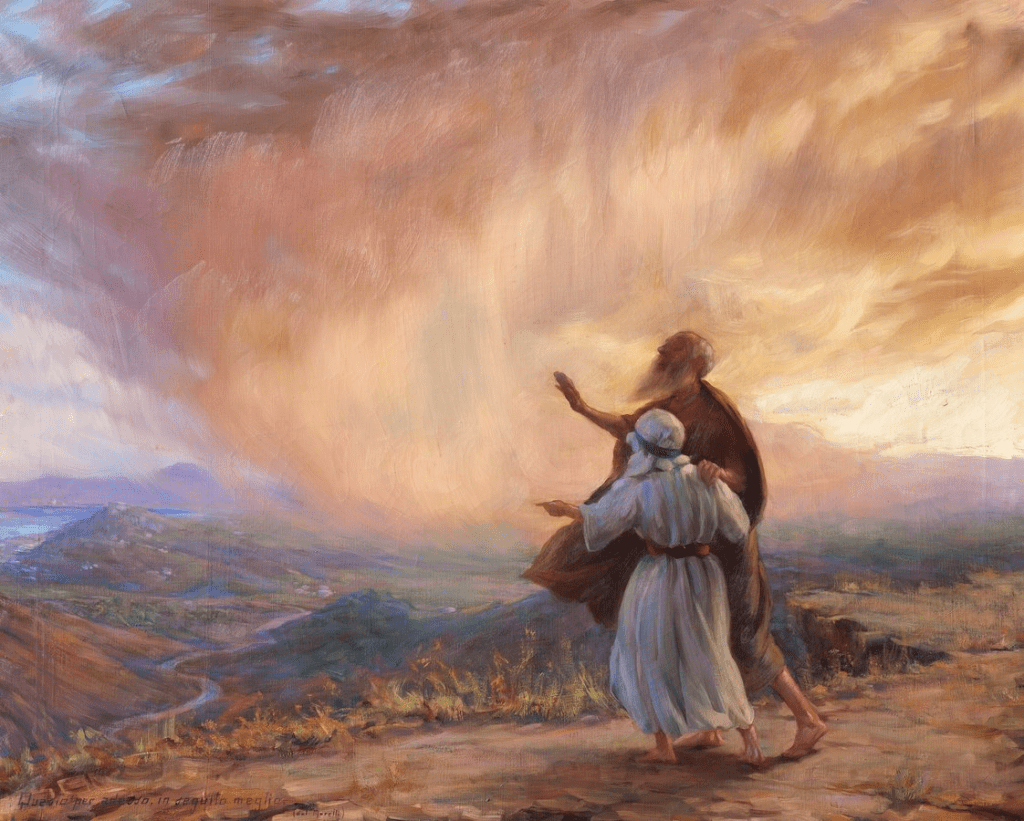
It is therefore more than surprising when Statius has his anti-hero Oedipus raise his eyes to heaven in a scene that is about seeing and not seeing, about light and gloom, about darkness caused by dishonour and the cruel light of the heart, and in the same breath has him hammer the hollow earth with bloody fists (manibusque cruentis | pulsat inane solum, 55). However, the reading of this passage is anything but clear. This is because another manuscript, Codex Parisinus 8051 in France’s Bibliothèque Nationale, written around the end of the 9th century, reads palpat instead of pulsat, which would mean: “He touches the hollow ground tenderly with his bloody hands.”[2]
But what does that mean? Johann Friedrich Gronovius (1611–71), who published and annotated Statius’ Thebaid, reminds us that “ground” can be used to describe the ground of any thing (“solum appellari omne cuiusvis rei fundamentum”).[3] For example, Cicero says in his Brutus that “the ground… or so to speak the foundation, on which oratory rests is, you see, a faultless and pure Latin diction” (Solum quidem… et quasi fundamentum oratoris vides locutionem emendatam et Latinam, Cic. Brut. 74). And Virgil in his Aeneid can describe baked goods as “wheaten base” (Cereale solum, Aen. 7.111).

So, when Oedipus touches the hollow ground with his bloodied hands, this refers to his eye sockets. This also fits in with the picture of the whole scene. Oedipus is sitting in the lowest place imaginable and can only turn “upwards”, i.e. towards heaven (caelo), for his prayer to be answered. It makes little sense for the reader to follow Oedipus’ gaze towards heaven from the deepest place in the Underworld, only to fall back to the ground of this desolate place. Touching his eye sockets also fits in with the beginning of the scene where Oedipus searched for his nefarious eyes and did not find them. Reminded of his dishonour in this way, his only option is to flee into prayer and turn to a god. In order for Tisiphone to hear his prayer, Oedipus uses his eye sockets as a kind of bargaining chip. He shows her what he has lost and thus hints at his innermost motivation for his desire for revenge.
However, this interpretation was not shared by everyone. Even Lactantius, the ancient commentator, understood the hollow ground to be the physical ground of the underworld (Bene, inania Tartara).[4] Others see it as logical that Oedipus strikes the ground because Tisiphone, the goddess of revenge whom he invokes, is a chthonic, i.e. an earth-related deity.[5] As legitimate as this interpretation may be, Oedipus’ movement (from the lowest point to heaven and back again) does not fit in with the drama of the scene.
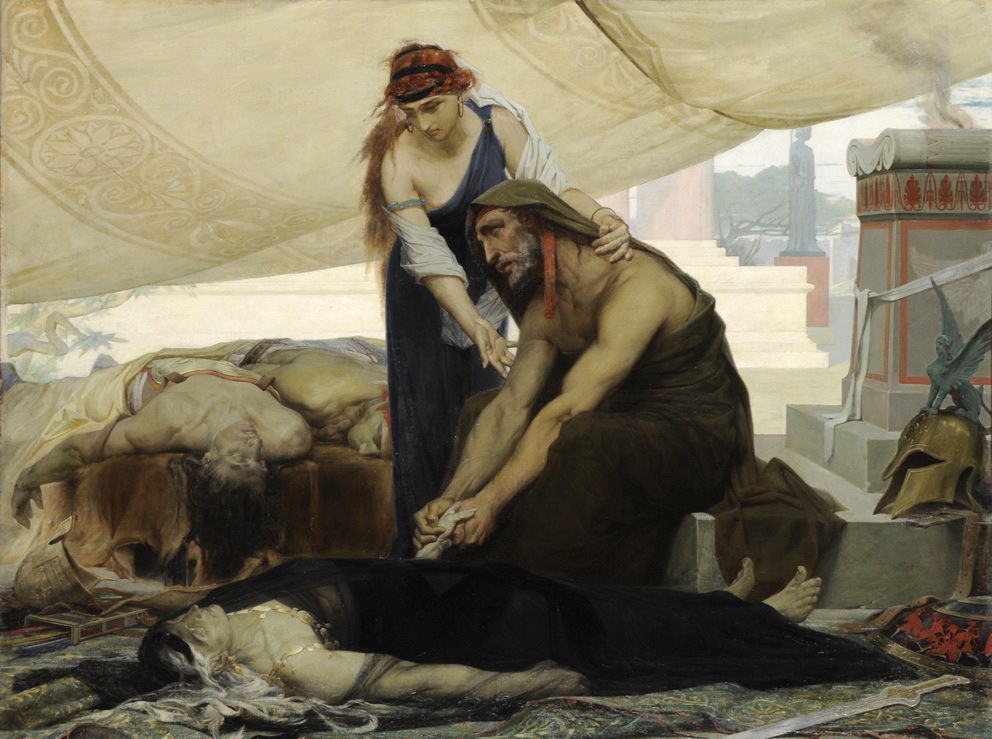
There is a very special irony in this scene, an irony of fate, so to speak. Oedipus reproaches his sons for recklessness (impietas), but ultimately it is his own recklessness that causes his sons to act in this way in the first place. He alone had – albeit unconsciously – triggered a series of family disgraces, which now comes to a climactic end in his own fury and rage. In the logic of the myth, his sons, descended from a nefarious family, could never do otherwise than indulge in impiety, as their father was already the epitome of an impious man. Statius uses this literary motif and makes it the starting point of his entire epic, based on the symbol of this impiety – namely the missing eyes. The avalanche triggered by Oedipus’ family guilt only comes to an end in the Thebaid when both sons kill each other in a duel and Oedipus then begins to lament, significantly by invoking Pietas:
tarda meam, pietas, longo post tempore mentem
percutis? estne sub hoc hominis clementia corde?
vincis io miserum, vincis, Natura, parentem.
Tardy Piety, after so long do you smite my soul? Does human mercy exist in this heart of mine? Nature, you conquer, behold, you conquer this unhappy parent! (11.605–07, tr. D.R. Shackleton Bailey).

Damian Domke studied History and Latin at the Ruprecht-Karls-University of Heidelberg, Germany. He is currently a PhD candidate writing an intellectual-historical biography of the Reformed theologian Amandus Polanus. He is interested in the intellectual and Christian dogmatical history of the 15th to 17th centuries, as well as the reception of Classical texts in the Early Modern Period.
Further Reading
Stefano Briguglio, Fraternas Acies. Saggio di commento a Stazio, Tebaide, 1,1-389 (Orso, Alessandria, 2017).
Franco Caviglia, P. Papinio Statio – La Tebaide – Libro I. Introduzione, testo, traduzione e note (Ateneo, Rome, 1973).
Heathcote William Garrod, P. Papini Stati Thebais et Achilleis (Oxford UP, 1906).
Herman Heuvel, Publii Papinii Statii Thebaidos. Liber Primus, Versione Batava Commentarioque Exegetico Instructus (Nauta, Zutphen, 1932).
Willy Schetter, Untersuchungen zur Epischen Kunst des Statius (Harrassowitz, Wiesbaden, 1960).
Johannes Vahlen, Opuscula Academica. Pars Posterior (B.G. Teubner, Leipzig, 1908).
David Vessey, Statius and the Thebaid (Cambridge UP, 1973).
Notes
| ⇧1 | See Willy Schetter, Untersuchungen zur Epischen Kunst des Statius (Harrassowitz, Wiesbaden, 1960) 150. |
|---|---|
| ⇧2 | For a defense of this reading see Alfred Klotz, „Die Statiusscholien“ in Eduard von Wölfflin (ed.), Archiv für Lateinische Lexikographie und Grammatik (B.G. Teubner, Leipzig, 1908) 485–525, at 487–8. Johannes Vahlen has doubts about this reading, see his Opuscula Academica: Pars Posterior (B.G. Teubner, Leipzig, 1908) 428–9. |
| ⇧3 | See Herman Heuvel, Publii Papinii Statii Thebaidos. Liber Primus, Versione Batava Commentarioque Exegetico Instructus (Nauta, Zutphen, 1932) 80. |
| ⇧4 | See Heuvel (1932) 81. |
| ⇧5 | See Franco Caviglia, P. Papinio Statio: La Tebaide, Libro I. Introduzione, testo, traduzione e note (Ateneo, Rome, 1973) 99, and Stefano Briguglio, Fraternas Acies. Saggio di commento a Stazio, Tebaide, 1, 1-389 (Orso, Alessandria, 2017) 157–8. |