Robin Meyer
When we think of Classical reception, a number of well-known cases immediately spring to mind: from Shakespeare’s histories such as Julius Caesar or Titus Andronicus, or tragedies such as Romeo and Juliet and Hamlet, over innumerable renaissance paintings of scenes from Greek mythology to 20th-century interpretations as varied as Jean Anouilh’s Antigone and Disney’s Hercules.
We need not even leave Antiquity and the Middle Ages to find authors inspired to translate, adapt, or otherwise use previously existing material: the Roman Epic tradition emulates much of its Greek predecessor; Plautus’ and Terence’s comedies are indebted to Attic New Comedians such as Menander, Seneca’s tragedies to the drama of Sophocles and Euripides; Apuleius’ Metamorphoses to the story of Cupid and Psyche; and so on.

Beyond literature, drama, and mythology, ancient philosophers such as Plato, Aristotle, Cicero, and Seneca have enjoyed wide and long-lasting popularity throughout time – including in other cultural spheres. One of the earliest and better attested of such receptive traditions can be found in Armenia, whose literary tradition begins in the 5th century AD with the translation of the Bible (first from Syriac, then from Greek) and the composition of a number of historical texts like the Life of Maštoc‘ (the inventor of the Armenian alphabet) by Koriwn and the History of the Armenians attributed to a certain Agat’angelos (from Greek ἀγαθός “good” and ἄγγελος “messenger”).
Over the following centuries, Greek philosophy – especially via Plato’s dialogues and the works of Philo of Alexandria and Porphyry of Tyre – was ravenously translated and subsequently commented upon, to the extent that some works (such as Philo’s Quaestiones) are in their entirety only extant in the Armenian tradition.
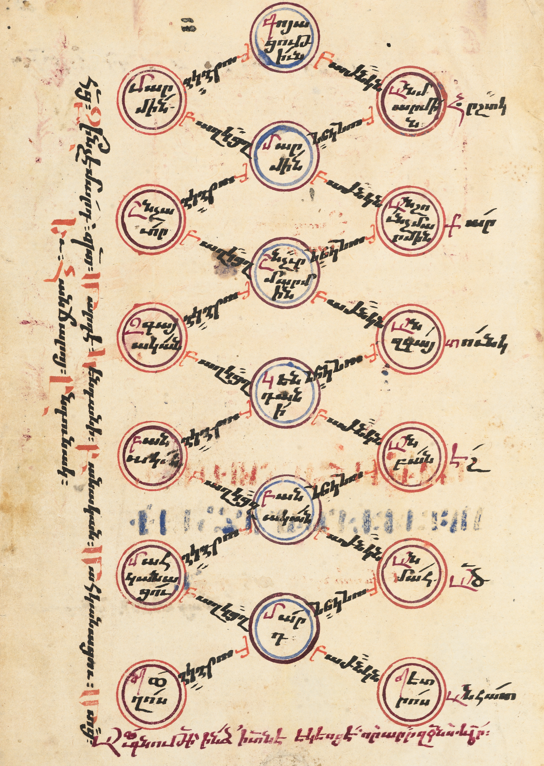
What is perhaps more surprising, however, is that one of, if not the, first Greek text beside the Bible that was “translated” into Armenian was the Art of Grammar (Τέχνη γραμματική, Technē grammaticē) attributed to the Alexandrian scholar Dionysius Thrax (170–90 BC). This work is the first in Europe to come close to what we would call a grammar in our terms, and second only to Pāṇini’s Aṣṭādhyāyī (a grammar of Sanskrit) worldwide.
In it, Dionysius (or more probably a later scholar) describes the Greek language of his time: from its pitch accent and sound system, over the different grammatical categories like gender, number and case, to the formation of simple and compound word forms. Little is said about syntax or what one should or should not do; rather, Dionysius follows the Aristotelian tradition and is interested in categorization and sub-categorization above all else. Take, for instance, the discussion of grammatical gender:
γένη μὲν οὖν εἰσι τρία· ἀρσενικόν, θηλυκόν, οὐδέτερον. ἔνιοι δὲ προστιθέασι τούτοις ἄλλα δύο, κοινόν τε καὶ ἐπίκοινον, κοινὸν μὲν οἷον ἵππος κύων, ἐπίκοινον δὲ οἷον χελιδών ἀετός. (Dion. Thrax 12)
There are three genders, the masculine, the feminine, and the neuter. Some add to these two more, the common and the epicene: common as horse, dog; epicene, as swallow, eagle.
Here, Dionysius gives the different values that the category gender can assume (masculine, feminine, neuter), adding some optional, finer categorization (common, epicene); he exemplifies the latter, less obvious values by giving specific examples: ἵππος (hippos) “horse” and κύων (kuōn) “dog” are common gender, since either the masculine or feminine article can be added to change the grammatical (and referential) gender, thus: ὁ ἵππος “horse”, “stallion”, but ἡ ἵππος ‘mare’. The epicene words, by contrast, have only one grammatical gender (ἡ χελιδών, hē chelidōn, “swallow”, ὁ ἀετός, ho aetos, “eagle”) but refer to both referential genders, so male and female birds.

If Dionysius’ Art of Grammar is a description of the Ancient Greek language rather than an instructive, prescriptive grammar, why were the Armenians interested in it? And, in the same vein, what exactly does grammar have to do with the reception of Classical ideas? As you may have noticed, I carefully put scare-quotes around the word translate above because, in fact, the Armenian version of the Art is not just a translation – that is to say, it is not a description of the Greek language but written in Armenian. Rather, the Armenian editors have produced something of a chimaera: part translation, part adaptation, part creation.
A number of passages are no longer ostensibly about describing the Greek language, but rather give details about Armenian as it was used at the time; others take up new bits of Armenian grammar to make it fit Greek grammatical categories. All the while, most references to Greek culture or literature are replaced with biblical or Armenian ones. In short, it is linguistic mayhem.

To give you an idea of what exactly the editors and translators have done in the Armenian version, here are a few examples. In the first instance, famous Greeks mentioned by Dionysius are replaced by more recent ‘celebrities’. So, instead of Socrates as in the passage below, the Armenian version refers to Պաւղոս (Pawłos, or simply: Paul the Apostle):
ὄνομά ἐστι μέρος λόγου πτωτικόν, σῶμα ἢ πρᾶγμα σημαῖνον, σῶμα μὲν οἷον λίθος, πρᾶγμα δὲ οἷον παιδεία, κοινῶς τε καὶ ἰδίως λεγόμενον, κοινῶς μὲν οἷον ἄνθρωπος ἵππος, ἰδίως δὲ οἷον Σωκράτης. (Dion. Thrax 12)
A noun is a declinable part of speech, signifying something either concrete or abstract (concrete, as stone; abstract, as education); common or proper (common, as man, horse; proper, as Socrates).
The Ajaxes suffer a similar fate: where Dionysius speaks of the Homeric heroes Telamonian Ajax and Ajax, son of Oileus, the Armenian translators once more go for New Testament characters: John, son of Zechariah (perhaps better known as John the Baptist), and John, son of Zebedee (John the Apostle). In both cases, the grammatical point in question is patronymic epithets, that is forms of a father’s name added to a given name to distinguish individuals of the same name.
So far, so unproblematic. This kind of adaptation (a so-called domesticating translation) is not historically uncommon. Similarly, there exist passages that are straightforwardly translated without any additions, subtractions, or substitutions. When Dionysius explains the Greek pitch accent, for instance, the Armenian editors provide a clear translation – even though Armenian does not have such an accentuation pattern.
τόνος ἐστὶν ἀπήχησις φωνῆς ἐναρμονίου, ἡ κατὰ ἀνάτασιν ἐν τῇ ὀξείᾳ, ἡ κατὰ ὁμαλισμὸν ἐν τῇ βαρείᾳ, ἡ κατὰ περίκλασιν ἐν τῇ περισπωμένῃ. (Dion. Thrax 3)
Tone is the resonance of a voice endowed with harmony. It is heightened in the acute, balanced in the grave, and broken in the circumflex.
Barring the aforementioned substitutions, much of the translation would therefore seem to be just that: an Armenian translation of a Greek grammar. But then there are passages such as the following, in which the alphabet and sounds of Greek are described:
γράμματά ἐστιν εἰκοσιτέσσαρα ἀπο τοῦ α μέχρι τοῦ ω… τούτων φωνήεντα μέν ἐστιν ἑπτά· α ε η ι ο υ ω.… σύμφωνα δὲ τὰ λοιπὰ ἑπτακαίδεκα· β γ δ ζ θ κ λ μ ν ξ π ρ σ τ φ χ ψ. (Dion. Thrax 6)
There are twenty-four letters from α to ω… Of these letters, seven are vowels: α, ε, η ι, ο, υ, ω… The remaining seventeen letters are consonants, β, γ, δ, ζ, θ, κ, λ, μ, ν, ξ, π, ρ, σ, τ, φ, χ, ψ.
In the Armenian version, however, the editors did not simply translate the Greek, but rather adjusted the details to describe the Armenian language instead. Thus, they write of 36 letters, eight of which are vowels and the remaining 26 consonants. This adaptation is not an isolated case: when describing the case system, for instance, the five cases of Greek (nominative, genitive, dative, accusative, and vocative) are joined by the instrumental case in the Armenian version.

Next to straightforward translations, which give us information about Greek, and these adaptations, which provide details about Armenian, we also find, for lack of a better word, new creations in the Armenian version of the Art. These commonly occur when Greek has a category (such as gender) or a value of a category (such as the dual for number) that Armenian does not possess. When discussing the definite article – which, as such, Armenian does not have either – Dionysius writes the following:
ἀριθμοὶ τρεῖς· ἑνικός, δυϊκός, πληθυντικός· ἑνικὸς μὲν ὁ ἡ τό, δυϊκὸς δὲ τώ τά, πληθυντικὸς δὲ οἱ αἱ τά. (Dion. Thrax 16)
The numbers are three: singular, dual, and plural: singular, as ὁ, ἡ, τό; dual, as τώ, τά; plural, as οἱ, αἱ, τά.
Having neither a category gender, nor a dual, nor indeed an article, what do the editors do? They use the appropriate forms of the demonstrative pronoun (“this”, “these”, and so on), simply creating new forms for the feminine and neuter as well as for the dual. Doing something comparable in English might result in forms like the man (masculine) but thi woman (feminine) and tho table (neuter)… To add insult to injury, when, about 500 years later, medieval commentators remark on this passage, they expand on it not by admitting that such forms were ad hoc creations for illustrative purposes only, but by proposing further paradigms by the example of the name Plato. And so, in an 11th-century commentary we read about the feminine, neuter, and dual forms of Plato – a “Madame Plato” / “Platoness’”, a “Plato-thing”, and “a pair of Platos”.
This brings us back to the other question asked above: why did the Armenians “translate” a Greek grammar in the first place, and why did they do so in such an unusual fashion? There is, alas, no simple answer. It has been proposed that such translations might have served as study aides for young Armenian scholars engaging in the trivium (the first of two medieval liberal arts courses focusing on logic, rhetoric, and grammar) at a Byzantine, and thus Greek-speaking centre of learning like Alexandria, Edessa, or Constantinople.
To what extent this kind of ‘translation’ would have helped learners is, however, a different question. That being said, the connection with a Greek education, particularly in view of the other translated texts mentioned above, is undeniable. Next to their primary function, these early translations also have an emancipatory role, creating for the Armenian language a technical and scientific vocabulary that had not existed before.

While some of the specifics remain shrouded in mystery for the time being, this instance of Classical reception in the Late Antique East of the Eastern Roman Empire differs from most, if not all, of its predecessors – and many successors. The creation of a large corpus of heterogeneous translated texts, most written in what is best called Hellenising (i.e. idiosyncratic) Armenian, allows for the development over the course of time of a scholarly and philosophical tradition in Armenia, informed by but independent of previous and contemporary Greek thought. More broadly, it goes to show that Ancient Greek (and Roman) thinking has influenced other cultures in perhaps unexpected, and certainly understudied, ways.

Robin Meyer is assistant professor of historical linguistics at the Université de Lausanne and works on Latin, Greek, Armenian and Iranian syntax and language contact. He has previously written for Antigone about sociolinguistic variation in Greek and Latin literature.
Further Reading
G. Uhlig (ed.), Dionysii Thracis Ars Grammatica (Teubner, Leipzig, 1883, available here).
R. Meyer, “The Armenian version of the τέχνη γραμματική: a linguistically uncomfortable Compromise,” in E. Bonfiglio & C. Rapp (edd.), Armenia and Byzantium without Borders (Brill, Leiden) 39–61, available here.
An online version of the Art of Grammar with parallel Greek, Armenian, and English translations is available here.