Art Pomeroy
I was born in Greymouth, a small town on the west coast of the South Island of New Zealand, in 1953. There was not a lot going on, but in the days before television two cinemas provided entertainment to the residents. One method of attracting an audience was to programme a group of films as a “Festival” – a War Films Festival, for instance – that would show a new title each day for one or two weeks. When I was about ten years old (around 1963) one of the cinemas promoted a series of “historical films” of dubious historicity from truly diverse time periods and geography.
Some starred famous names from Hollywood: Anthony Quinn as Attila the Hun, John Wayne as Genghis Khan, and Yul Bryner as Taras Bulba. There were also lesser-known features from Italy in dubbed English versions: The Colossus of Rhodes (1961) starring Rory Calhoun and already displaying the cinematic skill of its director, Sergio Leone; The Trojan Horse (1961) and The Avenger (1962) depicting the struggles of Aeneas at Troy and in Italy; and Son of Spartacus (1962) from the then-unknown Sergio Corbucci, whose classic western Django was soon to be banned in New Zealand for its excessive violence. The last three films all starred the American body builder, Steve Reeves.
Reeves (1926–2000) was the iconic star of what came to be described as “peplum” films: efficient adventure tales made in Italy in the late 1950s and early 1960s. They were set in Ancient Greece or Rome, often drawing on mythological themes, and the male actors generally wore short tunics which revealed their musculature. Hence derives the name “peplum” – a Greek garment (peplon), though in fact a long, female dress. “Sword and sandal” movies is another frequently used term for such productions.

The film which inaugurated this trend was released in 1958 as Le Fatiche di Ercole (The Labours of Hercules) in Italy, but simply as Hercules in the USA. Promoting it was Joe E. Levene, who had already recognized the potential of a Japanese film named Godzilla (1954) and had shown the power of saturation booking by launching Attila the Hun (1954) in 90 theatres accompanied by intense radio and television advertising. The million-dollar publicity campaign that Levene devised for Hercules resulted in almost five million dollars of ticket sales in the US alone. The awesome strength of Reeves was emphasized and the Montana-born Mr Universe (1950) became a star both as a muscleman – for instance, in Hercules Unchained (1959), the sequel to Hercules – and as an all-round action hero – in titles such as Morgan the Pirate (1960) and Sandokan the Great (1963).
Other champion bodybuilders obtained leading roles in Italian films in the early 1960s, including Gordon Mitchell in The Fury of Achilles (1962) and the South African Reg Park in a number of Hercules films, including Hercules in the Haunted World and Hercules and the Captive Women (both 1961) for the respected Italian directors Mario Bava and Vittorio Cottafavi. The Italian strong man, Sergio Ciani, duly changed his name to the more American “Alan Steel” to play the role of Hercules in Samson and the Mighty Challenge (1964). The list of bodybuilders who have become film stars now includes such worldwide celebrities as Arnold Schwarzenegger and Dwayne “the Rock” Johnson.

Muscular defenders of justice have always been popular in film. English-speaking audiences would have been familiar with Tarzan, a regular in feature films and serials in the days before Hollywood superheroes. Yet long before the peplum era, a recurring character called Maciste not only served as the guardian of the heroine – as did Ursus, “the Bear”, Lidia’s slave in Quo Vadis, played by Bruto Castellani in the 1913 version and Buddy Baer in the 1951 version – but became an audience favourite in his own right.
The name “Maciste” may seem odd, and indeed it is. It was the name given to the slave character, formerly known as Heracles, in the 1914 epic Cabiria by the poet and aesthete Gabriele D’Annunzio, when he provided poetic intertitles for Emilio Pastrone’s film. D’Annunzio asserted that Maciste was a cult name of Heracles, although the claim is disputable. What is certain is that Maciste, played by the Genoese longshoreman Bartolomeo Pagano (1878–1947), has a remarkable role in the film.

For Cabiria, the director Emilio Pastrone adapted the plot of a popular adventure story set during the third war between Rome and Carthage, Emilio Salgari’s Cartagine in fiamme (Carthage in Flames, 1908). While the Romans are the villains in Salgari’s novel, Pastrone transferred the setting to the time of the Second Punic War (218–201 BC) and foregrounded Hannibal’s invasion of Italy and Rome’s desperate struggle for survival.
Historical events from Livy’s Ab Urbe Condita (The History of Rome from its Foundation, written at the end of the 1st century BC) provide an epic background to the story. The tale of the doomed Carthaginian princess Sophonisba leant a romantic note to Livy’s account of great battles that became popular with European artists and composers. Pastrone’s film tells the tale of a young girl, Cabiria, whose family’s villa on Sicily is destroyed by an eruption of Mount Etna. She is then kidnapped by Phoenician pirates who bring her to Carthage to be sacrificed in the furnace of the god Moloch. Fortunately, a pair of Roman spies in disguise (Maciste and his master, Fulvius Axilla) intervene, snatching the girl as she is about to be sacrificed, and fight off the enraged followers of the god on the roof of his temple. As they flee, Cabiria is entrusted to the protection of Sophonisba before Maciste and Axilla are betrayed. Put in chains, Maciste is made to do forced labour grinding flour at a mill.
Axilla escapes to an Italy that has now been invaded by Hannibal and, after his ship is burned in the harbour of Syracuse by Archimedes’ sunlight-powered “heat ray”, washes up at the villa of Cabiria’s parents. He returns to Carthage, rescues Maciste and joins Scipio’s expedition against the Carthaginians and their African ally Syphax. Roman victory in battle is followed by the capture of Cirta and Syphax’s queen, Sophonisba, who now marries Massinissa. The Roman commander, Scipio, demands that the Numidian prince return his prisoner to him. Massinissa instead sends, via Maciste, a vial of poison to his wife. Sophonisba consumes the poison and dies in full film-star fashion, but before she expires she also reveals that Cabiria, now known as Elissa, is still alive. The film ends with Axilla and Cabiria sailing back to Italy as Maciste entertains the lovers by playing the pan pipes.

Pastrone’s Cabiria is a film that is epic in many ways. Its locations vary from the Alps in Northern Italy (which we see Hannibal cross with his elephants) to the deserts of North Africa (through which a camel train proceeds to Cirta). The temple of Moloch is monumental, filled with hundreds of worshippers in Arabian dress following the words of the High Priest.

The battle scenes are thrilling; the depictions of Sophonisba’s court extravagant. At times, it shares themes with disaster movies; at others, with the “maiden in distress” genre personified in the 1914 serial The Perils of Pauline.
The Romans ultimately win, an outcome that resonated with the new Italian state, which had claimed Libya as its African province only three years previously. Axilla is technically the protagonist of this romance, but it was Maciste, performing feats of strength to protect the innocent, who won the hearts of the audience. He may have been portrayed as a mixed-race slave (after all, as Axilla’s slave he cannot be a freeborn Italian), but he was pointedly not Semitic or Arabic, the two types that underlie the portrayal of Carthaginians in the film. He is a man-child, with an immense appetite for the pleasures of life, but embarrassed when an African woman takes a liking to him.
The health benefits of bodybuilding had been publicised by the German showman Eugen Sandow (1867–1925) in the late 19th century, particularly through his striking poses based on Classical statuary, which were distributed internationally through the new medium of photography. The Samson figure of early cinema also derives from this background. Maciste, though, was unique: much more than a circus strongman bending bars and breaking chains. In his second appearance in Maciste (1915), the heroine, fleeing the criminals who have kidnapped her mother, writes to Maciste at his film studio. The star is happy to assist; once he is revealed in fact to be a white Italian, he even uses the disguise of blackface to outwit the villains.

The white Maciste starred in around 26 films bearing his name between 1915 and 1926. He could be a soldier defeating the Austrian army in Maciste alpino (1916) or engaged in adventures all over the world – Maciste and the Javanese (1922), Maciste versus the Sheik (1926) – or even beneath it – Maciste in Hell (1925), a film which deeply affected the young Federico Fellini.

As an everyman figure, Maciste could be a racing driver or an aircraft pilot. This set the stage for other strongmen – including political figures such as Benito Mussolini, who enjoyed striking Maciste-like poses. By 1937 Scipio Africanus, a remake of Cabiria, had no need of a Maciste: Scipio, as avatar of Mussolini, was the only strong man needed.

In even more recent times, Vladimir Putin, with his shirtless performances of machismo, recalls that tradition in which manly rulers present themselves as seemingly capable of performing virtually any feat…
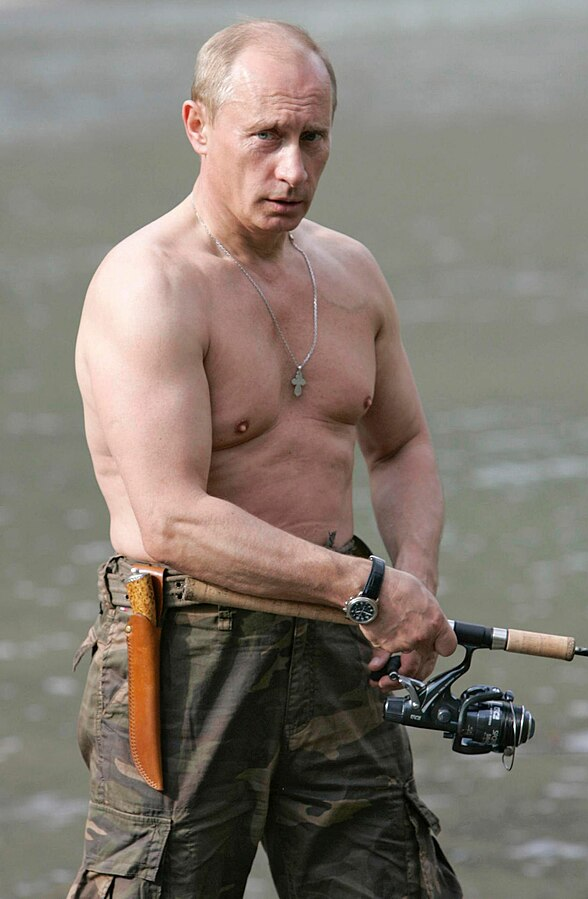
What the latter two lack, however, is the self-deprecating sense of humour that makes Maciste such a sympathetic character. That, of course, was a trick that Schwarzenegger, in particular, was to adopt successfully.
Outside Italy, the memory of Maciste gradually faded. Some films from the peplum era featured Maciste, such as Ricardo Freda’s Maciste all’Inferno (Maciste in Hell, 1962), which was released in English dub as The Witch’s Curse and starred “Kirk Morris” (the former gondolier Adriano Bellini). All were retitled as Hercules or Samson films for English-speaking audiences. Yet the appeal of Steve Reeves, the bodybuilder from Montana, in many ways continued the path blazed by Bartolomeo Pagano. When Reeves extends his arms which have been chained to pillars and tears down the palace of the king at the conclusion of Hercules, he is repeating the feat performed by Pagano, bound to the grinding wheel in Cabiria.

Reeves dominates the film, but he acts on behalf of the unjustly exiled Jason in attempt to prove himself worthy of the princess, Iole. Like Pagano, Reeves is unthreatening despite his strength, which sometimes provides the basis for humour. There is an almost feminine aspect to the strong man, appealing to both male and female audiences, which allowed Reeves to be cast in a range of adventure films. Yet, unbeknownst to him, he was following in the footsteps of another Hercules, Pagano’s Maciste.

Art Pomeroy is Professor Emeritus in Classics at Victoria University of Wellington, New Zealand. He has published extensively on Roman social history and the imperial historian Tacitus, as well as articles and books on the reception of the Ancient Greek and Roman worlds in modern film and television.
Further Reading
The rise of Italian cinema to international dominance with its blockbuster films by the start of the First World War (1914–18), and its later collapse in the face of Hollywood’s expansion, is well explained as the result of social and economic developments in Italy after unification by Irmbert Schenk, “The creation of the epic: Italian silent film to 1915’”, in A.J. Pomeroy, A Companion to Ancient Greece and Rome on Screen (Wiley Blackwell, Chichester/Malden MA, 2017) 37–60.
On the invention of the term “peplum” as a metonym to describe Italian sword-and-sandal films of the late 1950s and early 1960s, see my chapter, “The peplum and other animals” in A.J. Pomeroy, Then It Was Destroyed by the Volcano (Duckworth, London, 2008) 29–60. Over a six-year period, around 300 such films were made in Italy in various styles (mythological, historical, science fiction, horror, and comedy).
Eugen Sandow played a major role in the development of bodybuilding, linking it with Classical Greek culture and the ideal of mens sana in corpore sano (“a healthy mind in a healthy body”). He even enlisted the novelist Arthur Conan Doyle and the sculptor Charles Lawes-Wittewronge as judges in a charity bodybuilding competition held in London’s Royal Albert Hall in 1901. Sandow’s contribution is well explored by Alastair Blanshard, “High art and low art expectations: Ancient Greece in film and popular culture,” in A.J. Pomeroy, A Companion to Ancient Greece and Rome on Screen (Wiley Blackwell, Chichester/Malden, MA, 2017) 429–47.
A number of the early Maciste films, including Cabiria, have been restored through the efforts of local film archives in Italy (especially Turin and Bologna) and overseas. Their creation and social significance is described by Jacqueline Reich, The Maciste Films of Italian Silent Cinema (Indiana UP, Bloomington/Indianapolis, IN, 2015).
On the political significance of Cabiria and its cinematic descendants, see A.J. Pomeroy, “Rome vs. Carthage. Imperial and racist aspirations in Italian films of the twentieth century,” in K. Nikoloutsos, Brill’s Companion to Ancient Greek and Roman Warfare on Film (Brill, Leiden, 2023) 295–323.