Robin Alington Maguire
Part I: Analysis of Events
Julius Caesar’s daring and risky move to cross the River Rubicon and capture the town of Ariminum was the opening move in the Roman Civil War of 49–45 BC. It is one of the most famous episodes in history, and one described at length by ancient writers. Yet somehow the story of this dramatic episode is strangely unsatisfying. For example, we are told that Caesar sent ahead a small party of soldiers to capture the city of Ariminum (modern Rimini) but our sources do not explain how so few men accomplished such a feat: it sounds like a dramatic exploit, if only we knew more of it. Then there are the aspects which might make us wonder whether to take the details of the story seriously. We are invited to accept that it took a mysterious apparition blowing a trumpet to persuade a doubting Caesar to advance, and there is a peculiar account of the mighty Caesar having to borrow mules from a bakery to pull his carriage.
This is the first of two articles which seek to unravel just what happened and why. In Part I an examination of the evidence supplied by ancient writers, together with some basic tactical considerations, makes it possible to reconstruct in detail how Caesar planned and conducted the operation. Part II aims to get to the bottom of episodes in the original accounts which appear problematic and which seem to cast doubt on the authenticity of what the ancient authors tell us. (The original text of Part I has been amended to accompany the subsequent Part II.)

Background
From 58 to 50 BC, Julius Caesar (100–44 BC) was Roman Governor of three provinces – Illyria (to the East of the Adriatic), Transalpine Gaul (equivalent to southeast France at the time of his appointment) and Cisalpine Gaul (equivalent to northern Italy). During this time, Caesar engaged in almost continuous warfare of sometimes dubious legitimacy and extended Roman control to all of Gaul, a territory extending from the Pyrenees to the Rhine.

At the start of 49 BC, Caesar wished to stand for election as Consul without first giving up command of his forces. He was opposed in this by his political rivals in Rome, who wished to see him stripped of his command and perhaps blocked from the consulship. Rome was in a ferment, as everyone waited to see how events would play out, and whether conflict could be avoided. At this time, Caesar was in Ravenna, to the north of the River Rubicon, which marked the eastern part of the boundary between Cisalpine Gaul to the north and Italy proper to the south.
Under Roman law, a governor of a province was prohibited from leading an army out of his assigned territory. If Caesar crossed the Rubicon with an army, he would be breaking the law. More to the point, he would be declaring his readiness to counter the Senate by force of arms.

In the event, learning that the Senate had decreed a state of emergency and mobilised its forces, Caesar decided to confront his political dilemma by immediately marching into Italy. Four years later, after a civil war fought all around the Mediterranean, he would be master of the Roman world, only to fall victim to assassins’ daggers a year later, in 44 BC.
Caesar’s first step, despite having only one legion with him, was to cross the Rubicon without warning, and capture by surprise the fortified town of Ariminum (now Rimini) a few miles south, which controlled road access into Italy. He used an undercover advance party whose mission calls to mind the special forces or commando operations of modern times.
This master stroke was utterly unexpected, and caused consternation in Rome. Less than a week later, the senatorial party took the astonishing step of abandoning Rome to escape Caesar’s advance. This handed Caesar a bloodless victory out of all proportion to the force at his disposal, thanks to the moral shock of his sudden capture of Ariminum.
The crossing of the Rubicon is generally calculated to have occurred early on 11 January 49 BC, by the old Roman calendar.[1] At this time the calendar was out of alignment with the seasons; by the Julian or Gregorian calendar, the crossing occurred on 23 November 50 BC,[2] so in late autumn rather than winter.

Sources
There are numerous surviving accounts of the Civil War. Caesar’s own account (Civil War 1.7-8) briefly mentions Ariminum but not the Rubicon:
Having thus learnt the disposition of the soldiery, he sets out for Ariminum with that legion, and there meets the tribunes who had fled to him.
Below are extracts from sources which go into more detail about the crossing of the Rubicon and the capture of Ariminum. There are several references to companions accompanying Caesar. Some were members of his staff; others were recent arrivals from Rome who had opted to support his cause.

Plutarch (AD 46–c. 120), Life of Caesar:
Now, Caesar had with him not more than three hundred horsemen and five thousand legionaries; for the rest of his army had been left beyond the Alps and was to be brought up by those whom he had sent for the purpose. He saw, however, that the beginning of his enterprise and its initial step did not require a large force at present but must take advantage of the golden moment by showing amazing boldness and speed, since he could strike terror into his enemies by an unexpected blow more easily than he could overwhelm them by an attack in full force. He therefore ordered his centurions and other officers, taking their swords only, and without the rest of their arms, to occupy Ariminum, a large city of Gaul, avoiding commotion and bloodshed as far as possible; and he entrusted this force to Hortensius.
He himself spent the day in public, attending and watching the exercises of gladiators; but a little before evening he bathed and dressed and went into the banqueting hall. Here he held brief converse with those who had been invited to supper, and just as it was getting dark went away, after addressing courteously most of his guests and bidding them await his return. To a few of his friends, however, he had previously given directions to follow him, not all by the same route, but some by one way and some by another. He himself mounted one of his hired carts and drove at first along another road, then turned towards Ariminum. When he came to the river which separates Cisalpine Gaul from the rest of Italy (it is called the Rubicon), and began to reflect, now that he drew nearer to the fearful step and was agitated by the magnitude of his ventures, he checked his speed. Then, halting in his course, he communed with himself a long time in silence as his resolution wavered back and forth, and his purpose then suffered change after change. For a long time, too, he discussed his perplexities with his friends who were present, among whom was Asinius Pollio, estimating the great evils for all mankind which would follow their passage of the river, and the wide fame of it which they would leave to posterity. But finally, with a sort of passion, as if abandoning calculation and casting himself upon the future and uttering the phrase with which men usually prelude their plunge into desperate and daring fortunes, “Let the die be cast,” he hastened to cross the river; and going at full speed now for the rest of the time, before daybreak he dashed into Ariminum and took possession of it. (Caesar 32; Loeb, tr. Bernadotte Perrin 1919)

Plutarch (AD 46–c. 120), Life of Pompey:
And now word was brought that Caesar had seized Ariminum, a large city of Italy, and was marching directly upon Rome with all his forces. But this was false. For he was marching with no more than three hundred horsemen and five thousand men-at‑arms; the rest of his forces were beyond the Alps, and he did not wait for them, since he wished to fall upon his enemies suddenly, when they were in confusion and did not expect him, rather than to give them time and fight them after they were prepared. And so, when he was come to the river Rubicon, which was the boundary of the province allotted to him, he stood in silence and delayed to cross, reasoning with himself, of course, upon the magnitude of his adventure. Then, like one who casts himself from a precipice into a yawning abyss, he closed the eyes of reason and put a veil between them and his peril, and calling out in Greek to the bystanders these words only, “Let the die be cast,” he set his army across. (Pompey 60.1-2: Loeb, tr. Bernadotte Perrin, 1917)
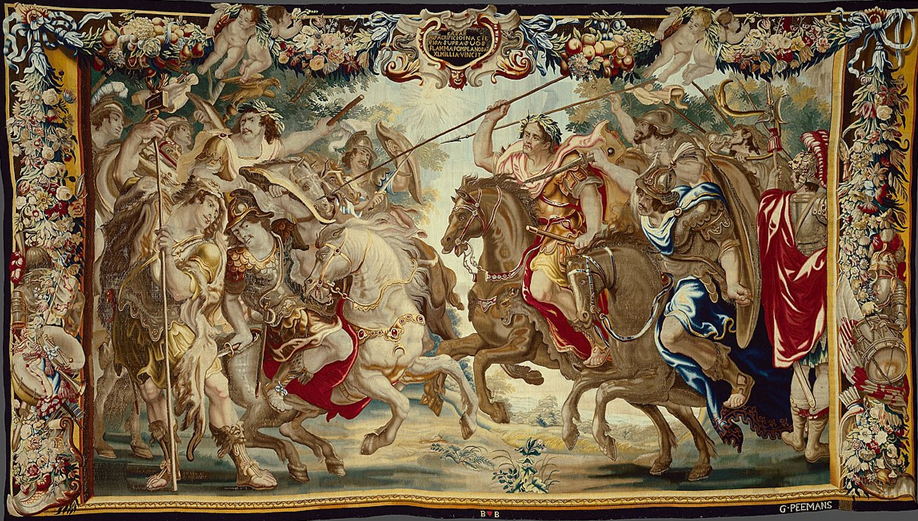
Appian of Alexandria (c.95–c.165):
Caesar had sent messengers to bring his own army [from other parts of Gaul], but as he was accustomed to rely upon the terror caused by the celerity and audacity of his movements, rather than on the magnitude of his preparations, he decided to take the aggressive in this great war with his 5000 men and to anticipate the enemy by seizing the advantageous positions in Italy. Accordingly, he sent forward the centurions with a few of their bravest troops in peaceful garb to go inside the walls of Ariminum and take it by surprise. This was the first town in Italy after leaving Cisalpine Gaul. Toward evening Caesar himself rose from a banquet on a plea of indisposition, leaving his friends who were still feasting. He mounted his chariot and drove toward Ariminum, his cavalry following at a short distance. When his course brought him to the river Rubicon, which forms the boundary line of Italy, he stopped and, while gazing at the stream, revolved in his mind the evils that would result, should he cross the river in arms. Recovering himself, he said to those who were present, “My friends, to leave this stream uncrossed will breed manifold distress for me; to cross it, for all mankind.”
Thereupon, he crossed with a rush like one inspired, uttering the familiar phrase, “The die is cast: so let it be!” Then he resumed his hasty journey and took possession of Ariminum about daybreak, advanced beyond it, stationed guards at the commanding positions, and, either by force or by kindness, mastered all whom he fell in with. As is usual in cases of panic, there was flight and migration from all the country-side in disorder and tears, the people having no exact knowledge, but thinking that Caesar was pushing on with all his might and with an immense army. l (Civil Wars 2.34-5; Loeb tr. Horace White 1913)
Caesar’s apparent vacillation on the bank of the Rubicon, as recounted by Plutarch and Appian, is derived from a lost account by Gaius Asinius Pollio (75 BC–AD 4), who was present.[3]

Gaius Tranquillus Suetonius (c.69–c.123):
Accordingly, when word came [from Rome] that the veto of the tribunes had been set aside and they themselves had left the city, he [Caesar] at once sent on a few cohorts with all secrecy, and then, to disarm suspicion, concealed his purpose by appearing at a public show, inspecting the plans of a gladiatorial school which he intended building, and joining as usual in a banquet with a large company. It was not until after sunset that he set out very privily with a small company, taking the mules from a bakeshop hard by and harnessing them to a carriage; and when his lights went out and he lost his way, he was astray for some time, but at last found a guide at dawn and got back to the road on foot by narrow by-paths. Then, overtaking his cohorts at the river Rubicon, which was the boundary of his province, he paused for a while, and realising what a step he was taking, he turned to those about him and said: “Even yet we may draw back; but once cross yon little bridge and the whole issue is with the sword.”
As he stood in doubt, this sign was given him. On a sudden there appeared hard by a being of wondrous stature and beauty, who sat and played upon a reed; and when not only the shepherds flocked to hear him, but many of the soldiers left their posts, and among them some of the trumpeters, the apparition snatched a trumpet from one of them, rushed to the river, and sounding the war-note with mighty blast, strode to the opposite bank. Then Caesar cried: “Take we the course which the signs of the gods and the false dealing of our foes point out. The die is cast,” said he.
Accordingly, crossing with his army, and welcoming the tribunes of the commons, who had come to him after being driven from Rome, he harangued the soldiers with tears, and rending his robe from his breast besought their faithful service. (Divus Julius, 31-3; Loeb tr. J.C. Rolfe, 1913.)
The phrase praemissis confestim clam cohortibus (Divus Julius 31) is usually translated (as above) to mean that Caesar sent forward, immediately and secretly, “a few” or “some” cohorts. This is misleading. Suetonius gives no indication of the number of cohorts. A better translation might be “the”, or indeed “his”, cohorts – that is to say, all of them. In other words Caesar sent forward all his available infantry as soon as he received the news from Rome.
Suetonius’ mules seem as implausible as his phantasmal apparition. Caesar was supreme governor of the province, and commander of a vast army, and would not have needed to borrow mules from a bakery. And after nearly a decade of solid campaigning, Caesar and his staff officers would have known how to ensure that commanders did not lose their way. The mules and the mysterious trumpeter are examined further in Part II of this article.
Marcus Velleius Paterculus (19 BC–AD 31):
When at last, rejecting all the demands of Caesar, who was content to retain the title to the province, with but a single legion, the senate decreed that he should enter the city as a private citizen and should as such, submit himself to the votes of the Roman people in his candidacy for the consulship, Caesar concluded that war was inevitable and crossed the Rubicon with his army. Gnaeus Pompeius, the consuls, and the majority of the senate abandoned first the city, then Italy, and crossed the sea to Dyrrachium. (History of Rome 2.49.4 Loeb, tr. Frederick W Shipley, 1924.)
Lucius Cassius Dio (c.165–235)
When Caesar was informed of this, he came to Ariminum, then for the first time overstepping the confines of his own province, and after assembling his soldiers he ordered Curio and the others who had come with him to relate to them what had been done. After this was over he further aroused them by adding such words as the occasion demanded. Next he set out and marched straight upon Rome itself, winning over all the cities on the way without any conflict, since the garrisons either abandoned them, because they were powerless to resist, or preferred his cause. (Roman History 41.4.1, Loeb, tr. Earnest Cary, 1914–27)

Paulus Orosius (c.380–c.420) was a Christian priest and student of St Augustine of Hippo who wrote a chronicle called History against the Pagans. In the extract below he refers to the history of Rome by Livy (59 BC–AD 17), most of which has been lost, including the account of Caesar’s civil war. We do have an epitome or summary version of Livy by Lucius Annaeus Florus (c.74–130), but it contains no detail about the Rubicon operation.
After crossing the Rubicon River, Caesar came to Ariminum, where he at once instructed the five cohorts, the only body of troops he had with him at that time, what he expected them to do. With these cohorts, according to Livy, he set out to attack the whole world. (Orosius, History Against the Pagans 6.15.3; adapted from the translation by I.W. Raymond (1936).)

These accounts come from works of history. It is worth adding another by the poet Marcus Annaeus Lucanus, known in English as Lucan (AD 39–65), who was (for a time) a friend of the Emperor Nero (ruled 54–68), and wrote an account of the war in verse about a century after the events. He seems to draw on accounts which go beyond those mentioned above, so his work may expand our knowledge. Leaving aside the poetic flourishes, the extra details he supplies about Caesar’s operation seem to ring true, comparing favourably with parts of Suetonius.
Caesar has crossed the Alps, his mighty soul
Great tumults pondering and the coming shock.
Now on the marge of Rubicon …
… He gives the word
And bids his standards cross the swollen stream …
From modest fountain blood-red Rubicon
In summer’s heat flows on; his pigmy tide
Creeps through the valleys and with slender marge
Divides the Italian peasant from the Gaul.
Then winter gave him strength, and fraught with rain
The third day’s crescent moon; while Eastern winds
Thawed from the Alpine slopes the yielding snow.
The cavalry first form across the stream
To break the torrent’s force; the rest with ease
Beneath their shelter gain the further bank.
When Caesar crossed and trod beneath his feet
The soil of Italy’s forbidden fields,
‘Here,’ spake he, ‘peace, here broken laws be left;
Farewell to treaties. Fortune, lead me on;
War is our judge, and in the fates our trust.’
Then in the shades of night he leads the troops
Swifter than Balearic sling or shaft
Winged by retreating Parthian, to the walls
Of threatened Rimini, while fled the stars,
Save Lucifer, before the coming sun,
Whose fires were veiled in clouds, by south wind driven,
Or else at heaven’s command: and thus drew on
The first dark morning of the civil war.
Now stood the troops within the captured town,
Their standards planted; and the trumpet clang
Rang forth in harsh alarums, giving note
Of impious strife: roused from their sleep the men
Rushed to the hall and snatched the ancient arms
Long hanging through the years of peace; the shield
With crumbling frame; dark with the tooth of rust
Their swords; and javelins with blunted point.
But when the well-known signs and eagles shone,
And Caesar towering o’er the throng was seen,
They shook for terror, fear possessed their limbs,
And thoughts unuttered stirred within their souls.
(Civil War 1.183-214; translation of Sir Edward Ridley (1905).)

Geography
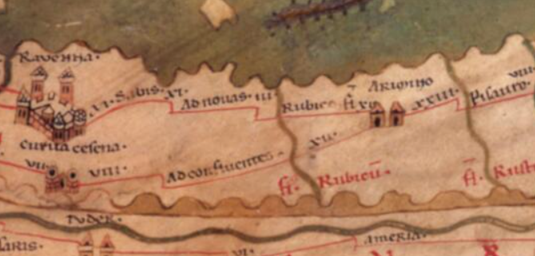
The map above shows why Caesar’s capture of Ariminum was to cause such panic in Rome. Taking Ariminum at the outset would guarantee Caesar’s ability to advance down the east coast of Italy or to cross over the Apennines on the Via Flaminia and move towards Rome. Failure to capture Ariminum would place his entire campaign in jeopardy before it began.
Ariminum is 50 km from Ravenna, while the Rubicon[4] is just 18 kilometres from Ariminum. The journey from Ravenna to the Rubicon might require two hours at good speed on horseback, or a good six hours at a rapid marching pace. From the Rubicon to Ariminum would take about an hour on horseback, or three hours for infantry.
Ariminum at this time had a strong defensive wall, and could surely have kept out Caesar’s advance party if not taken by surprise.

There is no mention of any defensive force at Ariminum, so the authorities there may have had nothing more at their disposal than a few watchmen. These would be no match at all for Caesar’s advance party of hardened soldiers, provided they did not get the opportunity to close the city gates before the soldiers entered. Evidently the city authorities in Ariminum had failed to put the city into any kind of defensive posture.

Caesar’s Resources
Caesar had the benefit of surprise. Nobody expected him to move so precipitately, having with him only one of the ten legions under his command, plus 300 cavalry.
The legion was the Legio XIII raised by Caesar in Cisalpine Gaul in 57 BC. It had since fought under him in Gaul almost continuously. Plutarch and Appian say the infantry numbered 5,000; Velleius Paterculus mentions a single legion; Orosius (after Livy) has five cohorts implying some 2,500 men. The latter figure sounds realistic for the total strength of a legion depleted after years of hard fighting; the Romans lacked effective arrangements for replacing battle casualties.[5]
By contrast the figure of 5,000 sounds like a round-number reference to the full nominal strength of a legion.

It seems that different writers looked at the same situation in different ways. Plutarch and Appian see a single legion, and a legion has a nominal strength of around 5,000. Orosius (Livy) and Suetonius see a depleted legion equivalent to only some five full cohorts.
Caesar’s 300 cavalry were probably the attached cavalry arm belonging to the legion. It is quite likely that (as in much of Caesar’s Gallic wars) they had been raised from Gallic tribes unfriendly to Rome. Lucan implies a little later that they were viewed as far more foreign than the legionaries:
Fierce Caesar hurries his barbarian horse
With all his eagles and his standards joined. (Civil War 1.476.)
The advance party consisted of Caesar’s centurions along with his other officers (Plutarch) or along with a few of their bravest men (Appian), and so would have amounted at most to a few dozen hand-picked soldiers. They would have been formidable opponents, hardened by years of brutal hand-to-hand combat. They were commanded by Quintus Hortensius Hortalus, son of the famous Roman orator of the same name who was Cicero’s most formidable courtroom adversary at the start of his career. The younger Hortensius was probably in his early forties in 50 BC, suggesting that Caesar elected to appoint a mature and experienced commander to the advance party rather than someone too young and eager.
It would seem likely that Caesar mounted the advance party on horses taken from his small cavalry force so that they could make good speed, and arrive at Ariminum ahead of any rumour of Caesar’s move. He had done this before. In the first campaign of his Gallic wars in 58 BC, he had agreed to a parley with the hostile German chieftain Ariovistus, and took along a bodyguard of trusted soldiers from the Tenth Legion whom he mounted for the purpose on horses taken from his Gallic cavalry (cf. Caesar, Gallic War 1.42).

The Sky and the Weather
The crossing of the Rubicon took place early on 11 January 49 BC by the Roman calendar, or 23 November 50 BC, a Wednesday, by ours. There was a waxing moon, although on this date the moon had set below the horizon before the start of Caesar’s night march. Sunrise that day was at 0715.
The period before sunrise is often divided into successive stages of twilight. Nautical twilight, when sailors can observe both the stars and the horizon, is the period when the sun is between six and twelve degrees below the horizon. During this time, people and objects can be discerned but it is still too dark for most everyday outdoor activities. On the fateful morning this interval ran from about 0625 to 0650. It would have made sense for Caesar with his main force to enter Ariminum at this time. Our sources agree, saying he entered the town “before” or “at” daybreak.
In the absence of other evidence we are entitled to take note of Lucan’s description of the weather that morning:
Then in the shades of night he leads the troops
Swifter than Balearic sling or shaft
Winged by retreating Parthian, to the walls
Of threatened Rimini, while fled the stars,
Save Lucifer, before the coming sun,
Whose fires were veiled in clouds, by south wind driven,
Or else at heaven’s command: and thus drew on
The first dark morning of the civil war.
In other words the sky was clear until it clouded over towards dawn, giving Caesar starlight, dry weather and a mild south wind for his march, and the extra obscurity of cloud cover as he reached Ariminum. Ideal weather for his purpose in fact.
Tactical imperatives
In planning the operation to capture Ariminum by surprise, Caesar would have the following requirements:
- Obtain accurate and up-to-date intelligence about the situation in Ariminum;
- Maintain complete secrecy about his plans until the last possible moment;
- Allow no military units to cross the Rubicon until ready to commit himself;
- Keep the Gallic cavalry with him. On a tricky operation like this it is best to keep them under his eye, rather than employ them in the subjugation of a Roman city;
- Keep the advance party as small as possible to avoid suspicion;
- Ensure the advance party can move fast enough to avoid being overtaken by travellers who might raise the alarm in Ariminum;
- Instruct the advance party to surprise and hold only the northern gate: they are far too few in number to control the town;
- Have them seize control of the gate as soon as they reach Ariminum. Their incognito should protect them for long enough to reach the gate and overpower a few sleepy guards in the small hours of the morning, but if they try to mingle with the inhabitants they will surely be detected. Close up it will be obvious that they are soldiers – these men have not been picked for their acting skills – and why would they be wearing swords with civilian dress?
- Minimise the time that the advance party are left unsupported at Ariminum.
- Time his march with the main force so as to arrive shortly before sunrise.

Who was sent ahead on the morning of the 10th?
Plutarch, Appian and Suetonius all have Caesar send forward a party of soldiers early on the 10th, many hours before he himself sets off. In the first two cases, these are the advance party tasked with taking control of Ariminum. In Suetonius, they are “the cohorts”, destination unstated. Given the tactical constraints mentioned above, I feel sure that Caesar would not have sent on his advance party, or even briefed them, so early on. It would have been very risky and entirely unnecessary to expect them to seize the entrance to Ariminum on the 10th, and hold it unsupported until the arrival of the main force the following morning.
My interpretation is that on the morning of the 10th, all of Caesar’s infantry left Ravenna to march to the Rubicon, and that Pollio (source for Plutarch and Appian), writing over ten years later, thought it logical to insert his description of the advance party at this point in his narrative. He probably did not know about the advance party until after the operation was over and most likely never learned at what point they had been given their orders and sent on their way.
According to my analysis, the advance party were briefed at the Rubicon in the small hours of the morning of the 11th immediately before setting off for Ariminum.

What Caesar did
All these considerations lead me to reconstruct Caesar’s tactical plan and the sequence of events as follows.
10th January (the day before the crossing of the Rubicon and capture of Ariminum)
After receiving the news from Rome, Caesar decides on a plan.
Early on the 10th he sends a few scouts on horseback, possibly civilians, to check unobtrusively on developments at Ariminum. They are to assess the mood of the city, look for military preparations and report back to Caesar at Ravenna by sunset. They know nothing of Caesar’s intentions.
Once they have left, Caesar quietly sends his legion forward to a minor crossing point on the Rubicon, perhaps just a ford, out of sight of any main road. It would be madness to position his force of several thousand men, on the very border of his province, within sight of a public highway, where anyone could see them. The march of over 30 kilometres from Ravenna to the Rubicon takes most of the day.
In modern terminology, the northern side of the crossing is Caesar’s “forming up point” from where he will launch the attack on Ariminum. It should be no surprise that his forces pause there for some hours, until the time is right to advance.
Caesar’s own behaviour at Ravenna is calculated to allay any suspicions that he might be about to act.
Caesar leaves town in the evening at (say) 5 PM closely followed by his cavalry detachment, and takes precautions to shake off observers. Reaching the crossing point on the Rubicon at 7 PM, he sends out a final scout to check that the northern gate of Ariminum has not been closed for the night, with orders to be back by midnight.

11th January (the day of the crossing)
Caesar will not issue orders until it is time to move, in the interests of both security and discipline. This is in accordance with his usual practice:
He never gave forewarning of a march or a battle but kept his troops always on the alert for sudden orders to go wherever he directed. (Suetonius Divus Julius 65; translation of Robert Graves)
While waiting, Caesar discusses the situation with his companions, carefully restricting the conversation to windy platitudes about the consequences of conflict. Even now he tells them nothing at all about his plans, beyond the immediate river crossing. He does not even mention the imminent seizure of Ariminum or the advance party. Caesar chooses to appear indecisive, in order to draw out the real convictions of his companions, and assess their commitment to his cause. In fact he is not in the slightest doubt about what to do; he has never been one for letting I dare not wait upon I would. The point is considered further in Part II of this article.
Either here or in Ariminum after its capture, Caesar addresses his soldiers and obtains their assurances of support (see Caesar, Civil War 1.7). To do so any sooner would be insecure.
At about 3 AM Caesar privately briefs the advance party. No-one else knows of this.
The advance party, in civilian clothes with swords worn under their cloaks, are sent off on horseback at around 3.45 AM, three hours before dawn. They will ride fast enough to ensure that no travellers can overtake them. Caesar and the infantry set off soon after the advance party. The cavalrymen accompany the infantry.
Caesar’s alea jacta est, upon which so much ink has been expended, is perhaps just the “right, let’s go” of a modern commander.
The advance party reach Ariminum around 4.45 or 5 AM. They quietly overpower and detain the guards on the gate.
The absolute imperative is that Caesar’s men should now keep control of the gate for up to two hours until the main body arrive.
The citizens fail to react to the arrival of the advance party and when Caesar arrives with his cavalry and infantry around 6.45 AM, shortly before sunrise, they at once realise that resistance is useless. We may well credit Lucan that upon entering Ariminum the soldiers parade in the forum with all possible pomp and trumpeting.

What if?
What if the final scout reports the town gate closed for the night? Caesar will only need to make modest changes to his plan without an intolerable increase in risk.
It is likely that the gate will reopen at around sunrise. On the 11th, Caesar’s entire force sets out together at 0415, three hours before sunrise. The cavalry patrol the neighbourhood around the marching force and detain anyone they find out and about. The soldiers halt close to Ariminum but out of sight of the town. The advance party go ahead: as soon as the gate is opened, they ride up and seize control of it. Many in the town are awake by now and might try to fight back, but within minutes the cavalry will arrive in support, closely followed by the legion.

Caesar’s daring
Caesar’s capture of Ariminum by coup de main exemplifies his ability to spot opportunities, and to seize them with impetuous daring, as he did several times in his career. To conclude, here is what a couple of our sources have to say about this.
Sometimes he fought after careful tactical planning, sometimes on the spur of the moment – at the end of a march, often, or in miserable weather, when he would be least expected to make a move. (Suetonius, Divus Julius 60; translation of Robert Graves)
And later in the war, when about to sail from Italy to pursue the senatorial army into Greece, he addresses his men:
Fellow-soldiers – you who are joined with me in the greatest of undertakings – neither the winter weather, nor the delay of our comrades, nor the want of suitable preparations shall check my onset. I consider rapidity of movement the best substitute for all these things. (Appian, Civil Wars 2.53; Loeb, tr. Horace White, 1913)
Or in Plutarch’s fine phrase:
take advantage of the golden moment by showing amazing boldness and speed.

Part II of this essay can be read here.
Robin Alington Maguire is a former civil engineer and banker with a longstanding interest in ancient history and culture. He likes to seek out new deductions from fragmentary ancient sources. He has translated and edited Napoleon Bonaparte’s Commentaries on the Wars of Julius Caesar (Pen & Sword Books, Barnsley, 2018). His earlier essays for Antigone argued that Cicero should have taken a different tack during the Catilinarian Conspiracy of 63 BC and reconstructed the rations supplied to the crews of Athenian trireme warships.
Further Reading
J.F.C. Fuller’s Julius Caesar: Man, Soldier and Tyrant (Eyre & Spottiswoode, London, 1965) gives a fine account of Caesar’s career and of his generalship. Fuller spent the first half of his career as an officer of horsed cavalry and so was one of the last people to experience in person many of the practical issues facing armies in the Classical era.
Robert Morstein-Marx’s Julius Caesar and the Roman People (Cambridge UP, 2021) gives a most detailed examination of Caesar’s rise to power and of the political institutions of the Late Republic, and strongly challenges some received opinions.
Where possible, links to the sources are given in the text so the reader can readily access the original works.
Notes
| ⇧1 | See R. Morstein-Marx, Julius Caesar and the Roman People (Cambridge UP, 2021) 322. |
|---|---|
| ⇧2 | See J.F.C. Fuller, Julius Caesar: Man, Soldier and Tyrant (Eyre & Spottiswoode, London, 1965) 179. |
| ⇧3 | So Morstein-Marx (as n.1) 325. |
| ⇧4 | I follow the view which identifies the Rubicon with today’s small River Fiumicino, for which there is respectable supporting evidence. |
| ⇧5 | The men of Legio XIII were raised as a body and fought together for twelve years until the survivors were discharged and given land grants at the end of the civil war in 45 BC. Compare Legio VI Ferrata which brought Caesar victory at the battle of Zela in 47 BC despite going into action with less than 1000 men (see the Pseudo-Caesarian Alexandrian War at 69-76). |