Giovanni Lido
Although people working in and closely following artificial intelligence have for years been saying – sometimes optimistically, often with trepidation – that AI will radically change the world we live in, the technology has only recently entered the general public’s awareness in a big way, trending on social media and making headlines in the popular press. This is thanks primarily to programs which produce texts, notably ChatGPT, and images, such as Midjourney, Dall-E, and Stable Diffusion. (The face generator This Person Does Not Exist has been around since early 2019.)
I’ve produced a number of images with Midjourney, some of which are shared below with brief comment. The response to those I have shared online has been mostly amusement, enthusiasm, and wonder. AI is in the spotlight at the moment, because the dazzling results are now such as anyone can appreciate, even with no understanding of how the technology works. But this is no fad, rather the turning of a corner onto something enormous and new. (Of course, Classics enthusiasts know that enormis and novus are not invariably positive adjectives.) As AI becomes ever more visible in our day-to-day lives, we will grow used to its presence; we should try in the future to remember these days of transition.
I have no background in artificial intelligence, little understanding of the mechanics of the thing, and no background in the visual arts. What I’ve done, with quite unsophisticated prompts, can be done by anyone with just a little imagination and curiosity – and the patience to keep hitting refresh until something halfway decent emerges. Prompts more detailed and sophisticated than mine would probably result (at least sometimes) in better or more interesting images, but the creative skill is less in the user than in the technology – including the algorithms, the set of images a program has to draw on, and the feedback it receives from users, who can respond to the machine’s results with essentially a thumbs up or thumbs down.
As the collection of human-made images increases and is better analysed and indexed, and as the system is refined, these computer-made images will continue to improve. And they will continue to impress us, until we become all too used to them and they’ve simply become part of the scenery of our world – for better or worse.[1]

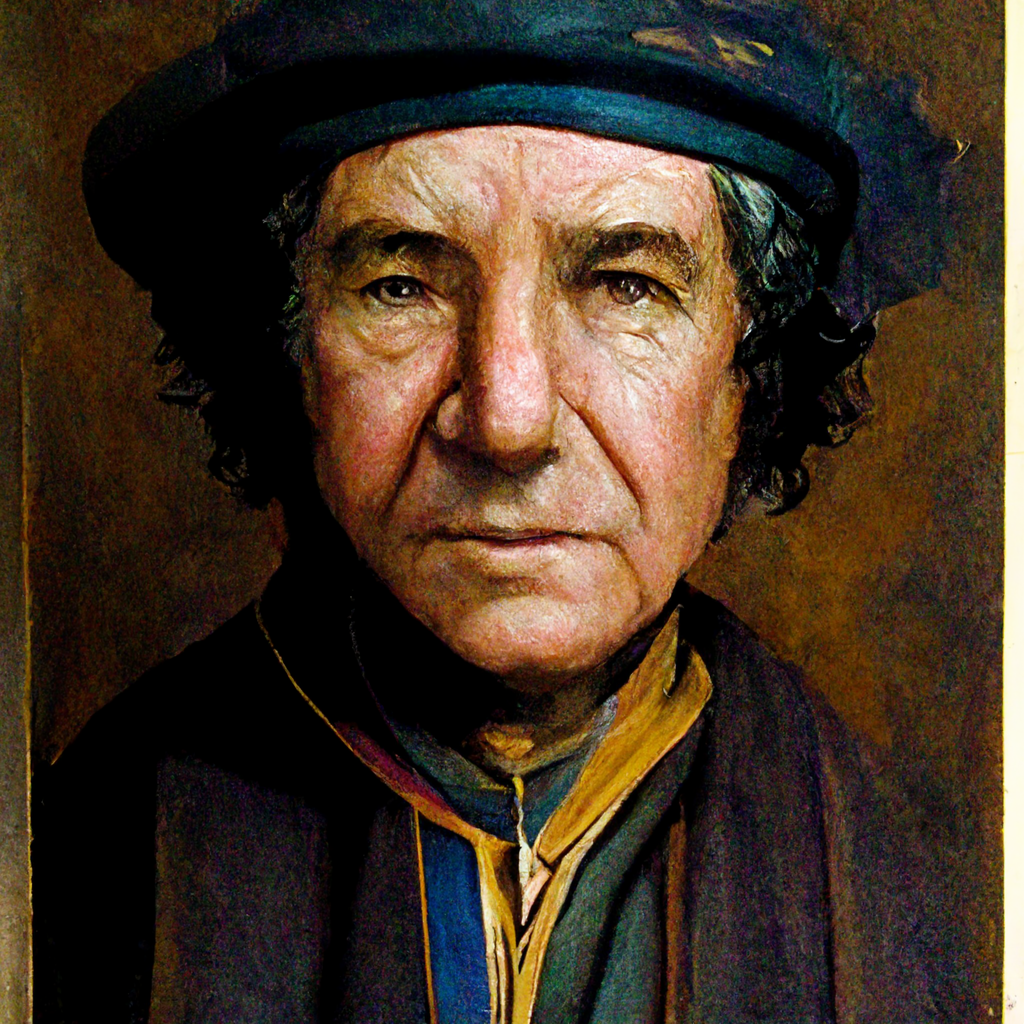


Images 1-4:
Prompt: “Robert Graves, painted by Hans Holbein.”
Images 1 and 2 were generated on 31 October 2022; image 3 on 16 January 2023, and image 4 on 26 January 2023. Some have found the first two images appealing, but they are no Holbeins. The program’s improvement in just two and a half months is astounding. (This, as mentioned above, is from Midjourney. Results from Dall-E and Stable Diffusion are, at the time of this writing, far inferior when it comes to paintings like these, but they will no doubt also improve.)


Images 5-6:
Prompt: “Robert Graves, Food for Centaurs, Psilocybin.”
Image 5 was generated on 31 October 2022, image 6 on 26 January 2023. It is clear that not everything always gets better. The earlier image (a variation of a variation) is an intriguing one – what’s happening in those woods? The more recent ones look like collages from the 60s and 70s. Not an improvement.

Image 7
I’ve had difficulties with Midjourney in getting scenes with more than one character. Oedipus and the Sphinx based on Moreau’s painting, Aristotle and Phyllis based on Cranach, and Miranda Kerr and Orlando Bloom as Cupid and Psyche, all misfired. The prompt for this image was “Laocoön and Sons, in the style of Liebig meat extract pictures”; whether this should also count as a failure I leave to the reader’s judgment. The program was somewhat more successful in reproducing the style of Punch cartoons, but still has a way to go.

Image 8
Prompt: “Portrait of Wilamowitz, painted by Cranach the Elder.”
I find the result more reminiscent of Patrick Stewart.


Images 9-12
Prompt 1: “Painting of Mount Athos, by Pieter Brueghel the Elder.”
Prompt 2: “Painting of a Zeppelin flying over Mount Athos, by Pieter Brueghel” (my nod to Auden’s “expensive, delicate ship”).

Image 13
Prompt: “Color photograph of a man. Facing left. Light brown hair. Narrow beard” plus this Cranach the Elder portrait of Philip Melanchthon, Professor of Greek at the University of Wittenberg (among other things).
It’s possible to include in the prompt a link to an online image; the program then uses that pre-existing image in forming the new one. My attempts to get a good image of Reuchlin were not successful.

Image 14
Prompt: “Hyperrealistic photograph of a man. Facing left. Light brown hair. Narrow beard. Slight grin” plus the preceding Melanchthon portrait (the original by Cranach).
Midjourney tends to “beautify” its subjects (if we may use that word over Polonius’s objections). Or was the historical Philipp Schwartzerdt really such a dreamboat?


Images 15-18
Prompt: “Painting of Sophia Schliemann, painted by Klimt” plus this reference image.


Images 19-22
Prompt 1: “Painting of Sophia Schliemann, painted by Klimt.”
Prompt 2: “Painting of Sophia Schliemann, wearing the treasure of Troy, painted by Klimt.”
Prompt 3: “Klimt painting. Sophia Schliemann wearing the jewelry of Troy, painted by Gustav Klimt.”
Prompt 4: “Painting of Sophia Schliemann, painted by Klimt.”
Without a reference image, the figures in the pictures, which look more like modern paintings influenced by Klimt, do not particularly resemble their supposed subject. (Midjourney sometimes adds nonsense text, as can be seen in the last of these four.)


Images 23-25
Prompt: “Portrait of Homer, painted by Cranach the Elder” plus this ancient bust.
It’s also possible to use a statue as a reference image. For these I used a well-known bust. The program fills the eyes in, often imperfectly; in the case of the blind Homer, the third image here may be the most appropriate. (As some have pointed out, Midjourney’s Cranachs usually look more like Holbeins.)


Images 26-27
Prompt: “Portrait of Sophocles, with brown eyes, painted by Holbein the Younger” plus the image of a composite bust (= image 26).
Midjourney allows one to “blend” up to five images. This first image is a composite of three ancient busts (1, 2, 3) and forms the basis for image 27. (The eyes here are imperfect; Sophocles looks like his contact lenses need adjusting.)


Images 28-34
Prompt 1 (twice): “18th-century French portrait of Alexander the Great” plus this composite bust.
Prompt 2 (twice): “Portrait of Lord Byron, painting” plus the bust.
Prompt 3 (twice): “Portrait of Napoleon, painting” plus the bust.
The bust used here is a mix of five ancient busts of Alexander the Great (1, 2, 3, 4, 5). The features of the three characters are then applied to it. The result is not exactly Byron or Napoleon, but I think they would have appreciated this. Or, at least, Byron would have.

These three portraits, which stand at the top of the article, are based on ancient busts of Aeschylus, Euripides, and Sophocles (left to right), supposedly in the style of Cranach the Elder.

Before joining Twitter, Giovanni Lido studied Greek and Shakespeare and was a student at too many universities for too many years. He taught high-school Latin in America and now lives in Bavarian Swabia with his wife and their two sons.
Notes
| ⇧1 | If you wish to inspect a larger version of an image, right-click and select “open image in new tab”. |
|---|