Elton Barker
(Continued from Part I)
We have the choice before us. The poet Sophocles is often quoted – or is often quoted by me anyway – as saying that there are many terrifying things in the world, but none is more terrifying than mankind. And it’s certainly true that Sophocles was right in that sense, in that our species is uniquely capable of our own destruction and the destruction of everything around us. Er, but, if could look at the Greek, what Sophocles actually said was that man – πολλὰ τὰ δεινὰ κοὐδὲν ἀνθρώπου δεινότερον πέλει – is what he said, deinos, man is deinos, and terrifying isn’t quite right as a translation for deinos. What Sophocles really means is that mankind, er humanity, is awesome. Both terrifying but also awesome. And I think he was right there: we have an awesome power to change things… In the next 40 days, we have to choose, the world has to choose, what kind of awesome we’re going to be.
Boris Johnson, address to the 76th Session of the United Nations General Assembly, 24 September 2021[1]
Taking a stand
Where Antigone appears to set up a series of oppositions between Creon and Antigone (and between male and female, state and family, the Olympian and Chthonic gods, etc.), the conflict between the two never takes a stable form. Just when it seems we’re getting to the crux of the matter – the statement of what philiā might mean to them, how it might relate to both brothers, how it impacts on our understanding of the relationship between the family and the state – enter [stage right] Ismene. This moment, in which opposition is triangulated through a third party, is typical of the play. Throughout it, bystanders are drawn into the conflict. This tragedy leaves no room for impartial spectating. It demands we get involved. It performs the taking up of sides.
We’ve already seen Antigone clash with Ismene. At the climax of the play’s opening scene, Antigone exits one way to bury her brother, Ismene the other, back indoors, judging her sister “rightly dear to her dear ones (φίλοις φίλη) but without sense (ἄνους)” (99). Things move on at pace in her absence: when we next hear of Ismene, Creon informs us she’s the one “raving” (λυσσῶσα, 492). With her return to the stage here, we get a rerun of the sisters’ opening conflict; only now does Ismene try to claim a share in responsibility (ξυμμετίσχω, 537; ξύμπλουν, 541). She does so using the dual that Antigone has dropped: “it’s our error” (νῷν ἐστιν ἡ ᾿ξαμαρτία, 558), she asserts. In reply Creon address them as one in the dual form (τὼ παῖδε). Both of them he now judges to be without sense (ἄνουν, 561–2).

Once again, in a replay of that opening scene, Antigone rejects her sister. The effect is to push Ismene on to Creon:
Ismene: But you’ll kill the bride of your own son?
Creon: Yes, for others too have furrows to be ploughed.
Ismene: But they won’t suit as he and she are suited.
Creon: I hate evil wives for my son.
<??>: Dearest Haemon (ὦ φίλταθʼ Αἷμον), how your father dishonours you. (568–72)
In what is very probably a Sophoclean invention,[2] we are informed that Haemon, Creon’s son, is Antigone’s betrothed. The stakes of affiliation are being raised, and, in turn, the question of affiliation. Who, for example, articulates the line “Dearest Haemon” (572)? It seems natural to take this as part of the stichomythic exchange between Ismene and Creon, a reading that’s supported by all the surviving manuscripts. But critics and translators often assign this expression of devotion to Antigone, for whom, as we have seen, philiā is (allegedly) everything. There is much at stake here, since it would be the only verse in the entire play in which Antigone even acknowledges her ties to Haemon. If we hear this line as Ismene’s, what does Antigone think? Where is her commitment to philiā now?
With Haemon on the characters’ lips, it’s significant that he’s the next figure to arrive on stage. Entering under this cloud of uncertainty, the chorus give vent to the audience’s concerns by asking: “Here is Haemon, the latest born of your sons. Does he come grieving Antigone’s fate, in bitter pain at being deceived of marriage?” (626–30). Creon puts the question more bluntly: “My son, now you’ve heard the final vote about your bride-to-be, are you in a rage (λυσσαίνων) against your father? Or are we dear (ἡμεῖς φίλοι) to you no matter what we do? (632–4).
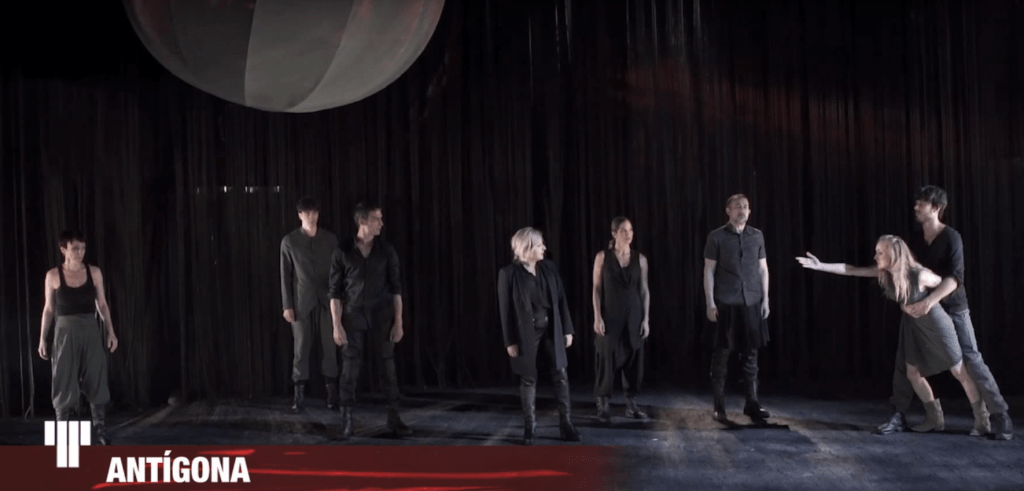
By responding to his father, Haemon – whether he intends it or not – creates an agōn. Or, rather, the form of an agōn is established; but, as with the scene between Antigone and Creon, formal opposition is stymied somehow. Before, the antagonists spoke at cross purposes to each other and conflict was instead triangulated via the entrance of a third party (Ismene); here, Creon takes it for granted that his son will obey him, while Haemon for his part takes the path of non-confrontation. When stichomythia again breaks out, it is all the more shocking a demonstration of how the form of the agōn not only represents but reproduces conflict.
I say shocking, because of its duration (726–65) and savagery, in which previously sound political sentiment is sucked in, disputed, and deformed. Previously, Creon had paraded his commitment to the polis above all else, as a way of framing the democratic basis of his edict: now he proclaims that the polis belongs to “the one who rules it” (τοῦ κρατοῦντος, 738)! Where’s his commitment to the political over the personal now? Nor does Haemon remain untouched. When he enters, he displays tact and recommends flexibility; as soon as he meets his father’s resistance, he retreats all too swiftly to as hard-line a position as his father, warning that Antigone’s death “will destroy another” (751). The man who demands allegiance to the state becomes a stage tyrant; the son who recommends flexibility swears he’ll kill himself. That escalated quickly!
Where Creon’s “royal we” arguably belies the uncomfortable fit of philiā with political authority, Haemon displays no such equivocation. “Father, I am yours”, he declares. His father’s thoughts keep him “straight” (the verb used is ἀπορθῶ, 635–6), just as earlier Creon had promised to keep the ship-of-state “straight” (ὀρθή, 190). Yet, after his father’s typically forceful demand for absolute loyalty (639–80), Haemon does exactly that: he equivocates: “I couldn’t – and may I never know how to – say that you don’t say these things right; however, perhaps there’s some other way” (685–7). The clunkiness of my translation here tries to capture Haemon’s hesitating grammar,[3] as he tries to prepare the ground to dispute his father’s judgement. He even draws on Creon’s ship-of-state metaphor (715–17) as he builds to his point: that his father “cease” (εἶκε) from anger (718).
More worryingly, there are questions for us too. Even if we had been inclined to side with Creon, especially given his commitment to the polis, well, we can’t still be with him now surely? So: were these tyrannical inclinations there all the time, or were they ignited by (what he sees as) illegitimate resistance to his decree, or is there indeed a problem in the very political generalisations that he (and we) hold so dear? As for Haemon: is he driven to this position by his father’s obstinacy, or were these views also always there, buried under formal pleasantries? What does his commitment to his bride, this bride, mean, in this context? More broadly, how does (should) a son belong to a father; how does (should) a son bring another into the house? As the arguments twist and splinter, Sophocles stages how political rhetoric that sounds reasonable breaks down into violent distortion. Each person’s commitment to the cause leads to them adopting ever more extreme positions that deform (or do they best represent?) the very principles they hold dear. Take a stand — but be careful where you do.
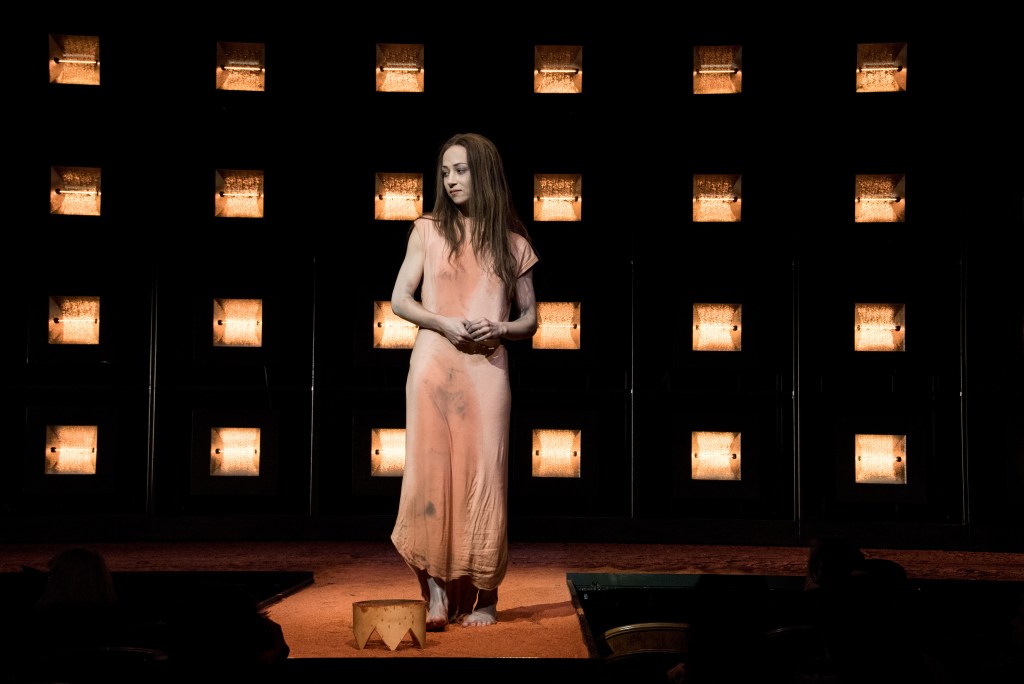
Creon is confronted one final time, by Teiresias, the prophet. The episode follows the same pattern. Opening salutations are friendly and respectful:
Teiresias: I’ll teach, and you obey the prophet.
Creon: I haven’t before stood apart from your thinking (σῆς ἀπεστάτουν φρενός).
Teiresias: That’s why you’ve steered the polis straight (ὀρθή). (992–4)
When, however, Teiresias unambiguously explains the interconnectedness of the personal and the political – “the city is sick because of your thinking” (τῆς σῆς ἐκ φρενός, 1015) – and recommends that Creon should “yield” (εἶκε) to the dead man (1029), Creon refuses. This in spite of the initial concord and Teiresias’ diplomacy, who observes how “it is common (κοινόν) for all people to err” (1023–4). In a variation of the agōn form, Creon’s short rebuttal (1033–47) leads (again) to vicious stichomythia, before Teiresias pronounces forth, at length (1064–90), and promptly departs. The structure lends weight to the prophet’s parting prophecy: “Know well that you yourself from your own entrails (τῶν σῶν αὐτός) / will have betrayed a corpse for corpses (νέκυν νεκρῶν… ἀντιδούς, 1066–7). The intensifying, turned-in-on-itself language (τῶν σῶν αὐτός); the political in the personal (“betray”); the doubling up of woes (νέκυν νεκρῶν) – caught in the “sinews of argument”,[4] Creon cannot escape his family’s history, however much he tries to suppress it.
I’ll come back to where this leaves Creon (and us) in a moment. But, before I conclude this section on figures who triangulate the conflict, I want to consider Creon’s first confrontation, with the Guard. Though a minor (and unnamed) character, the Guard plays a critical role in the tragedy. In basic terms he brings news of resistance to Creon’s rule: someone has buried Polyneices! Or, rather: as the Guard puts it, Polyneices “had vanished, not in a tomb but a thin layer of dust was on him as if from someone trying to escape pollution” (ἄγος φεύγοντος ὥς, 255–6). When he is tasked with trying to uncover the untraceable doer (ἄσημος οὑργάτης, 252), he returns almost immediately with Antigone, a doer all too easily traced. This time his report is explicitly uncanny:
At that time suddenly from the ground,
a whirlwind raised a storm of dust, anguish in the sky;
it filled the plain, shaming all the foliage of the wood
on the plain, and the vast ether was filled with it.
Shutting our eyes we endured the divine sickness (θεία νόσος).
When this set us free (τοῦδʼ ἀπαλλαγέντος) after a long while,
the girl was seen, and she was crying bitterly. (417–23)
While divine involvement is explicitly marked (θεία νόσος), what do we imagine the gods’ role to be exactly? Do their actions imply support for Antigone by enabling her to bury the body? Or on the contrary do they expose her role in it? But there is a more pressing question: why anyway is Antigone doing this again? As the Guard has already observed, dusting of the corpse is enough for the ritual of burial to be satisfied. To explain (away) the problem, Bonnie Honig proposes a “sororal conspiracy”[5] in which it’s Ismene who conducts the first burial. The sense of the uncanny, that something is not quite right, can, should, be a worry for the audience.
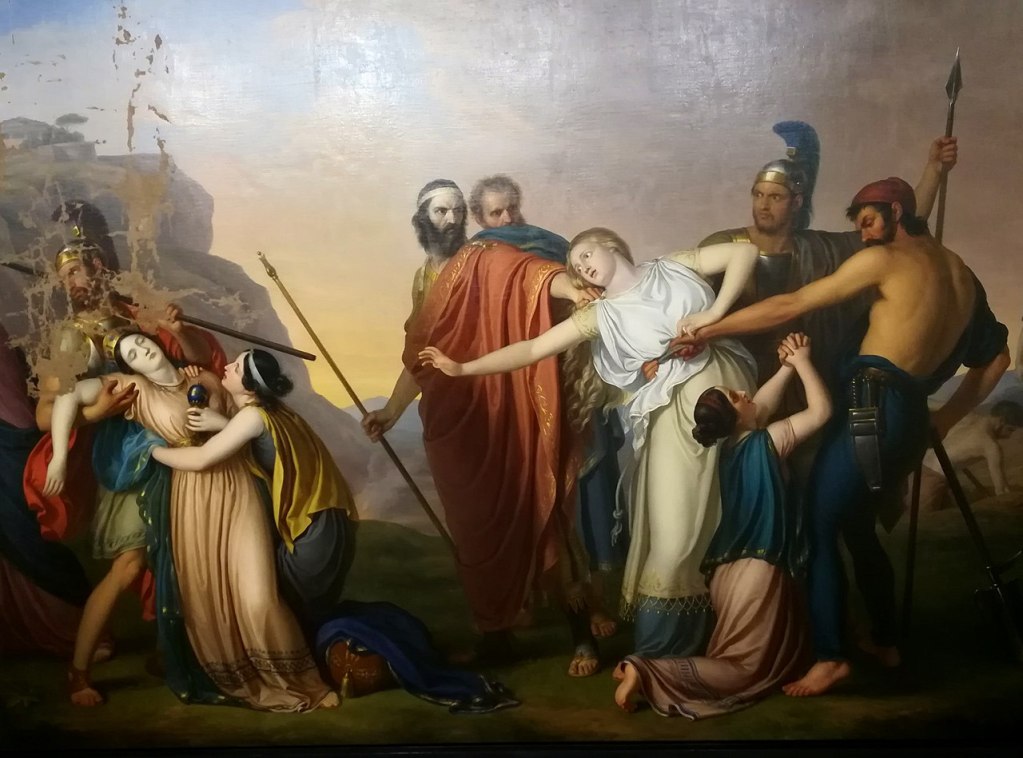
This inexplicability brings me on to my second point to note about the Guard: the uncertainties of his narrative mimic those of the play itself. Immediately on entering, he provides a running commentary to his motivation for being there, or, rather, his lack of one:
Lord, I won’t say I came as quickly as possible,
having plied a nimble foot.
For I had many pauses for thought (φροντίδων),
circling this way and that on my way (ὁδοῖς κυκλῶν ἐμαυτὸν εἰς ἀναστροφήν). (223–6)
There is something oddly diverting, funny even, in the Guard’s prevarications. Like the Porter in Shakespeare’s MacBeth, the Guard represents an ordinary character who finds himself on stage and doesn’t want to be here – with good reason, since it’s a tragedy and no tragedy ends well! At the same time, the Guard’s down-to-earth perspective “throws into relief the more high-minded ideals of the main characters”.[6] In fact, tellingly, whereas the play’s named protagonists move in straight lines and claim certainty for their actions, the Guard displays hesitation, uncertainty, wandering around in circles. He performs the very anxiety of entering conflict, of taking a stand.
Yet take a stand he does. Forced on stage initially by the “terrible/terrifying” news (τὰ δεινά) he has to divulge (243), he hurries back to it after returning to the body with Creon’s “terrible/terrifying” threats (πρὸς σοῦ τὰ δείν’, 408) ringing in his ears. In the interlude, the Chorus sing about the many “awesome” things in the world, none more “awesome” than people (πολλὰ τὰ δεινὰ κοὐδὲν ἀν-/θρώπου δεινότερον πέλει, 332–3). The question is to what this awesome/terrible/terrifying-ness might refer in the play – to Antigone’s act of defiance (implied by the Guard’s first use) or to Creon’s diktats (of the Guard’s second use). (Later, Antigone claims that, in Creon’s eyes, she dared terribly, δεινὰ τολμᾶν, 915). What is clear is why the Guard has returned so swiftly, having previously sworn that he would let Chance judge (τοῦτο γὰρ τύχη κρινεῖ) whether the culprit would be caught; Creon would not see him again (329). It’s the fact that he has found Antigone and, thus, an escape from these woes:
And now, lord, you take her yourself (αὐτός), as you wish,
and judge (κρῖνε) and test her. But I am free (ἐγὼ δʼ ἐλεύθερος);
I am justly released from these evils! (δίκαιός εἰμι τῶνδ᾿ ἀπηλλάχθαι κακῶν). (398–400)
Where before he was content for Fortune to judge, now he demands that Creon judge. He’s now free, delivered from evil, from the moment when the storm had set them free and delivered unto them Antigone. With Antigone in tow, he can now remove himself from judgement. Is it so easy for us?
Mediations nuance the idea of conflict. First, the play represents a series of oppositions: not just Creon and Antigone, but Antigone and Ismene, Creon and Ismene, and the Guard, and his son, and his special advisor… Second, these oppositions polarise opinion, even as they collapse in on themselves. Each character is forced to take a stance, voice ever more extreme views, even as they find it ever more difficult to keep things apart. And third, it in this double helix of polarisation and implication that the audience find themselves bound, and bound to endlessly replay the conflict. The tendency to articulate that conflict in terms of a binary opposition that is abstract from the events of the play fails to take into consideration the drama. The conflict doesn’t stand still but continually shifts, moves on. Is there any space for neutrality left?

Radicalisation
I came in and saw a cat with a hammer jumping out of the window.
Yorgos Lanthimos, Dogtooth (Κυνόδοντας)
I end this discussion of forms of conflict by considering the final scenes involving Antigone and Creon, which for many have been regarded as particularly problematic.
We last see Antigone in the immediate aftermath of Haemon’s agōn with his father. As trailed in that agōn, Antigone is condemned to die, walled up in a cave. Her final appearance on stage (801–943) comprises chiefly of a lengthy ritual lament (kommos) with the Chorus (801–83). In Aeschylus’ Choephoroe, the kommos performs the coming together of the two siblings, Orestes and Electra, as they invoke their father’s spirit, working up to the moment when his son is ready to exact vengeance on those who killed him. While marking the “emotional and musical climax of the play”,[7] the dynamic in Antigone is very different, and not only because this kommos is preparation for Antigone’s own death.
Though the Chorus join in singing with Antigone, there is a question as to what extent they understand her, she them. Early on in their exchange Antigone expressly marks their lack of communication, when she complains that the Chorus mock her (838). Later she wonders: “What justice of a god (δαιμόνιων δίκην) have I transgressed?” (921). What does δαιμόνιων δίκην mean? Is it a gloss on θεών νόμιμα (455),[8] or an entirely different conception of justice (and divine-human relations)? Are the gods on her side (does she think)?
In all this confusion, Antigone reflects on her actions:
And yet I honoured you as those who think well.
For never would I, if I was the mother of children
or if my husband had died and was decomposing,
have taken on this task, in defiance of the citizens.
By virtue of what law (nomos) do I say this?
If my husband had died, I could have had another –
and a child by another man, if I had lost the first.
But with my mother and my father in Hades,
I could never have another brother. (904–12)
Up until this point, Antigone has consistently seemed to advocate a general principle – a divine law even – of burying the dead. But here she suggests that she has risked death only to bury a brother!

Unsurprisingly, this passage has been a cause of much concern. Goethe is reported to have said that he would “give much, if a competent philologist demonstrated to us that it was an interpolation and spurious”.[9] Noting its difficulty, Cambridge’s best-known Sophoclean scholar, Richard Jebb comments: “I cannot bring myself to believe that Soph[ocles] wrote 905–12.”[10] But, then, Aristotle had already labelled Antigone’s argument here as unbelievable (ἄπιστον, Rhetoric 3.16.9). Indeed, Antigone herself appears to anticipate the bafflement her argument will provoke when she asks: “By virtue of what law do I say this?” (908).
It is noteworthy too that this passage marks the culmination of a long lament in which she’s struggled to communicate with the Chorus, particularly in relation to her (over-?) investment in filial bonds. “I’ll come dear (φίλη) to my father, dear (προσφιλής) to you mother, and dear (φίλη) to you, my brother (898–9),” she avows – a tricolon that underscores her devotion to Polyneices. Simultaneously as doubling down on her commitment to philiā, however, she expresses doubts for the first time – whether, that is, she is in fact “friendless” (ἄφιλος, 876), “deserted” by her philoi (ἐρῦμος πρὸς φίλων, 919). She even imagines herself as the last of her line (ὧν λοισθία ᾿γώ, 895; τὴν βασιλειδῶν μούνην λοιπήν, 941) – seemingly oblivious to Creon, Haemon (her betrothed, we should recall), not to mention her sister-in-arms, Ismene.
Her cognitive dissonance is mirrored by the staging. From all indications in the play – i.e. the lack of any announcement of departure and/or re-arrival[11] – in all likelihood Creon is on stage throughout, a spectre, and spectacle, of threatening authority. Yet Antigone doesn’t once address him. This has led some editors to think that Creon must enter at 883, when he delivers his only lines to her during the whole lament scene. The problem passage is just one element in a ramping up of the stakes.
By ranking her brother over a husband, Antigone rejects any possibility of a return to normal genealogical relations. In doing so, she completes the self-destructive inward-turned fate of this incestuous family. More urgently, Antigone’s argument provokes a moment of bafflement in which we audience members have to struggle to work out what is appropriate, or not appropriate, for her to say. And it’s this sense of bafflement which reproduces the drama’s polarising tendencies in a way that implicates us. It demands that we judge while simultaneously withholding from us a definitive judgement.

Creon’s end also incites strong reactions. We left him still resisting all efforts to change his mind, as he first rejects Haemon, then Teiresias. As each antagonist departs, the Chorus’ response is framed by the same phrase: “Lord, the man is gone”, Haemon in his rage (766), Teiresias prophesying terribly (δεινά, 1091, again). With terrifying words now ringing in his ears, Creon finally exhibits doubt:
I myself (καὐτός) know that, and I’m shaken out of my wits (φρένας).
To yield would be terrible/terrifying (δεινόν), but if by resisting
I smite my spirit with ruin – this too is terrible/terrifying (ἐν δεινῷ). (1095–7)
Such is the impact of Teiresias’ prophecy that Creon is physically affected, as similarly his wife will be when she hears news of its fulfilment (the death of their son), in her only lines of the play: “The sound of a blow to our house struck my ear. / In terror (δείσασα) I sank back into the arms of my slaves, and I lost my senses” (1187–9). Too late, Creon realises his terrible, and terrifying, predicament.
At long last, then, he yields:
Chorus: You must take good counsel, son of Menoeceus.
Creon: What must I do? Speak. I’ll obey. (1098–9)
At which point many critics howl in protest. Eminent scholars such as Bernard Knox, writes:
In Creon we are presented with the spectacle of a man who displays every symptom of heroic stubbornness, who is placed in the classic situation of the Sophoclean hero, expressed in the appropriate formulas, but who is swayed by advice, makes major concessions, and collapses ignominiously at the first real threat.[12]
Or Cedric Whitman:
There is nothing tragic or even morally interesting about him. Whether we find Creon thoroughly hateful or merely pitiable, his plight brings little satisfaction. He is puny.[13]
Puny: not much humanism – heroic or otherwise – in that word. In fact, while Whitman and Knox are two of the foremost post-war critics of Athenian drama, both show themselves to be utterly deaf to Creon’s predicament or to the form of this play. Creon has been countered by everyone, from the Guard, Ismene, Haemon, Teiresias, and now the Chorus – hardly the case, then, that he “collapses ignominiously at the first real threat”. Ironically, at the very moment Creon belatedly acknowledges that he needs to change his mind, there are those to be found still resisting.
The issue for these scholars is whether Creon’s response should, or could, be considered tragic. His yielding doesn’t fit their preconceived notions of what a (Sophoclean) hero should look like. But perhaps that’s the problem: are we being as inflexible as Creon has been in this play? In not wanting him to bend, in not thinking that tragic enough, are we re-enacting his role in defiance of evidence to the contrary?

Call backs
It’s the top shop for the tired and rundown
Going up for the final comedown
First and second floors, third and fourth world wars.
Carter the Unstoppable Sex Machine, Shoppers’ Paradise (1991)
In this essay I’ve considered forms of conflict in Antigone. This perspective I owe to Hegel, who helps shift the critical lens from understanding tragedy as morality dramas, which focus on the individual in isolation, to hone in on the protagonist’s relations to others, particularly as confrontation. But, while the drama stages a clash of ideals over a range of issues (state, family, gender, the gods), the conflict depicted is not abstract and never remains stable. On the contrary, it continually shifts and expands, moving the ground under its characters’ feet, while simultaneously pulling in others…
For the characters, it becomes increasingly difficult to maintain and keep apart the “other”. Antigone absorbs the language of the state in her articulation of filial devotion. Creon tries to define philiā relationships from his investment in the polis; but in the end he reductively asserts that the city is his. These oppositions collapse in on themselves, even as the play also polarises opinion: the mediating characters – Ismene, the Guard, Haemon – are all driven to get involved.
And this mimics and structures our involvement too. The play reproduces the sense of difficulty of finding a place outside debate, free from bias. With the space for neutrality rapidly being erased, like the Guard we turn this way and that to avoid implication, only to become implicated as soon as we cast judgement. At the point when Creon turns to the Chorus and yields power, critics condemn him for not being a proper hero – which reproduces Creon’s own resistance to reason. Rejecting Creon, perhaps we see Antigone as the true heroic protagonist – but to do so ignores the end of the play which ignores Antigone. Or do we ignore Antigone (even if she is absent from the drama at the end) at our own risk?
For Simon Goldhill:
It is difficult, in other words, to read Antigone without making not only moral judgements but the sort of one-sided moral judgements that the play itself seems to want to mark as leading to tragedy… It is always interesting to see for which readers Antigone is a noble idealist, a defender of individual liberties, a misguided, hysterical woman, an instrument of fate.[14]
As responses to the play mimic this drama’s tendency to polarise, can we maintain our distance or are we too incriminated in what is going on, like the offspring of Oedipus’ incestuous union? Just how stable are the positions that we adopt, or do they decompose around us, like the corpse left rotting off-stage? To what extent is our thinking polluting the world of the polis (1015)?
Creon’s last words are to the Chorus: “Lead me, as quick as you can, lead me away” (ἄγετέ μ᾿ ὅτι τάχιστ᾿, ἄγετέ μ᾿ ἐκποδών, 1324). It’s an expression and gesture that he soon doubles down on (1339). In Sophocles’ Oedipus Tyrannus, a decade or so later, these words and this gesture of removal from the stage are echoed:
Oedipus: Lead me away then (ἄπαγέ νύν μ᾿) from here already.
Creon: Go then, but let go of your children (στεῖχέ νυν, τέκνων δ᾿ ἀφοῦ).
Oedipus: No, don’t take them from me!
Creon: Don’t wish to control everything (πάντα μὴ βούλου κρατεῖν). (1521–3)
This time the hero is Oedipus, and this time there is an additional actor on stage: Creon. As Oedipus yearns for his removal, Creon steps in to take control over Oedipus’ silent daughters – one of whom is… Antigone. If this moment is an ominous call-back to Sophocles’ earlier play, we might also observe that the OT‘s Creon tells Oedipus “not to wish to control everything”. There is an unsettling irony to this petition, if heard in the fall-out from the Antigone – earlier in staging, but later in mythical chronology. Moreover, kratein may have special resonance with Creon – in whose very name (Κρέων, Kreōn) we hear the root of “power” (kratos).
Don’t wish to control everything: an apt warning against the simplification of conflict as we try to find (enforce) meaning?

Elton Barker is Professor of Greek Literature and Culture at The Open University. He has written widely on epic, historiography and tragedy, including on cross-genre representations of the contest of words (Entering the Agon, Oxford UP, 2009). With Joel Christensen he has published A Beginner’s Guide to Homer (OneWorld, London, 2013) and a monograph on Homer’s Thebes (Center for Hellenic Studies, Harvard UP, Cambridge MA, 2020). Since 2008 he has been developing digital methods and annotation tools for the study of historical geography: in 2019 he co-founded the Pelagios Network Association for linking online resources about places.
Further Reading
My main guides for reading Antigone are scattered in my text and footnotes. As will have been evident, I’ve found Mark Griffith’s commentary (Cambridge UP, 1999) indispensable for raising interpretative issues as well as on determining points of grammar, while Richard Jebb’s commentary (Cambridge UP, 1888; 3rd ed., 1900) still retains much thoughtful discussion. Helpful recent introductions to the play include Ruth Scodel, An Introduction to Greek Tragedy (Cambridge UP, 2010) 106–19); and Douglas Cairns, Sophocles: Antigone. Bloomsbury Companions to Greek and Roman Tragedy (Bloomsbury Academic, London, 2016).
The keen reader will have observed my critical indebtedness to Simon Goldhill (my antagonising former PhD supervisor). For more about the politics of the play, see “Antigone and the politics of sisterhood: the tragic language of sharing,” Chapter 9 of his Sophocles and the Language of Tragedy (Oxford UP, 2012) 231–48; as well as the “Antigone” chapters in Vanda Zajko & Miriam Leonard (eds.), Laughing with Medusa: Classical Myth and Feminist Thought (Oxford UP, 2006).
On why (the) politics matters, readers could do worse than read Goldhill’s review of Patrick Finglass’s Greece & Rome New Surveys in the Classics volume on Sophocles (Cambridge UP, 2019), though I’d recommend a stiff drink. I await Finglass’ keenly anticipated Antigone commentary with much excitement.
This essay is culled from the “highlights reel” of my 2006-7 lecture series on Antigone, given for Mods students at Oxford, which I recently reworked (in the light of contemporary events) for this spring’s series of the Godolphin & Latymer “Breakfast Club“. I provide this note not only to account for the slightly uneven referencing in this essay, which, I hope, nevertheless, offers a new way into viewing this play. Above all, I would like to thank the audiences of my lectures, whose feedback humbled and inspired me in equal measure.
Notes
| ⇧1 | The <outgoing> Prime Minister’s exegesis – an Oxford tutorial soundbite that jars with the setting of a UN address – seems to me to get the ambiguity of deinos the wrong way around. Humanity is awesome, as, indeed, when the Chorus offer their gnomic “many things are wondrous, but none more wondrous than man” (332–3). It’s in the drama itself that the force of deinos as “terrifying” is felt, as we shall see. Whether “man” will be awesome or terrifying (terrible, awful) in his practical response to the climate emergency is moot. |
|---|---|
| ⇧2 | See further on this Mark Griffith’s commentary on the play (Cambridge UP, 1999) 9, 212. |
| ⇧3 | For further discussion, see Griffith’s commentary (as n.2) on these lines. |
| ⇧4 | So George Steiner, Antigones: The Antigone Myth in Western Literature, Art, and Thought (Oxford UP, 1984). |
| ⇧5 | The phrase is used in her book Antigone Interrupted (Cambridge UP, 2013) 91, 196, a review of which can be read here. |
| ⇧6 | Griffith (as n.) 165. |
| ⇧7 | Griffith (as n.) 260. |
| ⇧8 | So Griffith (as n.) 280. |
| ⇧9 | See his remark of 28 March 1827, in Conversations with Eckermann, translated by John Oxenford (Oxford UP, 1850) 371. |
| ⇧10 | In his commentary (Cambridge UP, 1888) on lines 904–20. |
| ⇧11 | See Griffith (as n.2) 255. |
| ⇧12 | B.M.W. Knox, The Heroic Temper: Studies in Sophoclean Tragedy (Univ. of California Press, Berkeley, CA, 1964) 68. |
| ⇧13 | C.M. Whitman, Sophocles: A study of Heroic Humanism (Harvard UP, Cambridge, MA, 1951) 90. |
| ⇧14 | S.D. Goldhill, Reading Greek Tragedy (Cambridge UP, 1986) 89. |