Tom Moran
There is a lot that we don’t know about William Shakespeare (1564–1616), but there is one fact concerning him about which nearly everyone appears to be in full agreement. They agree with Shakespeare’s great contemporary Ben Jonson in his poem about his fellow playwright included at the beginning of the 1623 First Folio that Shakespeare had “small Latin and less Greek”:
For if I thought my judgment were of years
I should commit thee surely with thy peers,
And tell how far thou didst our Lyly outshine,
Or sporting Kyd, or Marlowe’s mighty line.
And though thou hadst small Latin and less Greek,
From thence to honor thee I would not seek
For names, but call forth thund’ring Aeschylus,
Euripides, and Sophocles to us…
It is one of the few statements about Shakespeare that is almost universally considered to be uncontroversial and accepted as fact. The editors of The Norton Shakespeare footnote the line, claiming that “The underrating of Shakespeare’s Latin was likely influenced by Jonson’s pride in his own impressive classical learning.” Even Jonson’s most recent biographer, Ian Donaldson, accepts the line at face value, claiming that Jonson was utilizing a rhetorical strategy that he had gleaned from the Roman rhetorician Quintilian: namely, that you should point out a person’s shortcomings (such as Shakespeare’s having “small Latin and less Greek”) before building up his virtues.

There’s only one problem with this assumption: not only is it not true, the exact opposite is true. Jonson’s statement concerning Shakespeare’s alleged ignorance of Greek and Latin might be the single most misunderstood and misinterpreted line of English poetry ever written: it means the opposite of what most people think it means. When we examine what Ben Jonson actually said, as opposed to what we think he said, we will realize that not only did Shakespeare know both Latin and Greek, and that Ben Jonson never said he didn’t, but that Shakespeare’s knowledge of Greek is evident in one of the most famous passages he ever wrote.[1]
To get what Ben Jonson is actually saying about Shakespeare’s knowledge (or lack of such) of Latin and Greek, there are two things that we need to understand. The first is that Jonson is making a hypothetical statement (the word “would” in the next line gives it away). The second is that he is using the word “though” in a sense that we tend to misinterpret because it is now obsolete.
To help illustrate this, let me give an example: I have two nephews, both of whom are excellent drivers. For the sake of argument, let us assume that one of them is not. Let us further assume that the one who is not a good driver is in fact a terrible driver who has gotten into multiple accidents and cracked up two cars already. But his birthday is coming up and he calls me and tells me that he would like me to buy him a car for his birthday, to which my response is: “Even if I won the lottery I would not buy you a car, because you would just crack it up like you did the other two.” Now, in making that statement, am I saying that I’ve actually won the lottery? Of course not: it’s a hypothetical statement and not meant to be taken literally. That is the kind of statement that Ben Jonson is making: his line “And though thou hadst small Latin and less Greek” is the Jacobean equivalent of “Even if I won the lottery“.

Why don’t we know this? The reason is that Ben Jonson is using the word “though” in a completely different sense from that in which we use it today. We think of it as meaning “even though” when in this context it means “even if”. How do we know this? There are two ways of confirming it. One, the word “though” is listed in the dictionary as having exactly that meaning (although it is labeled as “obsolete”), and two, the word “though” is used in the sense of “even if” in one of the most famous passages in the King James Bible, which was published seven years before the First Folio.
If we check The New Testament of the King James Bible, we will find in 1 Corinthians 13:1 the word “though” being used in exactly the sense in which Ben Jonson is using it: “Though I speak with the tongues of men and of angels, and have not charity, I am become as sounding brass, or a tinkling cymbal.” Saint Paul is obviously not claiming that he actually does speak with the tongues of men and angels: he’s saying that, even if he did, and lacked charity (agapē in the Greek, sometimes translated as “love”), it would be as hollow as a sounding brass or a tinkling cymbal. The word “though” is used in the same sense four more times in the next two verses. The word (ἐάν, ean, in the Greek) is translated as “though” in the King James Bible, the Geneva Bible, and as far back as William Tyndale. (In the Greek, on the other hand, ἐάν just means “if”, which is the way it is translated not only in the Catholic Douay-Rheims translation, but by two of the most recent translators of the New Testament, N.T. Wright and David Bentley Hart). So, given the fact that Jonson is making not a factual but a hypothetical statement, that he is using the word “though” in the sense of “even if,” and that he’s not claiming that Shakespeare didn’t know Latin or Greek, what is he actually saying? What point is he trying to make?

To find out what that point is, we need to look at the line within the context of the poem itself. Jonson compares Shakespeare with what he believes to be his Elizabethan contemporaries (or, as William Faulkner would put it, his coevals). He mentions the playwrights John Lyly, Thomas Kyd and Christopher Marlowe, making it clear that Shakespeare is superior to all three. Then we have the line that everyone gets wrong – “And though thou hadst small Latin and less Greek…” – which sets up Jonson’s next comparison, which is to pit Shakespeare against both the tragic and comic playwrights of Classical antiquity. Jonson mentions the Greek tragedians Aeschylus, Sophocles and Euripides, as well as the more obscure Roman tragedians Marcus Pacuvius and Lucius Accius, as well as Seneca, then the comic playwrights Aristophanes, Plautus and Terence. Jonson states, addressing Shakespeare directly, that he will:
Leave thee alone for the comparison
Of all that insolent Greece or haughty Rome
Sent forth, or since did from their ashes come.
The key words in these lines are “alone” and “all”.
Jonson’s meaning, though a little startling, seems to me to be pretty obvious, and the best way of getting that meaning across is to translate what Jonson is saying into 21st-century English. If we were to do so, the result would look something like this: “Even if Shakespeare knew very little Latin and even less Greek, that would not stop me from comparing him to the greatest of Greek and Roman playwrights, because he is not just as good as they are – he’s better.” That is what Ben Jonson is really saying. He’s not saying that Shakespeare didn’t know Latin or Greek: he’s saying that, even if he didn’t, Shakespeare would still be better than Aeschylus. Better than Sophocles or Euripides. Better than Seneca or any of the Roman tragedians. Better than the comic playwrights Aristophanes, Terence or Plautus. What Jonson is saying is that Shakespeare is the greatest playwright who has ever lived, and is superior to all the competition in all ages both in comedy and tragedy. Even superior to Ben Jonson. That’s a great deal different from claiming that he didn’t know Latin and Greek.
* * *

To illustrate Shakespeare’s possible knowledge of Greek, the best thing we can do is to look at the opening of two plays, one by Sophocles, one by Shakespeare, and speculate on the influence that the one might very well have had on the other. The Sophoclean play is Antigone, and in its opening speech the title character is speaking to her sister Ismene outside the walls of the palace where they, and no woman for that matter, are not permitted to go. It is almost morning but still dark, and there has been a pitched battle outside the city the night before, with fatal consequences. Here are the first ten lines of the play, in which Antigone is addressing her sister Ismene:
ὦ κοινὸν αὐτάδελφον Ἰσμήνης κάρα,
ἆρ᾽ οἶσθ᾽ ὅ τι Ζεὺς τῶν ἀπ᾽ Οἰδίπου κακῶν
ὁποῖον οὐχὶ νῷν ἔτι ζώσαιν τελεῖ;
οὐδὲν γὰρ οὔτ᾽ ἀλγεινὸν οὔτ᾽ ἄτης ἄτερ
οὔτ᾽ αἰσχρὸν οὔτ᾽ ἄτιμόν ἐσθ᾽, ὁποῖον οὐ 5
τῶν σῶν τε κἀμῶν οὐκ ὄπωπ᾽ ἐγὼ κακῶν.
καὶ νῦν τί τοῦτ᾽ αὖ φασι πανδήμῳ πόλει
κήρυγμα θεῖναι τὸν στρατηγὸν ἀρτίως;
ἔχεις τι κεἰσήκουσας; ἤ σε λανθάνει
πρὸς τοὺς φίλους στείχοντα τῶν ἐχθρῶν κακά; 10
And here is the same speech in my translation:
My sister, dear Ismene,
Do you know of any evil begun with Oedipus
That Zeus will not conclude with us who are still alive?
There is nothing either painful or disastrous
Nothing shameful, nothing deprived of honor
Which you and I (especially me) have not both seen and suffered?
And now, what of this proclamation, which they say
Has just now been laid down by the commander for all in the city?
Have you heard anything? Or has it escaped your notice
That our friends receive the evil due our enemies?
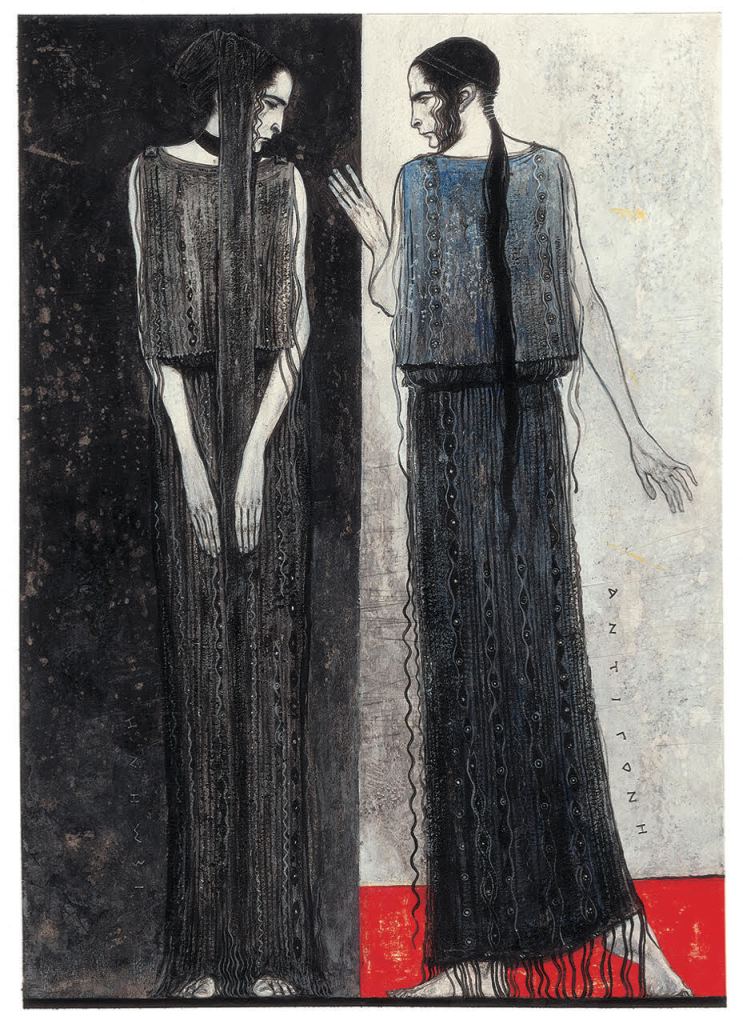
What do we notice about this speech? Antigone is describing all the disasters that both the sisters and their family have been through, claiming that there is nothing left (note the repeated uses of οὔτ(έ), out(e), in the Greek, which means “nothing”) for them to suffer, before turning her entire argument on its head with two words: καὶ νῦν, kai nūn, or “And now.” After this she divulges that, contrary to what she has just told her sister, there is a further and even more horrific indignity than anything their family members had to contend with previously that they will have to undergo: their brother Polyneices, killed in combat by his own brother the night before, will, by the proclamation of the new commander (who happens to be their uncle), not be buried with honor as is the usual custom. Instead, since he rebelled and fought against the city, will instead have his corpse exposed to the dogs and the birds until it is finally devoured by them. It is the ultimate insult by the state, and one which Antigone will not permit to happen, even if the price she will have to pay for her disobedience is to be stoned to death by the assembled populace of Thebes.
Shakespeare’s play Richard III would not, at least at first glance, seem to have all that much in common with the précis of the Sophoclean tragedy given above. But, like Antigone, Richard III begins at a time of nominal peace immediately following a period of savage hostilities. At most times an interval of peace would seem to be a blessing. Richard, on the other hand, like Antigone (although for very different reasons) sees it as a curse:
Now is the winter of our discontent
Made glorious summer by this son of York;
And all the clouds that lowered upon our house
In the deep bosom of the ocean buried.
Now are our brows bound with victorious wreaths,
Our bruisèd arms hung up for monuments,
Our stern alarums changed to merry meetings,
Our dreadful marches to delightful measures.
Grim-visaged war hath smoothed his wrinkled front,
And now, instead of mounting barbèd steeds
To fright the souls of fearful adversaries,
He capers nimbly in a lady’s chamber
To the lascivious pleasing of a lute.
But I, that am not shaped for sportive tricks
Nor made to court an amorous looking glass,
I, that am rudely stamped, and want love’s majesty
To strut before a wanton ambling nymph,
I, that am curtailed of this fair proportion,
Cheated of feature by dissembling Nature,
Deformed, unfinished, sent before my time
Into this breathing world, scarce half made up,
And that so lamely and unfashionable
That dogs bark at me as I halt by them –
Why I, in this weak piping time of peace,
Have no delight to pass away the time,
Unless to see my shadow in the sun
And descant on mine own deformity.

The first thing we notice is that the Elizabethan protagonist is as prolix as the Greek heroine is restrained. But Richard’s rhetorical verbosity merely masks the fact that his speech appears to be structurally influenced by that of Antigone. Lines 5-13 of Richard III do more or less what lines 1-6 do in Antigone: they set up, by detailing one situation, what will turn out to be a very different one. They just do it with more detail. Richard is describing a circumstance that, like the end of hostilities in Antigone, should, at least in theory, be a cause for celebration. And it is. Just not for Richard. The repeated use of “our” in those lines (which can’t help but seem visually reminiscent of the repeated use of “οὐτ(έ)”, out(e), in Antigone’s speech), emphasizes the collective emotion that peace has engendered among the citizens, and in which he does not share, any more than Antigone shares the presumed relief of the populace of Thebes that the internecine conflict between Eteocles and Polyneices for the leadership of the state has finally come to an end.
Then, as it does in Antigone, Richard takes what he has just been saying and turns it completely on its head through the use of two simple words. In Antigone it’s καὶ νῦν, “And now.” In Richard III it’s “But I.” Then we learn why Richard cannot join in the near-universal jubilation at the end of hostilities. Because of his physical deformity, he is unable to enjoy peace as wholeheartedly as he enjoyed war. He can’t enjoy peace at all. Richard in peacetime is like a fish out of water. For Richard, romance and lovemaking are out of the question: if dogs bark at him as he passes by them, what chance does he have to attract a woman? This “weak piping time of peace” merely highlights Richard’s sense of self-loathing and forces him to stew in his own juices and “descant on mine own deformity”. Not only that, when it’s peacetime you can’t kill people legally, and that seems to be the great appeal of war for Richard, whose bloodlust will, he believes, be thwarted by peace. The outlook for Richard at the end of his speech seems almost as bleak as Antigone’s is at the end of hers.

The two speeches are radically different, yet their respective rhetorical structures can be argued to be remarkably similar. I believe it demonstrates how Shakespeare was able to take a Classical model and make use of it in his own way. By closely studying Sophocles, very possibly in Greek, Shakespeare was able to elaborate on his model and embroider on the same general structure while crafting something significantly different yet equally effective. In his variations, not so much on the Sophoclean theme, but on its rhetorical structure, Shakespeare will do what he does over and over again in his literary career – make use of the ancients while adapting them to his own ends.
Was Shakespeare, for example, influenced by Oedipus at Colonus while writing King Lear? When Mark Antony pulls away the torn mantle of Caesar to reveal to the mob his bleeding corpse in Julius Caesar, is this a metatextual homage of sorts to the Electra of Sophocles, in which Orestes in disguise pulls away the shroud to disclose to Aegisthus that the corpse beneath it is not Orestes, as he believes, but rather that of his mother Clytemnestra, whom he has killed? And what about Shakespeare’s anachronisms, as when he has Hector in Troilus and Cressida quoting Aristotle in the middle of the Trojan War, which took place centuries before Aristotle was born?
* * *

While some Shakespearean scholars – Jonathan Bate in How the Classics Made Shakespeare (Princeton UP, 2019) and Colin Burrow in Shakespeare and Classical Antiquity (Oxford UP, 2013), among others – have been able to establish credible connections between Shakespeare’s work and the Classical tradition, we now have to consider the very real possibility that Shakespeare made those connections by reading these works in the original Latin and Greek. But once we have digested this premise, we are left with a conundrum: assuming that Shakespeare did in fact possess the Classical learning that Ben Jonson might be said to have given him credit for, how was that learning acquired? Was the Stratford Grammar School really, as so many Shakespearean scholars like to postulate, the academic equivalent of Oxford and Cambridge combined? Was Shakespeare a ferocious autodidact miraculously able to acquire on his own a working knowledge of Greek and Latin through a combination of diligent study and the pixie dust of linguistic genius? Or is there some other explanation altogether? It is enough, I believe, for this article to be in effect the early and somewhat halting steps towards a fresh and ambitious reassessment of the available evidence.
Once we finally abandon the long-held and misguided canard (or, as he would call it, the “sweet misprision”) that Shakespeare didn’t know Latin or Greek, and accept the very real possibility that he might have known both well, we will be in a far better position to understand and appreciate his work than we have been in the past. A great opportunity awaits the scholars and critics of the future.

Tom Moran has worked on the editorial staffs of Newsweek and Time magazines, reviewed books for Time, the Chicago Tribune and the Wall Street Journal, and is currently ABD at the CUNY Graduate Center in New York. His dissertation-in-progress is entitled “Truman Capote, Metatextuality and the Transfiguration of Genre.”
Notes
| ⇧1 | This article was written and, I thought, completed, before I discovered that two separate academics, Colin Burrow of the University of Oxford and Roger Stritmatter of Coppin State University, have published analyses of Jonson’s poem that anticipate, at least in part, my argument. But while both make cogent points in support of the assertion that Jonson’s text has been misinterpreted, neither, I would contend, quite gets the full thrust of Jonson’s argument as I present it here. [Note from the editor: The first person to make the crucial step of reinterpreting the English text appears to have been C.M. Ingleby, in his edition of 1874.] |
|---|