David Konstan
Envy, which has the worst reputation of all the emotions, is surely with us, and perhaps holds a special chair in Academe, where odium philologicum seems to have displaced the old odium theologicum as the prime locus.[1] A brief survey of attitudes toward envy, from Classical antiquity to early Christianity, may help to illuminate its nature. We may begin, indeed, with the livor or spite that characterizes literary rivalries, and in this connection, I cannot help but cite an epigram by the poet Callimachus,[2] from the 3rd century BC:
εὐδαίμων ὅτι τἄλλα μανεὶς ὡρχαῖος Ὀρέστας
Λευκαρέτα τὰν μὰν οὐκ ἐμάνη μανίαν
οὐδ᾽ ἔλαβ᾽ ἐξέτασιν τῶ Φωκέος ἅτις ἐλέγχει
τὸν φίλον· ἀλλ᾽ αἰ χἢν δρᾶμ᾽ ἐδίδαξε μόνον,
ἦ τάχα κα τὸν ἑταῖρον ἀπώλεσε τοῦτο ποήσας –
κἠγὼ τὼς πολλὼς οὐκέτ᾽ ἔχω Πυλάδας.
Old Orestes was fortunate, Leucarus, even though he was otherwise mad, since he wasn’t mad in the maddest way and didn’t submit the Phocian [i.e., his best friend, Pylades] to the test that proves a friend. But if he’d produced just one play, he’d have lost his pal soon enough. I did it myself, and no longer have my many Pylades.
Apart from the playful pretense that petty literary rivalries constitute a more severe trial of loyalty than the kind of life-and-death struggles in which Pylades manifested his devotion to Orestes, Callimachus’ epigram may also be drawing a contrast between two contexts and even genres. On the one hand, there is the solidarity characteristic of exemplary mythological friendships, above all as they were portrayed in Classical tragedy, like that of Pylades and Orestes in Aeschylus’ Oresteia and Euripides’ Orestes, or of Heracles and Theseus in Euripides’ Heracles. On the other hand, there is the fickleness that characterizes friendships in Callimachus’ own time, and particularly those among dramatic poets, who presumably stand in here for the litterati or philologoi in general, whom Callimachus castigates for their backbiting in the first of his iambic poems and elsewhere.
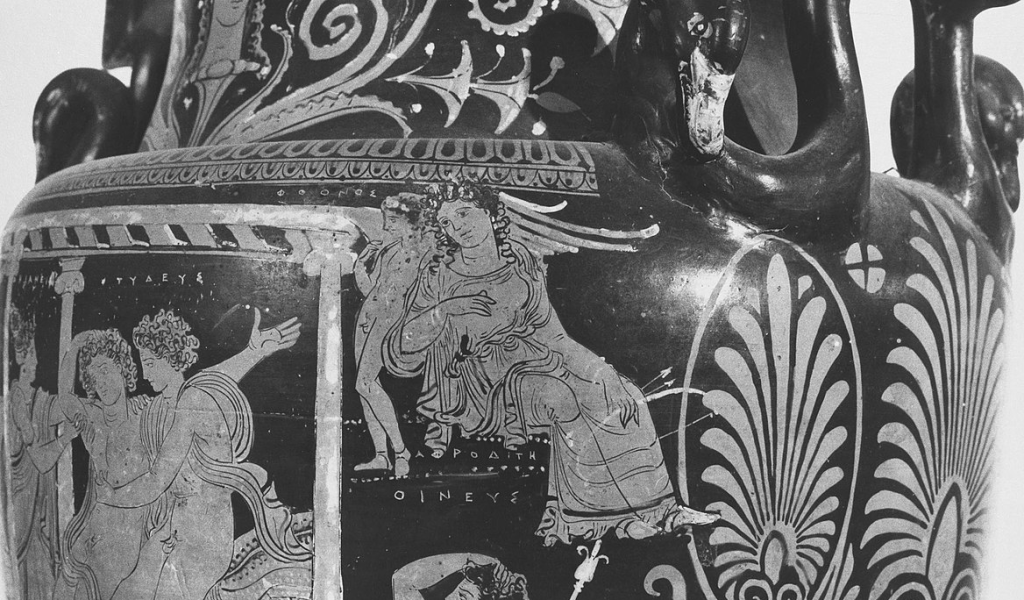
What does envy feel like? We can perhaps gain an intuition from a passage in an ode by Pindar (c.518–438 BC). I am thinking of the magnificent conclusion to the 8th Pythian ode, composed in 446 BC in celebration of the victory of the young Aristomenes of Aegina in wrestling:
νίκαις τρισσαῖς, Ὦριστόμενες, δάμασσας ἔργῳ·
τέτρασι δ᾽ ἔμπετες ὑψόθεν
σωμάτεσσι κακὰ φρονέων,
τοῖς οὔτε νόστος ὁμῶς
ἔπαλπνος ἐν Πυθιάδι κρίθη,
οὐδὲ μολόντων πὰρ ματέρ᾽ ἀμφὶ γέλως γλυκὺς
ὦρσεν χάριν· κατὰ λαύρας δ᾽ ἐχθρῶν ἀπάοροι
πτώσσοντι, συμφορᾷ δεδαγμένοι.
ὁ δὲ καλόν τι νέον λαχὼν
ἁβρότατος ἔπι μεγάλας
ἐξ ἐλπίδος πέταται
ὑποπτέροις ἀνορέαις, ἔχων
κρέσσονα πλούτου μέριμναν. (Pythian 8.80–92)
You were dominant in action with three victories, Aristomenes. And you fell from above on the bodies of four opponents, with grim intent; to them no cheerful homecoming was allotted, as it was to you, at the Pythian festival; nor, when they returned to their mothers, did sweet laughter awaken joy. They slink along the back-streets, away from their enemies, bitten by misfortune. But he who has gained some fine new thing in his great opulence flies beyond hope on the wings of his manliness, with ambitions that are greater than wealth.[3]
Envy bites: that is its essential characteristic, the bitter sting, the desire to hide, the reproachful look even of the young athletes’ mothers. But the winner had better be careful, since fortune is fickle. Thus Pindar continues:
ἐν δ᾽ ὀλίγῳ βροτῶν
τὸ τερπνὸν αὔξεται: οὕτω δὲ καὶ πίτνει χαμαί,
ἀποτρόπῳ γνώμᾳ σεσεισμένον.
95ἐπάμεροι: τί δέ τις; τί δ᾽ οὔ τις; σκιᾶς ὄναρ
ἄνθρωπος. ἀλλ᾽ ὅταν αἴγλα διόσδοτος ἔλθῃ,
λαμπρὸν φέγγος ἔπεστιν ἀνδρῶν καὶ μείλιχος αἰών (92–7).
The delight of mortals grows in a short time, and then it falls to the ground, shaken by an adverse thought. Creatures of a day. What is someone? What is no one? Man is the dream of a shadow. But when the brilliance given by Zeus comes, a shining light is on man, and a gentle lifetime.
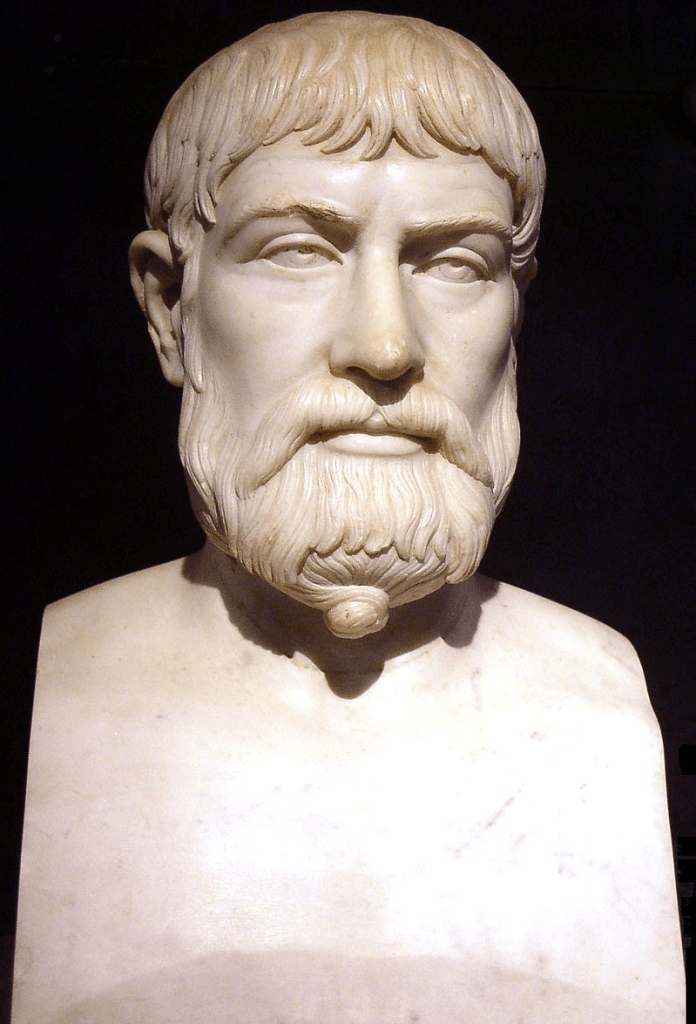
By and large, envy had the worst reputation among all the emotions in the Classical period. Aristotle (c.384–322 BC), for example, defined envy, or φθόνος (phthonos), as “a kind of pain, in respect to one’s equals, for their apparent success in things called good, not so as to have the thing oneself but [solely] on their account,” that is, because they have a good that we do not, irrespective of its use to us (Rhetoric 2.10, 1387b23–5). Because envy has no regard either for merit or even one’s own needs, Aristotle deemed it inappropriate to anyone who is morally decent (ἐπιεικής, epieikēs). It is motivated by a small-minded concern for image and characteristic of people who are mikropsūkhoi (“small-souled”), not far removed from mere spite or malice.
Now, there was in fact a more positive view of envy current in Greek thought. The orator Isaeus, for example, asserts that his clients “do not deserve phthonos, but much rather, by Zeus and Apollo, these others do, if they acquire what does not belong to them” (6.61). When Demosthenes (384–322 BC) says of Meidias, “pity doesn’t fit you in any way, but just the opposite: hatred and phthonos and anger. That’s what you deserve for what you do” (21.196), he means that Meidias’ arrogance is justly deserving of reproach. This kind of phthonos is elicited when people get above their station. It is in this sense that phthonos might be attributed to the gods, although Plato (c.428–348 BC) found the idea objectionable (Phaedrus 247A7; cf. Lucian Prometheus 18). Herodotus has the wise legislator Solon affirm that “the divine is wholly phthoneron”, that is, given to envy (1.32.5–6; cf. 8.109), and the idea was commonplace. Inordinate success or ambition invites the gods’ resentment because it threatens to cross the line between mortal and divine.
In fact, the philosopher or sophist Hippias of Elis (a contemporary of Socrates) articulated the distinction clearly between two kinds of envy. “There are,” he wrote, “two kinds of phthonos, one just, when a person feels phthonos in regard to bad people who are held in esteem, the other unjust, when one feels it in regard to good people,”[4] He may have had a famous passage by Hesiod in mind (composed around 700 BC), where he distinguished between two kinds of strife or rivalry (his word is ἔρις, eris):
ζηλοῖ δέ τε γείτονα γείτων
εἰς ἄφενος σπεύδοντ᾽· ἀγαθὴ δ᾽ Ἔρις ἥδε βροτοῖσιν.
καὶ κεραμεὺς κεραμεῖ κοτέει καὶ τέκτονι τέκτων,
καὶ πτωχὸς πτωχῷ φθονέει καὶ ἀοιδὸς ἀοιδῷ.
Neighbor competes with neighbor,
eager for wealth: this is the good ἔρις for mortals.
And potter begrudges potter, carpenter carpenter,
and beggar envies beggar, singer singer. (Works and Days 23–6)

It is evidently, as we have said, the good kind of phthonos that Herodotus (c.484–420s BC) had in mind when he had Solon (c.630–560 BC) affirm that “the divine is wholly phthoneron” (1.32.5–6; cf. 8.109; Pindar Pythian 10.21–2 and Olympian 13.25–6; Aeschylus Persians 362, etc.). Inordinate success or ambition, like that of Croesus (c.595–546 BC) in Herodotus’ tale, invites the gods’ resentment because it threatens to cross the line between mortal and divine. And yet, it must be admitted that the ostensibly positive sense of phthonos is rare in Greek literature.
Having qualified envy in a purely negative way, Aristotle introduced an alternative emotion representing justifiable indignation at another’s underserved prosperity, namely τὸ νεμεσᾶν (to nemesan, the verbal form of the noun nemesis). Aristotle defines to nemesan as “feeling pain at someone who appears to be succeeding undeservedly” (2.9, 1837a8–9). It is thus the true opposite of pity: indignation is pain at undeserved good fortune, whereas pity is pain at undeserved misfortune (Rhetoric 2.9, 1386b9–12). Indignation, unlike envy, is perfectly compatible with good character. Thus, Aristotle is content to ascribe to nemesan to the gods. As we have seen, however, popular usage did not correspond to Aristotle’s fine-tuned and, it may be added, aristocratic view of phthonos.
Cicero (106–43 BC), in turn, distinguished two senses of the Latin word invidia, associating one with phthonein, that is, envy in the negative sense, and the other with to nemesan, that is, legitimate indignation (as Aristotle defined it in the Rhetoric) at the undeserved good fortune of others. This latter, as we have seen, is the proper opposite to pity as the pain that arises at the perception of unmerited suffering (Cicero, Letters to Atticus 5.19.3). Contrary to what I had always imagined, Robert Kaster has demonstrated that the positive sense of invidia as legitimate disapproval, invoked to elicit shame or pudor, is in fact the predominant usage in Latin literature – and by far.[5] And so, neither phthonos nor invidia can be taken to designate a vice tout court.
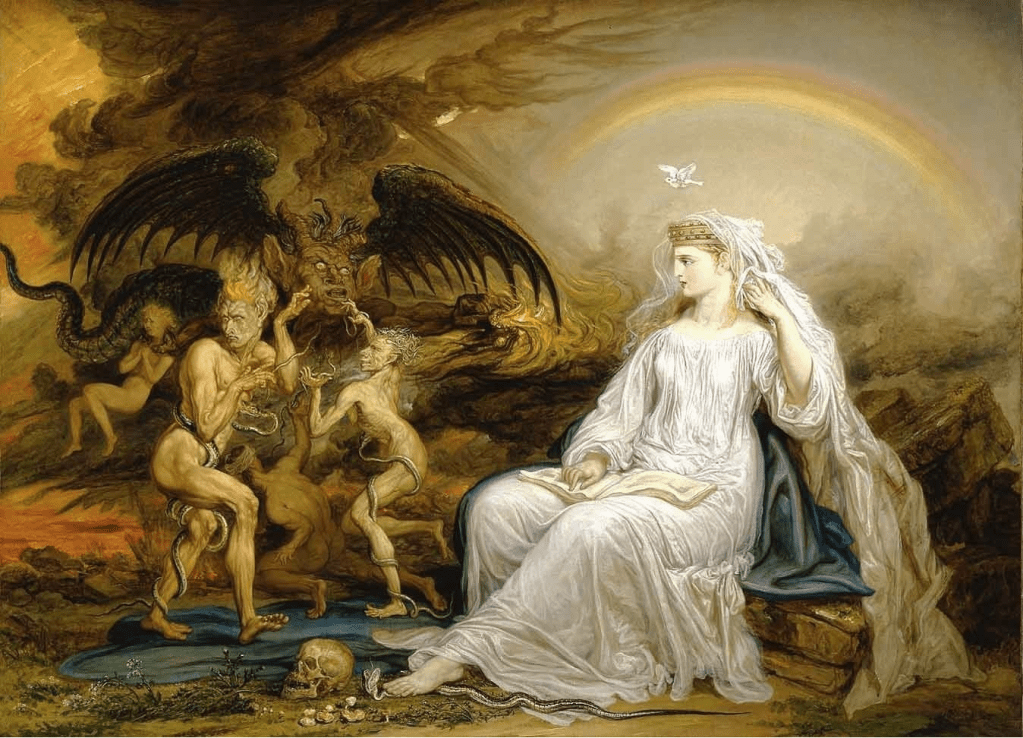
Christian writers generally took a negative view of envy. As Martin Hinterberger has noted, in his excellent study of phthonos in Byzantine Literature,[6] there is a distinction between the Byzantine and the Classical conception of phthonos, in that the Classical sense, unlike the modern “envy”, on occasion had a positive connotation. “Byzantine phthonos differs from ancient phthonos,” he writes, precisely in that “Byzantine phthonos is always and through and through negative” (p. 27).
The only early Christian work in Greek that treats envy at length, so far as I know, is the eleventh homily of Basil of Caesarea (AD 330–79). Basil’s definition of envy corresponds, at first blush, to Aristotle’s: “envy is pain caused by a neighbor’s prosperity.” But envy was regarded as inspired by the Devil. Basil affirms that the Devil rebelled against God out of envy – in this he differs from Augustine’s view, which ascribed his rebellion to pride – and he now wages war on mankind for the same motive, since God’s grace grants to mankind the possibility of redemption.
Thus, Basil exhorts the congregation to shun the vice of envy: “Let us guard, brothers, against the passion of envy, lest we become sharers in the works of the adversary and be found condemned together with him by the same judgment.” But there is a further consequence of this view of envy. Since envy derives from an outside agent, it harms the envious more than the envied; as Basil writes, “there is nothing more destructive planted in the souls of human beings than the passion of envy,” and he observes: “The perturbations of envy do no harm to the envied [τὸν βασκαινόμενον] but are a torment to the very one who envies.”
In the same vein he observes that
envy does minimal harm to others, but the primary and inherent evil is to the one who possesses it. For who, suffering from this distress, has ever diminished the goods of his neighbor? But he has consumed himself wasting away in his distress.
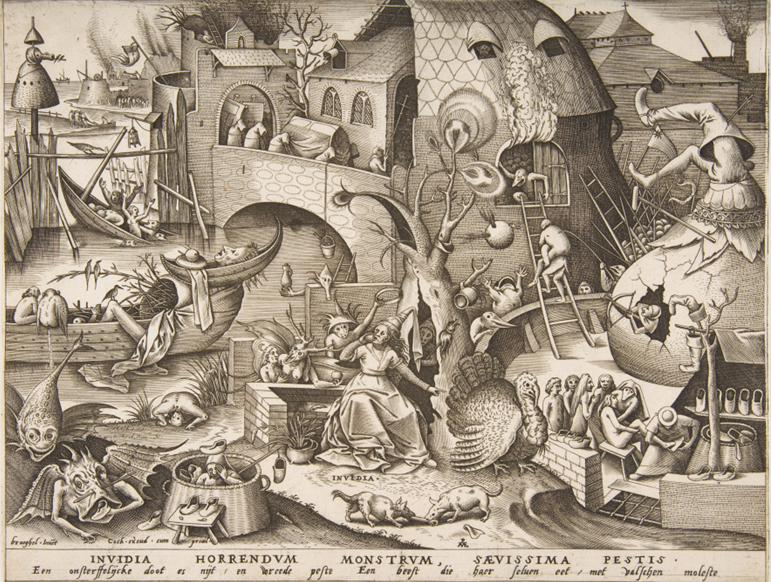
Basil illustrates the pernicious effects of envy on the physical appearance of the envious, a Classical trope that emphasized the gaunt and haunted look such people wear. In all, Basil comes near to displaying empathy for the envious, given the extreme nature of their suffering (cf. Hinterberger 2013, 63). The source of envy, Basil explains, is a misguided esteem for the things of this world, and he counsels freeing oneself from the desire for riches and reputation. In Stoic fashion he observes “these things are not up to you”. Rather, he urges the practice of virtue: “be just and temperate, and wise, and brave, and enduring in sufferings for the sake of piety, for in this way you will save yourself and have greater glory in regard to these greater goods.”
To the four cardinal virtues of the Classical writers Basil adds that of bearing up patiently, suggesting the humility that befits a Christian. In transposing envy from a fault of character to a disease inflicted by the Devil, Basil, like some other Christian writers, recast the problem that envy posed; and though he offered advice that was similar to Stoic injunctions, at bottom freeing oneself from envy demanded Christian humility and faith, which were the preconditions for salvation. This, then, was another antidote to envy, in addition to love.
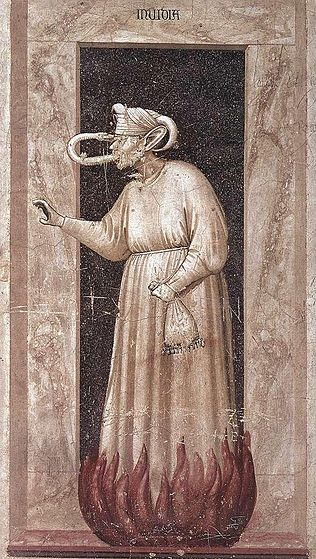
Envy gained a certain notoriety by its inclusion among the capital sins, a classification that goes back to Evagrius (345–99), who wavered between seven and eight such forms of depravity, and was brought to the Latin-speaking world by his disciple, John Cassian (360–435), though it was only with Pope Gregory’s list in the 6th century that envy rose to so distinguished a status. There were, of course, antecedents in the Bible. In the Gospel of Mark, when the Pharisees criticize the disciples for not washing before eating, as ritual demands (7:1-8), Jesus counters that all foods are clean (7:19), and explains: “For it is from within, from the human heart, that evil intentions [hoi dialogismoi hoi kakoi] come: fornication, theft, murder, adultery, avarice, wickedness, deceit, licentiousness, envy, slander, pride, folly. All these evil things [panta tauta ta ponēra] come from within, and they defile a person” (7:21–3). And in his Epistle to the Romans, Paul (AD c.5–65) declares: “For the wrath of God is revealed from heaven against all ungodliness and wickedness of those who by their wickedness suppress the truth” (1:18). Shortly afterwards, Paul is specific:
καὶ καθὼς οὐκ ἐδοκίμασαν τὸν θεὸν ἔχειν ἐν ἐπιγνώσει, παρέδωκεν αὐτοὺς ὁ θεὸς εἰς ἀδόκιμον νοῦν, ποιεῖν τὰ μὴ καθήκοντα, πεπληρωμένους πάσῃ ἀδικίᾳ πονηρίᾳ πλεονεξίᾳ κακίᾳ, μεστοὺς φθόνου φόνου ἔριδος δόλου κακοηθίας, ψιθυριστάς, καταλάλους, θεοστυγεῖς, ὑβριστάς, ὑπερηφάνους, ἀλαζόνας, ἐφευρετὰς κακῶν, γονεῦσιν ἀπειθεῖς, ἀσυνέτους, ἀσυνθέτους, ἀστόργους, ἀνελεήμονας.
And since they did not see fit to acknowledge God, God gave them up to a debased mind and to things that should not be done. They were filled with every kind of wickedness, evil, covetousness, malice. Full of envy, murder, strife, deceit, craftiness, they are gossips, slanderers, God-haters, insolent, haughty, boastful, inventors of evil, rebellious toward parents, foolish, faithless, heartless, ruthless. (Romans 1:28–31, English Standard Version)
These catalogues look like early, still not systematic, assemblages of sins, and yet, I would suggest that they are not quite as they seem.[7] I say this not because of the broad sweep and inclusion of such offenses as folly and gossip, which don’t quite make it into the Big Seven. Rather, it is because Mark and Paul describe these vices as wickedness, or iniquity, or evils, but not as sins, that is, hamartiai. Sins proper, I would maintain, refer to the failure to trust in Jesus – to have pistis – and not to evildoing of just any old sort. Later, to be sure, this crucial limitation of the term hamartia, or peccatum in Latin, would be forgotten, and so these vices would come to qualify as sins, and some of them even make it into the Capital kind. But this is an argument for another occasion.[8] Whether sin or mere depravity, envy is seen as a most undesirable passion. And I cannot help but agree that a good dose of humility is the best remedy.

David Konstan is Professor of Classics at New York University. He has published books on ancient ideas of friendship, the emotions, forgiveness, beauty, love, and, most recently, on sin, as well as studies of Classical comedy, the novel, and philosophy. He is a past president of the American Philological Association (now the Society for Classical Studies). His previous article for Antigone concerned the ethical challenges for Antigone herself.
Further Reading
David Konstan, The Emotions of the Ancient Greeks: Studies in Aristotle and Classical Literature (U. of Toronto Press, 2006).
David Konstan & Keith Rutter (eds.), Envy, Spite, and Jealousy: The Rivalrous Emotions in Ancient Greece (Edinburgh UP, 2003).
Ed Sanders, Envy and Jealousy in Classical Athens: A Socio-Psychological Approach (Oxford UP, 2014).
Notes
| ⇧1 | This paper began life as a response to the keynote speech by Danuta Shanzer, “Passion, Personification, Sickness, Sin: Brooding on Envy in the Aetas Covidiana,” delivered in 2021 at the 56th International Congress on Medieval Studies, hosted by the Medieval Institute at Western Michigan University, in Kalamazoo. I am grateful to Danuta for comments and inspiration. |
|---|---|
| ⇧2 | #59 in the usual order = Palatine Anthology 11.362. |
| ⇧3 | Diane Arnson Svarlien (tr.), Pindar: Odes (1990), available on Perseus here. |
| ⇧4 | Fragment B16 Diels-Kranz; quoted by Stobaeus 3.38.32 from Plutarch’s lost essay, On Slander. |
| ⇧5 | See Robert A. Kaster, “Invidia, νέμεσις, φθόνος, and the Roman Emotional Economy,” in David Konstan & Keith Rutter (eds.), Envy, Spite, and Jealousy: The Rivalrous Emotions in Ancient Greece (Edinburgh UP, 2003) 253–76; Robert A. Kaster, Emotion, Restraint, and Community in Ancient Rome (Oxford UP, 2005). |
| ⇧6 | Martin Hinterberger, Phthonos: Mißgunst, Neid und Eifersucht in der byzantinischen Literatur (Reichert, Wiesbaden, 2013). |
| ⇧7 | Cf. also Horace Epistles 1.1.38: invidus, iracundus, iners, vinosus, amator. Lorenzo Livorsi, “A ‘Vicious’ Interpolation in Horace’s First Epistle,” Hermes 146 (2018) 122–9, notes the remarkable coincidence of this list with the vices discussed in Gregory the Great, Moralia in Iob 31.45, and argues that the verse in Horace is a later interpolation, inserted sometimes after the notion of cardinal sins had been articulated. Again, I thank Danuta Shanzer for the reference. |
| ⇧8 | I discuss this in more detail in my recent book, The Origin of Sin: Greece and Rome, Early Judaism and Christianity (Bloomsbury, London, 2022). |